
and a Happy New Year to all my readers around the world.
Meet the Artist……Sally Whitwell, composer and pianist

Who or what inspired you to take up the piano and pursue a career in music?
When I was a kid, I lived in an extended family household i.e. my grandmother came to live with us. She brought her imposing beast of an instrument with her, a huge steel framed upright that she and I would play duets on, or sing songs together like Cockles and Mussels or The Wedding of the Painted Doll. I just felt drawn to the instrument. Maybe it was the bonding time with my grandmother? Maybe it was that it was the biggest toy in the house? I don’t know. I think it chose me rather than the other way around.
You are also a composer. Who or what inspired you to start composing?
My partner Glennda inspired me to start composing. At the time we met, we were both working strange hours. Musician hours are crazy at the best of times, and she worked rather unpredictable shift worker hours, so we found ourselves ‘dating’ at mostly odd hours of the night. I’ve always been a bit of a cheeseball and love Romantic period poetry, Shelley, Keats, Byron… Suddenly She Walks in Beauty Like the Night had great significance to me, so I wrote a choral setting of it and gifted her with the world premiere informal performance in our little shopfront studio we share (she’s a visual artist). My friend Michelle Leonard was at the performance and immediately asked if she could buy it for her community choir the Leichhardt Espresso Chorus. Thus my composing career was borne from love.
Who or what were the most important influences on your musical life and career, as both pianist and composer?
There are too many of those to list and I actually don’t like to single out someone over anyone else. I will tell you, however, what it is that these people have all done. They’ve made me feel capable of doing this crazy music thing. There is nothing so empowering and motivating as someone looking you in the eyes and saying “You can do this.” After that, it’s up to you to work hard at perfecting your skills and accumulating knowledge and experience that enables you to move people through your music making in whatever form that music making takes.
What have been the greatest challenges of your career so far?
Having the courage to attempt new things. For example, when I was approached by Universal/ABC Classics to record my first album of solo piano music (Mad Rush: solo piano music of Philip Glass) I hadn’t played a solo piano piece in public for 17 years. I’d been happily working as an accompanist and chamber musician all that time, thinking that any kind of career as a soloist was not a thing that I was good enough to do. But I got thinking about it and realised that they’d never have asked me if they didn’t think I could do it, so I did it.
Which performances/recordings/compositions are you most proud of?
I’m most proud of my latest album I Was Flying. It’s the first album I’ve recorded of all my own compositions, which is quite daunting but exciting too. What makes me particularly happy with it is the opportunity to invite a whole lot of my colleagues from the Sydney music scene to be a part of it, flautist Sally Walker, soprano Alexandra Oomens, violinist Kirsten Williams, the Acacia Quartet and VOX (the youth ensemble from Sydney Philharmonia Choirs). There’s just so much incredible talent here. It was rather emotionally overwhelming to be in the studio thinking to myself that at least 60 people were slogging their guts out to bring my little dots and squiggles to life. I had a few teary moments. Haha.
Which particular works do you think you perform best?
My own! Because they are all me. All of me, actually, and nobody knows me like I know me. Gosh, that’s a bit confronting.
How does your performing influence your composing, and vice versa?
Being a composer makes me increasingly aware of the value of detail on a musical score and how that manifests in terms of the dramatic shape of a piece of music. As a composer, I like to write with a considerable amount of detail in tempo and articulation, dynamic and phrasing, but I try not to make that detail stifling for a performer. They need some space for interpretation.
What are the particular challenges and pleasures of working on a commissioned piece? (if relevant)
Hoping that the composer gives you the score far enough in advance for you to have time to learn it properly, which is often not the case. Such timings aside, it’s quite a challenge to learn the particular language of a composer whose works you haven’t performed before. You might make some decisions about what you’re going to do, and then they don’t like your interpretation, so you end up having to make some huge changes at the last minute. Sometimes this gives you an edge in performance though, so that can be a positive thing. It’s just a bit scary! When the composer is open and communicative and willing to be flexible, it is a joy to work with them. When they are prescriptive about interpretation or inflexible in any way, it can become strained.
What are the particular challenges and pleasures of working with other musicians, ensembles etc, as both composer and pianist?
As a composer, I love hearing what different performers bring to my music. Playing my music with other performers is the best way to learn about writing for various instruments. It can be tricky if said performers are not forthcoming with advice, or if they are less than helpful with the advice they do give. It’s about communicating well and having the same goal which for me is always to communicate something to a listener, to make them feel something.
Do you have a favourite concert venue to perform in and why?
I’ve performed in concert halls and churches, convention centres and jazz bars, school halls and shearing sheds… none of them are better or worse, they’re all just different. What I find makes the difference is the connection with the audience. If the audience is in the right zone, it’s a great place to perform!
Favourite pieces to perform? Listen to?
I enjoy performing my own music the most, because it makes me feel that I’m really communicating something personal. Likewise I like to listen to people perform their own compositions because I feel I’m getting the whole of them as a person. It’s what continually draws me back to Philip Glass, Michael Nyman, Zoe Keating, Björk, Regina Spektor, Joni Mitchell, Rufus Wainright… I’m also listening to rather a lot of musical theatre at the moment ostensibly for research purposes, as I’ve just written my own musical Cog in the Machine. It’s interesting to explore the theatrical side of music making. I feel I may drift more and more in that direction. We’ll see!
Who are your favourite musicians?
It changes all the time, but at the moment I’m listening to lots of Björk, Agnes Obel and Olafur Arnalds. Being a performer/composer myself, it is particularly nice to see how others are doing at it.
What is your most memorable concert experience?
Too many to list! My most favourite recent concert was in a Steiner school here in Sydney. The kids there were genuinely curious and open to new experiences, the whole atmosphere of the school was really positive. The campus was like an enchanted glade, there was even a picturesque waterfall, and it appealed to me that I got to wait outside near the chicken coop in the sunshine prior to my lunchtime performance.
What do you consider to be the most important ideas and concepts to impart to aspiring musicians?
Do your theory homework. Seriously, I use those skills every single day of my life and I’m so thankful for them.
What is your idea of perfect happiness?
For myself, it’s connecting with people in all sorts of ways but primarily through my music. This world needs some joy and I try to provide that through what I create.
Award winning pianist Sally Whitwell maintains a busy freelance career as performer, conductor, composer and educator from her base in Sydney.
Sally’s album All Imperfect Things; solo piano music of Michael Nyman won the 2013 ARIA Award for Best Classical Album as well as Best Engineer for ABC Classics very own tonmeister Virginia Read, the first time that a woman has ever won this award. Additionally, her debut album Mad Rush: solo piano music of Philip Glass won her the 2011 ARIA for Best Classical Album. Her sophomore album The Good, the Bad and the Awkward is a truly unique compilation of film music where she played not only piano but toy piano, harpsichord, recorder and melodica. Sally’s fourth album I Was Flying is now available, featuring her own compositions in the art song, choral and chamber music genres.
Recent solo concert appearances for Sally have included the world premiere of the Philip Glass Complete Piano Etudes for Perth International Arts Festival and Ten Tiny Dancers, an all-singing-all-playing-all-dancing cabaret piano recital for the Famous Spiegeltent season at Arts Centre Melbourne. In 2014, Sally will travel to Los Angeles and New York City to perform again with Philip Glass. She will also be touring extensively within Australia, including shows for Adelaide Fringe Festival, concerts at Riversdale for the Bundanon Trust and various trips to regional centres on the NSW South Coast and Byron Bay. As a vocal advocate for classical music by women composers, Sally is currently curating a chamber music concert series in her home town Canberra. In Her Shoes features music by women creatives across the centuries, which she’ll be performing with Acacia Quartet, cellist Sally Maer and soprano Nadia Piave.
Sally other great love is choral music. Currently she is a staff conductor and pianist for Gondwana Choirs and Sydney Children’s Choir with whom she has performed throughout Australia and in Europe, Asia and the Americas. She has devised semi-theatrical choral shows for Sydney Philharmonia Choirs, Bel A Cappella and Door in the Wall, composed new works for (and with) Sydney Children’s Choir, Leichhardt Espresso Chorus, Woden Valley Youth Choir (ACT), St Ursula’s College Toowoomba (QLD) and had her choral works performed by Gondwana Choirs, Canberra Choral Society, Brisbane Birralee Voices, Moorambilla Voices, various ensembles from the Arts Unit of the NSW Department of Education and Kompactus – Canberra’s Compact Chorus. She’s looking forward to presenting workshops on collaborative composition at the 2014 Queensland Choral Conference presented by Australian National Choral Association.
On icebergs and creativity
Musicians will be familiar with this image of an iceberg. The tip, the visible part, represents our public persona and the music we perform and share with others, while the mass which is hidden below the surface of the water represents the many hours of practise, study and preparation which enable us to perform. Anyone who believes that music flows effortlessly from the musician’s body or who thinks it is “easy” should consider this illustration below and its metaphor.

But what if we allowed others a glimpse into our practise rooms, to watch us practising, working, refining and finessing our music, to sit in on rehearsals with colleagues, and to observe the long and detailed process that goes into making a concert which may only last for 90 minutes?
In a college of art and design in the US, students are being encouraged to do just that – to offer up their work-in-progress, their rough drafts and preliminary designs, even their mistakes, for scrutiny by others in a new exhibition called ‘Permission to Fail’. We are used in exhibitions, books and concerts to seeing and hearing the finished article and I think this often makes viewers and listeners rather complacent, or even ignorant, about the long and involved creative processes which go into producing a work of art or preparing a piece of music for performance. It is all the working out, the sketching, redrawing, practising and pondering which enables us to unleash our creativity, and by learning from our mistakes and our “workings out”, we reach a finished product wrought from a special mixture of curiosity, exploration, trial and error, hard graft, and imagination.
Music practise is usually undertaken alone and in private, except when colleagues come together to rehearse ahead of a concert. Do we really want others to see us sweating over a knotty section, swearing at that passage which always trips us up, hear 50 repetitions of the same section, practising to make the music permanent and perfect? There is however a great curiosity about how musicians, and other creative people, work: I find this often manifests itself in (sometimes daft) questions about “finding the time” and much exclaiming about the amount of time one spends doing it. Then there is the ongoing “not a proper job” aspect of being a musician (or writer or artist) whereby because one loves what one is doing it can’t possibly be serious or commercial, and that practising, or drafting a synopsis or sketching out a painting, is somehow self-indulgent and without value. The pianist Valentina Lisitsa filmed her practise sessions and it was the huge popularity of these video clips that enabled her to relaunch her career. In a way, these films proved that she was a fallible human being, and offered a glimpse into her world as a working musician, which made it more comprehensible to those outside the profession.
Many art exhibitions these days will include the artist’s ephemera, including notebooks, sketchbooks and scrapbooks. Of course for most artists, these books were private, not for public consumption and were the artist’s way of recording ideas to be worked up later in the studio: they were never intended to be shown to the public, yet they offer fascinating insights into the working practices, processes and mindset of a creative person. They also reinforce the fact that creativity is not just about the finished product, it is also about the journey to get there. I think it’s important that we as practitioners of a creative activity appreciate the the joys and frustrations, the mistakes and the eureka moments which we must go through, and to regard all of these as important staging points on the journey. The “10,000 hours rule” has largely been debunked, with an emphasis now placed more firmly on quality rather than quantity of practise. That said, one does need to put in the hours and practising should be habitual, concentrated and thoughtful.
I’ve never regarded my practising as some mystic art, to be kept secret and hidden. I’d much rather people better understand the process involved in learning and finessing music instead of saying daft things to me like “it’s amazing how it just comes out of your fingers” and “How do you do it?”. This is why I share my practise habits with my students, so that they understand that while we might undertake the practising alone, we are in fact engaged in a shared activity – creating music.
Further reading:
How Creativity is Helped by Failure
Accountability in Practice – article by pianist and teacher Graham Fitch
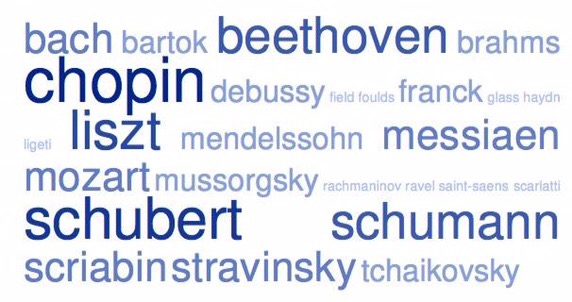
Composer wordcloud
A wordcloud of all the composers whose music I’ve heard in concerts this year




 The Cross-Eyed Pianist