in-action-nr-3

Who or what inspired you to take up the piano and pursue a career in music?

I fell into piano chamber music and accompaniment, whilst in the enrolment queue at Cardiff University, where I read music as an undergraduate. I was chatting to another first year student who I thought was very cosmopolitan and confident, a violinist, who wanted to perform the Grieg Sonata. Did I know it, he asked, and would I like to play it with him. Of course I knew the Grieg violin sonata, I lied, and I agreed to play it.
As we were the first in our year to play in a concert at university, a lot of people then started asking me to play for them too, which I did, with pleasure. I became a sort of default accompanist, which was no bad thing. This led to learning a lot of repertoire, and meeting some very lovely people along the way.

My earliest inspiration around this time was a fantastic pianist based in Cardiff, Michael Pollock. His first class playing aside, he also showed, by example, never instruction, how to work “with” your fellow musicians. Michael has this amazing ability to draw from people their best qualities, both as musical performers, and as individual personalities.

Who or what were the most important influences on your musical life and career?

Three people have had a very strong impact on my musical life and career, after coming to London, where I studied at the Royal Academy of Music.

My teacher since I moved here, Christine Croshaw, has been a constant source of inspiration, support and motivation. She is the most rigorous musician I have ever worked with, but in the sense that she gently coaxes more and more from you. It’s only when you walk away, feeling a little light headed, that you realise you’ve been there for over two hours and have a mind full of ideas. Her own playing is also something quite magical.

I enjoy performing contemporary scores a lot. I love the complexity, but also the freedom afforded to us by a new score, which has no preconceptions attached to it. My first real foray into this world was when we had a work written for us by the late Alun Hoddinott, one of the leading British composers of his time. We quickly became friends. I enjoyed his kindness, his humour and of course, as Britten and Pears described, the ‘legendary hospitality’ of Alun and his wife Rhiannon.

Alun taught me that, as with the written word, the written note can only ever be a rough guide, and that often composers rely on us musicians to take a particular effect further than perhaps notation allows. He reminded me often, that once the ink is dry on the manuscript, the piece belongs to the performer, and we have to make as much of the music, as we think the music requires. It is a liberating concept which helps us try to create our own interpretations, and have belief in their validity.

My third and final influence would have to be a duo partner, as this is the work I do, mainly. The soprano Claire Booth and I have commissioned, performed and recorded together for over ten years. She has a phenomenal capacity for learning music at a very quick pace. Yet she is never satisfied with this. Claire always delves deeper and deeper into the music, until she finds what she believes is the point of the composer’s intentions. She is also an unflinchingly supportive colleague and friend, which I think you have to be when you put yourselves out there in performance or on record. It’s a question of trust.

What have been the greatest challenges of your career so far?

I don’t think my challenges have been particularly great, or greater than those of my colleagues. I know my strengths and, like most musicians, I can give you a blow by blow account of my weaknesses.

I’ve never much enjoyed sight reading, which is weird for an “accompanist”. It used to be very good, until I started delving deeper into scores, wanting to understand them as well as, in my case, the singer I am partnering.

So, for me, as my own level of skill as a pianist increased, my sight reading seemed to fall back a bit. I can read through most scores at sight in rehearsals of course, but I don’t have the nerve to get up and sight read in public as some of my colleagues might. I have huge respect for this, but it’s not how I am wired. I need to “get” the score, and what the singer is doing, so I can have the peace of mind to sit back and react, in the moment, with my own technical trials mastered.

Navigating a route in this respect has been unique I suppose, but truthfully, every person has a unique carer route, be they musicians, lawyers or whatever. Just stay true to yourself, your strengths and work with these in mind.

Which performance/recordings are you most proud of?

This is tricky as I listen to my own recordings with frequent coughs and uncomfortable twitches, as I hear things I’m not happy with. I would never listen to anyone else’s recordings in this way, just my own, so I’m not perhaps the best person to answer this.
Our CD of song cycles by Jonathan Dove has done very well, and I am pleased we did his scores justice, and that they are “out there” more now as a result of our recording.

As for a performance I am proud of, I suppose it would be a recital we did in 2013, at the Southbank Centre, to mark the Britten centenary. I had always wanted to perform the canticle for tenor, horn and piano, ‘Still falls the rain’ (Sitwell texts), and performing it with my longtime duo partner Nicky Spence and French horn Jedi Richard Watkins, in the city where the “rain” fell, was a moving privilege. I also played a large solo piece on this occasion for the first time, professionally and in public, which was written for me. It felt very strange walking out on to a concert platform alone, and yet also very free. I enjoyed it, and the piece went down very well (I’m recording it this year in fact) but I missed having someone else there to react to. Enough time is spent alone, practising, for me, so it’s a joy to rehearse and perform with another spirit on the platform

Which particular works do you think you perform best?

Again that tricky to answer. Often we perform a piece in concert or on a disc, and what we think is “the” piece, that really shows what we can do, someone will say “yeh, that’s ok, but I LOVED this other one” and I think “really?!”.

I love anything contemporary by the composers I admire, but I also have a real passion for French composers, as their subtle complexity appeals to me. I love how an apparently simple gesture by Debussy sometimes involves huge technical, forensic (!), labour from the pianist. Yet the effect is almost nothing. This irony fascinates me, and I find it a little addictive.

How do you make your repertoire choices from season to season?

Repertoire choices for me often come from singers, unless I am curating something, and I might be in a position to suggest some music, as well as take on new scores. A few nights ago Claire Booth and I performed Grieg’s ‘Haugtussa’ songs, with Folksongs by Percy Grainger and then melodies by Fauré. All of them were new to me, and they were just a joy to explore and perform.

Favourite pieces to perform? Listen to?

I love the Southbank Centre, and always enjoy playing there. The audiences always seem open to new ideas sitting alongside something “established”. After concerts they often come up to me and say something so perceptive: “wow, the Knussen and Debussy worked well…some of those Debussy harmonies could be contemporary…” And I think how absolutely spot on that comment is. Great music often transcends period, or time. Occasionally, one of my Trinity Laban students will play some Bach, and I am astounded at how outrageous some of the harmonies are even in 2015. I often think listening to his music is like hearing something in 3D, so I can’t imagine how it must have sounded at the time Bach was actually writing it. Mesmerising.

Who are your favourite musicians?

So many inspire me, from legends who are seemingly untouchable, to a student in my performance class who might play something in a way that’s so “right” that I am amazed.

But in terms of people who I turn to, or listen to, for inspiration, the first names that come to me are Martha Argerich and Jacqueline du Pré. They have such immediacy., even when coming out of speakers.

As musicians there are thoroughly prepared technically and just let it go. By nature they remind me of a great jazz musician, like Oscar Peterson or Ella Fitzgerald, who have total technical command but allow themselves to play in the moment, almost unplanned. Thrilling.

As Claudio Arrau observed, when we walk on to the concert platform, ‘I don’t know what will happen, but I trust it will be wonderful‘. Of course he means the experience. He allowed himself to react to that experience, trusting he had the tools.

As I work with so many singers, I have to say that the late Welsh soprano, and compatriot, Dame Margaret Price, is an artist who had the ability to sing Schubert lieder, Dove sono or Verdi Requiem, and control her voice for each so that it was absolutely “right” for that particular piece of the repertoire. Her sound, basically, was double cream, served in a cold silver jug, presented on a velvet cushion. Rich, beautiful, but with a slight, and quite wonderful, edge.

Of the people I have been fortunate to work with personally, I love Christine Croshaw’s ability to suspend time, Roger Vignoles’ conductor-like sense of space and breadth, and Patricia Bardon’s gloriously fruity mezzo. There are so many more, but we have a word limit here I’m sure…

What is your most memorable concert experience?

My most memorable experience, was giving the premiere of Hoddinott’s last work for voice and piano, which he wrote for Claire Booth and me, with Michael Pollock joining me for the piano duet accompaniment. Towy Landscape, was written towards the end of Alun’s life, and the work’s sentiments reflect this; it was also one of the last premieres of his own music that the composer attended. That particular evening seemed to bring together a few personalities who mean a lot to me to this day.

What do you consider to be the most important ideas and concepts to impart to aspiring musicians?

Know what your strengths are, trust them, celebrate them, and seek to develop them further. Remember, music is not a career, it is an addiction. There is no career path, no pension plan or guaranteed salary increase every 12 months. Today’s musicians must be performers, coaches / teachers, curators, producers. It is all connected, it is valid work, and each skill will inform the other.

Be versatile, open minded, work hard and be a good colleague.

What is you idea of perfect happiness?

Happiness for me is a good meal and glass of wine with someone I love, with not a piano in sight.

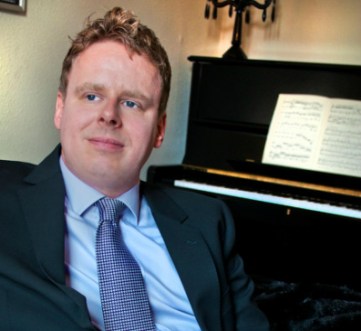
Andrew Matthews-Owen’s first solo disc, Halo, is available now and includes works by Joseph Phibbs, Dobrinka Tabakova and Hannah Kendall. More information

Andrew Matthews-Owen is among the most sought after collaborative pianists of his generation, regularly appearing in concert, and on commercial recordings with some of the finest classical artists of our time. Recent engagements include appearances at the Southbank Centre (Queen Elizabeth Hall and Purcell Room), Wigmore Hall, Kings Place, Birmingham Symphony Hall, St. David’s Hall, Warehouse and National Portrait Gallery with singers including Patricia Bardon, Claire Booth, Anne-Sophie Duprels, Helen Field, Gail Pearson, Natalya Romaniw, Nicky Spence, Katie Van Kooten, Sir Willard White, French horn player Richard Watkins, percussionist Joby Burgess and the Allegri and Brodowski String Quartets.

Andrew broadcasts for BBC Radio 3, most notably from a Purcell Room concert, on St David’s Day, which included the London Premiere of Alun Hoddinott’s A Contemplation upon Flowers with his regular duo partner Claire Booth. Andrew’s debut CD of song cycles by Alun Hoddinott (Naxos) was ‘Recommended Recording of the Month’ in Gramophone magazine, and a recent disc of world premiere recordings of song cycles by Jonathan Dove (Naxos) was Editor’s Choice in Gramophone magazine. Andrew will feature on a Debut Disc being released in 2014, for the NMC label, with soprano Claire Booth. His recordings are frequently broadcast on BBC Radio 3 and Classic FM.

A passionate commitment to contemporary music has seen Andrew commission, and give first performances of, major scores from some of the most distinguished composers of the 21st century including Michael Berkeley, Charlotte Bray, Philip Cashian, Laurence Crane, Jonathan Dove, Alun Hoddinott, Simon Holt and Arlene Sierra. Andrew studied at the Royal Academy of Music, where he was recently elected an Associate, generously supported by the RAM Trust, S4C Wales Television, Sir Edward Heath, Coutt’s Bank and the Rayne Foundation. He has also studied privately with Christine Croshaw, Roger Vignoles and Eugene Asti. Competition successes include a coveted Sir Henry Richardson Award for Accompanists (MBF/Help Musicians), John Ireland Trust Prize, Elisabeth Schumann Lieder Prize and the Ryan Davies Memorial Award. Andrew was recently honored, with the inaugural T.Glanville Jones / Leo Abse and Cohen Award, by the Welsh Music Guild, for his ‘Outstanding Contribution to Welsh Music’.  Andrew is a Fellow of the Royal Society of the Arts.

www.andrewmatthews-owen.com

A mile or so along the river from where I live in Teddington, SW London, the attractive 18th-century church of St Mary’s in Twickenham sits on a grassy plinth overlooking the Thames. And for the weekend of 10-12 June 2016, it became the home of a new chamber music festival, directed by Emily Pailthorpe of the London Conchord Ensemble.

Regional and local classical music festivals are such a good idea. They take music out of formal metropolitan concert venues and into communities, forging important and lasting connections between musicians, local people and venues, and many attract world class performers, as well as encouraging young musicians. Conchord Festival boasted an impressive roster of performers, including actor Simon Callow and baritone Roderick Williams. I was delighted to attend the Saturday afternoon concert, music for piano duo performed by Alasdair Beatson and Julian Milford.

St-Marys-Church-Tower-in-Twickenham-by-e1456080701261

The theme of the concert was dance and the connecting thread was Sergei Diaghilev, ballet impresario and founder of the Ballets Russes, who collaborated most famously with Igor Stravinsky in the staging of The Rite of Spring, the piano 4-hands version of which concluded the concert. The afternoon opened with Debussy’s Prelude à l’Aprés Midi d’un Faun, a symphonic poem which formed the basis of the ballet Afternoon of a Faun, choreogaphed by Nijinsky and staged by the Ballets Russes in Paris in 1912. The piano duo version was transcribed by Ravel and loses nothing of its sinuous lines and erotic textures in the piano reduction. Beatson and Milford’s performance was languorous, nuanced and sensuous, perfect for a humid summer’s afternoon. This was followed by four of Dvorak’s Slavonic Dances, a reminder of the popularity of music for piano duo during the nineteenth-century and a foot-tapping musical palette-cleanser before the main event, The Rite of Spring, which followed the interval.

When The Rite of Spring opened in Paris in May 1913 the avant-garde nature of the music and the staging caused a near-riot in the audience. The piece still has the power to shock over 100 years later, with its narrative of savage rituals and human sacrifice. Stravinsky first performed his own four-handed version of The Rite of Spring with Debussy, the arrangement created to accompany rehearsals for the first performance of the ballet. This music was born on the piano, written in a tiny room, so Stravinsky tells us, on an upright piano, and it contains an exhilarating and precarious excitement. Forget the orchestral version: here is a work of raw energy, convulsive rhythms and pagan exoticism, aptly described by Debussy as “a beautiful nightmare”. It remains a vertiginously challenging work for piano duet, straining the medium to its limits. Beatson and Milford rose to the challenge with aplomb, managing pianistic gymnastics with ease and creating a riot of colour, texture, rhythmic drive and narrative. The famous stamped-out chords were percussive and metallic, redolent of heavy machinery, pistons and steam engines. (Let us not forget this piece received its first performances as Europe was preparing for the most mechanised and destructive war in its history.) This was truly an enthralling journey.

Next year’s Conchord Festival takes place from 9-11 June 2017.

I never thought I’d write an article on “note bashing”. In general it’s not something I advocate – mindless repetitive practise, thoughtlessly hammering away at the same phrase or group of notes. However, during my work on one of Schubert’s late piano sonatas I discovered that note bashing really does have a purpose in practising.

Every piece we learn will have its tricky or hard-to-master sections – that finger-twisting little passage, that scalic run which never feels comfortable under the hand, those hand-filling chords which are just a little bit too hard to reach accurately. For me it was arpeggios, a weakness in my technique which was making it more difficult for me to play the (many) arpeggios in the Schubert sonata precisely and fluently. My teacher worked with me on both good fingering schemes and some useful wrist rotation technique but what I knew I needed to do was to be able to play the passages automatically without the need to think about what was going on in the fingers and hands.

Musicians endlessly talk about training the “muscle memory”. Of course our muscles don’t really have memory, and the correct term for this is in fact “procedural memory”. This is part of our long-term memory that is responsible for knowing how to do things (also known as “motor skills”). Procedural memory retains information on how to perform certain procedures, such as walking, talking and riding a bike – and playing the piano. Procedural memory is created through “procedural learning” – repeating a complex activity over and over again until all of the relevant neural systems work together to automatically produce the activity. This is why as musicians we should be engaging in a hefty amount of repetitive practise, for it is these repetitions which fix the music in head and hands. Forget “practise makes perfect” – the real reasons why we do repetitive practise is because practise makes PERMANENT.

I was away from my own piano at the time when the arpeggios in the Schubert needed the most work, but as luck would have it, I had access to a digital piano which belonged to my husband’s niece. No matter that the keys were covered in a rather unpleasant sticky residue due to repeated use by small children: for three days I worked solely on arpeggios, focusing only on learning the correct sequence of notes and fingering. I did not consider the tone or quality of sound, or any of the more esoteric/artistic aspects of playing these sections; I simply concentrated on repeating the passages over and over and over again…… Back home to my piano and the exercise continued for a further week, by which time my husband, who also works from home, was beginning to develop a deep aversion to those particular sections of the Schubert sonata. “When are you going to practise something else?” he asked me. “When I’ve learnt this bit” I replied.

The “note-bashing” exercise served its purpose: at the end of 10 days the sections were well-learnt and my attitude to them virtually intuitive. I no longer approached them with a feeling of unease, concerned that I was going to fumble the arpeggios, and I have subsequently used this approach to memorise and/or make secure other sections of the Sonata – and indeed other pieces of music. With such security comes confidence and the ability to play without physical tension or anxiety.

Of course my practising wasn’t really note-bashing because all the time I was playing I was taking notice of what I was doing to ensure that notes and fingering were correct, that I was employing the right amount of rotation to move smoothly up and down the arpeggios, that the tempo and pulse were accurate and so forth.

There are stories of pianists doing repetitive exercises or 100 repetitions of the same passage while reading a newspaper or reading aloud from a book. In these cases, one is training the procedural memory while testing one’s ability to divide one’s attention between several different tasks. I do this exercise with students, getting them to repeat a section and once the repetitions begin to feel comfortable and well-known, I might ask them what they are having for dinner or what they are doing at the weekend. Given the amount of multi-tasking that is required in piano playing, this can be a very useful exercise.

If you are simply note-bashing for the sake of it, it is perhaps time to stand back a little from your playing, consider the sound you are making and return to your practising with thought and care.


(photo by James Eppy)


The world of classical music is riven with conventions from the way we dress to the manner in which music is presented in public and when it is acceptable to applaud. Many of these customs developed in the second half of the nineteenth century when concertising became far more formalised. These conventions can seem restrictive and limiting, to both players and audience, but they exist and therefore we are largely obliged to work within them. The profession has its mavericks and colourful characters who kick against The System, but in general most of us abide by the “rules” to a greater or lesser extent – and there are good reasons for this. Our behaviour, from the way we market ourselves and interact with others in the profession to what we wear at concerts and how we deport ourselves on stage, in addition to how we play, is constantly under scrutiny by peers, audience members, promoters, agents, teachers, mentors and critics.

We are all being judged, whether we like it or not, when we work with others and when we perform. That is not to say that everyone should knuckle down and follow the directives of the conductor, nor engage in discussion with conductor and colleagues – and good colleagues and conductors will be open-minded and keen to discuss points which arise in rehearsal. But an ensemble or orchestra is a “team” and respecting the team dynamic and working with it rather than against it will lead to a happier working environment, good performances, and future work. In reality, while some may want to strike out and do something original and creative, such behaviour does not pay the bills, and freelance musicians have to be pragmatic as well as disciplined.

One may argue that soloists have greater freedom to buck the system and to play with spontaneity and originality, and while this is true up to a point, we are still bound by conventions. There are, for example, established ways of playing Bach, Beethoven, Schubert, Chopin et al, conventions which develop and change over time, reflecting historical precedents, new scholarship, differing attitudes to interpretation and teaching, and the influence of recordings. If anything, the way the big warhorses of the solo repertoire are presented in concert today is more standardised than ever as soloists, particularly younger ones, believe that they must play these works in a certain way to satisfy audiences, critics and promoters, not to mention the influence of high-quality recordings. With so much music being performed and so many concerts of largely the same repertoire, it can be hard to find an individual voice, and if you are playing the same programme across three continents for six months, it can begin to feel like a chore rather than a joy.

So how do we bring spontaneity, originality and individuality to our performances? Paradoxically, it is the very discipline of practising which brings freedom in performance. When we perform, we want our performance to be engaging and memorable (ideally, for the right reasons) for our listeners. The work we do in private, in the practise room, is crucial in enabling us to pull off a performance which is accurate, faithful to the score, imaginative, colourful, expressive and personal. No one, not even the greatest pianist in the world, gets by on talent alone. That talent has to be nurtured, honed and finessed, and the only way to do this is through regular and consistent work on one’s craft. Discipline turns ability into achievement.

Knowing we are well-prepared means we can step back from the music in performance, not over-think it, play “in the moment”, and produce a performance which is special, memorable and unique. In effect, one needs two personalities in order to be a convincing  performer: a perfectionist in the practise room and a “bohemian” (Stephen Hough) on stage. This sprezzatura, the result of many hours of careful, deep practising, allows the bohemian in us to be set free on stage. Audiences can sense this confidence too – just as they can tell when the performer is under-prepared, or is trying out something new which has not been road-tested in advance.

As regular readers of this blog will know, I attend many concerts and hear a wide variety of performers and repertoire, from well-established international artists such as Stephen Hough, Murray Perahia and Steven Osborne to lesser-known and young musicians. I can usually tell if a performer is not wholly convinced about his or her approach to particular repertoire, has not spent enough time with it or has been told to play in a certain way by a teacher or promoter. The playing lacks conviction and depth and sounds contrived or artificial. Occasionally someone comes along and does something new or unexpected with a Beethoven Sonata or Chopin’s Etudes, and if it is done with conviction, one has the sense of a performer who is well-prepared and who has spent many hours living with and thinking about the music. Such “wow!” moments are quite rare, but when they happen they are truly magical. Equally, a musician who has spent many years living with and performing the same repertoire can bring new and wonderful things to the music every time he or she performs it. A long association with certain repertoire also enables one to step back from it and set it – and one’s imagination – free.


The title of this post is a quote from Aristotle

Further reading

You Can’t Win a Performance….

Cavaliers and Roundheads