r8a9075_11
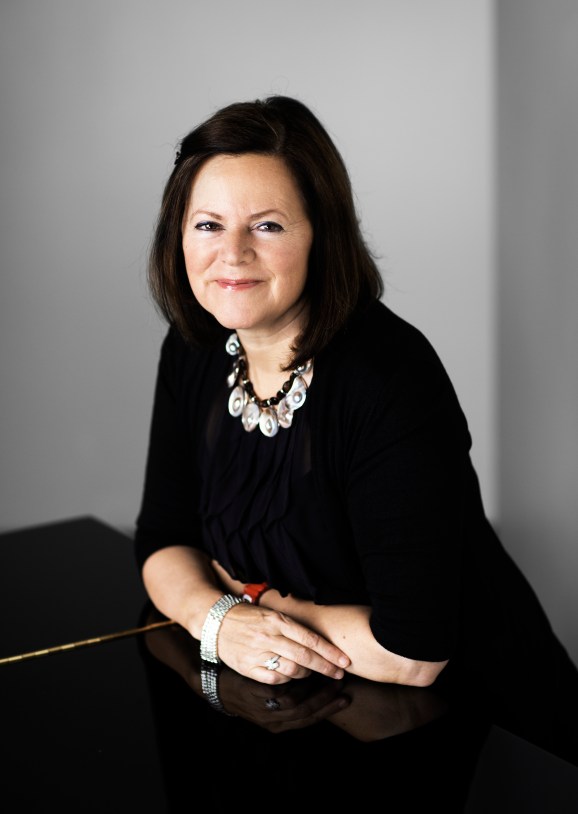
(photo Nikolaj Lund)

Who or what inspired you to take up piano, and pursue a career in music? 

I’m not sure I was particularly inspired by anyone at the age of 5, but we had an upright piano in the house as my mother gave piano lessons to little ones after her day job. I don’t remember she pushed me to start but I was easily drawn to the instrument and picked up the basics pretty quickly. I had no wish to sit there for hours on end, so I think my saving grace was being able to read music quickly and get on with whizzing through my little book! I’ve never felt that I made a conscious decision to pursue a career in music. I went to the Yehudi Menuhin School at the age of 8 and it just naturally led to studies at the Royal College of Music – actually I never felt there was a choice NOT to continue!

Who or what have been the most important influences on your musical life and career? 

Although my lessons were infrequent with Vlado Perlemuter, he did influence me a lot in the way he approached clarity and intensity of sound. Nadia Boulanger influenced my ears to be as wide open as is humanly possible but the teacher who actually had the most profound influence, was Kendall Taylor who I studied with for 4 years at the Royal College of Music. He basically put me together after I had become very fragmented and most important, was the first person who believed in me. I’ve known Yo-Yo Ma for all of my adult life (and worked with him for 31 years) and without doubt he has influenced me tremendously, both as a pianist and a person.

What have been the greatest challenges of your career so far? 

I’ve had a number of challenges along the way. Perhaps the greatest was balancing being a mother and trying to maintain a focus on having a career which often took me away from home. My other great challenge was to accept I didn’t really like performing from memory and just deal with the fact I prefer using the score. I’ve now been doing that for about 20 years. I remember a promoter told me the critics would shoot me after I gave my first full recital using the score. It appears I’m still here.

You’re performing in the inaugural London Piano Festival in October – tell us about your programme?

I initially thought it would be a good moment to perform the Dutilleux Sonata again – a piece I absolutely love. I performed it for a whole season 10 years ago but then it disappeared from my repertoire until I recorded it for BIS 2 years ago. Then of course comes the question of what to perform with it. Somehow I couldn’t escape the idea of F sharp and now here we are with music by Ravel, Messiaen and Fauré. I’m often fascinated by keys and why music sounds the way it does because a composer chose a particular key. I think it will be interesting to explore the contrasts of F-sharp for an hour. 

Which performance/recordings are you most proud of? 

I don’t particularly dwell on whether I’m proud of something or not so there are probably performances which went especially well which I’ve totally forgotten about. I think I’m proud of the fact that I performed Rachmaninov’s 4th Concerto for the first time only a few years ago. As I get older, adding works such as this seem a bigger mountain than when I was younger, but I would have been gutted to get to the end of the performing road and never have played it…what a piece! Recordings – I’d probably have to say my complete Fauré for Hyperion. Not because I think it’s better than anything else I’ve done but it was such a beautiful labour of love to learn the complete works. I know I would play everything differently now but that’s how these things go. I don’t listen to my recordings – that’s for other people to do.

Which particular works do you think you play best? 

I think there are certain pieces I perform better now simply because I’ve had some life experiences which have definitely affected how I express myself. For example I feel I now play the Britten Concerto in a way which makes much more sense than when I was younger – same with works by Shostakovich. I have no idea really – my interest in repertoire is vast so sometimes it’s good to explore even if I don’t think it’s for me.

How do you make your repertoire choices from season to season? 

It depends on the season and what is generally going on. I always have a lot of chamber music in my season, so as that repertoire is not necessarily determined by me, I might decide my own recital repertoire according to other things in place. Concertos I don’t play as often and it’s always been rare to dictate repertoire. Then of course, there are festivals where you might have a million things to play in a short space of time. I try to think how I’m going to be able to prepare everything time wise and so some choices are made on that. It goes without saying that I’ve programmed or hinted strongly I want to play a certain piece just simply because I have to play it!

Do you have a favourite concert venue to perform in and why? 

I don’t have one favourite but on the list would be Teatro Colon in Buenos Aires for its beauty and history, the Concert Hall in Luzern for being contemporary but warm and Symphony Hall in Boston for its acoustic, relationship to audience and wood floor (stage) which tells a thousand stories. I generally dislike very high stages so even a great hall where I’m too far from the audience is not in my top ten.

Favourite pieces to perform? Listen to? 

No favourites – depends what day it is. I love silence more and more but I love listening to Symphonic Music, Opera, Lieder –rarely piano music just for pleasure

Who are your favourite musicians? 

I don’t have favourites but I’m currently enjoying listening to Philippe Jaroussky.

What is your most memorable concert experience? 

If you mean me performing then performing at the Hollywood Bowl with Yo-Yo and lots of lovely, wonderful Brazilian musicians. I remember we all held hands to take a bow and I said to guitarist Sergio Assad ‘remember where we are’. He knew what I meant. It was a happy evening for us all in an iconic venue. If the experience is me sitting in the audience – I’ve just been to my first Wagner Ring Cycle performed by Opera North. Truly memorable.

What do you consider to be the most important ideas and concepts to impart to aspiring musicians?

I always think it’s important for young musicians to find their own voice and I often discuss the concept of being true to ones self, to think about why they want to be part of the music profession and to try to balance the wishes of a composer with what they have to say as an individual. Learning to tell stories via their instruments is what I’m interested in and most important, I do like to stress we all mess up and performances are not ruined thanks to some wrong notes. In the end, I hope to help them be creative, independent, courageous and above all curious.

Where would you like to be in 10 years’ time? 

Anywhere where I feel to be alive and well

What is your idea of perfect happiness? 

I don’t think it exists

What is your most treasured possession? 

My photo albums – I’m very nostalgic

What do you enjoy doing most? 

Walking in the countryside with my dog, Archie

What is your present state of mind? 

Always lots going on!

Kathryn Stott performs music in F-sharp by Fauré, Ravel, Messiaen and Dutilleux as part of the inaugural London Piano Festival at Kings Place on Saturday 8 October.

Further information here www.londonpianofestival.com
www.kathrynstott.com


A guest post by Dr Katy Hamilton

About ten years ago, when I first started my PhD, a fellow student explained to me the concept of self-efficacy. It’s a simple, logical premise: you are more likely to do well at something if you believe that you really can do it well – and visualising yourself doing whatever it is to the best of your abilities is a key tool. Whether it’s running the 100m faster than Usain Bolt, or playing the Elgar Cello Concerto to a packed concert hall and live TV cameras, you should imagine it happening, in as much detail as possible, to prepare for the actual event.

Rather less glamorously, I have a simple scenario that I like to play in my head from time to time. It goes like this. Audience members arrive at an evening concert. They say hello to old friends, buy a programme, wave their ticket at the usher, and sit down. They read the programme and chat amongst themselves. They might even chat about some of the things they’re reading about. Then, comfortable and hopefully a little edified or enlightened, they listen to the performance. On a really good night, they might glance again at the notes in the interval and even after the concert. When they get home, they’ll either throw the programme into the recycling, or keep it, if they are the collecting sort, or if it was a very special occasion.

It’s not smashing a world record, I grant you, but whether or not you enjoy your programme notes matters to me. That’s because I write quite a lot of them, and I do so not because it’s a good way of paying the bills, or an excuse to show off, or an outlet for academic material I couldn’t fit into an article, or any of the other negative reasons the cynics might imagine. I write them because I love finding out more about music, and learning new repertoire; and I love communicating – or at least trying to communicate – some of that sense of discovery and excitement to audience members just before they get the chance to hear the music live.

The process of writing a programme note is different for everyone, and obviously since I’m not the performer, there’s a great deal of information I can’t give you. I can’t tell you how they feel about the work in question. I can’t talk you through the experience of playing it (or at least, I can if it’s a piano work, since I’m a pianist, but it’s not my experience you’re interested in, and rightly so). I can’t tell you why the programme consists of that sequence of pieces in that order, unless the performer has thought to tell me, or I can work it out as I read (which is one of my favourite games).

But I can tell you a lot of other stuff. When something was written, where and perhaps why; what the composer, first performer or early reviewers thought of it; if there are diaries or letters from the composer about it; what the highs and lows of its reception have been; and how it’s put together, what it is exactly that you’re listening to. And no, that doesn’t mean ‘dry’ analysis. Anyway, if I gave you a blow-by-blow account, it would be a complete waste of words when you’re sitting in a dark concert hall with no chance of making out the tiny print as the sounds whizz past. But I can mention the structure, and a few things worth listening out for.

I won’t have many words to do this in, probably. The average programme note is 250 words long, for a chamber concert. That’s about a quarter of this post. And it often remains 250 words whether you’re writing about the Diabelli Variations or a single Chopin waltz. If you want a sense of how much work that takes, how much reading, research, listening and score examination, I can tell you that a set of notes I’m working on at the moment, destined to be 1,000 words when I’m finished, will be hewn from a lump of around 3,000 words of notes – and I haven’t quite finished the reading yet.

I was delighted that Fran (AKA The Cross-Eyed Pianist) asked me to write this post, because there are a few things I’d like to say on behalf of those of us who write programme notes. The first is, quite simply, that the programme note is not dead. It is not a waste of paper, not a patronising attempt at educating ‘you little people’ in the audience. It is not a job that is ever ‘done’, and it evolves over time – when I write a concert’s worth of notes, even if I’ve written on half the pieces before, I always tailor my writing to create a unified whole. We have not said everything there is to say about Bach’s Italian Concerto, and even if we had, we would only have said it to one or two very particular audiences’ worth. Every concert is a new experience, a new musical construction, and a new opportunity for different listeners in a space they might never have visited, with a player they might never have heard.

The second is that whatever you might think about the label ‘musicologist’, we are not attempting to create something removed from the live music you are there to hear. I wish I could talk to more performers about why they’re doing what they’re doing. Or interview them. Or get them on stage to talk to them. But time, planning and logistics often conspire against this. I’ve given plenty of pre-concert talks where I’ve never met the performer. I wish it weren’t the case, but there it is. So we are trying, sometimes against rather unhelpful odds, to draw that connection between words and performance.

Last but not least, we are the creators of the thing that will most likely serve as your enduring physical reminder of the evening: the programme. I still have (and from time to time, re-read) programmes for every concert I’ve been to since the late 1990s. So we writers make something which can be as ephemeral as the concert itself – straight in the bin on the way out – or as enduring as your memory of it. It’s a privilege to produce such things, and we do so with you, the audience, at the forefront of our minds. So spare a thought for us, now and then. We are thinking of you with every word we write.

Katy Hamilton is a freelance researcher, writer and presenter on music.

www.katyhamilton.co.uk

Twitter: @klhamilton

Tido, in partnership with renowned music publisher Edition Peters, has created a smart new iPad application for pianists which takes the educational app to new heights. Tido has already developed the Mastering the Piano app with Chinese superstar pianist Lang Lang, and therefore already had a stack of tech and musical know-how with which to build its latest app, Tido Music.

Most iPad music education apps are designed for children and young people, or for teachers to use with their students (such as Wolfie). Others, such as Tomplay, encourage independent learning combined with piano fun, but few offer detailed historical context, analysis, and instruction in the way Tido Music does.

What makes it special?

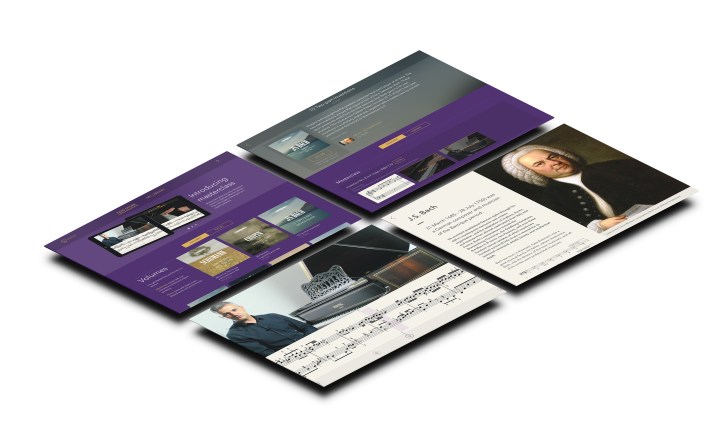
Tido Music is a platform for the discovery and performance of music. To achieve this, Tido has used Music Encoding Initiative’s open source framework which supports the development of dynamic notation. Put simply, for the end user, the app delivers interactive sheet music seamlessly layered with audio, video and text to allow musicians to feel more immersed in the music.

‘In designing Tido Music, our starting point was to find an architecture which could unite all the varied ways of experiencing music: notation, audio, literature, video and more…….We’ve created an app that does just that. Not only does it bring all the facets of music together in one place to create a truly immersive experience; it also features the very best content from some of the world’s leading performing artists and scholars.’

Brad Cohen, founder of Tido Music

The app has an attractive clean design and is very easy to navigate. Music is stored by composer in “volumes” – for example, Bach’s Two-Part Inventions, Chopin’s 24 Preludes – and for each piece, the user may listen to the music (played not by a MIDI player but beautifully by a real live pianist) and view the score. Tido’s technology includes a magic cursor, a mauve shadow which guides the user through the music (and which is far more comfortable on the eye than a coloured marker which some other music apps use). Within the score, the user can adjust the pulse and annotate the score, and there’s a useful help option too. The app also offers a revolutionary automatic page-turning facility that works by allowing the app to listen to the player. Page turns can also be programmed depending on how far ahead you read/memorise what is coming next – and the app will turn the page for you even if your performance isn’t 100% accurate.

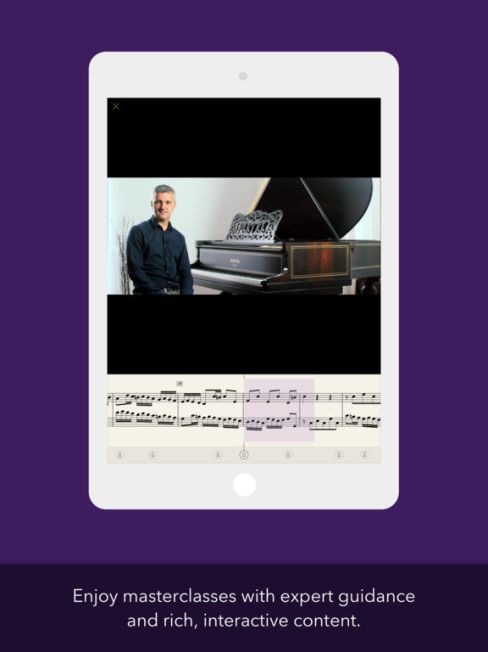
So far so similar to other score-reading apps….but the real achievement of Tido music is the inclusion of filmed live performances of the music being played. The audio and visual quality of these films is really striking, and the user can enjoy multi-angle performances of the pianist’s hands at work. While the video plays, you can also read the score at the bottom of the screen with a cursor which moves in sync with the performance. In addition, there are masterclasses where the user can explore the piece in the company of a real concert pianist or musicologist who offers their own insights into the music and how to play it. In future, the app will include masterclasses of multi-movement works as well.

sc1024x768
Concert pianist Daniel Grimwood introduces a Bach Two-Part Invention
There is information about the composer’s compositional style and techniques, and an in-depth guide to the music in each volume, including social and historical contexts. It is this additional content which, for me, makes the Tido app far superior to anything else I have seen. To be able to watch, close up, the music being played, and hear the pianist talk about it, is a compelling learning tool – in effect, one can enjoy a private masterclass with a top-flight pianist in the comfort of one’s living room or piano studio.

Edition Peters, who are responsible for developing the first set of content that flows into the app, has secured an impressive roster of international pianists for the app, including Daniel Grimwood, Clare Hammond, Adam Tendler, Richard Uttley, Joanna Macgregor and French piano music scholar Roy Howat. Each brings their own personal insights and “pianistic hacks” to the pieces (Richard Uttley, for example, has a neat “fix” for dealing with a tricky flourish in Brahms’ Intermezzo Op 119, no. 3). These are the sort of details one would normally only expect to obtain from a master teacher.

Tido’s partnership with music publisher Edition Peters also gives them access to a vast archive of scores for use in the app, from J S Bach to John Cage. Some of these are free, others can be purchased singly or in volumes. Those downloading the app can experience and explore its many features by signing up to a free, 30-day trial, and take advantage of a special introductory £2.99 monthly subscription. Tido promises that the app, “will continue to grow with a range of content from leading publishers”. The first collection, Piano Masterworks, offers a great selection, including popular favourites such as Beethoven’s Für Elise, Ravel’s Pavane, Chopin’s Preludes and Grieg’s Lyric Pieces, but it is cheering to also find music by Cage, Field, Scriabin, Mussorgsky, Clementi and Janáček, thus offering the user a wide variety of repertoire to explore and play. I’d like to see more contemporary piano music, and also more advanced repertoire, but hopefully this is in the pipeline.

This is an impressive and innovative  music app, particularly suited to amateur pianists or piano students who are looking for the opportunity for independent but supported study of the piano and its literature.

Recommended

Key features:

  • acoustic audio recordings, aligned with interactive scores from Edition Peters
  • exclusive video performances and in-depth tutorials from leading experts and concert pianists
  • historical context and critical commentary from established scholars and editors
  • powerful practice tools, including annotation and auto-paging

http://www.tido-music.com

The app is available now via the iTunes app store

ipad_screen_perspective_03_downsize(pictures: Tido Music)

Who or what inspired you to take up the piano and pursue a career in music?

When I was young, I was extremely shy around people. I felt more comfortable when I spent time at the piano, and the more time I spent exploring the sonic worlds of different composers and the instrument, the more I fell in love with music. Music became a vital way for me to communicate, and there were no second thoughts from then on pursuing a career in music.

Who or what have been the most important influences on your musical life and career?

As a pianist, my teachers and mentors throughout every stage of my development- Ian Fountain, Oleg Stepanov, Helen Dobrenko, and Neville Baird- have all shaped my sound on the piano and approach to classical music repertoire. I also look up to strong female role models during my period of learning- including the wonderful Joanna MacGregor who has been a real inspiration and who is ever so encouraging during my time at Royal Academy of Music, and the equally inspiring Natasha Vlassenko from Queensland Conservatorium.

Stylistically speaking, I listen to a very wide range of music and am constantly taking inspiration from great artists of other genres. For example, the structural construct for my album ‘Mediterranean Sounds’ was inspired by Frank Zappa’s ‘Civilization Phase III’ and Marvin Gaye’s ‘What’s Going On’. In terms of sound design, I also look up to Brian Eno and take inspiration from his treatment of sounds and samples.

When it comes to how the samples are integrated with classical music and performance presentation, I observe the practices of a wide range of artists (and their producers) and DJs ranging from Miles Davis, Gilles Peterson, George Benson, Quincy Jones, Gypsy Kings, Erykah Badu, Esperanza Spalding, right up to Justin Timberlake, Pharrell Williams, and more recently the phenomenally talented Jacob Collier.

In the end, I am a bit like a sponge, always absorbing sounds and formulating new ideas to integrate these with classical music language. There are many influences on my music and sound- all important and always evolving!

I think equally as important as influences are the people and new friends that I encounter and meet while sourcing my sounds. I am always curious about people, and encounters often allow for a glimpse inside their respective worlds and lives. Observing people’s stories and shared experiences very often provide the fuel and motivation for my works.

What have been the greatest challenges of your career so far?

I am a sensitive person, and it is always an internal struggle to stand strong and firm in my artistic visions amidst challenges and criticism, especially in my more experimental works. It has taken me a very long time to find a sound and style that is ‘me’- something that satisfied my need to create and communicate my own voice and experiences- and not merely perform the masterpieces.

Which performance/recordings are you most proud of? 

So far, I have been lucky with the attention that came from my first EP- ‘Listen, London’- which was an integration of sampled sounds captured around London with piano works by Poulenc, Sibelius, Liszt, Ginastera, and more. It has been a long hard road though, I remembered when I first showed it to a couple of people and recording stores, it caused them some very genuine confusion. “What, was this recorded in a car park?!” was one of the remarks… It was quite a challenge to power through the critical remarks in the beginning, as I had taken a leap of faith and poured my heart and soul into the project. But nevertheless, it was a great learning curve and I feel stronger as an artist because of this.

Since then, ‘Listen, London’ was handpicked by Brian Eno for Curator’s Choice in 2014 NOISE Festival, and then subsequently led to my recent win of 2015 London Music Awards’ Classical Music Rising Star Award.

Which particular works do you think you play best?

I play the works that speak to my heart and personal experience the best.

How do you make your repertoire choices from season to season?

Repertoire choices are often chosen after research and experimenting to find what fit the best in designing a particular experience through a programme.

Do you have a favourite concert venue to perform in and why?

I think my favourite concert venues are associated to the audience in it… I love all venues large and small, indoors or outdoors, when the chemistry and vibe between the audience and the stage is strong!

Favourite pieces to perform? Listen to?

When I was young, I listened to Ashkenazy’s recording of Rachmaninaff Piano Concert No. 2 & 3 with the Moscow Philharmonic a lot. It is partially because it was the first classical music recording that I owned, and it remains a recording that I hold close to my heart.

Right now on my iPhone music library are: Astor Piazzolla, Juan de Marcos & Afro-Cuban All Stars, Los Amigos Invisibles, London Symphony Orchestra, Marc-Andre Hamelin, Michael Kieran Harvey, Pascal Roge, Gilles Peterson’s Havana Cultura Band, Esperanza Spalding, Erykah Badu, St. Germain, The RH Factor, Justin Timberlake, Daft Punk, Vikter Duplaix, George Benson, Jacob Collier, and a list of Greek folk music that I am currently investigating.

Who are your favourite musicians?

There are so many! Vladimir Horowitz, Martha Argerich, Vladimir Ashkenazy, Brian Eno, Quincy Jones, and my more recent fascinations are as mentioned above!

What is your most memorable concert experience?

There have been several memorable concert experiences- the hilarious moment where I tripped over my own dress on stage, the touching moment when I could hear an audience member sobbing from on the stage (I was relieved when she later told me it was because she was touched… phew), the sweet moment of a very young girl climbing onstage to dance to a waltz and handing me a flower that she had picked from the garden… in midst of the intense heat and humidity of regional Australia… and very recently the surreal moment of doing a sound-design & piano set at Latitude Festival in the middle of the woods…! There are many great memories.

What do you consider to be the most important ideas and concepts to impart to aspiring musicians?

Find your own voice.

Where would you like to be in 10 years’ time?

I have a passion for traveling and exploring different cultures. I always source new audio and visual material when I travel and construct little pieces of sonic documentary as I go. I hope in 10 years time my portfolio will consist of sounds and works inspired by all seven continents!


Winner of Classical Music Rising Star Award at the inaugural 2015 London Music Awards, Australian-Taiwanese pianist Belle Chen has been enjoying a busy international schedule, performing a diversity of programmes ranging from classical piano recitals, chamber music recitals, to experimental collaborations with sound design, visual art, theatre, and dance.

Belle is a piano soloist for the prestigious Park Lane Group Artists in their 2015/16 season. Her festival appearances in recent years include: 2015 Newbury International Festival, Deal Festival, Australia & New Zealand Literature Festival, Shanghai World Expo, Bloomsbury Festival, Taipei Fringe Festival, and Teneriffe Festival. In 2014 & 2015, she toured UK as pianist in Concert Theatre’s production of Romeo & Juliet/The Rite of Spring, and as a solo recitalist in Taiwan and UK.

Belle’s performances have also been broadcasted and featured by media such as BBC Radio 3, BBC China, Monocle 24 Radio, Classic Radio Finland, Classic FM, ABC FM, 4MBS, and Dateline (TV). Belle graduated from Royal Academy of Music (United Kingdom) in September 2013 with Master of Music in Performance with Distinction, and has since been handpicked by Brian Eno for as a winner of Curator’s Choice for Music Award at 2014 NOISE Festival, awarded the 2014 Finalist Award for The American Prize for Music in Chamber Music, and winning the 2015 London Music Award.

Since 2016, Belle has been endorsed by Arts Council England under the Exceptional Talent visa scheme. She is currently a guest lecturer in Multimedia and Piano Performance at the Royal Academy of Music, where she was previously endorsed as a Graduate Entrepreneur after her degree. Belle is the founding director of Eito Music, where she leads a new generation of self-producing talents in classical and experimental genres.

Website/Social Media

bellechen.com

facebook.com/bellechenmusic

Twitter: @bellepianist