Who or what inspired you to pursue a career in music?
I honestly don’t remember the moment that I decided to start playing because I was about two and a half years old, but I do remember my mother teaching the piano for long hours and music always playing in the car. Even now, I hear pieces of music that I didn’t realise that I knew and know them back to front from childhood without knowing what it was!
The decision to pursue music as a career was really made when I was about four; my life already at that point was entirely scheduled around the piano. During my teenage years I made that decision again as a young adult. I rediscovered music on my own terms and realised that there was no way that I could live without music.
Who or what were the most important influences on your musical life and career?
Well this one is easy! In terms of my technique, personal standards, and foundation to becoming a musician my first serious teacher, Jimmy Gibb was invaluable. Douglas Finch has had and continues to have an enormous impact on my musical wellbeing and continues to inspire me. My humanities teacher in New York; John Pagano who teaches at Columbia and Manhattan School of Music in his “Genius and Madness” elective as well as “The Fantastic Imagination” shaped and reinvigorated my belief in the arts. Finally Russ Titelman, the producer of my album about to be released by Sony. His vision, deep understanding, knowledge and love of art is extremely special and I am honoured to have and be continuing to work with him.
What have been the greatest challenges of your career so far?
The greatest challenges have by their very nature been my times of growth and from which I have learnt the most. Rediscovering why I wanted to do music in my teenage years of my own accord and the bridge from child to adult artist was challenging certainly. Believing and rebelieving in one’s own ability and voice is something that I think we all go through. The classical music world is full of exciting and vibrant people at the moment and I think that there is huge potential and hope for a revolution of the whole industry! Being a female has also presented its own challenges throughout my career; I am proud to identify as a feminist.
Which performance/recordings are you most proud of?
I personally am very fond of the live recording in the finals of the Trinity Soloists’s Competition because it is Prokofiev 3rd piano concerto, probably my favourite piece of music, played with nothing other than pure conviction. Sure, there are flaws, it’s not the world’s best piano, and it’s unedited, but it’s real. Other than that, the album that I have just completed for Sony which is my first commercial album and representative of where I want to go as an artist and where I want to take my audience: Through the doors of perception.
Which particular works do you think you perform best?
I’m very comfortable and happy in the 20th Century. That’s a huge spectrum but I love playing Prokofiev, Shostakovich, Stravinsky, Ligeti, Lutoslawski etc.
How do you make your repertoire choices from season to season?
I’d say a combination of instinct, demand, and what opportunities present themselves to me. It’s generally a balance of things booked long in advance because someone has heard you play a particular piece and would like to hear it again in two year’s time, or sometimes there’s a composer’s anniversary which ties into a theme. Other times I’ve been waiting for a really long to time to have the right programme to fit a piece that I really want to play and then that programme happens naturally and that’s wonderful!
Do you have a favourite concert venue to perform in and why?
I have had many wonderful venue experiences but really it’s down to the audience as to what a place feels like at any given time. A generous audience anywhere makes that the best venue!
Who are your favourite musicians?
I love so many I could go on forever but Martha Argerich for her organic relationship with the piano, Jack White for his innovation and talent, David Bowie for being the master of many faces and never frightened to push a boundary. Jim Morrison for his poetry and reawakening of William Blake, my favourite poet.
What do you consider to be the most important ideas and concepts to impart to aspiring musicians?
To listen to and read as much as humanly possible across the genres, and to be truthful to the reasons that you pursued it in the first place. I am a founding member of the HoneyB Corps, an international civil society comprising skilled practitioners who volunteer their time to rehabilitate communities’ developmental needs like food, water, shelter, and health, and skilled artists who volunteer their time to rehabilitate communities’ formative needs: socially/relationally/artistically/therapeutically/spiritually. The HoneyB Corps is an exceptionally multifaceted and multi-dimensional community that supports and nurtures civil artists, but also deploys them across the world to touch lives, “cross-pollinate” ideas and creativity, and influence genuine conviviality through the cosmic force of art.
What is your present state of mind?
At the moment I am the happiest that i have ever been in my life. People spoke about 27 being a wonderful age and it really has been. Musically I am developing and growing and, most importantly, I am challenged and inspired by those around me.
Harriet’s debut album is due to be released in Spring 2017
Harriet Stubbs began piano studies at the age of three, performing in public a year later. At the age of five she was awarded a full scholarship to the Guildhall School of Music and Drama given by the Elsie and Leonard Cross Memorial Foundation. She studied with James Gibb, Guildhall’s Emeritus Professor and Ronan O’Hora, Head of Keyboard and Advanced Performance Studies. At the age of seven she had passed all eight piano exams with distinction.
I Musicanti, an ensemble formed in 2013 by double bass player Leon Bosch (formerly principal double bass with the Academy of St Martin-in-the-Fields Orchestra), launched their triptych of concerts at St John’s Smith Square with an afternoon recital featuring the world premiere of a new work by South African composer Matthijs van Dijk as the centrepiece. This arresting piece was bookended by Mozart’s Piano Quartet No. 2 in E flat, K493 and Schubert’s evergreen Quintet in A D667, the ‘Trout’.
I Musicanti includes artists who are all distinguished performers, who play in and with the best orchestras in the world, as soloists and chamber musicians. Sunday’s line up featured pianist Peter Donohoe, cellist Richard Harwood, violinist Tamás András and violist Robert Smissen, with Leon Bosch on double bass.
Leon Bosch (photo: Hyatt Studios)
St John’s Smith Square (SJSS) is now my favourite London venue, alongside Wigmore Hall, and while I and my concert companion were waiting for the recital to begin (there was a slight hiatus due to some mysteriously missing piano music, which was, luckily, found!) we perused the SJSS programme of forthcoming concerts and decided what we would like to hear next….. It really is a lovely venue, with a fine acoustic for chamber music, solo piano, choral and orchestral music, and its staff are friendly and helpful.
This elegant programme was guaranteed to dispel any lingering post-Christmas blues. The Mozart was elegantly-turned, warm and affectionate, while the Schubert rippled along as cheerfully as the eponymous fish, all holiday melodies and sunlit rhythms, with some charming interplay between the piano and the other instrumentalists. Peter Donohoe’s touch was bright and joyful, as befits the character of the music. Throughout the concert, there was a very palpable sense of all the musicians thoroughly enjoying both the music and the act of performing together, creating a lovely atmosphere in the venue. When I commented on this to Leon Bosch after the concert, he declared “I can choose who I work with” and he must be applauded for selecting musicians who display not only equal talent but also a shared sense of purpose and musical friendship.
The new work by Matthijs van Dijk, But All I Wanna Do Is Dance, was composed as a response to the extraordinary and unsettling events of 2016 which seem, in the composer’s own words, to have unleashed “a never-ending wave of anger, frustration, hate and bigotry in all shapes and sizes – all issues that need to be addressed, of course, and, once one is aware of them, unable to ignore”. The work is not intended as “a joyous declaration”, but rather a plea against the enormity of world events, an elegy to our inner child, and a wish to be allowed to forget what is going on, if only momentarily.
A haunting solo on the viola begins the work before it begins to open up with the addition of the piano and the rest of the ensemble. This meditative section is interrupted by febrile rhythms, suggesting lively dancing but always tempered with a sense of frustration and a yearning for the innocence of childhood, a time when one didn’t really know or understand what was happening in the world…..
I Musicanti returns to St John’s Smith Square on 5 March with an afternoon concert featuring another world premiere by South African composer Werner Bosch. Further details here
Iannis Xenakis (1922-2001) – composer, architect, boffin. Fearsomely experimental, he linked his disciplines by writing and designing co-dependent music and listening spaces. He arguably laid the foundations for modern electronica. And he was one of the first composers to use mathematical theory in creating music.
(photo: Ulf Andersen/Getty Images)
Why does Xenakis belong in a pianist’s alphabet? Because his first longer-form work for the instrument has been called ‘the most difficult piano piece ever written’. Clearly seeing this as underperformance of some sort, 12 years later he produced a second piece for solo piano that is, strictly speaking, ‘impossible’. What’s not to like?
In both pieces, Xenakis uses certain mathematical techniques or theories to shape and generate the music. When I heard about this kind of composition in my teenage years, I was suspicious in my ignorance. 1: If it was all down to maths, was it really composition at all, or just some kind of automated exercise? And contrarily, 2: Surely all music – including the really tuneful, harmonious stuff – has mathematical perfection at its root… so why does THIS have to sound so deranged?
I recently decided to go back to Xenakis’s piano music, purely as a listener. I wanted to satisfy myself that without considering ANY of the scientific background – deploying my ear over my brain – it still worked for me, had something non-clinical to offer.
Here is the earlier piece, ‘Herma’:
and the later one, ‘Evryali’:
I was genuinely surprised by some of my reactions.
* I found both pieces enjoyable and invigorating – but I wasn’t expecting to hear such a world of difference between the two. I think in ‘Herma’ you hear the maths, and in ‘Evryali’ you hear the music.
* The unpredictable dance to the extremes of the keyboard in ‘Herma’ make it feel like performance art – raindrops one minute, rubble the next. As a result, the piece attains a kind of spiky ambience.
* In ‘Evryali’, however, I think the sweeping curves in the structure are audible, the notes – however dissonant – seem to belong together, journey with each other. The images it conjures up in my head are geometric, symmetrical – spirals, waves.
There’s a twist in the tale, however. ‘Evryali’ is ‘impossible’ partly because in places it’s written using more than two staves (as you can see on the YouTube video). The pianist must create their own version based on which notes they want to cover and which they can live with leaving out.
Of all things, this reminds me of jazz. Jazz has very little to do with mayhem; rather it is (as the critic Whitney Balliett put it) ‘the sound of surprise’ – the unexpected choices players make within the established parameters. With ‘Evryali’, we seem to have a truly original hybrid: a composed framework through which the pianist can follow their own unique path. I love the idea that from mathematical principles, Xenakis has created a piece dependent, like so much other music, on flexibility, spontaneity and feel.
Adrian Ainsworth
Adrian Ainsworth writes for a living, but mostly about things like finance, tax and benefits. For light relief, then, he covers his obsessions – overwhelmingly music, but with sprinklings of photography and art – on the ‘Specs’ blog, which you can find at http://www.adrianspecs.blogspot.co.uk
John Pitts’ somewhat unusual book How to Play Indian Sitar Raags on a Piano is designed for adventurous pianists. Indian raags have an extraordinary musical heritage dating back several centuries (from the area that is now India, Pakistan and Bangladesh) – a truly unique musical genre of fascinating melodic beauty and rhythmic intricacy – freely combining elaborate composed melodies with carefully rehearsed improvisation. But now the amazing world of Indian raags has been opened up in a sympathetic but thorough reinvention for piano solo (or duet or two pianos) by an award-winning British composer.
In this guest post, John explains how his fascination with Indian raags began, leading eventually to his new book…..
My fascination in Indian raags (also spelled raga/rag) was sparked back in 1994-95 during a gap year in Pakistan before going on to study Music at Bristol and Manchester Universities. I had the great pleasure of several late night music sessions in a rural farming village in the Punjab, with local amateur musicians and a visiting classically-trained and highly accomplished ‘radio singer’, known to me only as ‘Ustaad’ – an Urdu term of respect. He accompanied himself on a harmonium – a little equal-temperament reed organ with the bellows pumped by his left hand. Drone notes were held down in the mechanism and his right hand loosely doubled some of his sung melody. Our generous host, a keen music enthusiast, provided the percussion layer on a pair of tabla. It was enthralling music, exotic to my youthful ears, gradually developing from a slow and atmospheric exploration of a tiny handful of notes to fast and frantic, highly rhythmic, full of passion and energy and intoxicating vocal virtuosity. The following year I had a few sitar lessons with Baluji Shrivastav in London – on an instrument I’d bought in Lahore’s music bazaar.
Both as pianist and composer I found an affinity with this music. There’s a peacefulness (and a certain self-indulgence) which I love – a focussed and absorbing stillness – in slowly improvising, with an evocative scale only gradually emerging, initially without the restrictions of a regular pulse. There are beautiful, richly ornamented melodies, and the organic sense of journey and destination. Then comes the thrashing rhythmic drive and the rapturous metric games, the fast and the furious. For the performer the pleasures bear many of the hallmarks of intelligent free jazz, along with a rich eastern mystique.
As composer I explored various aspects of Indian musical thinking in a number of my own pieces, in 2011 culminating in a virtuosic piano duet RaagGezellig. This sounds partly improvised but is actually through-composed within a fairly typical raag structure. While composing that duet, extensive googling of ‘piano’ plus ‘raag‘ or ‘raga‘ resulted in very little. Harmoniums have been used by Indian classical musicians for the past 150 years; pianos on the other hand have generally only gained a small foothold in Indian pop and in Bollywood film references to western classical music – but not in raags – the highest classical musical art-form of India.
The raag is a genre of highly ornate, partly-improvised music with a typical set of conventions and a typical structure. The nearest equivalent western musical term might be a cross between ‘air’ (a composition dominated by melody) and ‘sonata’ (a musical form with established conventions). The word raag literally means ‘colour’ and from that also ‘passion’ or ‘emotion’. Each individual, named raag is defined by a set of musical ingredients which determine its distinct ‘colour’. Raags are typically played by a melody instrument (or voice) accompanied by a drone instrument and rhythmic percussion, with performances lasting anywhere between a few minutes and a few hours.
Englishman William Bird published from Calcutta his “Airs of Hindustan” way back in 1789 – a collection of short keyboard pieces in a European classical style using Indian melodies (albeit largely major scale) that he’d collected. The result was European music with a slight Indian twist. Subsequently there have been plenty of other musicians – classical composers through to jazz and rock guitarists – who have found a fascination with music from the east and who have created European music inspired by features of Indian music.
But in the past very few years there has been a newly emerging development, on Youtube at least, which has quite suddenly featured a number of musicians, both Indian/Pakistani and European/American, playing classical raags on a piano – ie: using the piano as an Indian instrument playing truly Indian music – not some kind of crossover or simply one genre of music influenced by another. I’d recommend looking up videos of Utsav Lal, a brilliant young raga pianist from Scotland.
As a secondary school music teacher I wrote a simple piano version of Rag Desh in 2013to help our GCSE students develop an understanding of how raags work. From there came the idea of a bigger piano book containing a number of raags plus instruction on typical ways to improvise on the different sections of musical material. That summer, the book’s scope and size quickly grew because there are countless different and interesting raags to choose from – so many exotic scales, so many characterful motivic permutations and interesting time signatures and rhythmic cycles (talas). Now in December 2016 the finished 258-page book is a collection of 24 raags – reflecting the idea that individual raags are associated with a particular time of day. As well as the sheet music,there are loads of musical examples and a section of ‘Pick and Mix Ingredients’.
The purpose of “How to Play Indian Sitar Raags on a Piano” is first and foremost to open up the astonishing world of Indian classical music to pianists from western classical or jazz traditions who otherwise have no easy way to engage with Indian raags. The aim is to help enable you to perform a (pretty much) authentic, improvised raag, having understood the structure and having practised using, playing around with, and generally enjoying the key raag ingredients, and immersing yourself in a whole new emotional experience. I also hope that some more adventurous pianists will be encouraged to develop the raag tradition further in interesting new directions. The book is for good amateur pianists through to virtuosic professionals. It is suitable for any pianist who enjoys discovering new music, or who has an interest in music from other cultures, or who knows the pleasure of jazz noodling and wants to explore a rewarding and fresh (but centuries-old) form of improvisation.
What exactly is a raag?
At the age of 18 it was difficult for me to get my head around what a raag is, because as a concept it is really rather different to any western music. Western music is written by a composer, who chooses the notes – the pitches, the rhythms and the order they go in etc etc, it is all written down, and the completed piece of music has a title by which it is identified and copyrighted. Performers then play (more-or-less) what the composer has written. But traditional raags just don’t work like that. If ‘Raag Desh’ is listed in a concert programme, for example, all an informed audience can tell from that is that the performance is likely to contain a set of conventions and musical ideas that are historically associated with that raag – ie: improvisation using a particular scale, particular rising and falling versions of that scale, a particular set of little musical motifs etc etc. It does not specify the key, time signatures, rhythms, tempi, character, mood etc. And it probably doesn’t tell us anything that is affected by copyright laws – for instance it doesn’t tell us the name of the tune(s) being used, or who composed it. It is about as specific as saying that the performer is going to play ‘a boogiewoogie blues’
The term ‘Raag Desh’ conveys only this approximate set of historical musical ideas and conventions. This approximate set of ideas is then used by different performers as the starting point for creating a whole range of very different pieces, ie: live performances. Each of these pieces/performances is named ‘Raag Desh’ (despite frequently using completely different melodies), and on paper is distinguishable from the numerous other ‘Raags Desh’ only by the name of the performer and date of performance. To make matters worse, the pre-composed melody (the gat) rarely even has a name (unless it is taken from a song) and is not usually identified anyway, so you don’t know whether it is a variant of an old traditional melody or a newly composed one (by the performer or anyone else). Countless melodies may be associated with a particular raag. To help avoid this issue in “How to Play Indian Sitar Raags on a Piano”, as well as the Indian name I have given appropriate English titles to each of the 24 raags, which I hope my readers will find attractive and evocative. These titles have two functions – first to help you quickly capture the right atmosphere when learning the music, and second, as usual in western classical music, to give a formal identity to these particular melodies and raag adaptations – not least for the benefit of the Performing Right Society – I’ve got kids to feed!
John Pitts is a British composer who lives in Bristol, England, with his wife and four children. He composes mostly chamber music, especially for piano solo and duet, in styles perhaps best summarised as melodic, motoric, motif-driven, jazz-tinged, post-minimal impressionism. His pieces for two pianists have been performed at concerts and festivals in several European countries, Armenia, Australia, Russia, Ukraine and the USA, including in March 2015 a concert dedicated to his music in Perpignan’s “Festival Prospective 22ème siècle” by French duo Émilie Carcy and Matthieu Millischer.
His 2009 album Intensely Pleasant Music: 7 Airs & Fantasias and other piano music by John Pitts, performed by Steven Kings, was released to critical acclaim – receiving a 5 star review in Musical Opinion Magazine, several 4 star reviews including the Independent newspaper, with descriptions such as “beautiful, moving and relaxing”, “delicious”, “lovely”, “colossal… stunning and seriously impressive”, “great character and emotional integrity”, “exciting stuff all round… toes – prepare to tap.”
John studied at Bristol and Manchester Universities, under composers Wyndham Thomas, Adrian Beaumont, Raymond Warren, Geoffrey Poole, John Casken, John Pickard and Robert Saxton, and briefly with Diana Burrell in a COMA Composer Mentor scheme. He won the 2003 Philharmonia Orchestra Martin Musical Scholarship Fund Composition Prize at the Royal Festival Hall in London, and two of his chamber pieces were shortlisted by the Society for the Promotion of New Music. He has also written music for four plays and two short operatic works – “Crossed Wires” (Huddersfield Contemporary Music Festival 1997), and “3 Sliced Mice” (commissioned by Five Brothers Pasta Sauces). He writes music for Christian worship, with two hymns on Naxos CDs recorded by his eldest brother composer Antony Pitts and Tonus Peregrinus, including one in Faber’s The Naxos Book of Carols. In 2006 Choir & Organ magazine commissioned “I will raise him up at the last day” for their new music series.
John was the secretary of the Severnside Composers Alliance from its inception in 2003 until 2015, with a special interest in music for piano triet by living composers. His own first triet “Are You Going?” (“a toccata boogie of unstoppable, unquenchable verve” Jonathan Woolf, MusicWeb International) was premiered at the 2010 Kiev Chamber Music Session Festival by the Kiev Piano Duo (with Antoniy Baryshevkiy), for whom he wrote “Gaelic Faram Jig” for 2 pianos and 2 percussionists for the 2012 festival. John has conducted four Bristol Savoy Operatic Society productions, arranging Pirates of Penzance, Gondoliers and Iolanthe for small band. In January 2010 he became the Associate Conductor of the Bristol Millennium Orchestra.
In 1994 he spent a gap year in Pakistan, which led to a number of chamber pieces heavily influenced by Indian classical music, including “Raag Gezellig”, a piano duet composed as the compulsory work for the Valberg International Piano 4 Hands Competition 2011, subsequently recorded by French duo Bohêmes (Aurélie Samani and Gabriela Ungureanu) and released by 1EqualMusic/Hyperion. Hearing that virtuosic Indian piano duet performed by a number of superb duos led to the idea of writing this book – and to the desire to make Indian raags accessible to many more pianists. The sheet music for “Raag Gezellig” is available in the book “7 Piano Duets & Triets”.
The Cross-Eyed Pianist is free to access and ad-free, and takes many hours every month to research, write, and maintain.
If you find joy and value in what I do, please consider making a donation to support the continuance of the site


 Xenakis
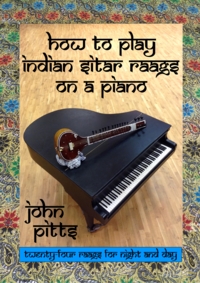 John Pitts’ somewhat unusual book How to Play Indian Sitar Raags on a Piano is designed for adventurous pianists. Indian raags have an extraordinary musical heritage dating back several centuries (from the area that is now India, Pakistan and Bangladesh) – a truly unique musical genre of fascinating melodic beauty and rhythmic intricacy – freely combining elaborate composed melodies with carefully rehearsed improvisation. But now the amazing world of Indian raags has been opened up in a sympathetic but thorough reinvention for piano solo (or duet or two pianos) by an award-winning British composer.
 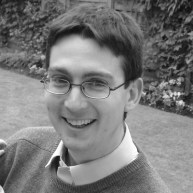 John Pitts is a British composer who lives in Bristol, England, with his wife and four children. He composes mostly chamber music, especially for piano solo and duet, in styles perhaps best summarised as melodic, motoric, motif-driven, jazz-tinged, post-minimal impressionism. His pieces for two pianists have been performed at concerts and festivals in several European countries, Armenia, Australia, Russia, Ukraine and the USA, including in March 2015 a concert dedicated to his music in Perpignan’s “Festival Prospective 22ème siècle” by French duo



 The Cross-Eyed Pianist