Our times maybe troubled, deeply troubled, but thank goodness we can still gain pleasure and solace from music – and Daniel Grimwood‘s recently-released disc of piano music by Adolph von Henselt offers over an hour of unalloyed bliss.
If you didn’t know the name of the composer beforehand – and many may not – the opening notes of the first track might have you confidently exclaiming “oh it’s Chopin!”. There’s the same ominous tread in the opening as Chopin’s Op 49 Fantasie. And then you might think “it’s Liszt!” on hearing the tumbling virtuosic passages which sparkle under the lightness and precision of Daniel Grimwood’s touch.
Other works recall the bittersweet lyricism of Schubert or look forward to the richer textures of Brahms and Tchaikovsky. But this is Adolph Von Henselt, a little known Bavarian-born composer whom Grimwood champions.
Organised in the manner of an old-fashioned recital disc, there is much to savour and enjoy in the variety of works explored here. Virtuosic concert pieces sit comfortably alongside elegant miniatures, offering the listener a broad flavour of Henselt’s style and oeuvre. The Nocturnes, Impromptus and Études prove Henselt was every bit a master of these genres as his contemporaries Chopin and Liszt – and he made similar technical and interpretative demands on the pianist too. There are passages of vertiginous virtuosity which appear sweeping and effortless rather than merely showy with Daniel’s acute sense of the scale and pacing of this music. It’s lushly expressive but Daniel’s clarity and delicacy means it is never cloying or too heavily perfumed.
This disc would go into my “lateral listening” recommendations: if you love Chopin, I guarantee you’ll love Henselt just as much.
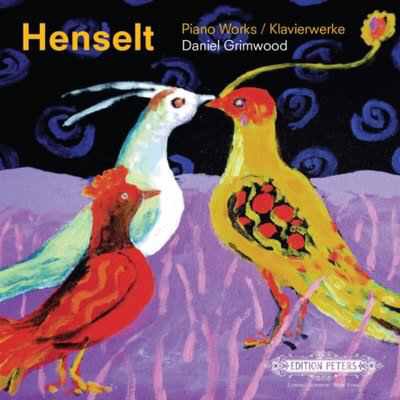
This is the second of Daniel’s recordings for the Edition Peters label and it has delightful cover artwork by Janet Lynch and comprehensive liner notes. As Daniel himself says of this disc: “It’s my small way of restoring Henselt…..to his rightful place in the repertoire”
Brahms and Messiaen do not immediately strike one as natural concert programme companions: Brahms teems with polyphony and darkness while Messiaen is about light, timbre, vertical chords, vibrant colour – indeed Messiaen hated Brahms, declaring that “it’s always raining” in Brahms’ music.
But unlikely or daring juxtapositions can create interesting and unexpected contrasts and connections, as one work shines a new light on another, enriching both listener and performer’s experience – and this was certainly my take on this remarkable concert by Pierre-Laurent Aimard and Tamara Stefanovich at St John’s Smith Square which combined Brahms’ Sonata in F minor, Op 34b with Messiaen’s Visions de l’Amen.
If there are connections to be made between the music that made up this large-scale programme it is that both works are mighty musical edifices, two great mountains which transcend mere notes on the page and which demonstrate each composer’s wish to remain in long moments of emotional distress, relaxation or ecstasy. Both works also display a high level of perfectionism in their structures and organisation, replete with many details, motifs and musical pathways which could easily become blurred in a lesser performance.
The Southbank Centre (SBC) yesterday announced its 2017/18 programme and there’s an embarrassment of riches for lovers of the piano and its literature with concerts featuring established international artists and rising stars. I am particularly looking forward to performances by Maurizio Pollini, Vikingur Olaffson, Leif Ove Andsnes, Mitsuko Uchida and Artist-in-Residence Pierre-Laurent Aimard, who will be performing Ligeti’s Etudes.
Young virtuosos
This year’s rising stars, Katia Buniatishvili, Alice Sara Ott and Benjamin Grosvenor offer a kaleidoscope of contrasting personalities and styles, while Bertrand Chamayoux makes his International Piano Series debut in the opening concert of the season.
Music from the North
As part of the festival Nordic Matters, Vikingur Olaffson makes his debut in this year’s series with Brahms’ Piano Sonata No.3 and its five movements containing echoes of Beethoven’s fifth symphony, alongside that most quintessential of Nordic performers, the Norwegian Leif Ove Andsnes.
The unmissable virtuosos
Enjoy a tremendous range of musical masterpieces while being thrilled by virtuosity with world-famous figures such as Maurizio Pollini, Stephen Hough and Paul Lewis.
A new partnership
Two recitals continue Southbank Centre’s partnership with Mitsuko Uchida. Renowned for her outstanding interpretations of Schubert, this piano legend embarks on the first of her recitals featuring the piano sonatas, from the boundless energy of the G major Sonata to the emotional depths plumbed by the sonata in B major.
Offering a different perspective, Southbank Centre Artist in Residence, Pierre-Laurent Aimard, throws light on 20th century scores with his performance of Ligeti’s Etudes as part of a weekend to celebrate the composer’s music.
These events go on general sale at 10am on Thursday 23 February.
Who or what inspired you to take up composing, and pursue a career in music?
My parents were both professional violinists, so the likelihood is that I was an embryo even as my mother played in the midst of all the instruments- quite an introduction to music! In addition my aunts were also musicians and so it seemed that music was the stuff of life.
To be a composer was the earliest desire I recall having for myself, although after that I tried many other ambitions as a growing adolescent, including going into politics.
I think a turning point came when I discovered Mahler at age 16, that’s when I understood what music can be more fully than before. Then when I went to study at the Royal College of Music, I was introduced to the avant garde of that time, i.e. Stockhausen etc, and I saw how music can be at the cutting edge. Since then I have attempted to redefine the cutting edge as once again melodious and to rededicate music to what it does best – the expression of emotion.
Who or what were the most significant influences on your musical life and career as a composer?
I would cite the late romantic era as the single greatest influence – the grandeur and vision combined with the emotional intensity are hall marks of that era.
But as a child of the mid 20th century I was also deeply influenced by film music Bernard Hermann, John Barry, John Williams, Ennio Morricone – and of course these were in turn influenced by the late romantic.
I would also mention the great American musicals
Amongst people who have influenced me, firstly my parents who provided an environment in which music making was like the air I breathed, whether it was my parents accompanying one another on violin and piano or playing the Bach double for two violins or my father playing the accordion, or both with my aunts on piano or violin not forgetting my brother on drums, or my older cousin Paul Lewis who is a distinguished composer of TV and film music and now increasingly of concert music. Then I should mention my extraordinary piano teacher in Brighton, the late Christine Pembridge. She taught at Roedean girl’s public school and privately at home in Port Hall.
A remarkable musician and teacher, she transmitted her passion for music with a northern directness. It was she who animated my ability to play and through her I gained direct exposure to the great music of Bach Beethoven Schubert Debussy and Rachmaninov. Among her other pupils, before me, was composer Howard Blake of ‘The Snowman’ fame. Her fine teaching prepared me for the Royal College of music which was my next great field of influence. Here I met contemporaries and great friendship with William Mival, now head of composition there. William was a devoted connoisseur of new music and introduced me to Tippett, Stockhausen and Boulez. I would later go on to rebel against the atonal establishment as I came to see it, but the initial stimulus of exposure to its heartlands and the decade I then spent exploring and writing in its styles was the essential formative experience that made my later enlightenment possible.
Once this rebellion happened I was in trouble but almost immediately found a distinguished friend in the form of the great Estonian composer Arvo Pärt. I was introduced to him in the mid 90s by his publisher and we got on immediately. I believe he identified with my struggle having had a struggle himself to escape the Soviet Union. He liked my music and gave me very direct help by splitting a commission fee with me to write music for the 900th anniversary of Norwich Cathedral. He wrote ‘The True Vine’ and I wrote my Missa Brevis. A remarkable man of vision and personal humanity.
Then a few years later, while working with South Bank Sinfonia I discovered their patron was the legendary Vladimir Ashkenazy when he came to conduct them. I asked for and was given an introduction. We found affinity immediately on the issue of tonality and he wrote to me positively about the music I was writing for the orchestra. Within a couple of years he arranged for my Symphony ‘Elixir’ to be recorded and released on Naxos. He remains a great friend and support.
Another great friend was the actor the late Corin Redgrave of the Redgrave clan.He produced my opera Manifest Destiny at the Tricycle Theatre and Ralph Steadman designed the sets. Corin, an activist campaigner along with his sister Vanessa Redgrave and wife Kika Markham( my close friend) have all supported my sometimes controversial pathway. Without them it would have been much more difficult and lonely.
What have been the greatest challenges/frustrations of your career so far?
For the first decade of my career broadly my twenties i ran an ensemble for the performance and commission of new works, The Grosvenor Group. We made some radio 3 recordings and were well supported by various trusts. Then as I approached 30 I underwent a Road to Damascus type conversion to Tonality as I began to compose more full time myself.
Simultaneously I understood that the unmitigated tonalism of my works would not be acceptable to the new music establishment as serious new music and thus began the greatest challenge of my career.
The establishment view was – and remains – based in the atonal paradigm. To challenge this is the same as challenging any establishment- very dangerous.
I felt that I needed not only to produce the work but at the same time to speak out- or even demonstrate. In particular I became involved in a group who booed a Birtwistle opera in 1994.This produced the most incredible outcry and rumble in the press that went on for years
This was captured on television here
and eventually led me to have to sue News International for libel which I did successfully in 2000.
The in 2003 I wrote with playwright Dic Edwards my opera ‘Manifest Destiny’ about suicide bombers who renounce violence and become peace makers. The press nevertheless accused me of glorifying terrorism , a serious criminal offence. Again I sued this time the Daily Mail Group. I won in the High Court but was defeated at Appeal and bankrupted by Associated Newspapers Ltd
What are the special challenges/pleasures of working on a commissioned piece?
Knowing that it will be performed and I will be paid.
What are the special challenges/pleasures of working with particular musicians, singers, ensembles and orchestras?
Having the opportunity to work within a dialogue in which changes and adjustments can be made as part of the working process
Of which works are you most proud?
I would have to cite first ‘Manifest Destiny’. This is a work which aspires to reflect and process the current geo-politics and translate then into a convincing human drama and then transmute the content onto a higher plane of transcendence. In this regard the opera seems to serve its purpose having had over 30 performances and several productions. With Dic Edwards the librettist we also managed to produce a work which has proven prescient to this day.
Also ‘The Year’s Midnight’, a meditation on the Holocaust which was broadcast on radio 4 on the first Holocaust memorial day in 2001; my music in memoriam the 51 people who drowned in the Thames in the Marchioness river boat disaster of 1989, Requiem for the Young; and my music in memoriam the former Leader of the Labour Party John Smith, ‘A Live Flame’ .
How would you characterise your compositional language?
Super Tonal
How do you work?
I type straight into the computer like writing a letter, with no sound, just hearing in my head
Who are your favourite musicians/composers?
Prince, Miles Davis, John Barry, Eminem, Mahler, Bruckner, Wagner, Bach, Elgar, Rachmaninov, Debussy, Mozart, Schubert, Schumann, Brahms, Scriabin
What is your most memorable concert experience?
Karl Bohm conducting the last three Mozart Symphonies with the Vienna Philharmonic in the Royal Festival Hall in 1978 – life changing visionary experience.
What do you consider to be the most important ideas and concepts to impart to aspiring musicians?
Music is a unique portal into the human soul
Keith Burstein was born in Brighton, England. He came from a musical family; both parents were classical violinists who played for Sadlers Wells Ballet, The Royal Philharmonic Orchestra, the BBC Ulster Orchestra and the Halle Orchestra as well as for the Royal Opera House. (Originally of Russian-Jewish extraction, the family name had been anglicised to Burston). Burstein held two scholarships at the Royal College of Music in London where he studied composition with Bernard Stevens and John Lambert. Post-graduation, he continued his composition studies with Jonathan Harvey. This was a period of great discovery for him.
The Cross-Eyed Pianist is free to access and ad-free, and takes many hours every month to research, write, and maintain.
If you find joy and value in what I do, please consider making a donation to support the continuance of the site






 The Cross-Eyed Pianist