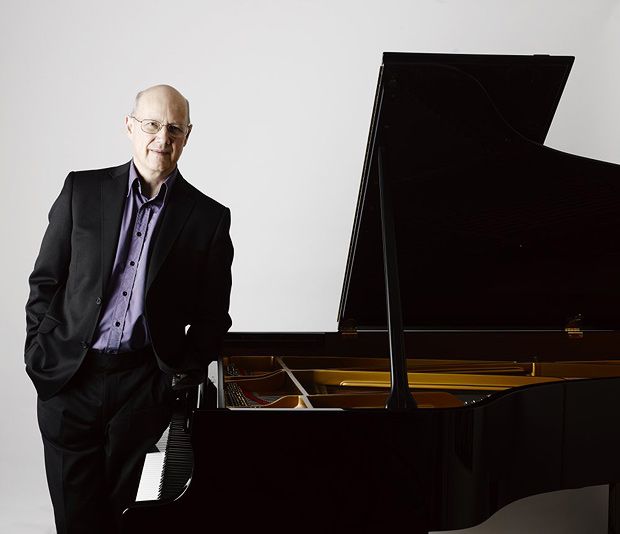
william-howard-plays-sixteen-love-songs-for-piano-lst198567

Love, in its infinite variety, was in the air at Hoxton Hall on Wednesday evening for a concert of newly-written love songs for solo piano, performed by British pianist William Howard. The event was the first of three marking the culmination of William’s Love Song Project, which began with the release of William’s album of romantic songs without words, Sixteen Love Songs, in June 2016. Having commissioned and performed music by living composers throughout his career, William wanted to explore the possibility of creating a contemporary version of his Sixteen Love Songs, modern songs without words on the theme of love which would connect to the composers featured on the Sixteen Love Songs disc. From an idea discussed while hill-walking with composer Piers Hellawell, the Love Song Project came to be and was met with great enthusiasm by the composers whom William initially approached.  Alongside the commissioned pieces by leading British composers including Robert Saxton, Judith Weir, Bernard Hughes, Cheryl Frances-Hoad and Howard Skempton, William launched a composing competition which yielded 526 entries, of which we heard the first, second and third prize winners in the under 25 and over 25 categories.

The subject of love is, of course, the major preoccupation of pop songs and composers of the Romantic period, but has rather fallen out of favour amongst modern and contemporary composers whose focus seems to be more abstract or concerned with the big issues of the day such as climate change or political upheaval. In his introductory talk, William explained that this  “very indulgent” project had revealed a great variety of compositional languages, imagination, moods and character. Many of the works are very meaningful, or highly personal, are easy to relate to and travel far beyond the confines of the strictly defined genre of “classical music”. What the works share is their brevity, and “an overwhelming tenderness for the piano” (Piers Hellawell), and reveal the infinite lyricism and resonance of the piano.

Aside from the championing of contemporary composers, the project has produced a wonderful body of new repertoire for solo piano to suit all tastes.

The audience was invited to give feedback and select favourites from the programme of 12 pieces, but it would be hard to choose one stand-out piece from such a broad range of very fine music. The winning competition entries had clearly been selected with thought, the judges careful to avoid imposing their own stylistic agenda on the pieces, and these were interleaved with commissioned works to create a programme of great charm and variety. The works reflected the myriad facets of love – from tender pieces written for babies or children (‘Camille’ by Joby Talbot, ‘Daniel Josiah is Sleeping’ by Simon Mawhinney) or a partner (‘For Teresa’ by Robert Saxton, which quotes Beethoven’s ‘Fur Elise’, another love song for piano, and is redolent of Schumann’s heartfelt outpourings to Clara in its melodic lines and rich textures). Other works focussed on more abstract aspects of love, or love other than the human kind (‘Arbophillia’ (love of trees) by Samuel Cho Lik Heng, third prize winner in the under 25 category). The programme ended with Cheryl Frances-Hoad’s ‘Love Song for Dusty’, which pays homage to both Dusty Springfield (“a temporary obsession of mine when I discovered that other types of music existed other than ‘Classical’“) in its song structures (verses, choruses, bridges) and pop-infused harmonies, and also to the nineteenth century composers of sweepingly romantic piano solos and songs without words such as Mendelssohn and Liszt. It had a wonderful warmth suffused with wit and humour. William’s sensitive, graceful playing brought to the fore the individual characters of each piece, not an easy task when one is moving between very short pieces of contrasting mood and style.

This was a really delightful evening, made more so by the number of friends and supporters in the audience who together created a very friendly and convivial atmosphere: it felt like a concert for friends and amongst friends – the best kind of music making – and pianists can look forward to the opportunity to explore some wonderful new repertoire.

The Love Song Project concerts continues at Leighton House Museum and Cheltenham International Music Festival in May and June, and include music by Judith Weir, Howard Skempton and Nico Muhly. Details here

Armenian-American conductor Tigran Arakelyan, creator of the Off The Podium podcast series, interviews Frances Wilson, founder and author of The Cross-Eyed Pianist, about her unusual path into piano teaching, the creation of the blog, concert reviewing, “changing the vocabulary” in teaching, and more…..

More about Off The Podium and links to other podcasts in the series here

PLG Young Artists Spring Series 2017, St John’s Smith Square, 24 April 2017

Joy Lisney, cello

Laefer Saxophone Quartet

Programme:

Gyorgy Ligeti – Solo Cello Sonata
Jan Vriend – Symphonic Dances for solo cello (world premiere)
Richard Rodney Bennett – Saxophone Quartet
Charlotte Harding – Sub to Street, to Scraping the Sky (world premiere)
Joy Lisney – ScordaturA for solo cello (world premiere)
George Crumb – Sonata for solo cello
Giles Swayne – Leapfrog for saxophone quartet (world premiere)
Mendelssohn – Capriccio Op. 81 No. 3 (for saxophone quartet)

The PLG Young Artists Series 2017 at SJSS has a special focus on young artists who are also composers, and the concerts include a number of world premieres by leading composers, as well as young artists performing their own works. A shame, then, that with so much young talent on display, this concert was so sparsely attended. We should be supporting young artists such as these – and composers too, young and old – for by doing so we future proof classical music for the next generation and beyond. Sadly, I suspect the modern and uber-contemporary repertoire, which featured in this engaging programme, was the deal-breaker for most potential audience members – it’s that recurrent “problem” with new music, the anxiety that it will be too esoteric, inaccessible, atonal, discordant, impenetrable….. In fact, this programme contained nothing to offend nor assail the ears, and much to delight and intrigue. There were melodies and lyricism aplenty in all the works performed, and the combination of performers – a solo cellist and a saxophone quartet – made for a varied and interesting evening of music which complemented and contrasted, and all of it was highly accessible, even to the novice listener.

I first heard Joy Lisney at SJSS in 2011. Back then, in her first year at Cambridge, she impressed with her musical maturity and poised stage presence in music by Lutolawski and Chopin. Six years on, she’s now working on her doctorate while sustaining a busy career, as a soloist, chamber musician, conductor of the newly-formed Seraphin Chamber Orchestra, and a composer. This multi-dimensional approach to music making is refreshingly enterprising, but also harks back to nineteenth-century composer-musicians like Franz Liszt and Clara Schumann. And there’s something really special about hearing a composer perform their own music – the sense of ownership is very potent and this was certainly the case with Joy’s work. In fact, as Joy explained in her introduction to her piece ‘ScordaturA’, named after the technique of tuning the strings of the cello out of their usual sequence of perfect fifths, and receiving its world premiere at this concert, she found writing for her own instrument particularly difficult, and that spending time writing at the instrument (rather than at her desk) enabled her to find a distinct voice in the music rather than be too heavily influenced by the other repertoire she plays. Having said that, the work pays homage to the Sonatas for Solo Violoncello by Ligeti and Crumb which she also played – it opens with pizzicato figures and strummed strings, motifs which are found in the sonatas. The Scordatura tuning produced striking colours and timbres, while the bariolage string-crossing technique created some very haunting and ethereal sound effects. After a climactic con moto middle section the work subsided back into the harmonic figures of the opening, its ending enigmatic and uncertain. An intriguing and thoughtful work which sat very well with the other music she performed.

The other work for solo cello receiving its premiere at this concert was ‘Symphonic Dances’ by Jan Vriend, a composer with whom Joy has a long-standing creative relationship. This work is dedicated to her and is redolent of Bach’s suites for solo cello (indeed it references the Suite No. 1 in G) in both its motifs and organisation – a sequence of dances of different meters and distinct characters. The work was delightfully varied, virtuosic but never overblown, engaging, witty, and melodically colourful, with much harmonic, textural and rhythmic interest which the composer employs to drive the impression of “symphonic” writing for a single line instrument. The work gave full rein to Joy’s formidable technique while also demonstrating how such technique should always serve the music. This is clearly the type of music she relishes – she’s very alert to rapidly shifting moods, contrasting motifs, expansive writing and technical challenges – and her enjoyment was evident: this was playing suffused with style and energy.

Similarly, her approach to the sonatas by Ligeti and Crumb demonstrated an ease with this type of repertoire. The Ligeti was wonderfully voiced, with a clear sense of dialogue between melancholy phrases and questioning pizzicato chords, and it proved an impressive opener to the concert. Both the Ligeti and Crumb draw inspiration from folk melodies of their native countries, the innate lyricism and expression highlighted by the warm resonant tone of Joy’s instrument and her sensitive shaping of motifs and phrases.

In constrast to the rather more darkly-hued, melancholy works (with the exception of the Vriend) performed by Joy Lisney, Laefer Saxophone Quartet (their name comes from the Anglo-Saxon for “reed” and “sheet metal”) presented works more upbeat in character, performed with style and panache. The saxophone is more usually associated with jazz or big band music, but in these works by Richard Rodney Bennett, Charlotte Harding, Giles Swayne and Felix Mendelssohn (arr. Martin Trillaud), Laefer proved the instrument’s importance, and success, in classical repertoire with fine ensemble playing, crisp articulation, contrasting vibrant and warm tones, close interplay between performers, and a sense of wit and playfulness – most evident in Giles Swayne’s ‘Leapfrog’ (2017). In Charlotte Harding’s ‘Sub to Street, to Scraping the Sky’ the buzzing, bustling, honking of New York City is atmospherically evoked: from the baritone sax’s low rumblings to suggest the rattle and grind of the subway trains, to the soaring skyline, lyrically portrayed by the soprano sax.

This was an impressive opener for a week of concerts at SJSS by PLG Young Artists, with all performers revealing deep commitment to their music making in a wide-ranging and very imaginative programme. In fact, these young people are not the musicians of the future, poised on the threshold of their professional careers: they are the musicians of here and now, fully fledged and ready to make their mark on the world. Please go and hear them and support them.


Guest article by Gregory Daubney, Msc, MBPsS and Dr Alison Daubney, PhD

One of the most enjoyable things about working as a psychologist is that we are never far away from the presence of our forefathers. The ghosts of Freud, Jung, Skinner and Pavlov (amongst others) hover around our every move whispering of the repressed and unconscious nature of human behaviour. That the past should be suggested as the greatest influencer of our future is as natural as night follows day. The mechanism of our individual history’s operation on the present is, quite rightly, shrouded in mystery and intrigue. However, this strait jacket of the past need not leave us feeling stuck in the present. The belief that a psychologist need not know the cause of an individual’s psychological problems is a strangely liberating (for both psychologist and client), if somewhat uncommon, approach to handling psychological skill development. So what alternatives to focussing on a problem can a music teacher who sees their students suffering from musical performance anxiety choose? Why not choose solutions? Solutions are everywhere. All around us, within us, permeating our environment and prevalent throughout our history. The problem is that we can become so fixated on the problem that we simply lose sight of our quest for a solution. As a professional collaboration between a performance psychologist and education expert, we have produced a free to download 52 page book rammed full of practical solutions and ideas to help teachers teach psychological skills to their students. The emphasis is on changing the focus from problems to solutions. So what does this mean in real life? Music teachers vary from person to person. And they should. They hold beliefs and prior experiences, which, in many ways, shape the person they are. They vary in their flexibility, creativity, capability and excitability, all of which blend together in a complex way to create the teacher they are. So when presented with a student who is very nervous about performing, they will approach this problem from very different angles. It should always be remembered that what one person may not view as a ‘performance’ is something that, in the mind of a student, may be an event provoking deep felt anxiety. Therefore, ignoring it and hoping it will go away, is seldom a good option. In our culture it is very easy to accept that until we know a cause we cannot provide a solution. Sometimes this is the right approach, but too frequently this line of thinking can inhibit effective action taking. By switching the focus to solutions, behaviour is encouraged not stifled and taking action itself is often very motivating.

Let’s take a look at how this might work in reality. A very useful question a music teacher could (and may already) ask a nervous student is: “As I watch you about to perform, what will you look like (that I can see) that will tell me you are ready, and looking forward to performing?” Here we can see that the music teacher has moved the focus of their student’s attention to a hypothetical future and away from the problem. The student is most likely to reply by giving a list of what they will look like (e.g. “I will be standing/sitting tall, my shoulders will be back, I will stride onto the stage, I will look up as I enter the performance arena”). This corresponds with one of our many short-term suggestions for handling performance anxiety – our suggestion of creating a body posture reminder sheet (strategy 6C, page 43 of our freely downloadable resource). This may help the student feel ready to perform in the future and is a solution that may help students in the moments immediately preceding a performance.

But the music teacher will not be finished there. Performance anxiety occurs over a much longer timeframe than just prior to performance. That is why, in addition to many practical strategies for use just prior to, during and after performing, our booklet also gives music teachers strategies for the week leading up to a performance, and in the longer term.

So, back to our teacher. The student may tell them one week prior to a performance that they are nervous and worried about performing next week. They may want to avoid the performance completely. There could be any number of reasons for this and it is likely that these will vary from student to student. So a further question the teacher may ask the student could be: “If you weren’t feeling nervous about this performance, what would you be doing in the week leading up to the performance?” Again, we can see a hypothetical future where the student has to think about a different future without the problem. The student may answer: “I would be happier, I would be looking forward to performing because I would be confident that I am going to play well.”

The teacher could then use one of our medium term strategies to help their student build confidence, such as our key strengths worksheet (strategy 2B, page 20) or our record and reflection of prior success and achievement (strategy 3B, page 21). These are immediately usable by the teacher and will help focus the student’s attention on things they do well thereby creating an atmosphere that promotes an excitement about performing.

But again, the teacher wouldn’t stop there! Finally, the teacher may turn their attention to their own teaching. They may ask themselves, “What would be different in my teaching practice if I tried to reduce the probability of performance anxiety having an impact?” They may answer: “I would set students challenging and differentiated goals that strongly emphasise the development my students make against themselves.” Using the flow charts within the booklet as a guide, the teacher could then select an appropriate long term strategy, such as strategy 6A (page 12) in our book with important recommendations for effectively setting goals with students. They can enhance this further by implementing our recommendations to address fear of failure using strategy 3A (page 9) or effective social comparison using strategy 4A (page10).

This type of solution-focussed reflection has the benefit of promoting action rather than merely thought about action. It is also highly motivating because it is achievable both by student and teacher. Finally, it removes the student and teacher from being stuck in a blame culture seeking reasons for experiences. It re-focuses attention on how progress can be made for both student and teacher.

There is often a requirement to work on handling musical performance anxiety in the future. We hope that through this article, it can be seen that progress is possible with a changed emphasis, leading to greater enjoyment of musical learning.

To find out more about how music teachers can help their students handle musical performance anxiety, download the free 52-page guide “Performance Anxiety: A practical guide for music teachers”. And why not book onto our next ISM full day workshop on 6 July 2017. It is only £45 for members and £55 for non-members, with a maximum of 14 people so we can work intensely for the whole day with plenty of opportunities to ask questions. Or for more information, contact us directly at greg@winningessence.com or contact the ISM directly on www.ism.org.


Gregory Daubney (MSc MBPsS) has worked extensively across performance psychology domains since 2008, establishing Winning Essence in 2013. He has developed a thorough understanding of the psychological impact of performance on individuals and teams, with a particular interest and specialism in sport and other performance settings. Greg has also been involved in evaluating the psychological impacts of music-based interventions for young people in mental health settings. Greg’s work is informed by wide-ranging evidence and his workshops over several years have enabled him to successfully translate complex theoretical ideas into applied, practical strategies that performers at all levels can develop to achieve optimal performance. Greg regularly writes about the ways individuals and groups can successfully embed psychological skills in order to maintain a healthy approach to skill acquisition, development and performance improvement.

Dr Alison Daubney (PhD) works across music education in formal and non-formal settings. She is a qualified teacher and mentor, and has extensive experience working across all age phases from pre-school to postgraduate. As a researcher, Ally has led projects considering the health and wellbeing of young musicians in and out of school, including those in a diverse range of challenging circumstances and in mental health settings. Since 2009 Ally has worked extensively with the University of Cambridge International Examinations on international curriculum and assessment development. She works part-time as a freelance researcher, curriculum developer and trainer, complementing her work in music education at the University of Sussex. Ally has worked with the ISM on many aspects of music education since 2008 and regularly runs professional development courses on behalf of the ISM Trust for music teachers and practitioners working in a variety of settings.