“The loneliness doesn’t worry me……I spend most of my life alone, even backstage…….I’m there completely alone. I like the time alone….”

Stephen Hough, speaking on BBC Radio 4’s Desert Island Discs

The pianist’s life is, by necessity, lonely. One of the main reasons pianists spend so much time alone is that we must practise more than other musicians because we have many more notes and symbols to decode, learn and upkeep. This prolonged solitary process may eventually result in a public performance, at which we exchange the loneliness of the practise room for the solitude of the concert platform.

Most of us do not choose the piano because we are loners – such decisions are usually based on our emotions, motor skills or the aural appeal of the instrument. For me, as a child – and an only child – the piano was a companion and a portal to a world of exploration, fantasy and storytelling. It remains a place to retreat to and time spent with the instrument and its literature can be therapeutic, rebalancing and uplifting. For many of us, being alone is the time when the sense of being at one with the instrument is strongest.

In addition, there is time alone spent listening to recordings – one’s own (for self-evaluation) and by others (for inspiration and ideas on interpretative possibilities, or purely for relaxation) – and time simply recovering from practising and refocusing in readiness for the next session. Many pianists tend to be loners – the career almost demands it and self-reliance is something one learns early on, as a musician – but that does not necessarily make pianists lonely or unsociable.

To me it’s always about connection – connecting with parts of myself, with the thoughts and feelings of the composer, and ultimately sharing with an audience. It’s travelling through time and space to experience other eras and cultures…..I can’t think of anything that makes me feel less lonely!

Stephen Marquiss, pianist & composer


The life of the concert soloist is a strange calling, yet many concert pianists accept the loneliness as part of the package, together with the other accessories of the trade. The concert pianist experiences a particular kind of solitude (as noted by Stephen Hough in the quote at the beginning of this article). The solitude of travelling alone – the monotony of airport lounges, the Sisyphean accumulation of airmiles, nights spent alone in faceless hotels. Dining alone, sleeping alone, breakfast alone, rising early to practise alone. And there is the concert itself: waiting backstage, alone, in the green room, and then the moment when you cross the stage, entirely alone….. The pianist Martha Argerich has described the “immense” space around the piano that has always made her feel alone on stage. But it is this aloneness, this separation, which the solo pianist exploits for the purpose of captivating and seducing the audience, drawing them into his or her own private world for the duration of the performance.

I suppose being an introvert in a ‘public performance’ profession has been my greatest challenge. It isn’t straightforward, of course – I seem to have a deep need to communicate music to an audience and get their reaction, and I love to be appreciated, but there are many other aspects of being ‘on show’ that don’t come naturally. I’m very interested in people, but I’m quite a private person and need lots of time to myself.

Susan Tomes, pianist and writer

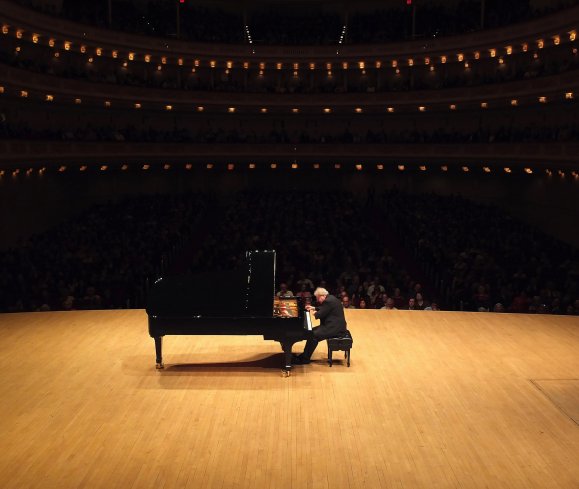
The traditional positioning of the piano on stage, so that the pianist sits side on to the audience, heightens this sense of separation and aloneness. In a concert, the pianist must navigate a path between private, subjective feelings and public expression in a curious display of both isolation and exhibitionism. The power of performer, and performance, is this separateness from the mass of audience. Some performers may exploit this to create a sense of “us and them”, while others are adept at creating an intensity or intimacy of sound and gesture during which the audience may feel as if they have a private window onto the pianist’s unique world, in that moment.
emanuel-superjumbo

Up there on the stage, one can feel more alone than anyone would ever care to be, yet it can make one better than one thinks possible because one’s ego is constantly being tested when one plays. To meet a Beethoven sonata head on, for example, it stops being about you – how fast you can play, how technically accomplished you are. Instead it is about getting beyond oneself, becoming ego-less, humble in the face of this great music, developing a sense of one-ness with the composer…..

After the performance, when the greeting of the audience and CD signing is over, the pianist may happily retreat to his or her solitary practise room or studio. Many of us long for this special solitude and actively relish the time spent practising alone.

The internet and social media has, for many of us, been a huge support in relieving feelings of loneliness and separation. Facebook, Twitter and other social media platforms enable us to connect with pianists and other musicians around the world, allowing us to preserve our solitude, while also engaging meaningfully with others when required.

An earlier version of this article appeared on the Pianodao blog


(Picture: Emmanuel Ax in recital at Carnegie Hall, photo by The New York Times)


Guest review by Magdalena Marszalek

 Grigory Sokolov – Meesterpianisten series recital, The Concertgebouw, Amsterdam 7th May 2017

Programme

  • Mozart – Sonata in C, KV 545
  • Mozart – Fantasie in c, KV 475
  • Mozart – Sonata in c, KV 457
  • Beethoven – Sonata no.. 27 in e, op. 90
  • Beethoven – Sonata n0. 32 in c, op. 111
  • Schubert – Moment Musical in C, D 780, No. 1 (encore)
  • Chopin – Nocturne in B (from ‘Deux Nocturnes’, op. 32) (encore)
  • Chopin – Nocturne in As (uit ‘Deux Nocturnes’, op. 32) (encore)
  • Rameau – 4e Concert : No. 2 L’Indiscrète (from ‘Pièces de clavecin en concert’) (encore)
  • R. Schumann – Arabeske in C, op. 18 (encore)
  • Chopin – Prelude in c (from ’24 Preludes’, op. 28) (encore)

There is no need to introduce Grigory Sokolov to anyone interested in the piano world today. He is an implicit giant, who does not seek nor need advertising, unnecessary media attention, flash-bulbs and buzz. He is above all that, yet so powerful in his modesty. His performances do not contain obvious technical fireworks. If you like this kind of showing off, there are other names you should look to. His performance will affect you first from the inside, starting slowly, almost shyly – and then it will swallow you and possess you whole.

Sunday 7th May 2017 was Sokolov’s 19th recital in a row (!) in the famous Meesterpianisten series in Amsterdam, which this year celebrates its 30th annivcersary. He chose to present two piano sonatas by Mozart (C major K 545 and C minor K457 with the Fantasy K. 475) and two sonatas by Beethoven (E minor op. 90 and C minor op.111). The first sonata, known as the “easy one” (Sonata Facile), may be a surprising opening piece. Heard so (too) many times, performed by all manner of child prodigies, only when under the fingers of a mature pianist does it bloom to its fullest. Still, I would consider it as a warm up before the Fantasy, where Sokolov visited every dark corner there was and brought to light every nuance of this piece. Cruising between the different moods, emotions and styles of this work, he immersed the audience in his mystical world. His natural transition to the sonata invoked the feeling of some unspoken deep, dramatic questions. Yet, his interpretation was not overly dramatic, which left the listeners even more emotionally disturbed and intrigued. It made me realized how this classical piece, decorated with almost baroque fugue elements, shyly and unintentionally hints towards a new era. Nevertheless, the genius of Mozart transcended his own time, just as the genius of Sokolov eclipses other performances.

After the first standing ovation and a break, the pianist came back to present the two sonatas by Beethoven, op. 90 and op. 111. My overall impression of the tone and colour was that the Steinway concert piano sounded much better in this repertoire. Multi-dimensional, Beethoven’s voice sounded much broader and bloodier than the rather flat and crystalline Mozart. Sokolov played the sonata E minor in a more contemplative way than I knew it and throughout his performance I realized that slowing down the tempo, even a little bit, might lead to great discoveries. Again, this sonata – like the Sonata Facile which opened the concert – was more like a prelude for the op. 111. A beautiful second movement resembled a ray of sun before the serious C minor piece commenced. Sokolov played the first movement of op. 111 so meditatively that the audience grew a little uneasy, guilty about barging into such a deep and intimate conversation he was having with a piano. But it was so compelling you simply want to be a part of it… I was curious how Maestro Sokolov would interpret the “rag-time”/syncopated elements of this sonata and I really liked the elegant, understated way in which he handled these rhythms with a little swing in a more playful way.

One can only guess at the maestro’s intention in building such a programme, but for me it was a beautiful journey, using the definition of a classical sonata as its point of departure. Sokolov presented the evolution of the form beautifully, and he chose pieces where the composers, even though firmly grounded in the aesthetics of their respective times, were already emotionally climbing on their tiptoes to see and feel what the future could bring. As a performer, he cleverly highlighted these musical fast-forwards and truly let the music shine. And by doing this he actually could not confirm any more strongly the impact that his personality exerts on the music. He shows so much respect to the music that when he touches the keys he gives the impression that he has disappeared and the only thing that is left in the hall is a beautiful, omnipresent sound. And yet this is not true – because he is everywhere, in every soul who is privileged to sit in the room with him.

The Concertgebouw audience cherishes and almost worships Maestro Sokolov, so a great set of encores was obviously going to follow a thundering standing ovation. He started with Schubert’s Moment Musical no. 1 in C major, and then went on to play two Nocturnes op. 32 by Chopin. He played them last year in the Concertgebouw, and I was not the only one with tears in my eyes, especially after the first Nocturne. That was the most emotional moment of the evening and it unlocked a new, deeper level of emotions in many listeners. He then played L’Indiscrete by Jean-Philippe Rameau and Schumann’s Arabeske in C major op. 18, which I also remember from last year. Again, a lesson should be learned that it does not necessarily pay to show off with tempo, even with a relatively easy piece like this, because one can overlook small pearls and diamonds in this charming work. The final encore was the Prelude op. 28 no. 20 (“Funeral march”) and it is impossible to describe what he did with this short piece! Sokolov turned that prelude into a musical haiku, and through masterful use of dynamics he evoked the weight of death with just the faintest shade of hope. No one else is capable of doing that.

Magdalena Marszalek

Amsterdam 8th May 2017
Magdalena Marszalek is an amateur pianist. She taught herself how to play and read music when she was 5 and then graduated to a primary music school in Poland. She did not pursue a professional career in music and went on to become a scientist (PhD in chemistry), however, piano music has accompanied her and inspired her all along. Currently residing in Amsterdam, when not working on new types of solar cells, she spends many hours at the piano practising and playing for pleasure – mostly Chopin, because he was a Polish emigrant, too. Very often she hops on her bike and in 10 minutes she is in the Concertgebouw, enjoying stellar performances by the finest musicians in the world. Realizing how lucky she is, she wants to share her passion for piano music with everybody. 

Magdalena’s piano story on instagram: @princess_mags_piano

Kingston Chamber Concerts launch, Thursday 18th May 2017

John Irving, fortepiano

Haydn: Sonata in A flat, Hob.XVI:46
Bach: Prelude & Fugue in F sharp minor (48, Bk.2)
Mozart: Sonata in C, K.330
Haydn: Sonata in E flat, Hob.XVI:49
Bach: Contrapunctus 8 from The Art of Fugue
Mozart: Sonata in B flat, K.570

For one night only the audience at the inaugural recital of the new Kingston Chamber Concerts (KCC) series at All Saint’s Church, Kingston-upon-Thames, were offered a fascinating and beautifully presented glimpse into the soundworld of Vienna in the late eighteenth century with a recital on fortepiano by John Irving. The concert was a treat for all sorts of reasons, not least because Kingston is a mere 15 minute bus ride from where I live – a privilege to enjoy such splendid music so close to home.

KCC is the initiative of local resident Leslie Packer and the stated aim of the series is to provide a platform for young artists and local performers in a friendly and convivial setting – the East End Cafe at All Saint’s Church. The audience were seated around small tables, reminisicent of the way music was enjoyed prior to 1850 when the modern concert format as we know it today developed. “Good wine” is also part of the KCC experience and my friends and I enjoyed a glass of delicious Riesling on arrival (and a second glass in the interval!). This undoubtedly added to the pleasure of the evening.

John Irving is an internationally-recognised Mozart scholar and is Professor of Performance Practice at Trinity-Laban Conservatoire. His concert programme, Keyboard Music from the Age of Enlightenment, featured piano sonatas by Haydn and Mozart, together with a Prelude and Fugue and a excerpt from the Art of Fugue by J S Bach. He had brought his McNulty fortepiano into the church especially for the concert. This instrument is a copy of a fortepiano by Walter, and one which both Haydn and Mozart would have known and played. The sound of the fortepiano is at first a little disconcerting: it’s more “clangy” than a modern piano and its voice is less resonant, but in the opening sonata by Haydn (in A flat, Hob.XVI:46) wonderful colours and orchestral tones were immediately revealed, from deeply resonant bassoons and horns in the bass to trumpet fanfares in the treble. The lighter action of the instrument, compared to a modern piano, made for really sparkling passage work, while the slow movement spun elegant melodic lines. The entire performance was imbued with much joy and wit.

image
John Irving

The playing was interspersed with interesting commentaries, which illuminated both music and instrument, and gave us a flavour of the musical life and times in Vienna in the late eighteenth century, including an amusing anecdote about one of Haydn’s pupils who asked for the cross-hands section in the Sonata in E flat Hob.XVI:49 to be made easier so that she could play it. John also explained the reason for including works by Bach in the programme: Mozart was familiar with Bach’s keyboard music and transcribed many of his fugues for string ensemble. Meanwhile, the Art of Fugue was not specifically composed for harpsichord and its intricate contrapuntal lines and voices suit ensemble playing. The Prelude & Fugue in f minor, from the second book of Bach’s 48, felt curiously modern compared to the Haydn, elegantly shaped, with an austere melancholy; while the excerpt from the Art of Fugue was sensitively voiced, building in grandeur as the myriad lines of counterpoint interwove to create unexpectedly piquant moments of dissonance.

The sonatas by Mozart (in C, K.330 and B flat, K.570) revealed more of the colourful treble of the fortepiano in their sprightly opening and closing movements, while the slow movements were replete with operatic arias and long-spun melodies. Here, John improvised in the repeated sections, a practice which was common in the eighteenth and early nineteenth century.

This was a really delightful concert, engaging, informative and very enjoyable, and I wish KCC success with the first season. For more information about the series, please contact kingstonchamberconcerts@gmail.com / 020 8549 1960

warwick-blair

Who or what inspired you to take up composing, and pursue a career in music?

My sisters used to play this track by Danny Kaye called ‘Thumbelina’, at 33 and a third, it was originally a 45 RPM recording, but they played it at a much slower speed, and consequently it used to freak me out, it used to scare me. I was only 3 or 4 years old, but it was the idea of the transformation of material. It remains very important to me and it marked a milestone, and if we’re talking a thread, that’s definitely one.

Who or what were the most significant influences on your musical life and career as a composer?

Although I have worked with Xenakis, and studied with Andriessen and Gilius Bergeijk; perhaps those composers can be viewed as more abstract.The fact that I was brought up in a household where Chopin’s music was revered, and played constantly, is a significant influence, resulting in an appreciation of lyricism and perhaps gesture. When I was living in London in the late 80s, I saw Dead Can Dance play at Sadler’s Wells, again a definite high point, showing me the possibilities of integrating pop cultural influences with a more classical music sound world. This shows itself in my practice today in the collision of styles, demonstrating a search for a deeper meaning, where eclectic diversity and temporal associations offer exceptional musical freedoms, where all sound is equally relevant and musical hierarchies are leveled, so that something more abstract, more universal, can emerge.

What have been the greatest challenges/frustrations of your career so far?

Although I am ambitious, being a New Zealander living in New Zealand, trying to bring my music to the world, via the UK. As I grow older and realise “who” I am; a composer, I will never stop writing music and that is the journey that I must accept and am on.

What are the special challenges/pleasures of working on a commissioned piece?

Apart from the obvious financial and emotional reward of being asked to write a commissioned work, there is no difference between a commissioned work and a non- commissioned work in terms of pleasure; they are equally pleasurable.

What are the special challenges/pleasures of working with particular musicians, singers, ensembles and orchestras?

The challenge of working with particular performers is an understanding of psychology (or sometimes psychiatry, ha ha). After all did not Ravel say performers are slaves?

Of which works are you most proud?

The work that I’m most proud of originates from 1985 called Dream State, an electronic work that is a precursor to Generative music, using the Japanese modular synthesizer, Roland System 700. I’m proud of it because it’s quite pioneering in a way. The instrumental work Electric (aka State of Being) is an opera dating from 2013, which had its world premiere at the Tête à Tête opera festival. The scene called ‘Love’, I find especially moving.

How would you characterise your compositional language?

My compositional language is quite eclectic, but broadly speaking folk or tonally influenced. There’s a sense of egalitarianism, as Louis Andriessen has said, I am working at a new kind of ‘world’ or ‘universal’ metaphysical musical language. Perhaps in a way, I’m trying to find the ‘truth’.

How do you work?

I use a variety of equipment to aid my compositional process, be it a computer, iPad, iPhone or pencil & paper. i use a lot of sampling techniques. there seems to be a conceptual approach that informs my technical processes.

Who are your favourite musicians/composers?

They tend to be mavericks, who exist outside an established or accepted system, but cross all styles, for instance whether it be pop, world or classical.

What is your most memorable concert experience?

Dead Can Dance 1988 at Sadler’s Wells.

What do you consider to be the most important ideas and concepts to impart to aspiring musicians?

Music should have a conceptual reason behind it, for instance we don’t need another string quartet to add to the canon and history of string quartets, but a work such as my Stars, a 24 hour work, could be said to have value from its very nature; it being unique, although inspired by (Gandharva music). To have something to say, to have a point of difference, not to follow the mainstream, and to listen to all sorts of music constantly. To never give up and keep going, and to share love with the world.

What is your present state of mind?
To share love with the world.


Warwick Blair Ensemble, featuring musicians from both UK and New Zealand, perform at Club Inégales (1 June), offering a unique insight into the work of the ‘enfant terrible’ of contemporary Antipodean music.

Hailing from New Zealand, Warwick Blair has a reputation of one of the most eminent composers New Zealand has produced in years. Having studied under Louis Andriessen and Iannis Xenakis, Blair’s music fuses classical and indigenous traditions with electronics in a mesmerizing minimalistic soundscape. In this London residency, he will examine the concept of memory, with the ability of the mind to retain certain information and yet reject other selective memories has fascinated the composer for many years. His performances will become his personal explorations of a musical palette that draws on various seemingly opposing genres or styles, creating a compelling and challenging soundscape.

The concerts will offer two his most eminent works, Melusine (2015) and Etuden (2014), both premiered last year during his Kingston University residency. While the former demonstrates the influence of Puccini’s lyrical melodies and Wagner’s pioneering chromaticism, but also draws on serialism, the avant-garde and contemporary songwriters, such as Lorde & Rowland S Howard, Etuden is a work that combines the influences of Chopin and Billie Holiday.

warwickblair.com


