Is this the most relaxing piece of classical music? asks Radio Three of Arvo Pärt’s contemplative and spiritual ‘Spiegel im Spiegel’. “If you ever need just eight or nine minutes to calm down, relax, switch off from the world, this is the piece you want to do it to…..” says pianist James Rhodes in his introduction to the piece in an episode of Saturday Classics on BBC Radio Three.

spiegel_paert

“Relaxing” is not a description I’d immediately associate with this piece – it’s far too trite for such a sophisticated work (its sophistication lies in its absolute simplicity and the austere rigour applied to its construction) and the word undermines the power of this music. (More about ‘Spiegel im Spiegel’ here).

Over on ClassicFM, great swathes of its programming and website are devoted to “relaxing classics” and “smooth classics”: “the most relaxing music ever composed” states the station of a list of works including Debussy’s Claire de Lune, Gymnopedie No. 1 by Satie, the slow movement of Rachmaninov’s second piano concerto and Einaudi’s ‘Berlin’. Alex James, formerly of the pop band Blur and one of the station’s presenters, declares “I find all classical music relaxing to be honest“. Does he include the ‘Rite of Spring’ in this, Handel’s ‘Hallelujah’ chorus, ‘Night on a Bare Mountain’, or Mahler’s ‘Resurrection’ symphony? Or maybe he’d prefer to chill out to Penderecki’s ‘Threnody for the Victims of Hiroshima’, which opens with shrieking strings, redolent of fingernails being dragged across a blackboard…… Mr James’s comment suggests he is the victim of “restricted listening”, and that he has only experienced music which is serene, slow, soothing, calm, contemplative….. Mind you, since much of what is played on ClassicFM includes a lot of “meandering ersatz-symphonic film music and post-minimalist mush”, it’s perhaps not surprising that Mr James finds this kind of music “relaxing”. Personally I’d rather set my hair on fire and put it out with a hammer than listen to the dreadful ‘Ashokan Farewell’, ‘Gabriel’s Oboe’ or ALW’s ‘Pie Jesu’……

Anything by Einaudi transports me to another world, and I can day dream to my heart’s content

– Margherita Taylor, Classic FM presenter

There are any number of articles and scientific studies out there vaunting the therapeutic benefits of listening to music. Calm, soothing and (usually) slow music has been proven to alleviate stress, lower heart rate and blood pressure, and ease depression. Music can provide a great comfort and a place of retreat or escapism, and from the Orpheus legend onwards, music has been praised for its ability to soothe: Bach may have written his Goldberg Variations to ease insomnia, and Haydn wanted his music to ‘give rest to the careworn’. British-German contemporary composer Max Richter has written an entire work (lasting over 8 hours) based around the neuroscience of sleep. Today, a whole industry seems to have been built on the premise that classical music is “relaxing” and it continues to prove a great marketing tool for record labels and some radio stations (you know which one I mean…..)

When any music of complex structure and energy is contextualised as a commodity to fit an objectified market-driven demand and that market begins to classify all music in the broadest affective terms to meet that demand, and people actually start to believe it through adopting the trend, they swap a multicoloured, multifaceted world for a one-dimensional, dumbed-down, monochrome fake!

Marc Yeats, composer

But to describe classical music simply as “relaxing” does a great disservice to so many works in the repertoire, reducing them to musical wallpaper or unobtrusive background noise instead of valuing them for what they really are. It mocks the achievements of Bach, Beethoven, Schubert, Tchaikovsky, Rachmaninov et al. It suggests that classical music is harmless and benign, and discourages engaged or attentive listening. If we constantly speak of classical music in this way we devalue it, undermine its greatness and its huge variety, and peddle the idea that it’s all “easy listening” – and if we do that, how do we introduce classical music newbies to composers such as Mahler, Schoenberg, Sibelius, Shostakovich, Prokofiev, Messiaen, Ligeti, Crumb, Ades, Birtwistle……? And assigning classical music the function of “relaxing” background music, to be played while you complete your tax return or cook dinner, is equivalent to describing it as “boring” – which anyone who has given the vast, wonderful repertoire a chance will know just isn’t true. But if it’s playing in the background, your ears won’t be fully open to it.

I don’t believe listening to classical music should be regarded as a passive activity. It was, and is, written by sentient people, people with emotions to share or a message to convey. It is born out of love, death, triumph, tragedy, loss, war, power, joy – feelings we can all connect to even if we cannot know the exact emotions of the composer at the time of writing. It was, and is, intended to fascinate the ear, stimulate the mind and elevate the soul and senses. It should shock, awe, terrify, annihilate, grab you by the throat, leave you breathless and have you listening on the edge of your seat. Active, engaged listening puts us in touch with the visceral qualities of music and human emotion. If classical music makes you relax, it has failed. It should be challenging and thought-provoking, because it has to something to say.

Music serves many purposes and we each listen and respond subjectively and intensely personally to what we hear. It can be transporting, taking us to other realms of our imaginations. It can evoke powerful emotions, recall past events or people, provoke a Proustian rush of memories. It can excite, amuse, tease. It can be deeply unsettling or ethereally serene. It can reduce us to tears or make us laugh.

You’ve got to hear this! It’s not meant to be relaxing.

Of course there are many works which are indeed “easy on the ear” – attractive, accessible, lyrical, melodic music which is immediately appealing (a quick glance at the Classic FM ‘50 Relaxing Classics‘ album reveals music which is generally slow and highly melodic). But is it all “relaxing”?

We need our advocates — composers, performers, educators, critics, orchestras and other institutions, and Lord yes, our radio stations — trumpeting what’s so vital in this music, inspiring the public to explore the repertoire and discover its power, so transformational that legions of us have dedicated our lives to creating it, sharing it, and supporting it.

– Patrick Castillo, composer

When I posted Alex James’s moronic comment on Facebook, I received a flurry of replies and some great examples of music which is anything but relaxing. I’ve even compiled a playlist of music which suggests all manner of emotions and scenarios, guaranteed to raise the heart rate and even the blood pressure on occasion!
 

nzso20yevgenysudbin-4416

Haydn Sonata in B Minor HobXVI/32
Beethoven Bagatelles Op.126
Tchaikovsky Nocturnes, Selection from the Seasons
Scriabin Prelude & Nocturne for the left hand Op.9, Sonata No.5, Op.53

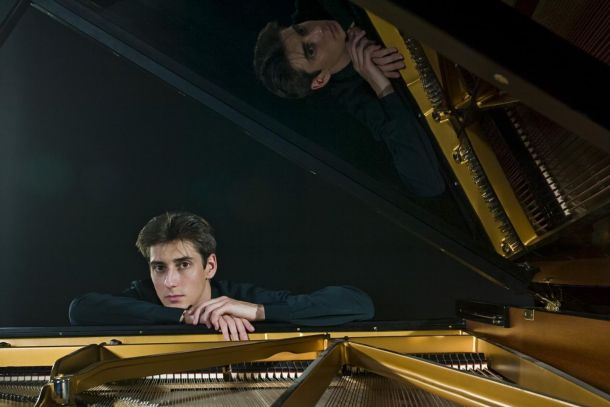
Yevgeny Sudbin, piano

Monday 13 November 2017, St John’s Church, Wimbledon

This was my first visit to Wimbledon International Music Festival, though I have been aware of the festival for some years. Now in its ninth year, the two week festival is very well established and offers an impressive roster of international musicians, together with opportunities and support for young and emerging artists. Concerts take place in a number of attractive churches and halls dotted around the hill leading up to Wimbledon village and are very well organised, with friendly helpful staff. This is in no small part due to the efforts of Anthony Wilkinson, festival director, who is, by his own admission, passionate about music and has created “a festival sharing the experience of hearing and meeting world class artists in the company of friendly festival audiences“.

The theme of this year’s festival is capital cities and Russian pianist Yevgeny Sudbin, who hails from St Petersburg, presented a programme featuring composers from two of the greatest European cultural capitals – Vienna and Moscow – represented by Haydn, Beethoven, Tchaikovsky and Scriabin. Vienna has always had a strong hold over the imagination of Russian composers, artists and performers, and although Tchaikovsky was born in St Petersburg, he spent time in Moscow teaching at the conservatory, which since 1940 has born his name, and where Moscow-born Scriabin studied under Anton Arensky.

Described by the Telegraph as “potentially one of the greatest pianists of the 21st century“, Yevgeny Sudbin possesses that rare talent of being able to move with apparent ease between different composers, eras and genres, yet always delivering pianism of the highest order, rich in expression and musical thought. I have enjoyed fine performances by him at London’s Wigmore and Queen Elizabeth Halls and have been impressed in particular by his performances of music by Scriabin and Scarlatti (Sudbin’s playing of this composer’s miniature sonatas is exquisite – poised, shapely and expressive – and confirms that this music can and should be played on a modern piano).

It is also rare to be at a concert where one is utterly captivated from the first note until the very last has faded to silence, but this was definitely my experience at Sudbin’s Wimbledon recital. He’s a modest presence on stage, restrained in gesture, so that the music can speak for itself. His Haydn was poised and precise, darkly-hued, the first movement paced to allow us to appreciate the composer’s rhetoric and wit and delight in the possibilities of the (then) recently invented pianoforte. The second movement was elegant, lyrical and intimate, while the Presto finale was delivered with an insistent pulsing intensity, replete with fermatas and false cadences to keep the audience guessing.

Beethoven’s Opus 126 Bagatelles were published almost 50 years after Haydn’s B minor sonata, the product of the same period in his compositional life as the Ninth Symphony and the late string quartets. Although a set of six miniatures, these are works of the profoundest emotions and a sense of “otherworldliness”, particularly in the slower works. Sudbin caught the individual character of each Bagatelle with supple phrasing and nuanced dynamics. The final movement, in E flat, was almost Schubertian in its expansiveness and long-spun melodies of its middle section.

More miniatures in the second half, this time by Tchaikovsky. Two Nocturnes and two movements from ‘The Seasons’, all tinged with a heartfelt poignancy and delivered by Sudbin with sensitivity and expression. Scriabin’s Prelude and Nocturne for the left hand offer the pianist technical and expressive challenges – to shape a melodic line with an accompaniment using the left hand alone. This was an impressive performance, graceful and intense. Sudbin launched into the Fifth Sonata with hardly a pause for breath. It opens like the Haydn, with a growling, rumbling figure deep in the bass, but that is where the similarity ends. This work is sensuous, and declamatory. Sudbin capered through it, artfully bringing together all the seemingly disparate elements and abrupt contrasts, from toccata-like scurryings to passages of swooning lyricism, and mercurial changes of rhythm and harmony (some of the more surreal tonalities look forward to Mahler and Schoenberg, who lived in Vienna). The final flourish was delivered with a cool wit and humour.

The Scarlatti encore felt like a palette cleanser after the perfumed excesses of Scriabin, played with an understated elegance and a wonderfully translucent sound, bringing to a lose this absorbing and varied programme.

(artist picture courtesy of the NZSO)

Guest post by Dinara Klinton

My life to date, like most people’s, has been continually evolving as a chain of decisions and coincidences. As a small child I was taken to the special music school in my hometown in Ukraine, and by coincidence to the teacher whose pupil my mother had seen on television a few years before, playing magnificently for the Pope. A few years later, another teacher decided to take a big risk to her reputation and started preparing my 8-year-old self for the Vladimir Krainev Competition, considered one of the most serious for young musicians in Europe and Asia. This time not by coincidence, but thanks to the hard work of that teacher, the dedication and wisdom of my mother, and obedience and hard work on my side, I won first prize, the youngest ever participant of that contest.

Three years after winning the competition, I was invited by Krainev to play in Moscow at the Central Music School. It became apparent that in order to secure my professional growth I would need to move there to study. During my Moscow years I met Dina Parakhina, professor at the Royal Northern College of Music. She suggested I investigate the possibility of studying in the UK, as she believed it would open up more opportunities for me, but at that time I didn’t feel ready to take such a big step. Some years later, when I was approaching my final year at the Moscow Conservatory, I randomly met Professor Parakhina again, who had started teaching at the Royal College of Music, and by then I felt the time was right.

My first year in London, 2012, was rather scary, and at points I felt lonely and lost – even after having lived in Moscow for 11 years and with a decent command of English. I found London a marvellous city with lots of possibilities, but completely different to my homeland and very competitive. Thanks to the friendly atmosphere at the RCM, kind care of Professor Parakhina and the Head of Keyboard. Vanessa Latarche. I managed to overcome my fears, and slowly I realised that my world view and piano playing had begun to change.

Upon completion of my Masters I decided to stay at the RCM for another year on the Artist Diploma course. What happened next changed my life, plans and even goals to some extent. At that time Michael Loubser – the founder of the Philip Loubser Foundation (PLF), ENO Mackerras Conducting Fellowship and RBS Nadia Nerina Scholarship – had been inspired to launch a new piano fellowship. It would be named, just like the other PLF fellowships, after an outstanding artist of the corresponding discipline, a figure admired by Michael. By coincidence I had an upcoming performance at the Royal Albert Hall’s Elgar Room, which Michael and his wife Catherine discreetly attended, following the RCM’s recommendation. It was mid-July 2014 when I was told I’d been chosen as the inaugural recipient of the RCM Benjamin Britten Piano Fellowship, which would generously cover my study costs and support any dream project.

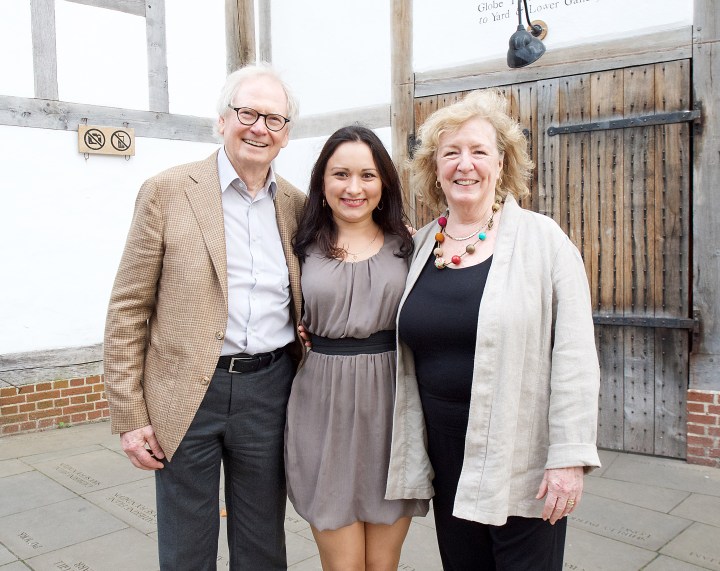
Michael Loubser, Dinara Klinton, Cathy Loubser
Dinara Klinton (centre) with Michael and Cathy Loubser
A few weeks beforehand I had played nearly all of Liszt’s Études d’exécution transcendante for my Master’s final recital, after which my professor told me wistfully that it would be so great to record them. Being very keen on that repertoire myself, I wasted no time, and the Études were recorded in June 2015 at the Leipzig Gewandhaus for the wonderful German label Genuin. That recording took place in between my performance of Rachmaninov’s Piano Concerto No.3 with the Philharmonia Orchestra and participation in the Tchaikovsky Competition in Moscow.

I was on cloud nine realising my longed-for project and despite the exhausting schedule of that period, I neither felt tired nor thought much about the outcome of the recording. What did matter to me was ensuring I did it to the highest standards and met the expectations of the people who had so kindly and generously given me a chance. I also needed to find a way to stay in the UK as my student visa would expire in few months. Thanks to the PLF and the RCM who helped me with this difficult business, I was finally granted the Exceptional Promise visa, just a week before taking part in the Chopin Competition. I felt strongly that it would be wrong to leave the UK at such a pivotal moment of my career and after having been given such help and support here. The CD was released in March 2016 and I was pleasantly surprised by many complimentary reviews, including BBC Music Magazine’s “Recording of the Month”.

The most exciting aspect of this Fellowship is that its effects have been long-lasting, well beyond the end of my studies and the completion of the recording. For one thing, acclaim for the CD has led to more concert engagements in the UK. Michael’s true dedication to and love of the arts has shaped the Philip Loubser Foundation into something very special, where all past and current ENO Mackerras, RCM Benjamin Britten, RBS Nadia Nerina and TA International Ibsen Fellows are one big family of artists, who support each other. We all regularly collaborate through the mentoring sessions and by attending each other’s performances. Just last month the whole team assembled for an amazing Fellowship Weekend, which began with a photo shoot on the Millennium Bridge and continued to the Giacometti exhibition at the Tate Modern and to Shakespeare’s Globe for a tour and dinner. The next day we gathered at Michael and Catherine’s home for brunch and a lively discussion. Each of us described an object or experience that had most shaped us as people and artists. It was fun, thought-provoking, and most importantly we walked out happier and more engaging individuals.

It is truly inspiring to see the PLF family grow each year. Certainly my life would not be the same if I had not been blessed to be a Fellow. It is extremely rare to meet someone who helps young artists, and almost impossible to meet someone like Michael, who wholeheartedly devotes himself to nurturing the next generation. I much look forward to more life- and arts-changing magic happening with the help of the Philip Loubser Foundation.

Dinara Klinton was the first recipient of the RCM Benjamin Britten Piano Fellowship, made possible by the Philip Loubser Foundation.

More information about Dinara at her website

Further details on all the Philip Loubser Foundation Fellowships

Meet the Artist interview with Dinara Klinton


(Photo credit Elliott Franks)


