I have British pianist Joseph Tong to thank for introducing me to the wonderful piano music of Jean Sibelius: Joseph played a selection of miniatures, ‘The Trees’, at a concert for my local musical society, which revealed the variety and expressive qualities of Sibelius’ writing for the piano, too often overlooked when compared to the statue and popularity of his symphonies.
Joseph is a keen champion of Sibelius’ piano music and has traveled to the composer’s home in Finland to play his piano. In his recordings of Sibelius’ piano works, Joseph seeks to demonstrate the composer’s command and understanding of the instrument through a selection of works written during the main periods of the his creative life. There are crisp textures, folk melodies, rhythmic dances and imaginative part-writing. This volume contains Sibelius’ most significant large-scale work for piano, the Piano Sonata in F, Op 12, and one of his best-loved orchestral transcriptions, the Valse triste, which opens as a melancholy waltz that grows into something more far expressive, romantic and upbeat (though always tinged with poignancy, not unlike Ravel’s La Valse).
The miniatures on this disc, the Six Bagatelles, Five Characteristic Impressions and Four Lyric Pieces have a quirky individuality, with their hints of folk idioms, lyrical melodic inspiration and pianistic challenges. Joseph is alert to the changing characters and moods of these miniature marvels and brings warmth and affection to his sound and interpretation.
In planning the running order for the disc, Joseph wanted to combine “large-scale works with shorter pieces (or sets of pieces) in a way which might mirror a concert programme” and so the recording closes with a fine reading of Sibelius’ early Piano Sonata in F, a large-scale work rich in late-Romantic expression which fully utilises the modern piano’s resources. It has a Rachmaninoff-like spaciousness to it – the piano music of both composers seems to acknowledge and express the vastness of their homelands (even when writing in miniature form), though Schumann is a more likely influence in Sibelius’ early piano writing. The first movement certainly shares Schumann’s extrovert exuberance and brilliance. The middle movement, Andantino, is more restrained, a simple hymn-like melody with an accompaniment of syncopated chords, which becomes more florid in the middle part of the movement. The finale is rambunctious cheerful rondo, driven by its motoring rhythms and busy theme, which ends in virtuosic cascades of notes.
Like the previous volume, this is a rewarding compilation, revealing Joseph’s affinity with the music and its composer in his depth of tone, varied colours and musical understanding. The recording quality is excellent, with an immediacy of sound which suggests a live concert performance (and I was fortunate to hear Joseph perform the Piano Sonata and shorter works at his recent concert at St John’s Smith Square to launch this recording).
Sibelius’ piano music is accessible and satisfying to play, and I urge pianists to seek out this excellent survey.
My second trip to Wimbledon International Music Festival proved as rewarding and enjoyable as the first. As part of the Festival’s New Generation Artist Series, pianist Christina McMaster gave a lunchtime concert featuring music by living American composers Meredith Monk and Philip Glass, together with Études by Claude Debussy.
Christina studied with Joanna Macgregor at the Royal Academy of Music and I think the influence of her mentor shows in her imaginative and eclectic programmes and the clarity, panache and vivid colour of her playing. Monk’s ‘Ellis Island’ was written to accompany a short silent film of the same name, which celebrates the gateway to the USA for thousands of immigrants in search of a better future. The music, originally scored for two pianos (I assume the transcription for solo piano was arranged by Christina herself), has a lilting Gaelic flavour, a reminder that many people from Scotland and Ireland emigrated to America. The overall message of the music is hopeful and joyful, though a quieter section at the end suggests eagerness tinged with anxiety at what the future may hold. Christina created a lovely bright, crystalline sound with a great sense of energy throughout, though the music never felt relentless, but rather light and dancing.
Fellow New Yorker Philip Glass is regarded as the master of minimalism, but his piano music when played with sensitivity can feel almost romantic, and this was certainly Christina’s approach to the two Études by Glass in this programme, one frenetic and urgent, the other more reflective with its Schubertian long-spun motifs, spaciousness and unexpected harmonic shifts. Her sense of pacing, elegantly nuanced dynamics and tempo made these works the highlight of this excellent programme for me.
Debussy’s Études follow Chopin’s model – short pieces written to exercise and improve the pianist’s technique, and like Chopin’s Opp 10 and 25 Études, Debussy elevates the pieces from student exercises to exquisite concert miniatures. The first Étude of Book 1 is dedicated to “Monsieur Czerny” and is an amusing take on Carl Czerny’s rather tedious five-finger exercises which many young piano students have had to endure (I know I did!). Cheeky interjections from rogue fingers hint at the student’s frustration at having to remain in a five-finger position on the keyboard and the work grows more expansive and virtuosic towards the end. It was despatched with playfulness and wit. The other Études were played with similar character, their individual quirks and delights carefully delineated by Christina. There were so many moments to savour – great delicacy of touch, subtle shadings, natural rubato and rhythmic vitality, and the entire performance was vibrantly coloured and very stylishly presented. The encore, Debussy’s ‘Girl With the Flaxen Hair’, was played with equal poise and elegance.
(Photo: Dominic Farlam)
Worbey & Farrell are Steven Worbey and Kevin Farrell….
Who or what inspired you to take up piano, and pursue a career in music?
We’d both say it was really a natural ‘calling’. We’re both from musical families and had a piano in the house. We have similar stories of our parents having difficulty getting us away from the piano. At school neither of us ever went into the playground – we could always be found at a piano somewhere in the music department surrounded by fellow students. A career in music was a happy option. What could possibly be better than doing something you love and being paid for it?
Who or what have been the most important influences on your musical life and career?
We both come from families involved in many aspects of the arts. Kevin’s mother was at the Royal Ballet School and Steven’s grandfather was an accomplished Jazz pianist who toured with a famous dance band. We were both fortunate to be raised with wide a range of great music around us. Steven had inspiring teachers from an early age. Kevin’s college professor Peter Wallfisch was an excellent teacher and rather intimidating but looking back Kevin says he was the most inspiring of them all. Steven’s first Royal College professor was Phyllis Sellick who was wonderful teacher and enormously influential. He then went on to study with Yonty Solomon and Peter Katin.
What have been the greatest challenges of your career so far?
We’re always challenging ourselves with new arrangements. When we first launched our duo, to stand out we included a fair amount of musical comedy. We soon realised that our strengths were really in the music and arrangements so had to make the changes subtly making the emphasis on the music. This lead to more concert engagements.
Which performance/recordings are you most proud of?
We recently recorded and filmed our arrangements of Bach’s famous Toccata and Fugue in D minor and Gershwin’s Rhapsody in Blue. There are a couple of versions of the Bach arranged for four hands on one piano but we thought them too embellished and heavy with not enough colour and contrasting textures that the piece requires being composed for organ. We were inspired to arrange the Gershwin for four hands on one piano as we feel the versions available don’t quite use the piano to it’s full orchestral potential which can mean crossing hands a lot.
Which particular works do you think you play best?
We like to take orchestral works and try and create orchestral sounds on the piano. You could say we like to think of the piano as our very own symphony orchestra. We wouldn’t take a well written sacrosanct piano piece (i.e. Chopin) and arrange it for four hands as it would simply spoil it. With the use of four hands and some clever trickery, it’s amazing that you can make a piano sound like a lush string section, a muted trumpet or like triangles and Glockenspiels.
How do you make your repertoire choices from season to season?
We’ve discovered that changing repertoire every season isn’t ideal as some of it can go to waste and not be heard by enough audiences. We now add and take away gradually throughout the year making sure that each work is performed to its best and also gets a good airing. We simply choose music that we love rather than trying to pander to our audiences. It wouldn’t be fun for us to play a work that we’ve chosen just because we think the audience may like it.
Do you have a favourite concert venue to perform in and why?
We tend to perform in concert venues and theatres. Concert venues often have wonderful acoustics for the piano but on the flipside they’re not ideal to talk to your audience as your voice gets lost. Conversely playing a piano in a theatre tends to sound very dry but is good for the voice. In those cases we sometimes add a little concert reverb to the piano. Our recent favourite venues were the Dora Soutzker Hall at the Royal Welsh College of Music and Drama, the Sejong Centre in Seoul, Korea and the Newbury Corn Exchange as part of the Newbury Spring Festival. This coming November we’ll be performing at Edinburgh’s Usher Hall which acoustically is wonderful.
What is your most memorable concert experience?
There are two – and we have to tell you about both! We were once performing our own Paganini Variations (which we called ‘Deviations on a Caprice’) and both had one of those wonderful and very rare moments of sheer bliss – where we completely lost ourselves in the music and nothing got in the mind’s way. It was what we all strive for. The other moment was when we were performing at the Grassington Festival and during a comedy moment a young boy on the front row burst into laughter and simply couldn’t stop. His father was holding his hand in front of his mouth and had to take him out. We later received an Email from the father thanking us for introducing his boy to music and fun. It was very moving for us.
As a musician, what is your definition of success?
There’s lots of talk of ‘making it’ and unfortunately musicians often compare their careers to others’ careers but as far as we’re concerned if you can make a career out of any aspect of music you’re definitely a success.
What do you consider to be the most important ideas and concepts to impart to aspiring musicians?
We’d say “be yourself”. If that means re-inventing the traditional recital do it. If you love to talk, be funny or tell stories then do it. When a performer enters the stage the audience doesn’t really know if they like you. Why not smile, say hello or chat first. Concerts don’t have to be so glum anymore. We’ve been to some amazing performances recently by world famous pianists that just look so unhappy. There’s no reason why they couldn’t enhance their stage technique a little.
Where would you like to be in 10 years’ time?
If we’re still doing what we do now we’d be most happy. Making a good living out of something we love. Sometimes we spend so much time striving for more we forget to enjoy what we’ve got. We’ve come to realise that a moderate amount of ambition is fine.
What do you enjoy doing most?
Aside from the obvious music we enjoy socialising and cooking. We rarely have a night at home and watch very little television. There’s so much going on in the real world such as theatre, concerts, parties, restaurants etc
Worbey & Farrell are internationally acclaimed concert pianists with a wicked sense of humour. They have played with the world’s leading symphony orchestras, achieved over a million hits on YouTube, and entertained in over 150 countries around the globe with their barnstorming blend of sparky comedy and utterly sensational piano playing.
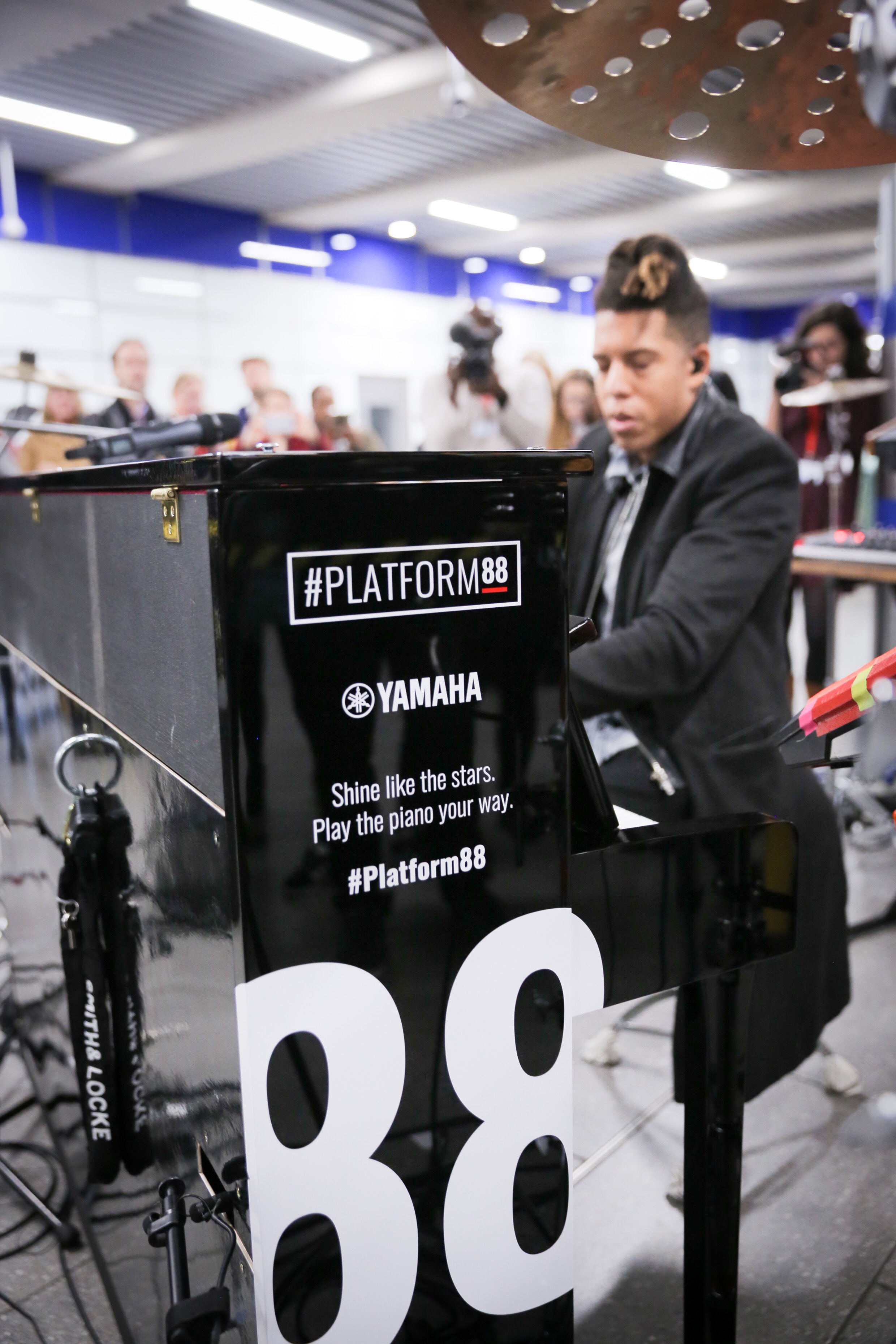
Transport for London (TfL), in partnership with Yamaha, today 16 November 2017 launched a programme which will make three pianos available at stations for customers to play. The first, placed at Tottenham Court Road, was launched with a performance by multi-instrumentalist, composer and producer Tokio Myers.
The two-year project named #Platform88takes its name from the number of keys on a standard piano and provides opportunities for musicians to play and entertain their fellow passengers.
During the two-year run of #Platform88, the pianos will ‘travel’ around the network to various stations, giving a range of our customers the opportunity to show off their musical talents. At the end of the scheme the pianos will be donated to charity.
One piano will be auctioned off to benefit the charity Railway Children which supports children alone and at risk on the streets in the UK, Africa and India. The remaining two pianos will be given to the London Music Fund and Music for All to pass on to a worthy school or young individual to help encourage their musical journeys.
Mark Wild, Managing Director, London Underground, said: “Music has been a part of Tube travel for many years now, with busking and classical music featuring at many of our stations, and we are always looking for new ways to improve our customers’ journeys. This project will bring music to some of our key stations, generate money for charity and also offer a platform for aspiring musicians to perform to some of the many thousands of customers who use our network every day.”
Charles Bozon from Yamaha Music UK said, “Our global Yamaha philosophy is to enrich lives through music, and #Platform88 is the perfect opportunity to connect to huge numbers of music fans and players and to create a vibrant new community – and hopefully discover some new talent along the way.”
Tokio Myers said: “My musical journey to this point has been full of surprises, chance moments and happy coincidences. Everyone loves listening to music and it’s my passion to inspire more people to move from listening to creating their own music. #Platform88 is a brilliant, fun way of doing this.”
Two more Yamaha pianos will be launched by two well-known recording artists in support of #Platform88 before Christmas. Each of the pianos boasts a specially commissioned, eye-catching design that guarantees the instruments are destined to become part of London’s transport and music memorabilia.
Yamaha is a successful manufacturer of musical instruments for professional and amateur musicians with a philosophy of cultural enrichment through music and excellence in the arts. It partners its strong heritage of traditional instrument craftsmanshipwith leading musicians, educators, and technicians to inspire innovation and design in new instruments. The company has a huge range of creative partnerships with many artists and learning providers throughout Europe.
The Cross-Eyed Pianist is free to access and ad-free, and takes many hours every month to research, write, and maintain.
If you find joy and value in what I do, please consider making a donation to support the continuance of the site






 The Cross-Eyed Pianist