Who or what inspired you to take up composing, and pursue a career in music?
I don’t really remember deciding to be a musician, it’s just something I always did, and always knew I wanted to do. It did take me a while to discover that I wanted to be a composer, however. I only really knew about performers, so that’s what I thought I’d be at first. (Of course the music we played was by composers – but they mostly seemed to be dead men from Europe!) At first I thought I would be a pianist, and then an oboist. I entered university as an oboist, and though it was a fantastic time, and I’m glad that I had those years of performance training and experience, it was never quite the right fit. I didn’t love practising, and I didn’t love performing: I loved the music itself, and those were the only ways I knew to get close to it. When I was 18 I went to a music summer camp and signed up for the composition class simply because it fit my schedule and the teacher seemed interesting. As soon as I started, I knew that I needed to be a composer.
Who or what were the most significant influences on your musical life and career as a composer?
There are so many it’s hard to list, but one huge influence on me has been the Canadian composer R. Murray Schafer. I’ve interacted with him, his music, and his writing in so many different ways over the years, and I think my own work would be quite different without his influence. Growing up in Canada, I sang many of his pieces in choir. These are pieces that can be sung by children or amateurs, but are really successful and interesting as new music, often using beautiful graphic notation to help non-music readers to create fantastic sound worlds. This has very much influenced my approach to writing for children and amateurs: music doesn’t have to be simplified or trivialized to be made accessible to performers of all experiences and abilities. In 1992 I attended a workshop by Schafer called Environmental Music Week. This got me started really listening to the sounds of the natural world, and thinking of music as something that belongs outdoors just as much as it does in the concert hall. And from 1992 until 2003 I was part of Schafer’s large-scale collaborative music-theatre work And Wolf Shall Inherit the Moon, which involves camping in the wilderness of Ontario for a week every summer, and co-creating the work with about 50 other participants (who are also the only audience). This has influenced me in so many ways that it’s hard to even know who I would be without having participated in it, but a few things that come to mind are the importance of community, the importance of creating for the people you are with, the importance of participating in all kinds of art forms even if you specialize in on, the importance of storytelling, and the way music and performance can serve as a ritual to deepen our connections with people and the natural world.
Other strong influences that come to mind, in no particular order, are my piano teachers, medieval and renaissance music, Ravel, the book Music, Myth and Nature by French composer François-Bernard Mâche, the two years I spend studying with Louis Andriessen in Amsterdam, traditional music, starting to play fiddle when I was 30 (and playing in a klezmer band and French Canadian traditional music band), Bread and Puppet Theater, and my interdisciplinary research on bird and other animal songs. And, more recently, becoming a parent!
What have been the greatest challenges/frustrations of your career so far?
Overall I feel very satisfied and lucky with my career: I’ve been able to compose, collaborate with fantastic performers, have some great performances of my music, and pursue my interdisciplinary animal song research with some wonderful biologists. At the moment, I have my dream job, a 4-year research fellowship at the Royal Conservatoire of Scotland in Glasgow. I’d say the first greatest challenge is simply composing itself! Though I find being a composer immensely satisfying, I’m not one of those (rare) composers who always finds the act of composing easy or pleasurable. I love having written a piece, but getting there often involves a lot trusting in the process even when I feel like I’d rather be anywhere than sitting at the piano or the desk! There’s also the ongoing frustration that it can be so hard for composers to earn a living. I’m ok at the moment, but it’s always precarious, and there have been times when I’ve had to live on almost nothing, or when I’ve had to rely on the help of family. I’ve been lucky so far: but artists shouldn’t have to be lucky to survive. We need security just as much as anyone else does!
My current biggest challenge is getting used to being a parent-artist. I had my first child when I was 40, so I had had quite a long time to get used to my schedule being my own: following the needs of the music I was writing, working on evenings and weekends as necessary, getting a slow start to my days, and so on. During the 5 years I was a freelance composer, I’d take all day to get myself into the right headspace for composing, and then have a brilliant and focused 3 or so hours to compose between 4 and 7 or so. Now I’m lucky to have 3 consecutive hours in a day. I need to focus immediately, even if I’ve been thinking about something completely different previously. And I’m always interruptable now – if the kids get sick, if the babysitter cancels, etc. I actually think that getting used to new ways of working is a good challenge – perhaps it will stimulate new kinds of ideas – but its not always easy!
What are the special challenges/pleasures of working on a commissioned piece? What are the special challenges/pleasures of working with particular musicians, singers, ensembles and orchestras?
I’ve combined these questions, since they’re related. I only write pieces for specific performers or performance contexts: sometimes they’re commissioned by the performer, sometimes they’re initiated by me. An essential part of music for me is the communicative aspect. Ultimately I want to communicate with the audience (it doesn’t have to be everyone in the audience, but I want at least someone in the audience to have a meaningful experience with the music!), and the performers are the ones who are communicating the music to the audience: so having a good relationship with the performers is necessary! It’s always a great pleasure when performers just “get” my music without me having to say anything. But equally, it’s a great pleasure if they don’t “get” my music at first, but are willing to work together with me until they do!
Of which works are you most proud?
This is always changing, but at the moment I’m feeling most proud of my chamber opera ‘Jan Tait and the Bear’, which I was working on on and off since 2012, and which was premiered in 2016. I wanted to write something engaging and interesting for audiences of all ages – not a children’s opera, but an opera that both children and adults could enjoy equally – and I think I succeeded with that. I wrote the libretto myself – something I had never thought I could do – and discovered that I actually really enjoy writing lyrics. And I hadn’t really thought that I would be able to write something as large-scale as an opera, but I did, bit by bit, and here it is! The whole process of working with the ensemble, the singers, the narrator, the stage director, the costume designer, and everyone, has also been really fun: it’s so wonderful to see what an entire creative team comes up with.
How would you characterise your compositional language?
Oh dear, this is always the hardest question to answer! I like notes, melodies, harmonies (tonal and non-tonal), sounds, colours, patterns, irregular rhythms, narratives, stories, words, silences. My pieces use these in various different combinations and to varying degrees. On average my work is tonal-ish, though some of my pieces are not. Many but not all of my pieces are influenced by my research on bird and other animal songs.
How do you work?
This is constantly changing. I used to take hours – hours spent wandering, reading, cooking, biking, napping, daydreaming – to settle into the right headspace for composing. This is not currently possible, so I’m working on becoming better at just sitting down at the piano or desk and getting right to it. When starting a piece, I often improvise at the piano until I come up with the ideas I want to follow, or I start out with verbal or pictorial sketches. When I look back at the initial sketches, they usually have very little to do with what the piece ends up being – but I guess they’re essential as the way into it. I’ve never had a great concentration span, so composing for me is a continual process of redirecting my attention back at the music. When I get stuck, I like to sight read piano music or go for a walk. (I’m considering getting rid of my smart phone so I don’t have to constantly fight off the temptation to check facebook or the news!)
I never compose without a cup of coffee. Even if it has gotten cold and I am no longer drinking it, I find it reassuring to have it there!
Who are your favourite musicians/composers?
There are so many, so this list is by no means comprehensive! From the classical/new music world, certainly Machaut, R. Murray Schafer, Ravel, Meredith Monk, Bach, Xenakis, Ruth Crawford Seeger, Stravinsky, Andriessen. I also love listening to the music of my peers – though I won’t name any because I don’t want to risk leaving people out! And I listen to a lot of traditional music, from all over the world. At the moment (as a relative newcomer to the UK – I moved here 2 years ago) I’m listening to a lot of English and Scottish traditional song – the Copper Family, Annie Briggs, Ewan MacColl, and so on.
What is your most memorable concert experience?
I think the most memorable experiences have been large-scale, multidisciplinary, outdoor works: Murray Schafer’s And Wolf Shall Inherit the Moon, the summer circuses of Bread and Puppet, Hanna Tuulikki’s Away With the Birds, the Environmental Art Festival in Scotland. Though those were not just about music – they were about theatre, community, and environment as well.
What do you consider to be the most important ideas and concepts to impart to aspiring musicians?
Keep listening and learning, and don’t let setbacks set you back. Everyone fails or is rejected sometimes. The successful musicians are the ones who learn and keep on going.
And look for as many ways as you can to build the kinds of musical communities you want to be part of. Some people try to get ahead by thinking only of how to further their own careers, but I think we’re all happier and healthier when we’re looking for ways to help others as much as we’re looking to help ourselves.
Where would you like to be in 10 years’ time?
At the moment I have a number of composition and research projects that I’m really excited about – and I basically hope for the same thing 10 years from now! I do have some nascent ideas for future operas – larger scale than anything I’ve done so far. Perhaps these will be outdoor or site specific pieces, perhaps with a larger cast that I’ve written for previously – and I hope I am in the position to be making some of those happen then.
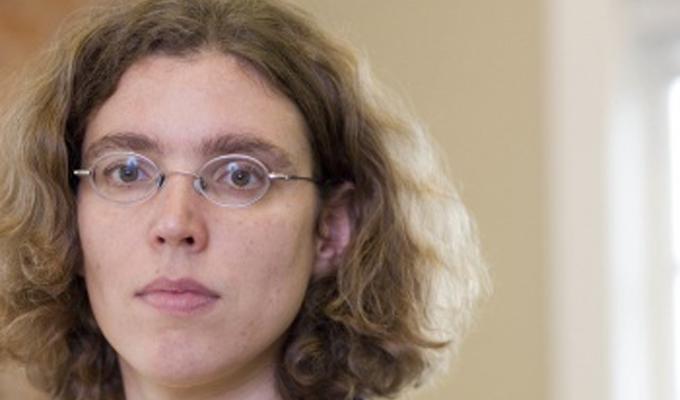
Canadian-born, Scotland-based composer Emily Doolittle grew up in Halifax, Nova Scotia and was educated at Dalhousie, Indiana University, Princeton University, and the Koninklijk Conservatorium in the Hague, where she studied with Louis Andriessen with the support a Fulbright fellowship. From 2008-2015 she was an Associate Professor of Music at Cornish College of the Arts in Seattle. She now lives in Glasgow, UK, where she is an Athenaeum Research Fellow at the Royal Conservatoire of Scotland.
Doolittle enjoys writing for both traditional and less standard instrumentation, and has been commissioned by such ensembles and soloists as Symphony Nova Scotia, the Vancouver Island Symphony, Orchestre Métropolitain (Montreal), the New York Youth Symphony, Tafelmusik Baroque Orchestra, Ensemble Contemporain de Montreal, the Motion Ensemble (Canada), the Paragon Ensemble (Glasgow), soprano Suzie LeBlanc, viola da gambist Karin Preslmayer, and alphornist Mike Cumberland. Upcoming projects include a chamber opera called Jan Tait and the Bear, which will be performed in Glasgow by Ensemble Thing in October, 2016, and a concerto for Canadian bassoonist Nadina Mackie Jackson.
An ongoing interest for Doolittle is the relationship between music and sounds from the natural world, particularly bird and other animal songs. She has explored this in a number of compositions, as well as in her doctoral dissertation at Princeton and in interdisciplinary birdsong research with biologists and ornithologists. In 2011 she was composer-in-residence at the Max Planck Institute for Ornithology in Seewiesen, Germany, where she collaborated with ornithologist Henrik Brumm in researching the song of the musician wren and presented a concert of her birdsong-related works, performed by members of the Bavarian State Opera.
Other recurrent interests include folklore, musical story-telling, and making music for and with children. These interests are combined in her piece Songs of Seals, based on Scottish folklore and written in collaboration with Gaelic poet Rody Gorman, for the Voice Factory Youth Choir and the Paragon Ensemble (Glasgow), which was premiered in the fall of 2011 in Glasgow and Skye.
Doolittle has received a number of awards for her music, including the 2012 Theodore Front Prize for A Short, Slow Life (commissioned by Suzie Leblanc and Symphony Nova Scotia), two ASCAP Morton Gould Awards, and the Bearn’s Prize. Her work has been supported by grants and commissions from the Artist Trust (Seattle), the Eric Stokes Fund, The Culture and Animals Foundation, ASCAP, the Canada Council, the Nova Scotia Arts Council, FIRST Music, the Montreal Arts Council, and the Conseil des Arts et Lettres du Québec, and with artist residencies at MacDowell, Ucross, Blue Mountain Center, Banff, and the Center for Contemporary Art in Glasgow.
emilydoolittle.com


 Alison Mathews is a classically trained pianist and composer living and working in Surrey, UK. A graduate of the Royal College of Music, London, she holds both a Teaching Diploma and an Honours degree. Alison went on to complete a Masters degree at Surrey University, with the aesthetics of music at the heart of her studies. This led to a wider exploration of the links between art, myth and music with the award of a scholarship for a Doctorate at Surrey University. She was unable to complete this, as having a family intervened and a career in music education came to the forefront. Alison has been running a thriving private teaching practice for over 25 years along with workshops integrating art and music. Alison’s interest in composition grew out of a desire to provide students at all levels with imaginative music to play and the opportunity to explore the full range and sonority of the piano. Alison’s solo and collaborative works are published by Editions Musica Ferrum.






 The Cross-Eyed Pianist