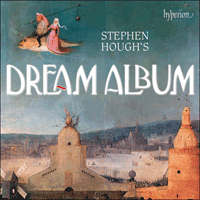
Stephen Hough’s Dream album

034571281766

A few years ago, I heard Stephen Hough in concert in a programme of “serious” music: the premiere of his ‘Trinity’ Piano Sonata III alongside Cèsar Franck’s mighty Prelude, Chorale & Fugue, plus works by Liszt and Schubert. And the encore? Eric Coates’ By the Sleepy Lagoon, which many will recognise as the theme tune from the BBC’s long running Desert Island Discs programme. Played with as much care and expression as the main programme, it was a delightfully witty and nostalgic close to the evening. This charming miniature appears on Stephen Hough’s latest release ‘Stephen Hough’s Dream Album’ and is given a lilting Chopinesque delicacy by Hough.

Dreaming – Isn’t this what we do when we listen to any kind of music? We suspend the reality of our ordinary lives, we long for spells to be cast, for phantoms to be grasped, to enter a state of ecstasy. (Stephen Hough).

Most of us go to concerts and listen to music to be taken to another place, and this album succeeds in this objective in spades, offering a varied selection of flights of fancy, erotic reveries, melancholy ponderings, and fleeting visions. All the works on the disc are transcriptions, by Hough himself and others (if you, like me, own Hough’s ‘Tributes and Transcriptions’ collection of piano music, you will be delighted to hear his mischievous Radetzky Waltz, the witty Niccolo’s Waltz with its nod to Paganini, Osmanthus Romp and Reverie, and Lullaby played by the composer/performer himself). Here, Hough the concert pianist is cast also as transcriber, interpreter and re-creator, and his own transcriptions are a testament to his musical insight, skill, and whimsy.

What makes this album so charming is Hough’s skilled programming, mixing high art with pieces, which in the hands of certain others, could sound schmaltzy and sentimental. Thus powerful performances of works Liszt and Dohnányi sit happily alongside Hough’s cheery Matilda’s Waltz (a reference to his father’s heritage and scored as a rumba) or amusing transcriptions of dances from Don Quixote. Hough avoids kitsch and brings to every piece his characteristic clarity, musical intelligence, wit, elegant phrasing, tasteful pedalling and an intoxicating kaleidoscope of expressive colours and moods to create an album which delights and surprises at every turn. It’s also deeply personal (two pieces were written for Hough’s partner), ending with “the piece I want to be the final piece I play in concert – the last encore of my last concert which I first heard on my first LP“. Nostalgic and bittersweet, redolent of “at homes” in Edwardian drawing rooms or pre-war cocktail hour, the music evokes a dreamy golden age tinged with poignancy. Hough’s magical soundworld brings an intense intimacy and elegance to every piece. Listen to it as an entire recital album or dip in and out of it: you will be utterly charmed and transported.


Stephen Hough’s Dream Album is available as a CD or download from Hyperion


A few years ago, I heard Stephen Hough in concert in a programme of “serious” music: the premiere of his ‘Trinity’ Piano Sonata III alongside Franck’s mighty Prelude, Chorale & Fugue, plus works by Liszt and Schubert. And the encore? Eric Coates’ By the Sleepy Lagoon, which many will recognise as the theme music from the BBC’s Desert Island Discs programme. Played with as much care and expression as the main programme, it was a delightfully witty and (for those of us of a certain age) a rather nostalgic close to the evening. This charming miniature appears on Stephen Hough’s latest release ‘Stephen Hough’s Dream Album’.

Dreaming – Isn’t this what we do when we listen to any kind of music? We suspend the reality of our ordinary lives, we long for spells to be cast, for phantoms to be grasped, to enter a state of ecstasy. (Stephen Hough).

Most of us go to concerts and listen to music to be taken to another place, and this album succeeds in this objective in spades, offering a varied selection of flights of fancy, erotic reveries, melancholy ponderings, and fleeting visions. All the works on the disc are transcriptions, by Hough himself and others (if you, like me, own Hough’s ‘Tributes and Transcriptions’ collection of piano music, you will be delighted to hear his Radetzky Waltz, Niccolo’s Waltz, Osmanthus Romp and Reverie, and Lullaby played by the composer/performer himself). Here, Hough the concert pianist is cast also as transcriber, interpreter and re-creator, and his own transcriptions are a testament to his musical insight, skill, and whimsy.

In others’ hands, this music could sound schmaltzy and sentimental, but Hough brings to it his characteristic clarity, wit and an intoxicating kaleidoscope of expressive colours and moods to create an album which delights and surprises at each turn. It’s deeply personal, ending with “the piece I want to be the final piece I play in concert – the last encore of my last concert which I first heard on my first LP“. Nostalgic and bittersweet, redolent of “at homes” in Edwardian drawing rooms or pre-war cocktail hour, the music evokes a dreamy golden age tinged with poignancy. Hough’s magical soundworld brings an intense intimacy and elegance to every piece. Listen to it as an entire recital album or dip in and out of it: I guarantee you will be utterly charmed and transported.

Stephen Hough’s Dream Album (Hyperion)
Who or what inspired you to take up composing, and pursue a career in music?

Despite my parents efforts to convince me not to, I started the violin when I was three. Throughout my childhood I was determined that I would be a violinist, but when I was eleven I went to a course called The Walden School, a composition course for teenagers situated five minutes away from my step-grandmother’s place in New Hampshire. I wanted to go to a performance course but my mother convinced me to try it… she’d noticed that most of my ‘practice’ time was spent improvising.

Walden and the world of new music was a revelation to me and I fell quickly and deeply in love with the madness and freedom of the vast array and different sorts of music that I heard there. Walden’s motto, ‘Music is Sound organised in Time’, was emblazoned across the top of the recital hall and I took it to heart. It was ear and mind opening and although I continued to claim to want to be a violinist for the next year or so, I kept returning to Walden and spending my time writing… as my mother says, ‘you vote with your feet’.

Who or what were the most significant influences on your musical life and career as a composer?

I’m always looking for new sounds from any musical genre to excite me and spark thoughts. I also look outside of music: my mother is a sculptor (you can have a look at some of her works here: Josiespencer.com), and my father is a theatre manager and producer, so I grew up with influences from all sorts of art forms.

Certain pieces catch me at certain times in my life, and I suppose they become part of me, whether or not their influences can be heard in my music – among these, Mahler’s Rückert-Lieder, George Crumb’s Vox Balaenae and Black Angels, many pieces by Hildegard Von Bingen, Kurtag’s Hipartita, Pauline Oliveros’s philosophies of deep listening, and many works by Oliver Knussen – especially his Songs for Sue. Alongside these classical influences, I like to sneak little bits of R&B, pop, folk, and rock into my pieces.

I’m lucky enough to have had three wonderful composition teachers and each of them challenged me and helped me grow as a composer in different ways. I studied with Giles Swayne during my undergraduate degree and afterwards in London, Simon Bainbridge during my masters and the first years of my PhD, and Oliver Knussen currently. They each have been insightful and supportive mentors as well as being composers whose music I deeply admire.

What have been the greatest challenges/frustrations of your career so far?

Starting each new piece always feels like it’s an insurmountable challenge… until it isn’t.

I think this is true of any career – but keeping life in balance is another constant challenge. It’s how you spend your time each day and what those days add up to as a life in total.

I don’t think either of these two will ever become less challenging.

What are the special challenges/pleasures of working on a commissioned piece?

Commissions give me deadlines, certainty, and variety. These are all things that are both pleasures and challenges at the same time.

Of which works are you most proud?

A few years ago, I had the slightly impractical idea that I’d like to create a piece of music for an especially designed space. I wanted to create a way for people to interact acoustically with a piece of music and physically walk around interwoven lines within a piece to explore how they relate to one another and what they’re doing individually.

Along with my sister, violinist Tamsin Waley-Cohen, and two architectural designers, Finbarr O’Dempsey and Andrew Skulina, we made ​Permutations​, a playfully immersive & interactive artwork. It was developed on an Open Space Residency at Snape Maltings and premiered at the 2017 Aldeburgh Festival along with the release of a CD by the same name on Signum Classics.

I’m unbelievably excited that it will be going on tour starting later this year! The tour will launch at the Dartington Festival during week four, After that ​Permutations ​will travel to the Royal Academy of Music for their ‘Festival of Space’ in November, and on to the Royal Institute of British Architects North, in Liverpool for May 2019. Other venues & dates will be announced later.

Finbarr and Andrew designed six chambers, each lined with rotating doors, with polished timber on one side and corrugated felt on the other. The chambers have Amina Technologies’ invisible speakers built into the wood of their ceilings, and each one plays a different one of the six recorded violin parts, all recorded by Tamsin. If you stand in the middle of the space with the six chambers surrounding you, you can hear the 18 minute piece, equally balanced. You can interact with the music in several ways: you can walk around, in and out of chambers, you can acoustically isolate a solo or a duo by rearranging the doors, you can fully rotate the doors of a chamber to change how resonant the acoustic is, or you can find a seat and place yourself in one particular place and listen from there. There’s also a social element – you can decide whether to create a private closed off space to listen from, or move into the more open communal spaces with other listeners.

It’s a multi-sensory experience – so the best way is often to show rather than tell… here’s a video from the premiere:

I’m also really proud of the string quartet I wrote for the Santa Fe Chamber Music festival last summer. It’s called Snap Dragon and the Heath Quartet are going to be playing it again this summer at Dartington. You can listen to the fantastic Flux Quartet playing it in this recording:


How do you work?

I start by sketching on paper and writing pages of semi-nonsensical scribbles (in both words and music notation) in various notebooks. Depending on what is forming, at some point I start to move towards working in Sibelius (music notation software). I go back and forth a bit between paper and Sibelius during the writing process, but at a point of critical mass I work almost entirely on Sibelius.

Currently, I’m writing a piece for the concert series Listenpony, which I co-founded along with Josephine Stephenson and William Marsey in 2012. We started Listenpony to produce concerts where we would hear the music we love – regardless of genre – in a friendly atmosphere, while also providing a platform for outstanding young musicians.

In May, we had our first ever tour, including at date at the Playground Theatre in London among my mum’s sculpture exhibition ‘Murmurations’. For the tour, I wrote a piano piece for pianist George Fu – it’s influenced by Scottish folk music and the clarity of texture in Couperin’s keyboard works as realized on the modern piano.

I’ve also recently completed piece for 12 players (string quintet, clarinets, flutes, oboe, trumpet, trombone, piano, percussion) from the Philharmonia Orchestra for their Music of Today Series. It was performed in May at the Royal Festival Hall.


Who are your favourite musicians/composers?

My favourite composer is Messiaen, although some days I think it’s Bach, Schubert or Stravinsky.

As a musician, what is your definition of success?

Success is clarity of vision mixed with the flexibility to allow for discovery during the process. If I am getting this balance right, composing is a joyful and playful experience.

Success in the broader career-minded sense is best left out of the creative process – concern with it can poison the waters.

What do you consider to be the most important ideas and concepts to impart to aspiring musicians?

As much as you can, free your work from your ego – ego will hold you back from learning and growing. Presumably you’re doing it because you love it – so don’t let anything compromise that joy in creation. Don’t compare yourself to others. Write music that you want to listen to.


Where would you like to be in 10 years’ time?

Anywhere, composing.

What is your idea of perfect happiness?

Happiness comes in flashes, when I’m not searching for it, and its beauty is often in its imperfection. One of my favourite poems is ‘Happiness’ by Jack Underwood. It’s probably not legal to print the whole thing here but if I can quote a line: ‘we know happiness because it is not always usual, and does not wait to leave’.


Described as “at once intimate and visionary” by BBC Music Magazine Freya Waley-Cohen’s music has been heard in the Wigmore Hall, Sage Gateshead, St John’s Smith Square, The Barbican Centre, The New Mexico Museum of Art and at Aldeburgh, Tanglewood, Santa Fe, Dartington, Cheltenham, St Magnus, Ryedale and Spitalfields festivals. 

Winner of a Royal Philharmonic Society Composition Prize in 2017, Freya is associate composer of Nonclassical, NightMusic at St. David’s Hall, and Reverie Choir, and will be a featured artist at this years Dartington Festival. Freya held an Open Space Residency at Snape Maltings from 2015-2017, where she created the collaborative artwork Permutations, which will tour to Dartington, the Royal Academy of Music and RIBA North in 2018/19.

In 2017 Signum Classics released a CD of Freya’s music including Permutations and Unveil – both of which are recorded by her sister Tamsin Waley-Cohen. Her works have also been released by Nimbus Records, Listenpony, and McMaster Records.

Upcoming commissions include works for the Philharmonia Orchestra’s Music of Today series, CHROMA ensemble, and the LA Philharmonic’s Green Umbrella series.

She is a founding member and artistic director of Listenpony, a concert series, commissioning body and record label that programmes classical music, both new and old, alongside a variety of other genres including folk, jazz and pop, in beautiful and unusual venues. 


http://www.freyawaleycohen.com

http://www.permutations.co

http://listenpony.com

Guest post by Lee Varney

Owning a really fabulous grand piano is what most pianists dream of and aspire to. I remember when I used to have a ropey old upright with candle holders on the front, and a whiff of old timber dating back to circa 1925. It was good enough to start me off learning at the tender age of 12, but I used to daydream about owning a big black gleaming beast of a piano, with bright brassy wheels and a thunderous tone that could silence orchestras, or reduce the listener to tears with its ineffably sweet tone and colour. That was 1982, and of course I gave up playing 3 years later after achieving the dizzy heights of grade 5 It wasn’t until I was 38 that I rekindled my love of the piano, and I realised that the black beast daydream still burned strong and bright somewhere inside of me. Thus, my piano buying journey commenced. Some 10 years later, I have been lucky enough to have owned 5 grand pianos since then, of which number 5 is the latest incarnation. Alas, during this journey of piano enlightenment, I realised that not all black shiny pianos are created equal, and so I set about buying “the one” – the piano to rule them all (within the limits of my living room and the tolerances of my neighbours).

So, how does one go about buying the piano of one’s dreams when there are so many to play and choose from, and with huge budget considerations to factor in?

Tip oneGo as big as possible within the constraints of the room the piano’s going to be in. This is not for volume. I could make an enormous sound on my previous small grand – a wonderful Boston 163, which one of my students now has in her possession. A long piano gives you far more tonal range and colour than a small grand. In fact, I found that I can play quieter on my bigger grand than I could on my old 163. This is particularly noticeable in the bass, where long sustaining notes are much easier to maintain with half pedalling.

Tip twoMaximise your budget. You’re not going to find anything that resembles your dreams under £10,000, and anyone who’s telling you otherwise is lying. Even then, this is only the start of your journey, and you’ve got to keep going. Unless you’ve got a spare £25000 plus lurking under your bed to start off with, there are ways to upgrade your piano to better models. I was advised by my lovely (now sadly deceased) piano teacher Denise Patton, to go to Coach House Pianos in Swansea, who would “sort me out” with a decent grand (they are simply the best for thousands of miles – try them). They have an upgrade price promise plan, where you can trade in a piano bought from them, and they will honour the amount paid for it originally, less VAT, towards a better model. This was the route I chose, and I’ve encouraged my students to follow suit.

Tip three – Keep your budget to yourself. There are big discounts to be had out there, and deals are there to be made. Never accept the price on the piano – go for those discounts that are hidden. You have the money after all, and the piano dealer wants it.

Tip four – Play as many pianos as you can. Travel widely to different dealers and don’t expect to find “the one” there. Be open-minded and accept the disappointment of travelling hundreds (yes, hundreds) of miles and not finding “the one” – despite having the cash in your account and ready to go. I made this error once, and bought a complete donkey of a piano. It was horrendous, and the only one where it made me so angry I threw all my sheet music around the room in utter wrathful agitation.

Tip five – Beware the black and shiny ones. There are some dreadful pianos on offer (their name may sound German in an attempt to woo you over with that engineering thing the Germans do so well), but they’re manufactured elsewhere, usually in Asia. These pianos play like you’ve taken the action out, given it a good kicking, left it out to weather over winter, and then had a go at tuning it yourself (because you’ve seen the tuner do it and it looks a doddle).

Tip six – Try, try and try before you buy. When you’ve found what you think is “the one”, don’t buy it yet. Try it with at least 5 or 6 pieces of contrasting test music. This needs to be music you can play to a very high standard, is technically sorted, and you know exactly the sound you want the piano to make. This is crucial. My own test pieces are Ravel Sonatine, Chopin Berceuse, Scarlatti Sonata in C major Kk420, Rachmaninov Etude Tableau in C minor Op 33/3, and the opening bars of the first movement of the Waldstein Sonata. Your potential new musical soulmate must be able to do exactly what you want in all your test pieces. Disregard it if it fails. Be ruthless. Try again on a different day but maintain your standards – if it still fails to deliver, walk away.

Tip seven – Take a piano mate with you (I had the esteemed Cross-Eyed Pianist as my buying companion), and ask them to play their test pieces. Listen to the sound that is emerging from the instrument. Close your eyes and actively listen to it as if you were listening at a concert. Move around the piano and listen to it from lots of different vantage points in the showroom.

28471168_2073544942661450_3095249880412964445_n
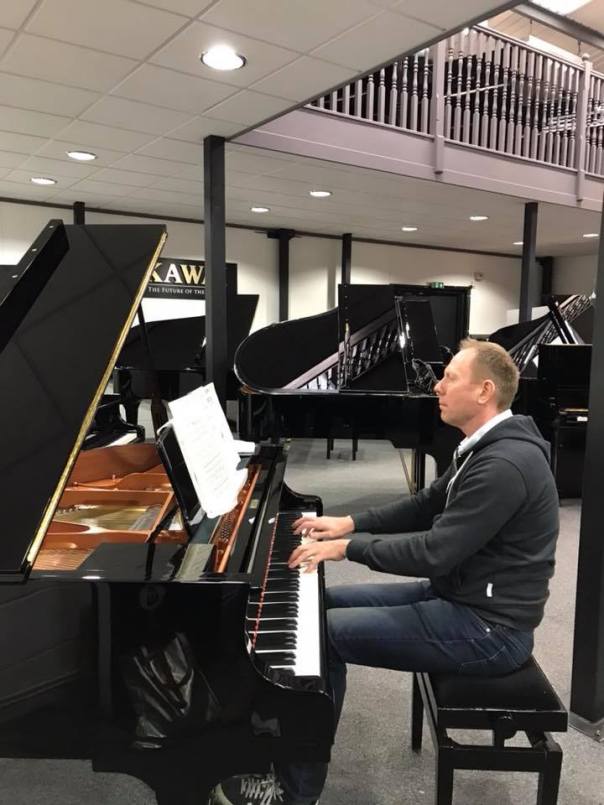
Trying out pianos at Coach House Pianos’ showroom in Swansea

Tip eight –  Don’t buy the one you see in the dealer’s showroom. If you’re going to be spending a lot of money on a new piano, you must try as many of the models you are considering as possible. I played a total of 10 new Yamaha C3X’s before settling on “the one”. After playing 5 pianos at Coach House’s showroom, the team there arranged for me to spend half a day at the Yamaha selection centre in Milton Keynes where I had another 5 pianos to try – all the same model that I wanted, all beautifully set up and tuned, in a decent sized concert room. Even then I had a tough job deciding between number 1 (a sweet, and oh so beautiful tone), and number 3 (ravishing tone and velvety touch), before being ordered to play number 5 by a somewhat impatient Mrs Cross-Eyed Pianist because I had ignored it up until then. With the first chord of Schubert’s last piano sonata, I realised that this was the piano of my dreams. It’s a surreal moment and one I hope all pianists will experience.

Tip nine – Consider different makes. If your attention is focussed on a Steinway Model A, I strongly suggest you try the new Yamaha C3X range. Under the fingers, there is very little, if any difference in these 2 models. They are the same size, but the Yamaha is about £30,000 cheaper – and in my opinion, you absolutely do not get £30,000 more piano with a new Steinway A.

I adore my new Yamaha C3X, and I hope you find the piano of your dreams too. There is something incredibly special when you find “the one” – a connection that is effortless. For me it took 30 years – and my own journey has only just begun….

Lee Varney is a keen advanced amateur pianist and piano teacher. He has collaborated with The Cross-Eyed Pianist on a number of projects, including charity concerts for SPIN and Hannah Lindfield, and performance workshops for adult amateur pianists. He is currently working towards a Licentiate Performance Diploma. In his other life, Lee is an anaesthesia practitioner at a leading London teaching hospital.


Resources

Coach House Pianos

Yamaha UK

Steinway UK

Guest post by Joanna Wyld

I recently enjoyed a concert in the rejuvenated Queen Elizabeth Hall on the Southbank Centre; ‘An Evening with Danielle de Niese’ in which the soprano was joined by a host of other stars: Menahem Pressler, Sir James Galway, Mark Simpson, and the Navarra Quartet. The concert was memorable for reasons too numerous to detail here, but, alongside the purely musical elements of the occasion, I was struck by the fact that the programmes sold out.

Before the concert, the QEH kiosk queue (try saying that after an interval drink) was considerable and, alarmed by the increasing urgency of the announcements that the concert would start at any moment, I went into the hall, expecting to pick up a programme in the interval (it just so happens I’d written the programme notes, so I knew the works and running order already). At the interval I duly tried again to obtain the elusive programme, but was told by the QEH staff that they’d run out. They took my name and address, along with those of several other audience members hoping for a copy to be sent to them afterwards. Then, after the concert was over, I noticed that people were still giving their names to staff, wanting a programme even after any immediate necessity for one had passed.

So what? You might ask. Things sell out all the time. Gig tickets snapped up by touts. Almond croissants in cafes. Those leisure trousers you’d hoped to snaffle in the sale. But the significance here, especially for someone who writes programme notes, is that it demonstrates the real value of concert programmes to audiences. For some, it will have been a tangible souvenir of a combination of artists not likely to be seen together again. But concert tickets alone are a souvenir, so there must be more to it than that.

Programmes have a tactile appeal; they have gloss and weight, a sensual pleasure akin to a well-bound book. They tell us about the artists – yes, you can look up biographies on the internet, but it’s so much better to have all the information in one place, to browse during the concert or on the train home. And they contain the programme notes, those insights into the music and the composers, the song texts and translations. For many, a programme is essential during a concert, but it’s also a joy to happen upon at a later date, an aide memoir discovered whilst tidying a bookshelf. By that time, perhaps years later, one might well have forgotten the details of the concert, but finding the programme again brings to life the whole experience, reminding us of the artists and music we heard, animating faded, ghostly memories with fresh colour and life.

The need for programmes has been called into question in recent years. There are those who suggest that artists should speak about the music beforehand, as a replacement for programme notes. I’m not against this idea for those artists who wish to; it can be a pleasure to hear from musicians if they feel like engaging with the audience verbally as well as musically. But not all artists wish to do this, and there are language barriers to be considered, too. I heard James Rhodes perform a couple of years ago and he began with his own spoken programme notes. Rhodes is a great example of how this approach can work: personal, humorous, engaging. But, whilst I remember enjoying what he had to say, I remember his playing much more vividly. His words are harder to recollect now, not because they weren’t well communicated – they were – but, perhaps, because memory (my memory, at least) responds differently to visual and aural experiences. The nature of memory is far too complex to delve into here and is hardly my area of expertise, so I recognise that and it would be unfair to extrapolate a general principle from one experience. But perhaps the convention of hearing music and reading words has evolved because this is the way our brains best assimilate each facet of the concert. If one reads the score and listens to someone talking about it, it’s a lecture, not a concert; the visual and aural aspects of music are not straightforwardly interchangeable.

I overheard a woman at a conference recently dismissing programme notes as “boring”. Now, I took this with a pinch of salt, as people at conferences very often want to sell things to each other, and I imagine that whatever she wanted to sell was an alternative to the “boring” notes she mentioned. But it’s a nonsensical statement, too easily articulated in an age of poor attention spans; like saying that newspapers are boring on the basis of one article that didn’t immediately grip you, or that all food is boring because of one dish of overboiled Brussels sprouts. I cannot imagine someone talking of theatre programmes with the same dismissive attitude. For plays or musicals, programmes are a must, and to imply that classical concerts are fusty by including them is part of a wider trend in how classical music is sometimes discussed: self-flagellating, hand-wringing, terribly worried we’re not accessible enough, not fun enough. Whilst I agree that the accessibility of classical music to as wide an audience as possible is of real importance, there is a risk of creating a vicious cycle: the more we repeat those fears, without anything constructive offered as an answer, the more they risk being absorbed as insurmountable fact. Whereas if we believe in music as its own reward and act on that belief, many will discover it for themselves without needing to be apologised to or persuaded. Music writers are amongst the most devoted and enthusiastic out there; usually, if you take the trouble to read our efforts, you’ll be rewarded.

Programme notes can be fascinating because music, and musicians, are fascinating. I still love writing about music after 15 years of this kind of work, not only because of my own love of the music, but because it’s a real joy imagining that my writing might increase the pleasure of a listener; that it might entertain, move, amuse, or even, on a good day, induce goosebumps. Composers themselves are wonderfully helpful in providing these moments: flawed, eccentric, passionate, their words can be almost as delightful as their music. One of my favourites was a letter found in a library book (shout out to Bromley Library, to whom I owe a huge debt) when I was writing for a concert of music by Shostakovich and Prokofiev. Shostakovich had written to Prokofiev, who was reaching the end of his life, with remarkable tenderness:

“I wish you at least another hundred years to live and create. Listening to [your] works… makes it much easier and more joyful to live.

​I warmly clasp your hand.”

Goosebumps.

Then there’s the bawdiness of Mozart (much of it unprintable), the searing melancholy of Beethoven, the love-triangle of Brahms and the Schumanns (enough to titillate a tabloid), the pitch-black, meandering thoughts of Mussorgksy, the dry wit of Stravinsky (exhorting us to listen – “a duck hears also”) …

I could go on, but far better if, at the next concert you attend, you buy a programme and read the contents which, hopefully, will add to the joy of the music itself. I wish you charmed evenings of thrilling music, exceptional performances, absorbing programmes, and goosebumps. I warmly clasp your hand.

© Joanna Wyld, 2018


Joanna Wyld was born and educated in London before reading Music at New College, Oxford, where she was an Instrumental Scholar. She was listed as one of the Women of Distinction in 25 Years of Women at New College.



Joanna established Notes upon Notes in 2004 and has been writing liner notes, programme notes and other copy for a wide range of artists and record labels ever since. She also worked on Stop The Traffik for Steve Chalke and Cherie Blair, a book used as a resource by the UN.

Joanna won the 2014 OUP spoof Grove Dictionary article competition, as well as both second and third runner-up slots.

She curates playlists for classical streaming service IDAGIO, and recently appeared in a Southbank Centre video introducing a concert at the new Queen Elizabeth Hall. Joanna is Editor at Odradek Records, and is working on her first libretto for an opera by Robert Hugill.

Notes upon Notes