I’ve been going to live classical music concerts since I was a little girl – and not just professional concerts, but also amateur performances when my dad (a clarinettist) played in a local amateur orchestra. As keen music-lovers, my parents took me to all sorts of concerts – big orchestral performances at Birmingham Old Town Hall (the former home of the City of Birmingham Symphony Orchestra), chamber music, opera and choral concerts in churches. I quickly grew to love the “special occasion” nature of going to a live concert and enjoyed the rituals and etiquette (even if I found some of the music over-long or boring on occasion!).
Going to concerts with other people can be a very special shared experience. There is the pleasure of meeting beforehand, perhaps for a drink in the venue’s bar, purchasing a programme, easing oneself into plush seats and enjoying the hum of anticipation before the performers come on stage. Then there is the interval when one can chat about the first half and enthuse with friends before the music begins again.
When I started reviewing concerts in 2011, I tended to go alone, unless a friend or two happened to be at the same performance. At first I felt slightly awkward, sitting alone in the bar beforehand, a glass of wine in hand, reading the programme, making notes…. but gradually I came to enjoy the experience of attending on my own, and now I actively relish it.
Attending a concert can be a powerful, shared experience that transcends the boundaries of individuality, regardless of the genre of music being performed. While the idea of going to a concert alone might seem daunting to some, there is undoubtedly positivity in the shared atmosphere of live music. Whether you’re surrounded by a sea of familiar faces or standing alone in a crowd, the concert space creates a special sense of community, connecting individuals through the universal language of music.
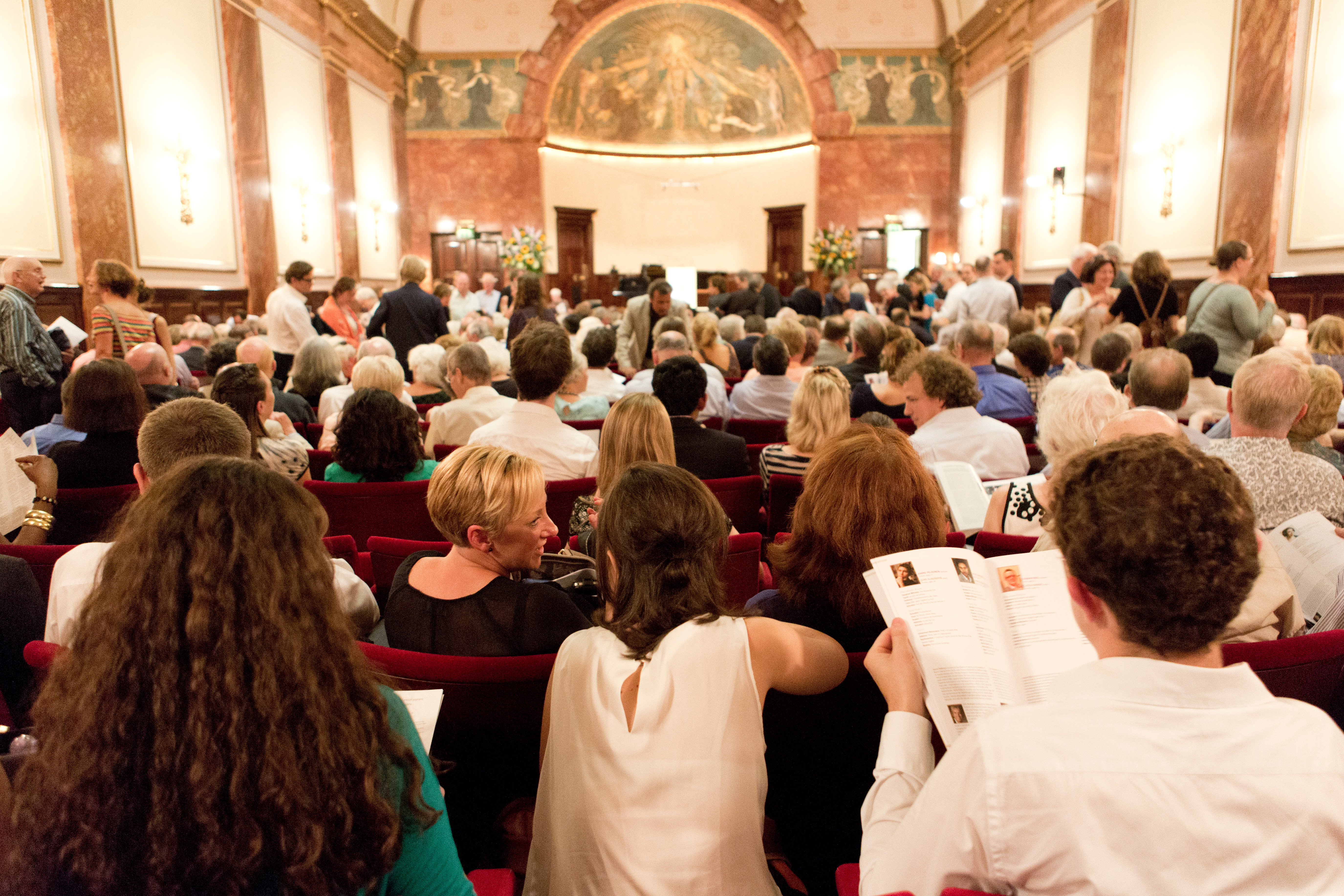
London’s Wigmore Hall
Perhaps one of the most tangible aspects of this shared experience is the palpable sense of communal energy. The collective anticipation, excitement, and emotions create a shared atmosphere that unites the audience. As the house lights dim, an expectant hush pervades the concert space as the audience anticipate the arrival of the artist or artists. In such an environment, it becomes less about being alone and more about being part of a larger, unified whole.
Regardless of whether you attend a concert alone or with friends, the music itself becomes the common thread that binds everyone together. In a crowd of strangers, the shared appreciation for the artist’s craft creates an unspoken connection, fostering a sense of unity and camaraderie among concert goers. I love those moments when it seems that the entire audience is listening really intently, as if with one, collective ear. Or the sense that the audience is holding its collective breath, so engaged are they with the performance. And then, at the end, a joint exhalation as the audience relaxes, anticipating the applause.
Attending a concert on your own offers an opportunity for personal freedom and self-discovery. Free from the expectations of others – the obligation, perhaps, to express your opinion of the performance during an interval chat – when attending a concert alone, you can fully immerse yourself in the music, allowing it to resonate with you personally. You can choose to listen intently, or allow your mind to wander. The solitude within the crowd provides a space for self-reflection, and an opportunity to experience the music in a way that is entirely your own.
Thus, attending a concert alone is not an act of isolation; rather, it is an opportunity to experience the communal tapestry of music. Even if you never speak to a fellow audience member, there is something very special about experiencing music together.This is because the unifying power of live performance goes beyond individuality, creating an environment where strangers become companions in a collective journey of musical expression and a celebration of shared experience.
This site is free to access and ad-free, and takes many hours to research, write, and maintain. If you find joy and value in what I do, why not
A legend in contemporary piano music, Ursula Oppens has just turned 80 and shows no sign of trimming back her busy life of recording, performing, teaching and commissioning new works from American composers. She fights the aging process with tremendous vitality and mostly wins.
But as she told The New York Times recently, “The eyesight goes, the fingers, the retention”.
A few weeks later in my telephone interview with her, she was more optimistic. “My mind is still functioning the way I would like it to function. I am lucky to be very active at this time and I plan to continue.”
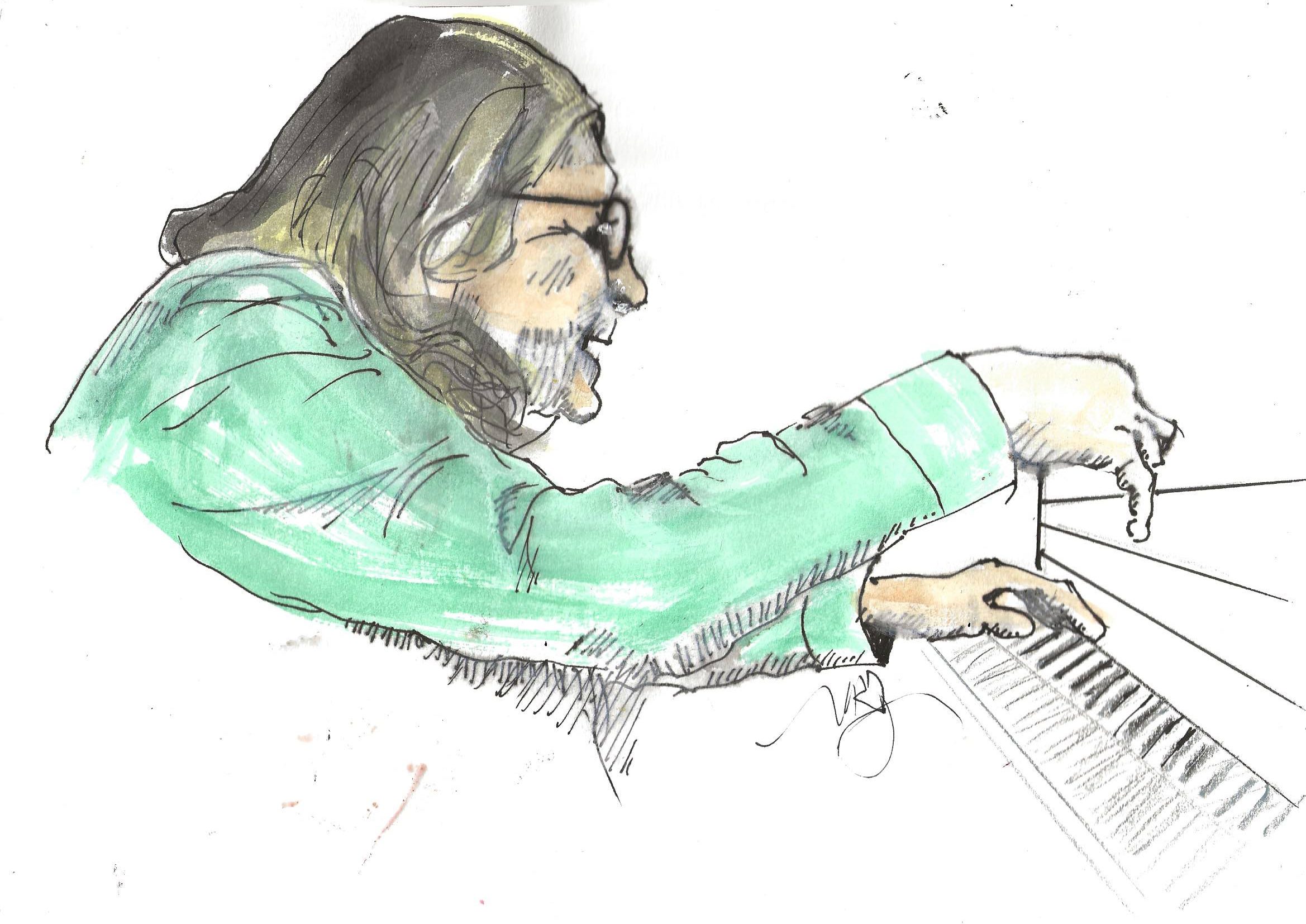
The Times rather bluntly described her as “a little fragile, tiny and stooped”. I tried to capture some of that in my portrait of her.
But she is also recognized as a powerful performer who tackles the thorniest of new pieces. As she said in our interview, she remembers hearing the difficult works of Julian Hemphill for the first time and thinking “This is for me!”.
Composers who have been commissioned by her or who have written works for her include such leading lights as Frederic Rzewski, William Bolcom, and Charles Wuorinen.
Perhaps her best known collaboration was with expatriate American Rzewski with whom she became “very, very, very close friends” and produced the now standard “People United will Never be Defeated”, a magnificent set of 39 variations. Some critics have classed it alongside Bach’s Goldberg Variations and Beethoven’s Diabelli Variations.
She worked together at a distance with Rzewski during the pandemic, ending with his musical tribute “Friendship”. As Oppens told me, we could not meet in person for two years but “he could write and I could play”.
In this clip she plays Rzewski’s “Friendship” on a Fazioli grand.
Her attraction to modernity took shape when she attended lectures and a concert at Radcliffe College with the young French composer Pierre Boulez. She was musically smitten and never looked back.
Edited excerpts from our recent conversation, recorded while she was at a music festival in North Carolina:
You have helped shape contemporary American music through your commissioning of new works. How did you become so interested in modernity?
My parents were refugees from Europe and they felt they had left a great culture behind. I found out much later in life that my mother had taken a course with Anton Webern. And my father joined the ISCM (International Society for Contemporary Music). So they had been interested in new music all along. I didn’t know that as I was growing up but it might have been an influence in ways I didn’t understand.
You are perhaps best known for your commissioning. Are there other people out there also looking for new works? Or are you alone?`
Oh no. There are people like that all over the place.
Where has the commissioning money come from? Family funds?
No, some has come from foundation grants. For example, I received a big grant from the Washington Performing Arts Society. But funding commissions can come from all kinds of sources.
When did you start commissioning?
I didn’t really commission until after college. The first composers I approached to write pieces for me were Tobias Picker and Peter Lieberson. I recorded both their pieces.One composer who had a great influence on me was composer John Harbison. I also played with this wife, the violinist Rosemary Harbison.
I believe the late Fredric Rzewski was among your friends. You knew him, didn’t you?
Oh yes, he was a very, very very close friend. I commissioned his “People United Will Never be Defeated”. The most recent piece I commissioned from him was “Friendship”. It was very much a pandemic piece. For two years we couldn’t see each other but he could write and I could play. He died at 83 in Italy during the pandemic.
You have a new CD coming out soon?
Yes, it’s the music of Charles Wourinen. Mostly solo piano but there’s also a ballet for two pianos that we still have to record. I knew Charles well and worked with him from 1966 to his death in 2020, maybe the longest relationship I’ve had.
What was your relationship with Julian Hemphill?
I lived with Julian for almost twelve years. He is a fine composer and a wonderful man. When I heard his difficult music I thought, “This is for me!”
In your CD “Winging It”, you featured the John Corigliano music that you had commissioned. Does that happen often? You commission something, the composer writes it and you record it. Is that how it works?
That’s what it’s all about. Yes, when you commission a piece it’s a little bit like having a child. You let the child go out into the world, make his own friends, and live his own life. What’s exciting is that after a while other people start playing it.
You seem to be focused on the American composers.
Basically yes, because American composers are people I can work with, people I can bump into. You want this personal contact and you become their friends, like Thomas Picker — I am very honored to be a friend of his, you know. Working with him has made my life very exciting.
Your fans worry about your health. Should they?
Not really. I work more slowly. I don’t run any more. But I’m perfectly healthy as far as I can tell. Of course as one gets older things get a little creakier. My mind is still functioning the way I would like it to function. I am lucky to be very active at this time and I plan to continue. I have had a wonderful share of happiness in my life.
What has aging done to your piano technique?
Luckily I don’t have any serious problems but I cannot say I play as well as I did when I was fifty. I am careful about expanding my repertory. I don’t take on impossible pieces, like Prokofiev’s eighth Sonata.
Are you slower, are you careful about your repertory?
Yes, recently I was teaching the Prokofiev. It was very sad that I had never played it. It’s too difficult a piece for me to learn at this point. I could practice but I probably would not be able to perform it.
But you could still teach it?
Oh yeah.
It is like a master class, I suppose? You play a few bars to show the way?
Not necessarily. You can point out the phrasing, and this and that. You’ve got to hear this note to make sense of the next one — and stuff like that.
Most of the musicians I talk to avoid contemporary music because it requires a lot of learning and they are not sure it’s worth the trouble. Is it really that difficult to master?
It can be difficult, yes, but often it is absolutely wonderful. There is no limit to how exciting it can be. It’s very, very thrilling. You bring to life something that has not existed before.
What about the limited reception by people who are not tuned into contemporary sound worlds? They say well, it’s not Mozart. Doesn’t that drive you up the wall?
No. Live music in a small hall with an audience of sixty people can be so wonderful. Sometimes I tell the audience to listen for certain passages. It makes it an exciting experience for them.
Do you have any fear of being slightly crowded out by the Asians who have suddenly discovered us?
No. If immigration were not part of America I would not exist. I am the daughter of immigrants. We are a mixture, and that is fantastic. I know some of the great young pianists are Chinese. There are people everywhere who can run better, who can jump better, and there are people who can play the piano better.
Do you have a swan song in mind? Are you even thinking of your legacy after the inevitable end?
I will keep making music as long as I can. I know that one day I won’t be able to, and that’s a normal part of life. But I don’t wish to be playing the harp for eternity.
(Ursula Oppens, portrait by Michael Johnson)
MICHAEL JOHNSONis a music critic and writer with a particular interest in piano. He has worked as a reporter and editor in New York, Moscow, Paris and London over his journalism career. He covered European technology for Business Week for five years, and served nine years as chief editor of International Management magazine and was chief editor of the French technology weekly 01 Informatique. He also spent four years as Moscow correspondent of The Associated Press. He is a regular contributor to International Piano magazine, and is the author of five books.Michael Johnson is based in Bordeaux, France. Besides English and French he is also fluent in Russian.
Michael Johnson, in collaboration with The Cross-Eyed Pianist (Frances Wilson), has published ‘Lifting the Lid’, a book of interviews with concert pianists. Find out more / order a copy
‘….simply beautiful choral writing by someone who knows, from a singer’s perspective, how to compose music which every choir will want to sing.’ Sir John Rutter CBE, composer
Following Heaven to Earth, Joanna Forbes L’Estrange’s first album on Signum Classics, Winter Light is an album of works (complete with some world premiere recordings and new arrangements) celebrating the season of Winter, as well as Christmas and Advent. The common themes linking all 19 tracks are of light triumphing over darkness, good overcoming evil and, ultimately, love conquering all.
The first 12 tracks tell the familiar Christmas story, from the eager anticipation of the saviour’s birth (Advent ‘O’ Carol, track 1) and its foretelling by the prophet Isaiah (Isaiah’s Prophecy, track 2) to the Annunciation (I Will Hold Him, track 3, and O Virgo Virginum, track 4), to the birth itself (Carol of the Crib, track 5 and Jesus Christ is Born Today, track 7) and its significance for humankind (In the Bleak Midwinter, track 8, and Love Came Down, track 9). Thereafter, the visitation from the shepherds (Song of the Shepherds, track 10) and the arrival of the magi at Epiphany (A Present for the Future, track 12) remind us that we, like the shepherds and wise men, need also to follow the light (A Story of Light, track 11). In the midst of this nativity narrative sits the title track (Winter Light, track 6) whose words mark the transition from darkness to light.
The second part of the album takes on an altogether different tone to reflect secular winter themes. As a professional singer Joanna Forbes L’Estrange is known for performing in a wide variety of styles and this is reflected in her compositions. Whereas the first half of this album is stylistically largely within the familiar realms of the sacred choral music tradition, the latter leans towards jazz and folk. The Three Wise Women (track 13) was written in response to a commission from St Swithun’s School in Winchester. ‘There are numerous pieces in the Christmas choral repertoire about the three wise men so it was about time for the women to have their own song,’ says the composer. The remaining six tracks explore various winter themes. Winter Songs (tracks 14-16) was composed for the 60th anniversary of Finchley Children’s Music Group. Though conceived for children’s voices, the songs’ themes of hibernation, homelessness and human kindness are relevant to all ages. Green Christmas (track 17) was written during the first covid lockdown and is a subtle play on Irving Berlin’s classic, White Christmas. Track 18, Spring Will Come Again, is a folk-style song about the cyclical nature of the seasons. The album concludes with an arrangement of Auld Lang Syne (track 19) which Joanna wrote many years ago when she was Musical Director of The Swingle Singers.
Joanna Forbes L’Estrange says, ‘The impetus for recording this album sprang from my desire to present choirs with some contemporary yet singable Winter/Christmas-themed pieces which they might like to add to their repertoire.’
Praise for Joanna Forbes L’Estrange ‘Joanna has an amazing understanding of both the human voice and the human heart. The result: quality music making effective use of the voice, with tunes and harmonies and a wonderful storytelling quality to the songs which lift the hearts of singer and listener heavenward. These will surely be part of the Christmas choral canon for centuries’ – Ken Burton, conductor, composer & arranger
‘…an album of fresh new gems, full of Christmas warmth and great tunes’ – Louise Clare Marshall, singer
‘Forbes L’Estrange seems to have been born with catchy melodies coursing through her veins’ – BBC Music Magazine
Winter Light is released on 18 October on the Signum Classics label on CD and streaming. Joanna Forbes L’Estrange, composer London Voices Ben Parry, conductor Richard Gowers, organ Olivia Jageurs, harp Harry Baker, piano
I first discovered this wonderful set of variations through a concert pianist friend, who performed them in a salon concert some years ago. As a lifetime lover of Schubert’s music, I was struck by how “Schubertian” this music is, especially in the minor key variations, where Haydn finds great emotional depth and expression.
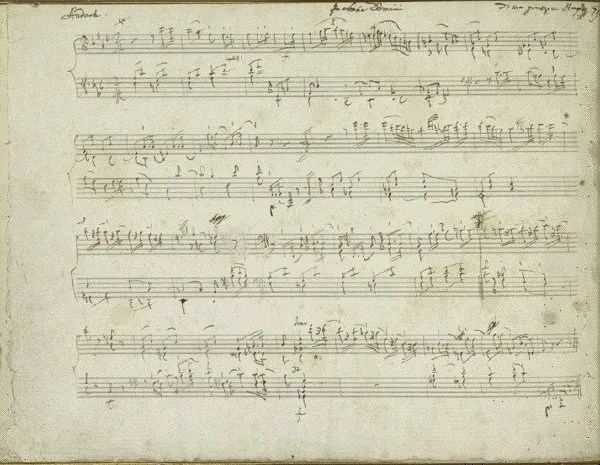
The piece was composed in 1793, and was described as a Sonata‘Un piccolo divertimento’ in the autograph manuscript, written for a “Signora de Ployer” (probably the pianist Barbara Ployer, for whom Mozart composed the piano concertos K449 and K453). It was written at a time when the pianoforte was developing fast – Haydn would have encountered the new Broadwood piano with its more sonorous bass on his visits to London – and this piece really capitalises on the range and sonority of these bigger, stronger instruments.
Autograph ms of f minor variations
The piece is a set of double variations, with the first theme in melancholy f minor and the second in warm F major. Two variations of each theme and an extended coda follow. While the music may look forward to Schubert’s lyricism and expressivity in its minor key episodes, it is also replete with Haydn’s characteristic wit achieved through articulation, dramatic pauses and embellishments, while his mastery of structure, harmonic innovation, and thematic development is evident throughout.
Haydn achieves a very effective and dramatic operatic dialogue as the music seamlessly transitions between passages of stark intensity and moments of delicate lyricism. For instance, the first variation introduces a more agitated character, with rapid figurations and abrupt dynamic shifts that inject a sense of urgency into the music. In contrast, the following variation may offer a more introspective mood, with subdued dynamics and lyrical embellishments suggesting a more intimate realm of expression.
Despite the relatively constrained harmonic palette, Haydn manages to infuse each variation with harmonic surprises and innovations that keep the player and listener engaged. Whether through unexpected modulations, chromaticism, or clever reinterpretations of harmonic progressions, Haydn demonstrates his ability to push the boundaries of tonal expression within the classical style. The result is a captivating, multi-faceted musical journey.
For the pianist, the music demands a high level of technical proficiency, particularly in terms of finger dexterity and agility. The variations encompass a wide range of technical challenges including rapid passagework and intricate ornamentation which require great precision. Minimal use of the pedal will ensure these passages retain their clarity. The music also requires sensitive dynamic shading to create contrast – from the softest pianissimo to dramatic fortissimo. A keen sense of the overall architecture of the piece will enable the player to balance the main themes with the diversity of the individual variations. Overall, this piece is very satisfying to play and its richness and complexity offers plenty of scope for expression.
Here is Alfred Brendel
This site is free to access and ad-free, and takes many hours to research, write, and maintain. If you find joy and value in what I do, why not
The Cross-Eyed Pianist is free to access and ad-free, and takes many hours every month to research, write, and maintain.
If you find joy and value in what I do, please consider making a donation to support the continuance of the site





 The Cross-Eyed Pianist