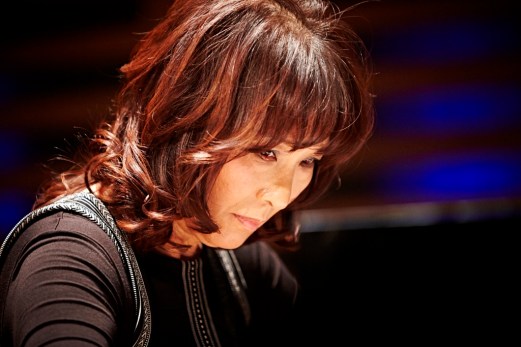
Who or what inspired you to pursue a career in music? 

My father was a huge inspiration for me. He was a fine pianist and played piano the Charles Kinz stride piano style. Along with my mother, they had a concert party after the way and with the other members of the “Wakeans”, as they were called, used to re-live the shows in our tiny front room in Northolt on a Sunday evening. Around 1953, when I was four, I can recall climbing out of bed and sneaking down the stairs to listen before getting caught and being sent back to bed.

I just wanted to play the piano so badly, and aged five I was sent off to piano lessons with Dorothy Symes, and indeed stayed with her throughout my grades before going to the Royal College of Music.

My father encouraged me to listen to as many different kind of music as possible and to play as many different styles as possible. I owe him so much.

Who or what have been the most important influences on your musical life and career? 

There are so many – Dorothy Symes was such an inspirational teacher; being taken to see Swan Lake aged about nine and the same year seeing Lonnie Donegan (who in later years became a great friend and fellow Water Rat).

I loved Trad Jazz and especially Kenny Ball, who I also got to meet in later life. My father introduced me to Prokofiev’s ‘Peter and the Wolf’, which mesmerised me. Here was a story being told in music – that was really the moment when I knew that’s what I wanted to do: tell stories in music.

What have been the greatest challenges and pleasures of your career? 

The biggest challenge has always been people saying “You can’t do that“, which makes me all the more determined to do it, regardless of the consequences. I was told doing King Arthur on Ice was doomed to failure, and it is still the most talked about show I’ve ever put on!

Likewise, I was told it was ridiculous to take a symphony orchestra and choir on tour in America – red rag to a bull! I did it and it was fantastic! Every day brings new challenges and if you manage to overcome and solve them, that’s where the pleasure comes in.

Which performances/recordings are you most proud of? 

I would probably give different answers on different days, but these are the ones that come to mind today:

‘The Six Wives of Henry VIII’ as that was the first solo album and was hated by the record company who kept asking when I was going to put the vocals on!

Also ‘Journey to the Centre of the Earth’ and ‘King Arthur’ from the early seventies as well.

With my band, ‘Out There’ (originally released 2003) springs to mind as a very complex album where those around me really understood what I was trying to achieve.

The remakes of both ‘Journey…. ‘ and ‘King Arthur’ are very important to me as it now means there are records of the music to be remembered. Both of there were limited to the amount you could get onto a vinyl recording, so to do the full length versions was very important to me. I did the same with ‘The Six Wives of Henry VIII’ and added the three missing pieces to a live recording made at Hampton Court.

In recent years Piano Portraits has meant a lot tome for many reasons, not lease that it was my way of celebrating the genius and friendship of David Bowie. This has led to my brand new album for Sony Classical, Piano Odyssey, which ventures a stage further with piano variations of the music I love, with a string section and choir. A lot of time was spent getting this album absolutely as I wanted it and so has a special place in my “recording heart”.

Tell us more about your ‘Piano Odyssey’ album….. 

When I recorded ‘Piano Portraits’, it was purely solo piano versions of pieces I loved or had a connection to that had great melodies, and I rewrote variations on themes for all. I was really pleased with the outcome and the album did extremely well, making the top 10 for more than eleven weeks. I had decided against a second volume; however, because whilst there were a lot of other wonderful pieces of music that I wanted to do, none of them would work with just piano in the way I envisaged them.

However, it was ‘Bohemian Rhapsody’ that started it all off again. Now working with the team at Sony Classical, I had wanted to do this originally but just couldn’t get it to work on piano alone in the way I could hear it. I kept hearing a string section and choir, and had a Eureka! moment one day when I realised this was indeed the answer – an album of piano variations of great music but with the addition of a small string section and choir.

I prepared a short-list of 40 pieces and eventually whittled it down to the 12 I really knew would work – and that included Bohemian Rhapsody, which I sent to my dear friend Brian May. He not only gave it his seal of approval but added a cameo performance of beautiful acoustic guitar.

‘Piano Odyssey’ is everything I set out to achieve and indeed has even gone a stage further than I thought possible.

What motivated your selection of the music featured on this album? 

Simple answer – melody. There has to be a great melody that allows variations without taking away from the original. There are pieces from The Beatles, David Bowie, Paul Simon, Liszt, Handel, Dvorak, yes and even me! There are also two original tracks that I wrote in memory of two wonderful moon bears which were saved from horrific bear bile farms, and as an Ambassador for Animals Asia, I am proud that we have save so many of these wonderful bears and celebrate them here. Both the bears – Rocky and Cyril Wolverine – sadly passe away. Cyril was my own bear and the loss was devastating for all of us who knew him. I wrote both these pieces surrounded by their photos.

Were there any special challenges in arranging the songs? 

To be honest, no. I have been doing this for many years, although never recording them like this. I also have a good team around me with the Orion Strings and English Chamber Choir, who know where I’m coming from musically.

Do you feel that progressive rock is a way to bring some classical sophistication to the pop world and, if so, are your achievements in some way striving towards leading an innovative, “parallel-classical” career? 

When I started in the late 1960s after leaving the Royal College of Music, there were real divisions within all music types, whether jazz, classical, pop, rock, folk, country, you name it. They all had their own identities and seldom met! I deliberately set out to fuse as much as possible and at first hit a lot of brick walls, but slowly started getting the message across, and today there are no taboos which is great.

With there being a Prog-revival of sorts, does you think there is potential crossover for youth audiences between the two genres? 

There already is and vinyl has a lot to do with it. Younger people are discovering vinyl and album covers and the information contained on them. Music is tactile and vinyl is bringing that back. Music now no longer has a date stamped on it. You either like it or you don’t. There is no specific age thing any more either – that side of things is very healthy.

Would you ever consider making a fully classical album? 

I have been asked to and the answer would have to be no. Although I occasionally turn to Mozart and Beethoven sonatas or plough through the Bach “48” for fun, it’s not what I would want to do, if I’m honest.

As a musician, what is your definition of success? 

Success is sadly always thought of in commercial terms, but for me it probably only comes after you have departed this mortal coil. In other words, if in 100 years’ time somebody on radio plays a piece of my music, then I guess I can say I was successful to a degree…

What do you consider to be the most important ideas and concepts to impart to aspiring musicians? 

Believe in yourself. Don’t be frightened of opinions and criticism from others, as long as they are qualified to give it (which 99% of them aren’t!). Most people who try and tell you what you should be doing do so because they can’t do it themselves (many don’t know a crotchet from a hatchet!), but occasionally the odd word of wisdom does get through: you just have to be able to spot it.

Where would you like to be in 10 years’ time? 

Alive please – and still able to play, composing and having music adventures.

What is your idea of perfect happiness? 

To be worry-free – so there’s no perfect happiness for any human being, I’m afraid!

What is your most treasured possession? 

My father’s upright Bechstein piano on which I learned to play and inherited when he died in 1980.

What is your present state of mind?

Jumbled! It always is – too much going on!


Talismans and Tokens: Rituals of Performance

Performance itself is a ritual – it happens in a special place, at a special time, for which the performer wears special clothing to distinguish him or herself from the audience, and the audience observes particular customs during the entirety of the performance. These rituals of performance are familiar to all who perform, no matter what the genre of music, whether at Sydney Opera House, Hollywood Bowl or a local music society, and are crucial in helping performers and audience enter the right frame of mind to engage with the performance and the music.

Individual performers also have personal rituals associated with performance which are used to help allay performance anxiety and act as “good luck charms” to enable the performance to go well. From lucky jewellery or shoes to a red handkerchief casually tucked inside the piano, these talismans can be highly significant. Most of us know deep down that these items hold no real power, that superstitions such as wearing a particular necklace or shirt cannot really influence the performance and that a concert is more likely to go well if we are properly prepared for it. Yet we invest meaning in these tokens, believing them to have special powers, and take comfort from having them with us. Such rituals are common to sports people as well: tennis player Serena Williams always wears the same pair of socks for the duration of a tournament.

It’s easy to scoff at such superstitious behaviour, but research has shown that these behaviours do actually have a beneficial effect on performance by increasing confidence, self-belief, setting higher goals for oneself, and self-efficacy (belief in one’s ability to do well at the task in hand). However, it can be risky to invest too much in lucky charms or special rituals to the extent that one develops an obsessive dependence on them and may feel anxious and lacking in confidence without them.

On a more practical level, most musicians employ pre-performance rituals ahead of a concert which help them focus mentally and keep them grounded, especially if travelling a lot, which can disrupt one’s regular routine. Here is pianist Alexandra Dariescu:

My ritual starts in the morning with a positive attitude. You never know what can go wrong on the day of a concert (flights canceled, trains running late, piano missing…) so an optimistic outlook is incredibly helpful. I like to practice slowly in the morning, on the score, looking at every detail and refreshing the memory. If there’s a rehearsal with an orchestra, I usually save energy for the evening performance. Lunch consists of fish, rice and lots of veggies. A nap is always welcome but if I can’t fall asleep, I lie down and breathe 3 in 7 out, a ritual I’ve had for years. I also visualize the hall, coming in and feeling free.

And Stephen Hough:

On the day of a concert, I have morning practice from about 10:30 to 1 PM. Then a substantial lunch, sushi is a favorite, and if a pudding is irresistible only a bite (or two). Then a walk, ideally somewhere where the spirit can soar, so a park, a museum, a surging cityscape. Then a nap, bedclothes thrown back, as if nighttime with the curtains firmly closed, phones unplugged, pillows fluffed, and unconsciousness for at least an hour. I set the alarm clock and at about two hours before the concert, I am out of bed. Then, with the kettle on, I travel with my own and the best tea bags I can find. I also usually just eat half a cookie to lift the mood a little. I Shower at full throttle–it takes the same time to brew a cup of tea as it does to wash your hair. I sip my mug of strong tea as I check emails. Then, dressed, I head over to the hall. I like to arrive about an hour before I’m due onstage. I like gentle, calm backstage practicing, most often on pieces other than the ones I’m playing that night. Then into concert clothes about ten minutes before going out from the wings.

(from The Musician’s Lounge, official blog of Utah Symphony)

While most musicians admit there is no “magic formula” to guarantee a successful performance every time, a consistent pre-performance ritual, combined with thorough preparation in practice, will ensure a concert goes smoothly. Certain pre-performance rituals are common to all musicians, whatever their genre, including resting ahead of the concert to keep mind and body relaxed. Any disruption to these rituals can leave one feeling disoriented and it is important for concert organizers, venue managers, colleagues, and friends and family to appreciate the rituals and not interfere with them. Of course some aspects cannot be controlled, such as delayed travel, the weather (too hot/too cold), or illness, but once again good preparation enables one to cope with these exigencies and not allow them to derail a performance

In the final minutes before going on stage, many musicians use visualization techniques – imagining themselves walking across the stage to take their place at the piano or in front of the orchestra and hearing the first notes of the first piece in their “mind’s ear” before they begin to play. Recalling a past successful performance, and the positive feelings associated with it, is also a useful ritual and one which pianist Polish Piotr Anderszewski employs.

…there are the occasions when none of the above is possible. And, strangely, those are often the best concerts. Ah, the frustration and joy of the glorious unpredictability of being human!

Stephen Hough


dm9xki0xoaehe2wClara Schumann: Prodigy, Muse, Virtuoso

Reiko Fujisawa, piano

Brahms – Intermezzo Op 119, no. 2

Clara Schumann – Scherzo Op 10, Romance Op 21, no. 3

Chopin – Impromptu no. 1

Schumann – Faschingsschwank aus Wien Op 26

Schumann/Liszt – Fruhlingsnacht & Widmung

The Sherling Studio, a small theatre space at the Lighthouse Poole, proved the ideal venue for Reiko Fujisawa’s lunchtime recital celebrating the life and career of Clara Schumann and the key personalities in her artistic and musical circle.

This concert marked the premiere of this programme, part of Reiko’s new Clara Schumann project – a series of narrated recitals, chamber music and concerto performances which will take place throughout the 2018/19 season and autumn 2019, to coincide with the 200th anniversary of Clara’s birth.

The size of the performance space, with the audience arranged on three sides of the pianist, combined with Reiko’s poised and self-contained presence, created an intimate ambiance which was entirely appropriate for this programme of music which would have been enjoyed in the home or salon rather than the concert hall. It allowed for very close communication between pianist, music and audience, from Brahms at his most passionately introspective in a late Intermezzo to the sparkling virtuosity of Clara Schumann’s music (written for herself to perform) and Robert Schumann’s exuberant ‘Carnival Jest from Vienna”, written to show off their twin talents as composer and agile performer. This engaging programme was presented with elegance, colour and commitment.

More about Reiko Fujisawa’s Clara 2019 project

Meet the Artist interview with Reiko Fujisawa

reiko-rehearsal-nov-2013-530aa

Still only a tender three year old, the London Piano Festival, organised by pianists Charles Owen and Katya Apekisheva is already a significant part of the London piano concert calendar, an event much looked forward to by myself and piano friends. In just three years it has grown from a weekend festival to a 5-day extravaganza and it looks set to extend further, such is the quality and variety of its programmes and performers. The secret of its success and evident popularity (judging by the commitment and enthusiasm of the audiences) lies in a simple formula: an impressive line up of pianists, imaginative programmes and a friendly atmosphere. Owen and Apekisheva curate the festival and also perform in it, thus creating a wonderful sense of common purpose, very much music with friends, for friends, and amongst friends. This year the young Russian pianist Pavel Kolesnikov stole the show, at least as far as I was concerned, in both his solo concert on Saturday afternoon (review here) and his performance with his duo partner Samson Tsoy which opened the 2-piano marathon on Saturday night.

While last year’s 2-piano marathon had a rather epic sweep to its programme, this year’s was more thoughtful, the main focus being the centenary of Claude Debussy’s death, and the tone was set by the opening works, Schumann’s Six Pieces in Canonic Form, performed with exceptional control, poetry and musical maturity by Pavel Kolesnikov and Samson Tsoy. It would be hard to match the exquisite intimacy of this performance, but the great thing about the 2-piano Marathon is that each pianist brings their distinctive voice to the repertoire performed, the pairs of performers sparking off one another, collaborating and interacting with evident enjoyment. Two works by Arnold Bax provided an impressionistic follow up to the Schumann, expressively played by Margaret Fingerhut and Charles Owen. Three works by Poulenc offered further contrasts, the triptych closing with his joyous l’Embarquement pour Cythere. The first half closed with Stravinsky’s Concerto for Two Pianos, a work which requires lightning-fast reflexes, masterfully played by Kolesnikov and Tsoy. It was good to see this extraordinarily mature duo together in more extrovert music.

The deliciously sensuous post-interval works by Debussy – En Blanc et noir and Danse Sacree et Danse Profane – were welcome bookends to Thomas Ades Lisztian Concert Paraphrase on Power Her Face, which while expertly played felt over-long and self-indulgent. It was good to see Stephen Kovacevich grace the stage once again at this year’s festival, side by side with Charles Owen in Debussy.

The closing work, Rachmaninov’s Russian Rhapsody for two pianos, was memorably played by Konstantin Lifschitz (who gave a solo performance earlier in the festival) and Katya Apekisheva, and left us with a hummable foot-tapping folk tune for the homeward journey.

Plans are already well underway for the 2019 London Piano Festival and full details will be announced in the new year.


Photo credit: Viktor Erik Emanuel / Kings Place