It’s been an interesting and busy year, marked in May by my move from London, my home for 30+ years, to a quiet corner of Dorset – the isle of Portland on the striking Jurassic Coast. Leaving London and its vibrant culture, not least a wealth of classical music which I have much enjoyed, might have felt like a huge wrench, but in fact I don’t miss the big city, and I am already discovering plenty of music here in Dorset.
In addition to allowing me to muse on things musical, the blog keeps me in touch with a large community of people, some of whom have become good friends in real life, and this has undoubtedly prevented me from feeling at all lonely or isolated here in Portland. In a way, I enjoy the best of several worlds: we live in a light-filled modern house, far bigger than anything we could have afforded in London, with views over Chesil Beach and the sea, and fantastic Turner-esque sunsets in the evening. My son lives in a flat in SW London, which means I can still visit to see friends and enjoy concerts and other cultural highlights, before retreatng once again to a place whose quiet and slower pace of life are very conducive to writing and piano practise.
People regularly ask me how I continue to produce so much “content” (an on-trend word for articles/writing). The truth is that I love music and I love writing about music and sharing my passion. Articles are inspired by encounters and conversations with other musicians and writers, concerts I’ve enjoyed, things I’ve heard on the radio, and much, much more….and while that inspiration remains, so the blog will continue (it will celebrate its 10th birthday in July 2020).
A big thank you to all my readers, followers, guest contributors and wonderful Meet the Artist interviewees, all of whom make the blog so interesting and varied.
Out of nowhere this morning, the ghost of John Cage and his creative genius visited me at a supermarket in Bordeaux, France. I was so glad to be back in touch with the old goat. It had been a while.
But along with a thousand other shoppers jostling for Yuletide goodies, I was being hammered by “Christmas Music”, a Muzak track of Jingle Bells and Silent Night (in English) as I emptied my wallet to bring champagne and foie gras to my home.
Suddenly I heard John whisper in my ear, “Tell them to play 4’33”.” Aha, I thought, that’s the perfect adaptation of a contemporary classic with the trashy earworms we must abide year after year after year. Is there any tune as trite as “Silent Night”? “Adeste Fidelis” and — oh no — “Little Drummer Boy” ! Are there any songs as perfect for the fine hand of John Cage? Silence was his byword, his bible, his autobiography.
I have trotted around the globe for most of my life, finally landing in Bordeaux, which seemed a safe haven from tacky popular culture and seasonal music-making. But it was another disappointment a few years ago to come face-to-face with musical globalization – American tastelessness transported into the heart of Southwest France, the home of Ravel, the birthplace of the Labèque sisters piano duo, the cradle of great writing and great thinking, Mauriac, Montaigne, Montesquieu. The home of soprano Natalie Dessaye, conductor Paul Daniel, and for many years, the adopted city of Roberto Benzi.
Hélas (as the French say), the greatness of the past is being swamped by the dumber tide of the present. Those of us who yearn for a Bach cantata (why not?) cannot even switch off the trash like a smart phone, the other plague of our time. Trivality is in the air, everywhere.
It’s hard to escape the earworm at this time of year, with shopping malls and public streets bombarding us. The less you like these tired tunes, the longer they hang around in the memory cells, circling the mind like fruit flies over an orange.
The late neurologist Oliver Sacks wrote in “Musicophilia” that these awful tunes have subverted the brain, forcing it to fire repetitively. . . “as may happen with a tic or a seizure.”
Sacks quotes a patient recalling a bout of earworms. The song “Love and Marriage” took possession of the man for ten days, leading him to desperate efforts to shut it off: “I jumped up and down. I counted to a hundred. I splashed water on my face. I tried talking loudly to myself, plugging my ears.” It finally subsided, only to return when he told Sacks about it.
Funny. That just happened to me this morning while shopping.
Michael Johnson is a music critic with particular interest in piano. He worked as a reporter and editor in New York, Moscow, Paris and London over his writing career. He is the author of five books and divides his time between Boston and Bordeaux.
A minute’s silence can feel like a long time when one is required to stop and focus on that time passing – as at 11am on Remembrance Sunday, for example. John Cage’s most famous and most controversial composition, 4’33”, at just over four-and-a-half-minutes, is surprisingly long when one is at a performance of it. Such is the way that this work is presented, one is required to listen, and focus on the performance just as one would any other piece of music performed in a concert.
In the last 18 months, I’ve been to three performances of Cage’s comment on what constitutes “music”, and an important example of conceptual art. The first was last summer in a performance by American pianist Adam Tendler, at which everyone in the tiny exclusive audience knew exactly what was going on (thanks in no small part to Adam’s fascinating introduction to the work – read about the performance here). The other performances have been this year, given by pianist Annie Yim as part of her MusicArt “conceptual concerts”, which combine music, words and art. Each performance has been unique, the experience determined by performer, location and audience, just as Cage intended.
Last week I attended Annie Yim’s latest MusicArt event, a Conceptual Concert in Three Acts, which drew inspiration from the creative collaboration between John Cage and American artist Robert Rauschenberg. The concert took place in a private gallery in Mayfair where Rauschenberg’s “spreads” collages were on display (full review here). Cage’s work was the final act, the finale. At this performance, I felt I came closest to the very first performance of 4’33”, and watching the audience’s reaction was rather fascinating.
The score of John Cage’s 4’33”
The score of John Cage’s 4’33”
As specified by the composer, the piano lid was closed and then raised to signal the start of the work – and subsequently closed and raised to indicate the separate movements (4’33” is scored in three movements). Large mirrors sited on either side of the piano allowed us, the audience, a sense of being on stage with the performers, which created an interesting and witty suggestion of “audience participation”, and reflected our reactions back to us – something I think Cage would have thoroughly enjoyed. As the piece moved inexorably through its silent bars, the ambient sounds of the gallery, the noise of the street outside (including a rather musical motorbike starting up), the constant rumble of a vibrant big city at nighttime, and the living, breathing audience all infused the performance. The audience was not the usual concert audience – many were friends of the gallery, as far as I could ascertain – and some were distinctly unsettled or confused by this “music” which was apparently completely silent (except of course it isn’t!). Ahead of me, a woman looked around anxiously, as if seeking some kind of reassurance that all was well from her fellow audience members. On the front row, someone tapped, somewhat impatiently, their ring on a wine glass, thus creating another note to complement the motorbike. There were embarrassed titters of laughter, some sighing and coughing, quickly suppressed as befits good concert etiquette. Behind me, about 3 minutes in, someone clapped, trying to pre-empt the end of the performance, but no one else joined in and the performers adhered assiduously to Cage’s directions, the work ending when the appropriate time had elapsed and the piano lid was finally closed.
This, for me, was the best performance of 4’33” I have attended so far – because it did exactly what Cage intended and proved that the work still has the power to intrigue, amuse and provoke.
“They missed the point. There’s no such thing as silence. What they thought was silence, because they didn’t know how to listen, was full of accidental sounds. You could hear the wind stirring outside during the first movement. During the second, raindrops began pattering the roof, and during the third the people themselves made all kinds of interesting sounds as they talked or walked out.”
– John Cage, speaking about the premiere of 4’33”
So why is 4’33” so provocative? When John Cage conceived it, in the years immediately after the Second World War, he was attempting to remove both composer and artists from the process of creation. Instead, by asking the musicians specifically not to play, Cage allows us, the audience, to create our own “music”, entirely randomly and uniquely, by listening to the noises around us during four minutes and thirty-three seconds of “silence”, and removing any pre-conceptions or pre-learned ideas we may have about what music is and how it should be presented, perceived and received.
Presenting the work in a gallery full of Rauschenberg’s art was also significant for it was Rauschenberg’s white paintings – seemingly blank canvases simply covered with white paint – which initially inspired Cage to create 4’33” and which, like Cage’s work, rely on the ambiance of the space in which they are presented to bring them to life. There are parallels with other visual artists too, including Carl André and Marina Abramovic, both of whose work explores the relationship between artist, artwork and audience.
But perhaps the most significant aspect of 4’33”, especially in our fast-paced, 24/7 21st-century world, is that it forces us to pause, to really listen, and encourages a special kind of in-the-moment focus, common to the practice of meditation.
John Cage: Ryoanji (Galerie Thaddaeus Ropac website)
The music of Alexander Scriabin inhabits a distinctive, personal soundworld which is hard to define. It is the music of excess, ecstasy, tumult and passion. It is excessive, overripe, decadent, heavily perfumed, languorous and frenzied, lacking in structure and sometimes downright bizarre. The music of extremes, it is “hyper everything”, and as such it defies description or categorization. Its language is complex, often atonal and frequently almost impenetrable. For some listeners, and artists too, it is this “over-the-top-ness” that is off-putting; for others, myself included, it is this sense of excess and rapture that is so compelling. His personal life and outlook mirrored the excesses of his music: he was dissolute, he could be outrageous, he had high-falutin’ ideas of his own self-worth, and he believed music should be intimately connected to all of human experience. Perhaps this explains the breathless sensuality, the roaring passion and mystic spirituality of his music. All of human life is here, in all its ecstasy, agony, terror and beauty.
In his piano music, he reveals himself as a master of the miniature, and while he wrote 10 piano sonatas – interesting in themselves as they chart his compositional development (nos. 5 to 10 are included on this album) – his shorter works for piano, including some 85 Preludes, distil in microcosm his unique style.
If anything, Scriabin’s late piano music is perhaps his most interesting, revealing his move away from the “pure” Chopin/Schumann/Liszt-influenced romanticism of the nineteenth century as he experimented with unusual harmonies (his “mystic chord”, derived from a dominant 7th) and a kaleidoscopic tonal palette. In addition, fleeting fragments of melody, fleeting filigree figurations, brooding dream sequences, haunting chromaticism, febrile complex rhythms point towards Schoenberg, Messiaen and the avant garde and leave us wondering what Scriabin might have written had he lived longer into the 20th century.
In this generous 2-disc recording James Kreiling makes a persuasive case for Scriabin’s late piano music, suggesting in his detailed readable liner notes that this is the best place for the Scriabin ingénue to start exploring his music. With scrupulous attention to detail and an insightful approach to the music (James’s doctoral research focussed on the late piano sonatas), James captures the composer’s idiosyncrasies with a compelling naturalness and an acute sensitivity to the shifting moods and colours, combining muscularity and delicacy. The free-form nature of this unusual music and the brevity of many of the works draw the listener into a continuous flow of sound – and a lovely sound it is too. The piano is bright-toned yet warm (the recording was made at Henry Wood Hall with Iain Gordon as piano technician, engineered by Michael Ponder), and stylishly-produced album artwork reflects the high quality of the recording.
The Cross-Eyed Pianist is free to access and ad-free, and takes many hours every month to research, write, and maintain.
If you find joy and value in what I do, please consider making a donation to support the continuance of the site


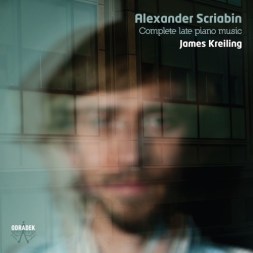 James Kreiling, piano (Odradek)



 The Cross-Eyed Pianist