Those of us who teach and play ourselves understand that music requires commitment in the form of consistent, focused practising. This does not mean a snatched half-hour here or there or a blitz the night before the weekly piano lesson, but regular engagement with the instrument and its literature (at least 5 days out of 7 for noticeable progress to be achieved).

As pianists, much of our “work” (practising) is done alone, for some in almost monk-like seclusion. This separateness enables us to focus fully on the task in hand, without distraction. Most of us who chose the piano as our instrument actively enjoy the solitariness (I know I do), but equally this time spent alone can trigger self-doubt and negative criticism from within. Looking at what others are doing, what repertoire they are learning, how they are progressing, is toxic too: comparing oneself to others sets up further negative thoughts and can lead to lack of confidence and motivation.

When I returned to the piano after a 20-year absence, I wanted to play EVERYTHING. Of course this was a ridiculous pipe dream, but my appetite for repertoire focused my attention and motivated me to practise diligently and enjoyably virtually every day. But when I co-founded the London Piano Meetup Group and started meeting other pianists, I encountered people whom I perceived as “better” than me – because they were playing repertoire which I believed I could not play. This depressed me and the mantra “I can’t play that” began to haunt – and limit -my practising. I grew increasingly envious of the people who knocked off Ravel’s Jeux d’eau or Grainger’s Molly on the Shore with apparent ease, not to mention countless other pieces which I aspired to play…..

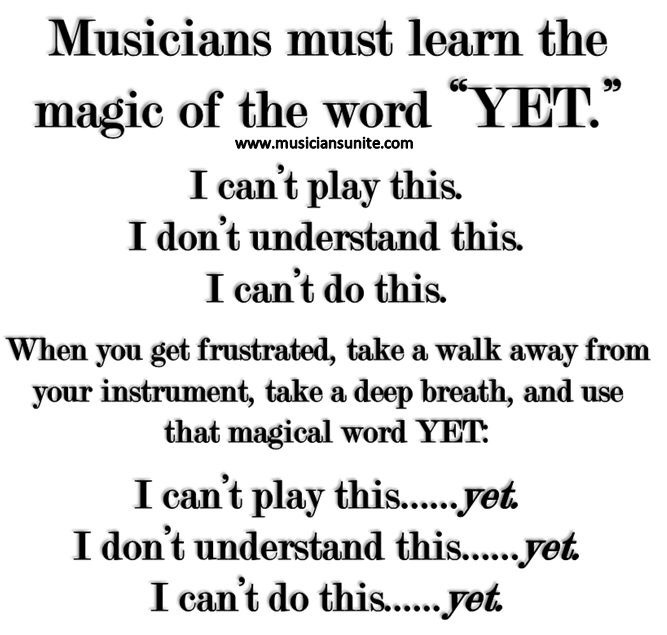
But hindsight and experience have taught me the power of “yet” – that simple three-letter word which can turn a negative phrase into something more positive and affirming:

“I can’t play that – yet

“Yet” turns the task into a challenge and is the spur to set to and practise, to strive, to master.

“Yet” makes that Beethoven Sonata or Rachmaninov Étude-Tableau achievable, with practise.

“Yet” turns the seemingly impossible into the possible

“Yet” is a declaration of intent
Those of us who teach and play ourselves understand that music requires commitment in the form of consistent, focused practising. This does not mean a snatched half-hour here or there or a blitz the night before the weekly piano lesson, but regular engagement with the instrument and its literature (at least 5 days out of 7 for noticeable progress to be achieved).

As pianists, much of our “work” (practising) is done alone, for some in almost monk-like seclusion. This separateness enables us to focus fully on the task in hand, without distraction. Most of us who chose the piano as our instrument actively enjoy the solitariness (I know I do), but equally this time spent alone can trigger self-doubt and negative criticism from within. Looking at what others are doing, what repertoire they are learning, is toxic too: comparing oneself to others sets up further negative thoughts and can lead to lack of confidence and motivation.

When I returned to the piano after a 20-year absence, I wanted to play EVERYTHING. Of course this was a ridiculous pipe dream, but my appetite for repertoire focused my attention and motivated me to practise diligently and enjoyably virtually every day. But when I co-founded the London Piano Meetup Group and started meeting other pianists, I rubbed pianistic shoulders with people whom I perceived as “better” than me – because they were playing repertoire which I believed I could not play. This depressed me and the mantra “I can’t play that” began to haunt my practising and my participation in the Meetup group’s regular performance platforms. I grew increasingly envious of, and irritated by the people who knocked off Ravel’s Jeux d’eau or Grainger’s Molly on the Shore with apparent ease, not to mention countless other pieces which I aspired to play…..

But hindsight and experience have taught me the power of “yet” – that simple three-letter word which can turn a negative phrase into something positive and affirming:

“I can’t play that – yet

“Yet” turns the task into a challenge and is the spur to set to and practise, to strive, to master.

“Yet” makes that Beethoven Sonata or Rachmaninov Étude-Tableau achievable, with practise.

“Yet” turns the seemingly impossible into the possible

“Yet” is a declaration of intent

City Music Foundation (CMF) welcomes applications from classical, jazz, folk, and world musicians – both soloists and ensembles – to join its innovative two-year Artist Programme.

Starting in September 2019, those selected for the scheme will enjoy:

  • A series of tailored Professional Development Workshopswith topics including tax and financial management, networking, presentation skills, contracts and legal issues, agents, PR, social media, pitching to venues and festivals, programming, and much more
  • Business Mentoringfrom senior business-people through collaborations with City firms
  • Artistic Mentoringfrom established, acclaimed international performers, including opportunities for collaboration in performance
  • Performance Opportunitiesin CMF-produced events, festivals, and residencies
  • Promotional Toolssuch as high-quality photos, a bespoke website, videos, and professional recordings
  • Day-to-day access to the Artist Manager, who works like an agent to secure live concert bookings and media appearances
  • Additional Supportwith individual projects and commissioning

The deadline for applications is Wednesday 3rd April 2019, 12pm.

Apply here: www.citymusicfoundation.org/apply


Current and previous CMF Artists include A4 Brass Quartet, Lotte Betts-Dean (mezzo soprano), Tabea Debus  (recorders), Foyle-Štšura  Duo (violin & piano), Andrey Lebedev (guitar), Ligeti Quartet,  Misha Mullov-Abbado (jazz double bass), and Emily Sun (violin).  

CMF’s mission is to turn exceptional musical talent into professional success by equipping outstanding musicians with the tools, skills, experience, and networks necessary for building and sustaining rewarding and profitable careers.

www.citymusicfoundation.org
Registered Charity Number: 1148641


Who or what inspired you to take up piano and pursue a career in music?

My parents encouraged me to become a musician. I was born in a communist country run by a psychopathic government. My parents believed that being a musician was a chance to travel the world and become free.

Who or what have been the most important influences on your musical life and career?

I think my father was the most inspiring person for me. He always provided records, books, charts and all the necessary materials for my work.

What have been the greatest challenges of your career so far?

For a talented person the hardest thing is to stay polite, patient, gentle and kind to the people around you. It takes a lot of everyday work to approach with inner love people who are less talented and more talented than me.

Which performance/recordings are you most proud of?

I think that my last album Earth Particles is not bad. I recommend it.

Which particular works do you think you play best?

I was always hired by film music composers to play ballads. Maybe that’s what I am good at…

How do you make your repertoire choices from season to season?

I play improvised music. I just listen to what I play and try to fix it. Sometimes promoters or producers ask for something specific and that is how I make my living.

I sit at the front of the piano, press the keys and throw the hammers in the air.

Every hammer then hits the metal string which produces a vibration reaching the ear of the listener.

Through this procedure I achieve the attention of the people in the hall so that some energetic processes can take place. We then start to exchange information on the subconscious level.

Intellectual, energetic and spiritual.

Do you have a favourite concert venue to perform in and why?

I like the venues which smell nice.

Who are your favourite musicians?

My favourite musicians are the musicians who listen while playing and react immediately.

What is your most memorable concert experience?

I forget what I’ve played, when and where. Music is the reality of abstract vibrations, I become confused when it comes to exact descriptions.

I definitely have some unforgettable memories, but I do not remember the scrupulous specifications.

As a musician, what is your definition of success?

I don’t believe that “success” exists. The only success is to become a better person than I was yesterday. By “better” I mean more trained. Please remember, that the relaxation is a part of a training.

What do you consider to be the most important ideas and concepts to impart to aspiring musicians?

I think the most important thing is to listen while playing. Listen to others and listen to yourself.

That’s why I play bare feet: everything is more “hearable” because the sound is also resonating through the bone conduction.

An outstanding artist consists of two elements: the well-trained body and high-quality soul. Both aspects need everyday training.

Where would you like to be in 10 years’ time?

I hope I will stay in this physical body, but it is not me to decide. I like this planet, although the system is ugly.

What is your idea of perfect happiness?

Achieving the understanding of a perfection of all that exists. It is in fact the perfect creation.

What is your most treasured possession?

My awareness.


Pianist and composer Leszek Możdżer is one of the great revelations of the last decade in Polish jazz. His classical training allows him to play the piano with great improvisational freedom, creating new musical landscapes to which he lends a timbre, eloquence and harmony all of his own. The result is a subtle, often mystical atmosphere that enchants his audience.

