For those of us who engage in music, as performers and teachers, the classical canon offers an endless source of excitement, thrilling stories and fantasies, portrayed in myriad colours, moods and styles. The desire to play this music and revel in its wonders is very potent and is what motivates us to practise, play, perform, and teach. Sharing the music with others is a special joy all of its own.

Alongside this, the musician’s daily life can be tough, restrictive and lonely: the routine of practising, trying to make a living in an uncertain, highly competitive profession, seeking out performance opportunities, travelling, teaching, and the quotidian admin of managing a career. When the creative pursuit of music feels more like a task than a passion, it can lead to a loss of joy.

There are added pressures too: the rigours of the musician’s training can affect one’s attitude to the music. It stops being a source of excitement and exploration and instead becomes a sequence of technical exercises to be practised with clinical precision to the point of perfection.  The need always to be at the top of one’s game, the knowledge that, as a performer, one is only as good as one’s last performance, the precarious nature of the profession – all these can impact on one’s attitude to the music.

How do we preserve the joy when so many pressures can conspire to remove it from our music making?

As a teacher, I think it should start in the earliest lessons. Too often children are encouraged not to make a mistake, to aim for perfection – an unrealistic artificial construct – and in doing so become fixated on avoiding errors rather than revelling in the pleasure of the music, relishing and cherishing the sounds they are making.

…too much emphasis is placed on how they [music students] perform, and too little on what they experience.

Mihaly Csikszentmihalyi, author of FLOW


Embrace the experience

As we mature and develop as musicians, whether or not we choose the path of formal training in conservatoire, our focus should remain on “the experience”. Of course we must practise deeply and intelligently, with due care and attention, but not to the exclusion of everything else. Life experience, from the mundane to the extraordinary, all feeds the artistic temperament and brings vitality and imagination to our music making.

Make the music for you and remain curious

Intrinsic motivation – whereby one undertakes a task or activity for its own sake rather than in the hope of gaining some sort of external reward or praise – leads to better focus and concentration, and far more fulfilling outcomes. So make the music for you – and don’t continually seek praise or endorsement from others; nor compare yourself to others.

Thirst for knowledge is a form of intrinsic motivation and this thirst can be fulfilled by learning new music and enjoying the process of learning. Personal fulfilment can be derived from knowing one is getting better, while the physical and mental satisfaction of actually playing music is a pleasure in itself and can lead to a state of flow, where one enjoys the activity for its own sake.

Regular reminders of why we have chosen to devote ourselves to music, which focus on the intrinsic motivations, rather than career advancement or external endorsement, and recalling our love for and pleasure in the art form, are very important too.

Give yourself permission for downtime

Taking regular breaks from practising and the other minutiae of managing one’s career allows time to refocus and reset. Regular exercise, plenty of sleep, having someone help with the mundane tasks, and getting away from it all by doing something else – reading a book, visiting an exhibition or simply chilling with a TV programme.

Acceptance

Know and accept that feelings of frustration and disgruntlement with one’s working life as normal and common to everyone.


And some helpful advice from musicians themselves:

Finding a few minutes amongst the (often huge) stresses of deadlines to engage in ‘play’/procrastination…and lots of listening to all kinds of music.

Thomas Hewitt Jones, composer


Reflect regularly on the transience of stress and anxiety and the permanence of art. Treat it as your friend, not your enemy. Even if things get much worse and they always can, know that art will always be with you and will continue long after you’re gone. A thirst for life and creation when willed into being tends to overwhelm the desire for death (of one form or another).

Luke Jones, pianist


For me, playing is the release. I mostly compose via improvisations, so as my mind wanders and deals with daily stress, my music is moving around under my fingers looking for a way to ground myself.

Simon Reich, pianist and composer


at times when my work is not bringing new repertoire to me, I find there is no cure for fatigue that is better than making a new thing

Sally Whitwell, pianist and composer


For me the joy is in the music. I love music.

Joseph Fleetwood, pianist

performers-quotes-15-1377772242-view-1

wm1_700x0__LL375_CovFor the musician looking to further their studies after Grade 8, Performance Diplomas offer a pathway to fully accredited professional qualifications, recognised by other musicians and music professionals around the world. A diploma, even at the lowest Associate level, is considerably more involved than Grade 8, requiring a high degree of attainment, combined with a professional attitude to preparation and practising, communication, musicality, presentation and stagecraft. As such, a diploma offers a significant musical, intellectual and personal challenge, and provides a useful framework for the honing and maturing of performance and teaching skills.

London College of Music (LCM) has recently updated and refreshed its music performance diplomas, and the Piano Diplomas have a revised repertoire list, together with the release of a second In Concert volume of music, edited by Joanna Macgregor, Head of Piano at the Royal Academy of Music and a concert pianist acclaimed for her highly original programming.

The new LCM piano diplomas syllabus now offers three types of performance diploma at DipLCM, ALCM, and LLCM levels as follows (mark weightings shown in brackets):

Performance: Performance (70%), Discussion [formerly called Viva Voce] (15%), Sight Reading (15%)

Recital: Performance (80%), Discussion or Sight Reading (20%)

Concert: Performance (100%)

For all diplomas, candidates must produce a written programme.

At Fellowship level (FLCM), there is a single Performance Diploma for which candidates must offer a 50-60 minute recital with programme notes of 3000-3500 words. Marks are not awarded; the performance is either Approved or Not Approved.

By offering three types of performance diploma, LCM gives candidates the opportunity to select the diploma format that is right for them. There is a lot of snobbery surrounding performance diplomas (just as there is a lot of snobbery concerning the different exam boards), but I believe candidates benefit from a choice of format and should select a diploma which will enable them to perform to the very best of their abilities. A quick glance at the diploma repertoire lists for each exam board reveals music of similar difficulty, with many pieces common to all boards.

For those who simply want to perform a recital programme, the Concert Diploma, introduced in 2017, is the route to take. While some may argue that the removal of sight-reading and other tests from the Concert diploma makes this an “easier” option, I would counter with the assertion that being judged wholly on one’s performance is a very good test of one’s musicianship and professional performance skills. This gives candidates the chance to focus entirely on the music and to be really imaginative in creating a proper concert programme (this was my reason for opting to take the Trinity College London diplomas rather than the ABRSM’s).

While the LCM diploma repertoire lists are not as extensive as Trinity’s nor the ABRSM’s, what the lists lack in quantity they more than make up for in variety, with a good selection of music by women and contemporary composers, including works by Florence Price, Emily Doolittle, Judith Weir, Thomas Ades and Tan Dun, together with key works from the core canon of piano music. Candidates also have the option to include own-choice repertoire, provided it is of a technical standard consistent with that of the appropriate diploma level. There is no need for own-choice repertoire to be approved in advance. Thus candidates can create a recital programme which plays to their strengths and musical affinities, which is interesting, well-balanced and varied. These are very much diplomas for the modern musician.

With the introduction of the Concert Diploma in 2017, LCM released the In Concert handbook, an anthology of pieces from Baroque to present day selected by Joanna Macgregor. A second In Concert volume has just been released for the Associate and Licentiate level diplomas, alongside the updated diploma syllabus, from which candidates must select at least one piece for their diploma programme. As with the previous volume, the pieces are accompanied by useful introductory notes, also by Joanna Macgregor, which set the works in context and offer guidance on technical and artistic issues. The selection of music is varied and imaginative, and as in the main repertoire lists, women and contemporary composers are well-represented, with the opportunity to enrich one’s repertoire beyond the core canon. The book is attractively-produced with clear music engraving on good quality paper.

I’ve been consistently impressed with LCM’s approach to graded music exams and diplomas since I was involved in the selection process for the current piano syllabus. This exam board is very consciously offering candidates and teachers something distinctive from the old-fashioned graded music exam, with an imaginative choice of repertoire and exam formats.

Highly recommended

Note: candidates should consuld the current syllabus and read the regulations carefully to ensure they are conversant with and meet all the necessary criteria for entry

LCM Music Diplomas Syllabus from 2019

LCM Piano Diplomas repertoire list from 2019


Further reading

Why take a performance diploma?


If you enjoy the content of this site, please consider making a donation towards its upkeep:

Buy me a coffee


Guest post by Michael Johnson

Let’s face it. Except for the lucky few who have the gift, young students struggling to coax music out of a piano are in for a world of pain. Most of them just suffer in silence, and so do their families in the next room, as sharps become flats, allegro becomes lento, everything is hammered to death, and Mozart rolls over in his grave.

But in the past few years, a strange ritual has taken root in our so-called civilization – a safety valve for those who crack under the strain of music’s harsh discipline. It is called “piano destruction” and it is more than a diversion for vandals.

This is different from performance art, in which pianos have been abused for decades by artists seeking to shock. A Swedish pianist, the late Karl-Erik Welin, took a chainsaw to his piano and composed a piece he calls “Esservecchia” calling for strong fist blows to the keyboard and strings.

The occasional comic take on piano destruction survives on film, such as Harpo Marx and his version of “Wreckmaninov”.

But now young piano students sometimes go mad, jumping on the keys, smashing the soundboard, torching the instrument, raking the strings with garden tools – and capturing it all on video

Is this really porn? At least it is an act offensive to public morality, so I call it “pure piano porn”.

Fine instruments produced by piano craftsmen are transformed into bonfires, torn to pieces by heavy construction equipment, exploded with TNT, pushed off cliffs and tipped over the edge of tall buildings.

3_Ortiz_Piano_Destruction-1100x733
Raphael Montanez Ortiz attacks a grand piano with an axe as part of a piece of performance art

Admittedly some ageing pianos are so worn out that they cannot be tuned, and there comes a time to drag them to the knackers yard like an old horse. What makes the practice obscene is the glee with which the demolishers attack the doomed instrument.

A search of the web reveals dozens of amateur piano-bashers at work under the heading “piano destruction”. The best compilation I have found is a link called “25 ways to kill a piano”, accessible here.

Not everyone can find enjoyment from these wanton acts of devastation. Music lovers cringe at the sight of them and scratch their heads. Piano tuners and piano builders weep.

And yet, men and women, boys and girls, will rush at a piano with an axe or hammer or iron bar if motivated by their desperation. The more ambitious of them go to the woods and plant explosives inside. Much merriment – diabolical laughter, actually — is associated with these events.

Occasionally a truly accomplished player takes out his frustration on the instrument. Recently in France, François-René Duchâble, during a pause in his career, recalled his personal act of vengeance. He says he liberated himself from an overly demanding career by dropping the wooden case of his grand piano from a helicopter into Lake Mercantour, in the French Alps, and never saw it again.

He branded the piano “an arrogant instrument which excludes all those that don’t know about music.”

People thought this was a desperate move,” he recalled. “In fact it was a liberation. An act of purification.” And he told a reporter, “I have had enough of sacrificing my life for one percent of the population. I have had enough of participating in a musical system, which, in France at least, functions badly and limits classical music to an elite.”

Thus he brought to a close three decades as a concert pianist and recording star, “a life I detested”, he said. At a stroke, the helicopter stunt had put an end to everything that was weighing him down – “the travel, the rehearsals, the recording sessions in which one is a mere student of the producer in the studio.” He hated taking direction from record producers and he likened his road trips to traveling around in a hearse.

Duchâble’s works are still on the market. His performances of all the standard repertoire of Liszt, Chopin, Beethoven, Rachmaninov, Grieg, are easy to find. He feels his entire life was ruined by his career. “I have a few good memories, a few successes, but not much,” he recalled. “I spent 30 years regretting I had this talent which prevented me from having a life,” he recalled. Finally, he snapped.

Until his recent retirement, he was saying he felt “reborn”, performing for children or the sick, or pedaling around seaside resorts with a keyboard mounted on a specially built tricycle, attracting crowds of old and young with his mobile arpeggios and snatches of Chopin.

The more common piano-bashers seem to be amateurs who arrive on the dreaded “plateau” of learning during which nothing seems to move forward despite intense practicing. Clips of piano destruction on YouTube are enlivened with viewer comments, such as: “Wow he must have had a terrible teacher.”

Yes, piano pedagogues have much to answer for.


Michael Johnson is a music critic with particular interest in piano. He worked as a reporter and editor in New York, Moscow, Paris and London over his writing career. He is the author of five books and divides his time between Boston and Bordeaux. He is a regular contributor to The Cross-Eyed Pianist


Another version of this story appeared on http://www.factsandarts.com

As I said in my little appreciation yesterday, following the announcement of his death, André Previn was a significant presence in my cultural upbringing, and his passing has given me pause to reflect on that.

andr-previn-1431338008-editorial-long-form-0
André Previn (picture from ClassicFM)

There was always a lot of music at home – on the radio, on LPs and, significantly, on television; so much in fact that classical music felt like a normal part of the day-to-day cultural landscape of the 1970s and 80s. As a family, we enjoyed André Previn’s programmes where, with the LSO, he introduced the great works from the classical repertoire in a way which was engaging, informative, intelligent – and accessible. The orchestra eschewed their usual formal attire of white tie and tails, as did Previn as conductor, yet despite the more relaxed setting, Previn never dumbed down the subject matter nor patronised his audience, but explained aspects such as musical structure and form in a way which was comprehensible to the lay viewer/listener. Talking about it this morning with my husband (who is not a natural classical music fan but who, like me, comes from an ordinary middle class family who enjoyed music of all genres), he commented that at that time (mid 1970s) it didn’t seem that unusual to find a full symphony orchestra or a string quartet or piano trio performing on the telly. In his André Previn & Friends programmes, Previn was joined by musical friends and acquaintances who performed music together and talked about it in a casual yet informed way which allowed the viewer to get beyond the notes and also discover some insights into the life of a classical musician (what I’m attempting to do with the Meet the Artist series). Come to think of it, having a classical musician appear on the Morecombe & Wise show, as Previn memorably did (“Mr Andrew Preview”), perhaps indicated just how much classical music was part of the our mainstream culture in those days.

In addition to Previn’s programmes, there were broadcast masterclasses with, amongst others, the cellist Paul Tortelier (about whom my mum had a bit of a “thing”!) and pianist/conductor Daniel Barenboim. I watched these programmes with great curiosity – as a fledgling piano player, I was fascinated by the students being put through their paces and the critical comments of the “master”, and when, as an “adult returner”, I participated in my first masterclass, I recalled these programmes with a Proustian rush of memories.

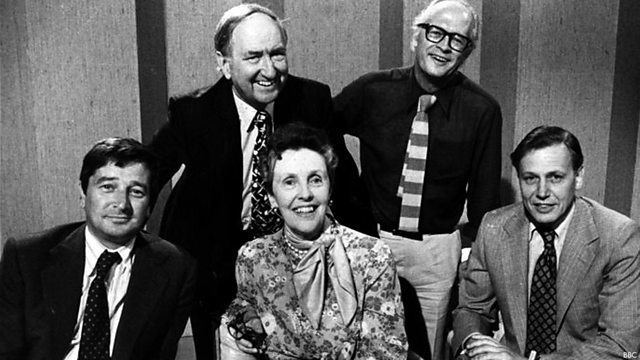
Face the Music was another popular television programme in the 1970s –  I loved it, taking pride in the rare occasions when I got a question right. Such an esoteric quiz show would never be shown on mainstream TV today, and in some ways Face the Music, with its intelligentsia-rich panel of people like Robin Ray and Bernard Levin, and hosted by accomplished pianist Joseph Cooper, was at the opposite end of the spectrum to Previn’s programmes, which demystified and democratised classical music by combining humour with breadth of knowledge, yet both were regular – and popular – features on the BBC.

face-the-music-tv-series-535580f4-9504-4614-b736-a914c391640-resize-750
Face the Music tv quiz show with Robin Ray, Joyce Grenfell and David Attenborough (front row)

Sadly, neither Previn’s programmes nor Face the Music would probably see the light of day on mainstream TV today (though FTM was revived, briefly and substantially dumbed down, in 2007 on BBCFour): both would be deemed too rarefied, too esoteric. We do of course still have programmes about classical music on the BBC but in general these are consigned to the relative backwater of BBCFour, which is where the BBC shows its more recondite programmes on, for example, art, history, music and drama. There have been some good classical music programmes on BBCFour, including The Sound and The Fury (broadcast in 2013 in conjunction with the Southbank Centre’s The Rest Is Noise festival of twentieth-century music) and Revolution and Romance: Musical Masters of the Nineteenth Century (2016), presented by Suzy Klein and featuring performances by pianist Daniel Grimwood. During the Proms season in the summer, the BBC broadcasts selected concerts, often edited to exclude modern, contemporary or potentially “difficult” music and to make the broadcast shorter (back in the good old days, Prom concerts were broadcast uncut). I know I am not alone in having an issue with this kind of presentation: it’s a form of censorship, the programme makers deeming what is acceptable for the viewer. It troubles me because if people are not exposed to modern or more challenging music how can they ever make a judgement about whether or not they actually like it or find it interesting? It also reveals a certain reverence towards the core canon of classical music, and a (possibly inaccurate) view that this is what the public wants. We also have the Proms Extra programme, which “casts an eye over the best of the action from the BBC Proms” and includes interviews and features with some of the performers. Personally, I find these programmes fairly anodyne, a kind of One Show for classical music. By contrast, Previn’s programmes, those masterclasses and other culture broadcasting now seems bold and challenging.

So why did classical music broadcasting on television become so dumbed down? In part, I think it is down to education: as music education has been eroded and devalued in our schools, so classical music in particular has dropped off the mainstream cultural radar. Now largely the preserve of the privileged few rather than the many, it is regarded as “elitist” and “inaccessible” and, importantly, unpopular. And so in an attempt to engage more people with the artform, some programme makers and presenters have sought to “trendify” or popularise classical music (the BBC’s Our Classical Century is, in my humble opinion, a cringeworthy current example of this). Take the BBC Young Musician competition. Once a serious music contest in which talented young players competed in instrumental categories to secure a place in the concerto final (and for many entry to a professional career), the focus of the competition now seems more geared to the back stories of the performers (and asking them immediately they come off stage “how did you feel?”), and attractive overly-enthusiastic presenters. The sets are flashy and in the midst of all the X-Factor style razzamatazz, the actual music – which is what the competition is meant to be about – feels rather sidelined. In fact, the performances are often edited to shorten them, usually to exclude that challenging contemporary music, and to make the show more appealing (for which read “popular”).

And this, I think, it what lies at the heart of presentation of classical music (what little there is now) on the BBC. As the corporation has had to become more commercial and competitive, so its programming has shifted towards the popular and populist.

I hope I do not come across as a classical music snob because I do not regard myself as one. I care very passionately about music and I want others to care as well. I also want people to engage with classical music, to discover just how wonderful and varied it really is, but not to be guided by presenters who cheerily tell us that Debussy’s Clair de Lune is “relaxing” rather than letting the music speak for itself. What André Previn did so successfully with his tv programmes was to raise “the public’s awareness of great music and its performance by demonstrating just how great – majestic, magical, exciting, moving – it actually is, as opposed to attempting to make it easy and approachable and thus losing almost everyone. ” (Peter Donohoe, concert pianist). Previn’s intelligent, informed and natural approach made the artform accessible, in the best possible sense of that word, rather than behaving as if it is some kind of taboo or weird hobby, to be whispered about behind one’s hand, as is too often the attitude now.

I’m not advocating a return to the 1970s style of broadcasting, but I think today’s programme makers and presenters could learn a lot from Previn’s unpretentious style and approach. I know some would argue that we have digital and streaming services like MediciTV and World Concert Hall which offer wall-to-wall classical music broadcasting – concerts, masterclasses, interviews, features et al – but the BBC does have a duty as a public service broadcaster to offer a broad range of programmes. Music is a key facet of our culture and heritage and as such should not be ignored nor devalued. We need music, and the BBC has within its remit the opportunity to foster an appreciation of and interest in music.

Watch Andre Previn at the BBC

The lost art of the classical music animateur


