Who or what inspired you to take up the piano and pursue a career in music?
I took up piano as a hobby after my grandmother asked if I’d be interested in learning it. Growing up on a farm in southern Tasmania meant there wasn’t much else to do, so I said yes. I didn’t decide to pursue a career in music until the end of my school years, when the head of music suggested I apply for conservatoires in London.
Who or what have been the most important influences on your musical life and career?
Probably my dad and my teacher. The former because he is inadvertently responsible for much of my taste in music, and my teacher Joanna MacGregor because she allowed and helped me to take a path less travelled in my musical development (no repertoire is off-limits!), and instilled in me a passion for new music.
What have been the greatest challenges of your career so far?
Moving to the other side of the world by myself at age 18.
Which performance/recordings are you most proud of?
I couldn’t say for certain, but in recent times I have been particularly pleased with a performance I gave of Michael Finnissy’s 2nd Piano Concerto with Ensemble x.y and An Assembly. Sometimes things do hold together when you need them to.
Which particular works do you think you play best?
I think I play modern/new music best, but I also like to think that I play Romantic-era works quite well too.
How do you make your repertoire choices from season to season?
Briefly:
It depends on the concert and the context of the concert. One thing I hate vehemently is uninspired programming. A programme needs to be more than a series of pieces one after the other without connection other than ‘similarity’ or ‘contrast’. I like forming narratives, be it stylistic, historical, emotional etc. and I feel it is necessary to talk to an audience (either verbally or through your own programme notes) to offer this information, and offer an approach to listening. I strive to choose programmes that will be relevant to either the venue, the context of the concert or a featured piece. So this is primarily what drives my repertoire choices. It usually means I have to learn new pieces quite regularly, but that’s fine.
Who are your favourite musicians?
I couldn’t say, it would change from week to week or day to day even.
What is your most memorable concert experience?
I don’t know, mostly because I have a bad memory. Although I once did a certain concert with a certain friend of mine where between us we performed about two thirds of Boulez’s output for piano(s) and in retrospect it was a completely ridiculous idea and I have no idea how we pulled it off.
As a musician, what is your definition of success?
Owning a home.
What do you consider to be the most important ideas and concepts to impart to aspiring musicians?
Do things other than music at least as regularly as you do music.
What is your idea of perfect happiness?
I don’t know. But I think if I owned at least three pianos, and a celesta, and maybe throw in a few harpsichords and/or a clavichord and a few other things with keyboards I reckon that would do for a start. You could ask me again then.
Joseph Havlat is a St John’s Smith Square Young Artist for 2019/20
Joseph Havlat was born in Hobart, Australia, and studied at the Royal Academy of Music in London under Prof. Joanna MacGregor from 2012 – 18. Joseph has performed in major concert venues around the UK and in Europe, America, Japan and Australia as a soloist and as part of chamber groups and orchestras. He is a keen sock enthusiast and chamber musician, performing frequently with multiple groups – Tritium (clarinet) trio, Trio Derazey, Duo Ex Libris as well as the LSO percussion ensemble, with whom he toured Japan in 2018 giving the premiere of a work by John Adams. Passionate about contemporary music, he is a founding member and artistic director of contemporary music collective Ensemble x.y and is also an avid composer, having written for the aforementioned ensembles, among others. Having now graduated from the Academy, he is there serving as a Piano fellow for 2018-19, having also been a Chamber music fellow for the previous year.
Isn’t it time all those piano boys stopped getting it all their own way? (Not that we don’t love ‘em!) From Bach to Ben Folds, from Beethoven to Billy Joel and from Mozart to Minchin, the list of famous piano players throughout history is dominated by men. I’m premiering my new show “The Piano Women” at the Edinburgh Fringe Festival to start redressing this imbalance… and have some piano fun as well.
I’m Emma Knights, from Adelaide, South Australia. At the keyboard since the age of four, I now work as a musician, pianist, producer, composer, creator and curator. The purpose of my lightning visit to the U.K. this time is to perform this new one-woman show, as well as bringing back “The Piano Men”, a show which I performed successfully at Edinburgh last year.
Both shows have been directed by Adrian Barnes. I’m on a mission to share the inspiring and entertaining stories of piano men and piano women across history. Researching and preparing these shows has taught me a lot about us pianists. Here’s a bit about my journey so far, and how these two shows came into existence.
My first piano hero was my dad. He was my piano teacher and he’s still the pianist I admire the most. As any pianist knows, achieving musical mastery as piano player is tough. Early on, I found that professional piano playing is a bit of a man’s world. I spent my early career in the background, very much the genteel piano girl. Those restaurant, cocktail bar and pub gigs – ‘Don’t play too loud, will you?” Then a guy with boogie woogie chops comes in, plays a few splashy numbers, and they fire me. What’s that all about? I can play boogie. Of course I can. Want to see my bunch of qualifications in classical and contemporary music at graduate level? But somehow all that sweaty, muscular jazz and rock wasn’t ladylike.
So I used to stay in the background… I was The Nice Accompanist Lady. I worked as a pit instrumental muso. Now don’t get me wrong; I have enjoyed every minute of professional piano playing, and I’m grateful for all opportunities that have come my way.
My creativity was being quietly stifled until a singer friend of mine asked me to accompany her original cabaret. As we rehearsed, she talked about
the opportunities I had provided her as a performer. She spoke about those internal struggles common to all artists: Will I get an audience? Am I ready to give an audience of my best? You know, those questions beautifully explored in the film “La La Land”. I started to think more about myself as a performer, not just a producer and promoter. I’m an artist too… and while I’d been busy enabling so many other artists to perform, I had allowed my little artistic spirit to fade a bit. So I started to take some baby steps.
I got a gig as accompanist for a two-woman comedy cabaret. Nothing new there. But their show was written so that the accompanist was one of the characters… and what a grumpy, unimpressed, purist musician I played! When the bell from a 1920’s gramophone fell onto my head during one performance, it was the comic hit of the night.
Next, a job as once-a-week rehearsal pianist for a 100-strong choir. On the day they put the choral arrangement for “Shake, rattle and roll” on the music stands, I thought… “If there’s ever going to be a safe space for me to bring my rock and roll licks, this is it!” The choir went off like a rocket, and this is still their favourite request whenever I am rostered on. I was starting to stick my quiet little piano-lady neck out.
Around this time, I watched Hannah Gadsby’s show “Nanette”, in which she memorably says “My story has value.” I realised that mine does, too, so I started writing “The Piano Men”, a one-woman show about my work as a female pianist. While delving into the history of a few other piano women, the show tells its story through the songs of my favourite piano men. I believe passionately in equality. Consequently, this show is all about where we can still improve the system (whatever that is!) for piano women without diminishing the works of the many piano men that have inspired us all.
I premiered that show in Edinburgh Fringe last year; it was still at an embryonic stage. Despite this, I received a 3-star review and excellent feedback. So I went back home to Oz and hired an award-winning director, Adrian Barnes, to help me bring the show to a whole new level. Next, I toured it to two states, and I’m extra-happy to be bringing this new, improved version of “The Piano Men” back to Edinburgh, where it all began.
An inevitable by-product of all the research I did for “The Piano Men” was a stack of fascinating information about some of history’s great female pianists. Discovering all those crazy coincidences, fun factoids and irresistibly silly stories meant that I simply had to create a partner show called… wait for it… “The Piano Women”. Both are stand-alone shows, but any piano nutter would want to see both.
Although “The Piano Women” has a little of my story within it, it’s mostly piano solos, songs and entertaining stories about women pianists throughout history, from the invention of the piano to today. Sadly, not all of them could be honoured in a one-hour show. (Watch for my podcast, coming soon!) I have had a truly mind-expanding time researching all these women who share with me an irrational passion for the piano. I was also surprised to find out how many of them there were. History has certainly not made much fuss about the world-wide Keyboard Sisterhood. I believe that “The Piano Women” carries messages of inspiration for any musician who sees it, as well as shining a light on the inner workings of the music industry over the last three centuries.
Pianodrome, Edinburgh
When I researched likely venues for the Edinburgh Fringe this year, I chose the beautiful Stockbridge Parish Church, complete with its grand piano. And my other venue was a no-brainer… the Pianodrome, a 100-seat amphitheatre constructed from over 50 discarded pianos. What wonderful upcycling! For my shows about pianos, I couldn’t imagine a more immersive setting anywhere in the world. Back home (Adelaide, South Australia) I devise and run immersive music-based events; to be able to do this with my shows in Edinburgh is amazing!
I hope you can get to see one of my shows in Edinburgh this year. If you do, stay back after and say “G’day!” to me. We pianists have to stick together.
The Piano Women
One World Premiere show only:
Thursday, 8th August, 2019 – at 5:00pm
Pianodrome at the Pitt, Pitt Street Market, Edinburgh
The Piano Men
Saturday, 10th August, 2019 – at 5:00pm
Pianodrome at the Pitt, Pitt Street Market, Edinburgh
The latest edition of the Aix Music Festival brought a stellar array of singers, pianists, instrumentalists and orchestras to Aix-en-Provence, near Marseille this year. Co-founder and violinist Renaud Capuçon tells me the festival has become the realization of a dream he has nurtured since childhood.
A highlight was Austrian pianist Rudolf Buchbinder who played the five Beethoven piano concertos while conducting the Sachsische Staatskapelle of Dresden from the keyboard. He accomplished this in a single day, showing no sign of strain, a remarkable feat for a player of 72 years of age.
On the day before he was to play his back-to-back concertos, Maestro Buchbinder sat down with me in the “Teddy Bar” of the Grand Théâtre de Provence to discuss his age, his stamina, his piano preferences, and his love for Beethoven. He was relaxed and cheerful and spoke freely. He dismissed his marathon feat of keyboard conducting as “nothing special”.
An edited transcript of our conversation follows.
Q. You probably don’t like this term “marathon” to describe your five Beethoven concertos in one day, do you?
A. Actually, a solo recital is much worse than playing the five. Even practicing for four hours is much worse. (Snorts) I once played the two Brahms concertos in one evening!
But you also conduct from the keyboard. That must be stressful, leading this collection of prima donnas….
This is nothing special. Before, everybody did it. Beethoven did it. I conduct with my eyes, with my mouth, a little bit with my hands. I have done it 500 times in my life. It’s a different kind of concentration. The players have to listen.
You have played the five concertos before in one day.
Yes, in 2011 I did it with the Vienna Philharmonic.
You are not intimidated by such a large task?
No. Why should I be ?
Well, because there are a lot of notes!
Oh no. The secret of piano playing is simple. You just have to touch the right notes at the right time. That’s it. (Laughs)
Do you have to prepare yourself for these five ? Do you review the scores prior to the concert?
No, this time I left the scores at home in Vienna. I don’t need them.
Really? You have them all in your head ? How many times have you played these concertos?
Over 200 times for No. 1, and probably a hundred or more for the others. No. 1 was my first big concert. I was 11 years old, in Vienna, dressed in short pants. (Laughs)
In what order you play them?
I play 2, 3, 4 in the first concert, and 1 and 5 in the evening. Because 1 and 5 are the longest. No. 1 has a longest slow movement.
Do you have a favourite among the five?
No. If I had a favorite, I could not play the others. It’s my problem. I have to love all of them. Each concerto is so completely different.
Aren’t they derived from Mozart’s piano concertos in certain passages ? Tovey wrote of “several examples of Mozart” that appear in No. 1. These two geniuses were rivals.
People say the first two concertos are influenced by Mozart but that’s not true. They have nothing to do with Mozart. It’s all about Beethoven. Beethoven didn’t think about Mozart. In fact, he hated Mozart. When he came to Vienna, Mozart was God. Beethoven was always jealous. It took him a long time to be as popular. People also try to make three periods in the Beethoven sonatas. Wrong. He had his ups and downs throughout this life.
Aren’t the Beethoven cadenzas a special feature of these concertos?
Not really. In 1809 or1810 Beethoven wrote all the cadenzas for his concertos. He just sat down and wrote them, one after another. He wrote three cadenzas for his No 1. There actually was one connection with Mozart. Beethoven wrote the cadenza for K466, the D-minor, because Mozart didn’t write this one. He improvised onstage.
Here Buchbinder plays the D-minor concerto with the Beethoven cadenza:
(interview continues after the video)
When you play the concertos, do you use Beethoven’s cadenzas or do you write your own?
Only Beethoven’s. Of his three cadenzas for No. 1, the first one is the best one but was left unfinished so I use some parts of the second and third cadenza to fill it out. They fit perfectly.
Are you the only pianist who plays around with cadenzas like this?
I think so. As far as I now, I am the only pianist to combine the cadenzas into one.
You compose cadenzas for other concertos but you do not use your own for the Beethoven concertos?
No… only Beethoven’s. They are not so bad, you know (Laughs).
I am fascinated that you can carry all these five concertos in your head.
Oh, this is only a part of my repertoire.
A personal question about your stamina. At age 72, can you play all five without worrying about fatigue or anxiety?
I admit that I am very nervous. The older I get, the more nervous I get. As a young man, I used to walk on stage confidently (Mimes confident posture, as if marching on stage.)
You don’t worry about this increasing nervousness?
No. No. Backstage, I don’t think about the concert that is coming. When I come onstage, I have cold fingers. A few seconds later, at the keyboard, I am back to normal.
Do you worry about memory lapses?
No. This should never happen. I am very secure. Well, maybe a little bit in K466.
You have said you want to die on the keyboard. Is this true?
Yes, like Wilhelm Backhaus. After two movements of a Schubert Impromptu he left the stage, then returned to play the same thing over again. It was his favourite. He was very ill and knew this would be his final performance. After his Schubert, he was taken to hospital where he died.
Do you have ten years left, or twenty, like Paul Badura-Skoda, who is still playing in his 90s?
Look. I have to play. But I only play when I am able to concentrate. I have always practiced only two hours a day, and sometimes I don’t touch the piano for one week. I am active. I just signed exclusive contract for Deutsche Grammophon.
Is playing getting more difficult or easier?
The Brahms concertos are much easier for me now than ten years ago. I played the Tchaikovsky First with Valery Gergiev maybe five or six times and also Rachmanninov.
Critics and other experts like to identify Beethoven’s development from Classical composing to a more Romantic style. Where does this begin to show?
This is stupid. The first one is Romantic. Beethoven always went up and down throughout his life. Beethoven was the most romantic composer in music history. He is the only composer who writes espressivo a tempo. Nobody else. He leaves the freedom to the interpreter.
Your views are fascinating because they are so individual. Is this a freedom that you can express now because of your age and experience? Does this empower you to say what you really think, regardless of other opinions?
You know the late Joachim Kaiser? We knew each other very, very well. He forced me … he said to me, “Rudi, you have to record the Beethoven sonatas again.” After 30 years interval I did them again for Sony in Dresden and then again at the Salzburg Festival. Thirty years ago I was not “free” like this.
And when did you feel this freedom arrive?
AYou cannot control it. It comes by itself. Like in the Hammerklavier, you play fast (Sings the opening phrase, loudly and vigorouslylike B-DUM PATA DUM PATA DUMDUM). You play those first seven or eight bars by the metronome, and then you are free. Beethoven writes everything very clearly. After that introduction he keeps the pedal. That makes a big difference. Many players do not have those freedoms today. They are afraid.
What about phrasing?
Beethoven writes rinf forzando (slurring), for the whole phrase. Only Brahms also used rinf. The alternative is fortepiano, which is short, like a mosquito bite.
But you have the discovered the freedom. Aren’t you afraid of criticism?
I have no problem with criticism if the critic declares what is right and what is wrong. What I don’t like is the critic who says, for no reason, “It was too fast.”
You always choose Steinways for your concerts. Why not a Viennese Bösendorfer?
Of course Vienna was very proud of Bösendorfer. But the tone to me is much too sharp, too harsh. Bösendorfer makes its own sound. I want to make the sound myself.
“Too glassy”, as some pianists say?
The point is that Steinway is the most neutral of all pianos. By this I mean that nothing comes from the piano, the way it is built. You must treat a woman like the Steinway, it’s the same. When you treat them good, they respond good. What you give, it comes back. I want to make the sound. You can play soft, you can pay lyrically, espressivo. The range is much bigger.
You say you have projects coming from Deustche Grammophon. For example?
In October, I will start a cycle of the Beethoven concertos. No. 1 with Andris Nelsons. No. 2 with Maris Janssons with Bavarian Radio. No. 3 with Valery Gergiev and the Vienna Philharmonic. No. 4 with Theileman Andriessen and the Staatskappelle. No. 5 with Riccardo Muti and the Vienna Philharmonic. All to be published by Deutcsche Grammophon. It’s a nice cycle. It will appear in about two years. We also have other plans.
Michael Johnson is a music critic with particular interest in piano. He worked as a reporter and editor in New York, Moscow, Paris and London over his writing career. He is the author of five books and divides his time between Boston and Bordeaux.He is a regular contributor to The Cross-Eyed Pianist
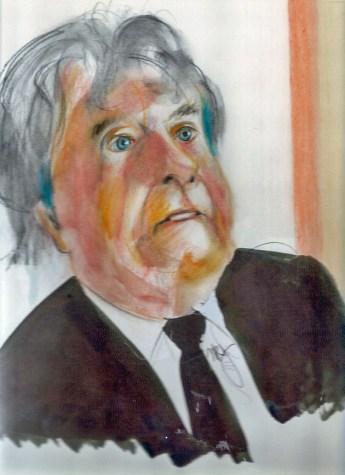
Portrait of Rudolf Buchbinder by Michael Johnson
music.
If you enjoy the content of this site, please consider making a donation towards its upkeep:
Your father, Masaaki Suzuki, must have had a major impact on your musical development as a child. Can you tell us about this, and what else inspired you to pursue a career in music?
My father had a lot of influence on me as a musician, though I never actually studied with him properly apart from at the Tokyo University for Fine Arts and Music, when I was a student in Masaaki’s class. This was quite special in a way, as I was able to see the way he works, as every other student in the class. Whilst Masaaki introduced me to the world of Baroque music, I became inspired whilst studying composition at the University of Tokyo, where I became familiar with many fascinating contemporary composers. This is especially interesting to me as the composers are still living, so I am able to see the inspiration of their compositions, relating to the world I live in now.
What have been the greatest challenges of your career so far?
Becoming Principal Conductor of the Bach Collegium Japan was a great challenge, as I was formerly the organist, and therefore my relationship with those I work with in the orchestra changed considerably. Every day presents new and exciting challenges that I look forward to tackling. Conducting an orchestra is pure fun for me!
You feature on numerous recordings with Bach Collegium Japan, and have recently been appointed their Principal Conductor. Which performances/recordings with Bach Collegium Japan are you most proud of?
The first would be ‘Bach: Cantata’s, Volume 28’ (BIS) my first recording as harpsichordist of the Bach Collegium Japan! I’m also proud of our Cantata’s Volume 44, where I played the solo part in Bach’s Organ Concerto.
Your new recording project with Antoine Tamestit sees you perform JS Bach’s three sonatas for Viola da Gamba and Harpsichord. What inspired you to take on this project?
Antoine and I have been very good friends for years, and share a love of sushi which always brings us together, and of course music. We have been talking about making a recording for a while, and it has been the greatest joy to finally work with him on this. The result has been so fruitful and I look forward to sharing this with people.
You will be making your debut at Edinburgh International Festival this season. What are you looking forward to about performing there?
I’m very happy to be returning to Edinburgh to make my debut at the International Festival. The press were very kind about my harpsichord playing last time I was here, and I’m of course looking forward to sampling Scotland’s famous whisky!
You seem to have a very busy workload! How do you make your repertoire choices from season to season?
I believe you have to enjoy making the music you choose to perform. I have always chosen music I love, and I’m happy with the results so far.
Do you have a favourite concert venue to perform in and why?
The Concertgebouw in Amsterdam is special to me as I used to live in this area. I always love visiting Tokyo’s Suntory Hall, and Wigmore Hall for its warm atmosphere.
As a musician, what is your definition of success?
I don’t have a definition of success, as such. I’m happy with the way my career is growing and developing, and believe musicians should always take a humble stance on their career. Acknowledging success might encourage you to stop striving as much, and there is always better music to be made!
What do you consider to be the most important ideas and concepts to impart to aspiring musicians? What advice would you give to a younger artist?
I once attended a masterclass given by the great Yo-Yo Ma who explained the three steps to becoming a musician. The first evolved around being confident and proud of what you are making. The second focused on overcoming your insecurities and inexperience as a young musician, and the third encouraged us to continue making music against all odds! I think this third step is the most important but also the most difficult.
Where would you like to be in 10 years’ time?
After 10 more years I hope I am still making music and still happy!
Masato Suzuki’s recording with Antoine Tamestit of J S Bach’s three sonatas for Viola da Gamba and Harpsichord is released on 23 August 2019 on the Harmonia Mundi label
Masato Suzuki joins the Dunedin Consort in a performance of keyboard concertos by J S Bach at this year’s Edinburgh International Festival. Further information
A multifaceted musician, Masato Suzuki appears on the concert platform as conductor, organist, harpsichordist and composer. His conducting engagements have seen him work with orchestras such as the Bach Collegium Japan (as Principal conductor), Hiroshima Symphony, Kyushu Symphony, NHK Symphony, Tokyo Philharmonic, and the Yomiuri Nippon Symphony Orchestras, with repertoire from Haydn and Mozart to Ravel, Tchaikovsky and Schnittke. As organist and harpsichordist Suzuki’s relationships with ensembles such as Bach Collegium Japan as well as chamber music have taken him to major concert venues and festivals across Europe and the US. In the capacity of composer, Suzuki is published by Schott Japan and has recently received commissions from Sette Voci, Tokyo Musik Kreis and Yokohama Minato Mirai Hall among others.
The Cross-Eyed Pianist is free to access and ad-free, and takes many hours every month to research, write, and maintain.
If you find joy and value in what I do, please consider making a donation to support the continuance of the site


 Emma Knights is a freelance musician, pianist, singer, producer, composer, creator and curator living in South Australia
 Guest post by Michael Johnson



 The Cross-Eyed Pianist