ABSOLUTE

J.S. Bach: Lute Suites BWV 996-998Transcribed for piano and performed by Eleonor Bindman

All my transcriptions are motivated by the desire to play my favourite music on the piano. – Eleonor Bindman

A lifelong love of J S Bach has led pianist Eleonor Bindman to produce a number of important transcriptions for solo piano and piano duo of his music for other instruments, including the evergreen Cello Suites and the Brandenberg Concertos.

In addition to recordings demonstrating ‘Bach playing of the highest order’ (Pianodao), Eleonor has also produced sheet music and anthologies of her transcriptions, primarily aimed at amateur pianists and piano teachers. Her two-volume ‘Stepping Stones to Bach’ features intermediate piano arrangements of the Baroque master’s most famous tunes, including the Gavotte from the Violin Partita, No.3, and the Badinerie from the Orchestral Suite, No. 2. In making these transcriptions, she is following in the footsteps of the master himself: Bach regularly transcribed his own and other composers’ music and created different instrumental versions of the same piece.

The resulting musical statement may be a faithful reproduction …, a transformation beyond recognition or something in between. Regardless of the outcome, the original source is of such exceptional depth and appeal that for the past three centuries it attracted a steady stream of pilgrims, ready to sacrifice their time and energy for the joy of communion.

Eleonor Bindman

In her latest project, she has turned her attention to works originally composed for the lautenwerk or lautenwerck (lute-harpsichord), one of Bach’s favourite instruments, similar to the harpsichord, but with gut (or nylon today) rather than metal strings, which results in a more mellow tone. Generally performed on harpsichord, lute, and guitar, Eleonor’s new recording of the Lute Suites brings a fresh perspective on these rarely-explored masterpieces, showcasing their intricate structures, rich textures, and emotive character on the modern piano.

Eleonor Bindman’s Bach pianism is all about clarity and order. Her strong and assertive fingerwork complements her firmly centred rhythm

Gramophone magazine

Highlights include BWV 997 and 998, featuring stunning fugues with ornate middle sections unlike typical keyboard fugues, and a heartfelt arrangement of “Betrachte, meine Seele” from St. John’s Passion, which serves as a moving conclusion to the album.

Fans of Eleonor Bindman’s previous transcriptions – such as The Brandenburg Duets and The Cello Suites – will appreciate this latest addition to the pianist’s catalogue, recorded on a Bösendorfer piano which truly captures the remarkable richness of Bach’s writing.

Eleonor Bindman writes, ‘Transcriptions can revive interest in original compositions, and I am hoping that a piano version of Bach’s Suites BWV 996, 997, and 998 will increase their popularity. Just like Bach’s other solo collections, these suites present a technical and musical tour de force for their performers and deserve their rightful place alongside Bach’s suites for keyboard, violin, and cello.’

Eleonor Bindman celebrates J S Bach’s 340th birthday and launches her new CD with a special concert at the 1901 Arts Club, London’s most stylish small venue, on Sunday 23 March at 3pm. Tickets/info here

ABSOLUTE is released on Friday 7th March on the Orchid Classics label. Available on CD and via streaming. Pre-order here

eleonorbindman.com

Ahead of the official launch of A Season To Sing, a reimagining of Vivaldi’s evergreen The Four Seasons for mixed voices and organ, composer Joanna Forbes L’Estrange offers insights into her compositional processes involved in rearranging this popular work for choir and explains why this piece is so appealing to her personally.

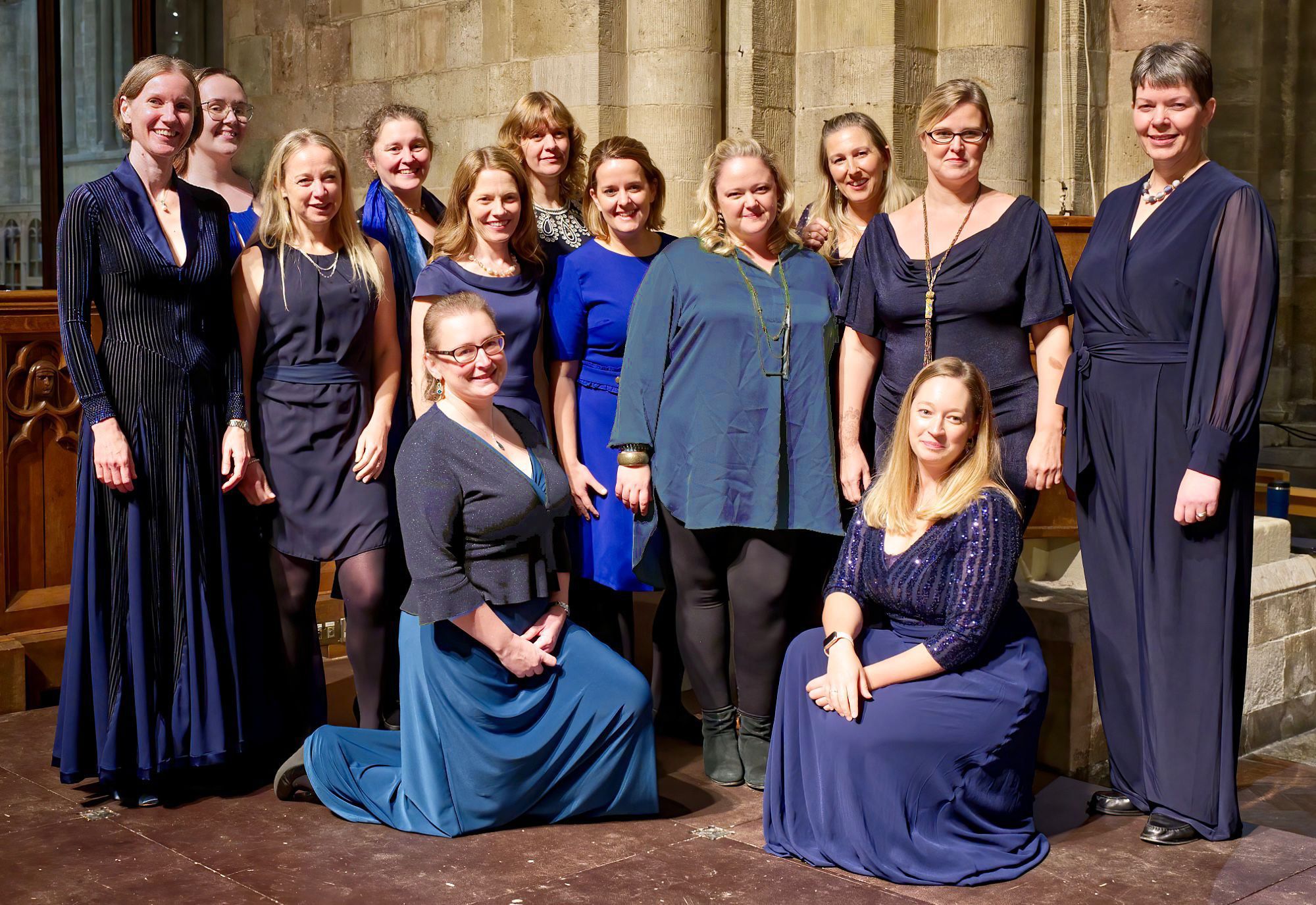
The work receives its London premiere on Saturday 22 March at St Bartholomew the Great in the City of London, perfomed by Luminosa Voices and organist Gavin Roberts. Info/book tickets here


Why Vivaldi’s The Four Seasons?

The Four Seasons is the first piece of classical music I remember listening to as a child. I have very vivid memories of dancing around the room to the 3rd movement of Autumn which is in 3/4 – my dad used The Four Seasons as a way of teaching me about 2/4, 3/4, 4/4 and 6/8 time signatures!

When I realised that 2025 will be the 300th anniversary of its publication I thought, “now’s the perfect time to make it possible for choirs to sing it!”

What is the appeal of this music for you?

One of the reasons that this particular work is so famous is because it’s programmatic – in other words, the music describes something specific – and was published with a programmatic title. Everyone, wherever they are in the world, can relate to the changing of the seasons and what makes each season different from the next. A piece called Violin Concerto in E major RV269 Op.8 No.1 has far less appeal to your average music-lover than a piece called Spring! Whereas Beethoven’s Piano Sonata No.14 in C# minor Op.27 No.2 wasn’t given the title ‘Moonlight Sonata’ until long after the composer’s death, The Four Seasons was published with that title. It was a genius move!

Vivaldi is known to have loved a series of paintings of Italian landscapes by his contemporary Marco Ricci, who was living in Venice at the same time, one of which we’ve used as the cover for the vocal score. The paintings inspired Vivaldi to write sonnets describing the seasons; the sonnets inspired the violin concertos and the violin concertos inspired me to write A Season to Sing. Perhaps A Season to Sing will inspire a choreographer to turn it into a ballet. Who knows?! This is the wonderful thing about art and artists – there are endless possibilities and inspiration comes from anywhere and everywhere.

How did you go about arranging the orchestral music for voices? Were there any particular challenges in this process, and what did you enjoy most about it?

The first stage was to study the score and work out which bits were singable. Last April, when I was just beginning to write A Season to Sing, I spent a few days in Venice to get into the zone. While I was there I attended a performance of The Four Seasons in Vivaldi’s church, sitting in the audience with the score on my lap, circling any bits which I knew would be good to sing. I’ve always approached choral composing very much from a singer’s perspective because it matters to me that everything I write feels nice to sing. With many of the movements the solo violin part became the right hand of the organ accompaniment while the choir parts were derived from the accompanying string lines of the Vivaldi. The slower movements (usually middle movements within each season) leant themselves more easily to being sung. Vivaldi’s melody-writing is absolutely sublime – sometimes I had to pinch myself to realise that they’d been written 300 years ago.

I decided early on that I wanted to keep all of the keys the same as in Vivaldi’s original. Sometimes, when you’re arranging instrumental music for voices, it makes sense to transpose into a different key, as was often the case when I was singing Bach in the Swingle Singers. I’m pleased that I chose to keep Vivaldi’s key structure because it helps my piece to retain more of the spirit of the original. Keys have certain colours and Vivaldi’s choice of keys fits perfectly with each season: the bright and joyful E major for Spring, the languid G minor for a hot and stormy summer and so on.

Tell us more about the texts you have chosen for A Season To Sing….

Sourcing the poems, hymn texts and Bible passages for each movement was an integral part of the process. It mattered to me that the words might sound as if they could have inspired the music, even though it was the other way round, of course! This meant matching their rhythms, rhyme schemes, phrase lengths and cadences to Vivaldi’s melodies whilst simultaneously enhancing his musical descriptions of different aspects of the seasons.

Vivaldi’s manuscript helpfully contains the Italian sonnets he wrote as the basis for his music. For the opening movement of Winter, I chose to adapt one of these sonnets, L’inverno, to create a soundscape. This is followed by the only wordless movement of the piece which I arranged in homage to Ward Swingle, the founder of The Swingle Singers, who became a close friend during my tenure as the group’s Musical Director. The remaining texts are from the Old Testament (Genesis, Exodus, Psalms, Song of Solomon and Zechariah), poems by two 19th-century English poets Emily Brontë and Eliza Cook, a hymn by Henry Alford and a Thomas Morley madrigal. It’s an eclectic mix into which I added the words of Ecclesiastes 3:1-8 (beginning ‘To every thing there is a season’) and set them in two movements which serve as bookends to the twelve Vivaldi movements.

In the final movement I’ve worked in a phrase from the Requiem Mass, Dona nobis pacem, (grant us peace) which helps to emphasise the ‘time of peace’ from the Ecclesiastes passage. Our world needs peace now more than ever.

What do you hope choirs/singers will enjoy in singing and performing this music?

My intention is for choirs to have a lot of fun with this piece, especially with the passages which are not so much “sung” as “performed”. For example, in SPRING there’s the birdsong chorus of whistlers and the nasal, bagpipe drone; in SUMMER there’s the call of the cuckoo and a storm created with body percussion; in AUTUMN, what were originally hunting horns are now a trumpet fanfare in praise of harvest; in WINTER the opening movement is half-sung/half-whispered to give the effect of the cold and the singers are required to shiver from time to time to maximise the effect!

As I always do when I’ve finished a new piece, I (together with my brilliant husband) have recorded every vocal line so that I can make sure that they all feel good to sing. Anything that feels awkward gets changed. So choirs can expect to have a lovely time learning and performing this piece. Nothing sits too high or too low and it’s deliberately on the easier side because I want all choirs to be able to sing it, from church choirs and chamber choirs to choral societies and community choruses and everything in between.

And what do you hope audiences will take away from the performances of A Season To Sing? I

imagine most people, even those who would profess to know nothing about classical music, have heard at least some parts of The Four Seasons before so I’m hoping that, as the performance unfolds, the audience will be thinking “ooh, I recognise that tune” from time to time. I’m also confident that by hearing a performance of A Season to Sing people might come to appreciate the genius of Vivaldi’s original concertos in a new way. Not only did he write great music but it is describing different aspects of the seasons – so clever!

Mostly I want audiences to feel joy when they hear this music. Performances should be visually as well as aurally entertaining and, because of the seasonal theme, they can happen at any time of the year. I love the idea that some concerts will be in the height of summer and others in the depths of winter! In 2025 there are performances happening all over the world. I’ll publish the list of dates and places as soon as it’s ready. I hope that everyone will be able to locate a performance happening near them and that all of the choirs who put on a concert will have a lovely, big audience of smiling faces.


A Season to Sing by Joanna Forbes L’Estrange is a choral re-imagining of Vivaldi’s The Four Seasons to mark its 300th anniversary in 2025.

Arranged for mixed voices and organ, A Season to Sing weaves into Vivaldi’s well-loved melodies with texts from poetry and the Bible on the subject of spring, summer, autumn and winter. The 40-minute work also includes a new setting by Forbes L’Estrange of Ecclesiastes 3.2 – To everything there is a season.

“…simply beautiful choral writing by someone who knows, from a singer’s perspective, how to compose music which every choir will want to sing.” – SIR JOHN RUTTER CBE, composer

A Season to Sing is a co-commissioning project with the Royal School of Church Music. The music is published by RSCM Publications and will be available from June 2025.

A Season to Sing events:

A Season to Come and Sing – a full day singing workshop, hosted by Joanna Forbes L’Estrange, followed by an informal concert. 15 March, St Thomas on the Bourne church, Farnham, Surrey. Full details/tickets

A Season to Sing – official launch concert. Saturday 22 March, St Bartholomew the Great, Smithfield, City of London. Full details/tickets

Last week I attended a reception and recital hosted by H.E. Tore Hattrem, Ambassador of Norway, and Mrs Marit Gjelten, together with Faber Music and Kode Art Museums & Composers Homes to celebrate the first ever Urtext edition of Fantasistykker (Fantasy Pieces) Op. 39 and I Blaafjellet (In the Blue Mountain) Op. 44 by Norwegian composer Agathe Backer Grøndahl. The exclusive event for leading music professionals took place at the Ambassador’s residence in London, an elegant mansion close to Kensington Palace.

Agathe Backer Grøndahl (1847-1901) was a Norwegian pianist, composer and music teacher. She studied with Franz Liszt and Hans von Bulow, amongst others, and was a contemporary and close friend of Edvard Grieg. She wrote over 400 works, mainly for piano and voice, and, like Grieg’s, her music blends Norwegian folk elements with Romantic influences. The English writer and music critic George Bernard Shaw described her as one of the foremost pianists in Europe, and at the time of her death in 1907, she was hailed as one of the great names of Norway’s musical heritage. Yet, over the following years her music was overshadowed by her famous compatriot and has remained relatively unknown, until now.

The music was performed by Christian Grøvlen, who gave some fascinating insights into Backer Grøndahl’s life and her compositional output. Although these works can be defined as “salon pieces” , they display an intriguing range of styles, textures and musical colours – at times impressionistic or nodding towards Bartokian folk idioms and dance rhythms; at other times, energetic, virtuosic and sweepingly Romantic, with a depth of emotion that goes beyond far beyond the salon miniature.  

The Fantasy pieces resemble Grieg’s Lyric Pieces yet they can also be seen as tone paintings with their programmatic titles (Summer Night, In the Boat, Bird’s Winter Song, for example). And while beauty and charm may lie on the surface of these pieces with their elegance and decorativeness, there is smouldering darkness beneath – and this is the core of Agathe Backer Grøndahl’s music.

This darkness is more evident in the suite I Blaafjellet (In the Blue Mountain), one of Grøndahl’s major works, dedicated to her sister, the painter Harriet Backer. It owes something to the programmatic music of Liszt in that the suite takes the listener on a journey, not unlike the first year of Liszt’s Annees de Pelerinage. The ‘fairytale’ suite evokes the different moods of the magical mountains of Norway, replete with trolls and wood nymphs, and from the outset, despite the relatively calm opening piece ‘Night”, there is an unsettling sense that something is afoot…. The suite builds in intensity, as the troll emerges from the mountain, heralded by portentous, almost aggressive chords, and unnerving jazz-like rhythms.

This was a splendid introduction to Backer Grøndahl’s piano music, characterfully performed by Christian Grøvlen, whose affection for and appreciation of it shone through every note.

The first-ever Urtext editions of two of Backer Grøndahl’s greatest piano works are published by the distinguished music publisher Edition Peters. Edited by Christian Grøvlen, they are based on the original manuscript and the first edition of 1898, which was out of print for many years. Now, in these new critical editions, the beauty and inventiveness of Backer Grøndahl’s writing for piano can be brought to a wider audience and enjoyed by pianists professional and amateur alike.

“I hope these new editions will make more people play, explore, understand and love Backer Grøndahl’s music” – Christian Grøvlen, pianist

 Find out more


Support The Cross-Eyed Pianist

This site is free to access and ad-free, and takes many hours to research, write, and maintain. If you find joy and value in what I do, why not

BUY ME A COFFEE

Guest post by Anthony Hardwicke


Instrumental Music Teachers as Individual Learning Coaches

In Episode 4 of his A Land Without Music? podcast series, Julian Leeks collected lots of evidence that a musical education can benefit our children. However, he stopped short of claiming that learning a musical instrument can boost a child’s progress right across the school curriculum. I believe we can and should make this claim, and the reason is simple: when children are given piano lessons, they get weekly one-to-one coaching on how to learn

Learning how to learn involves acquiring a key set of skills, such as planning, repetition, memorising, listening, feedback loops, etc. Once encountered, these can be deployed to help master other academic disciplines. Learning to learn has been championed in the past by academics such as Professor Guy Claxton. The main takeaway is that if we focus more on making children better learners, they can use their ‘learning muscles’ to make a success of other areas of their lives. 

In a weekly one-to-one piano lesson with a peripatetic teacher, the child will experience a wide variety of different approaches to learning to play the piano. The teacher might discuss the most efficient strategies for effective practice, explain how to memorise a piece of music, talk about how music theory relates to a Mozart sonata, or they might give the student an impassioned pep-talk about how interesting and exciting Beethoven is. Perhaps they might not even intend this as an outcome, but the piano teacher might find themselves auditing that individual child’s learning skills in a way that a classroom teacher simply hasn’t got time to. I really do see the peripatetic instrumental teachers in a school as a super-motivated, highly experienced team of personal learning coaches.

What nobody talks about is how easily these useful learning approaches can be applied to learning about STEM subjects (and indeed other academic subjects). To memorise eight different chords to let you play 20 pop songs, is a very similar proposition to memorising the formulae of eight different ions so as you can work out the formulae of 20 different ionic compounds in chemistry. 

Teach a child to play the piano and you will almost certainly additionally grant them regular access to an inspirational teacher who will coach them and rehearse the priceless skills they need to learn all other school subjects. In most cases, because the lessons are one-to-one, the teacher will diagnose which skills the child individually needs to develop and move forwards their ability to learn effectively. 

Whether you’re a parent who wants your child to have a competitive advantage, or a politician pondering how best to invest for future society, we must have more music education.


Anthony Hardwicke has been a classroom science teacher for nearly 30 years and is a dedicated amateur pianist.