This incredibly useful article comes from Graham Fitch’s Practising the Piano blog, which is full of sound advice and guidance for productive practising. This article chimed particularly with me, as this week I have been getting students, and myself, ready for our concert next weekend, and careful, attentive practice has been the watch word of my lessons recently.
We all have ‘black spots’ in music we are learning: sometimes these are not the most difficult passages, but such places need special attention to stop them becoming major problems, which can affect the overall continuity and flow of the music.
Drawn from yoga exercises, this sequence of warm up exercises for the pianist was devised by pianist and teacher Penelope Roskell.
Start each exercise from a ‘neutral’ stance – i.e. feet hip-distance apart, shoulders down, spine and pelvis in a neutral position, chest lifted and open, chin parallel to the ground – and keep all movements natural and free.
1. The Swing. Swing the arms forward and back, allowing the arms to fall back through their own momentum/gravity. You can be as energetic or gentle as you like. After a few minutes, your hands should start to feel warmer.
2. Empty Sleeves. Imagine you are wearing a coat but without your arms in the sleeves. With your arms hanging by your sides, twist your body slightly from side to side. Your arms should swing freely, following your torso, as you turn—one wrapping around your body in front, the other back, like coat sleeves flapping in the wind. Keep your shoulders, elbows and wrists relaxed at all times. Increase the movement to extend the swing and start to engage your feet and knees too.
3. The Monkey. Bend forward slightly and let your arms hang loosely in front of you. Swing your arms across your body at hip, chest and shoulder height. Gradually increase the movement, and notice how the opposite foot starts to engage in the move as well. Again, you can make this move as energetic or as gentle as you like.
4. Shoulder Drop. Inhale deeply (“thoracic breathing” – you should feel your chest expand noticeably as you breathe) and as you do, raise your shoulders towards your ears without tensing the neck. Hold the pose for a moment and then exhale, as if you are trying to push all the air from your lungs, while allowing your shoulders to drop down. Repeat five times.
5. Shoulder Roll. Exactly as described. Roll your shoulders forwards and up, then backwards and down, with your breath.
6. Softening the feet and legs. With your feet planted firmly on the floor, start to shift the weight from heel to toe and back again, one foot at a time. Again, gradually increase the movement and walk around the room, making sure each step is carefully planted.
7. Neck Circles. Allow your chin to rest on your chest and slowly rotate the head gently from side to side, ear to ear, in a half-circle move. Repeat a few times, being very gentle as the head comes back to the starting position.
8. Hand stretch. Hold the back of one hand in the palm of your other hand and bend it forward at the wrist. Then bend the wrist back keeping fingers and arms straight.
Balance
As with any physical exercise, work within your limits and stop immediately if you are in pain. These exercises are also very helpful in alleviating the effects of performance anxiety.
This brilliant video clip of a cat jumping in X-ray aptly and very clearly demonstrates a technique I was discussing and practising with my teacher today: keeping the wrists springy and the forearms soft and free of tension when our fingers make contact with the piano keyboard. Watch how supple and springy the cat’s skeleton is, with that “extra bounce”, which gives it the momentum to launch effortlessly into its next movement. Try translating this movement to the keyboard: practice on the fall first, allowing the arms to drop down without any tension so that the hand naturally “bounces back” as it hits the surface. As you allow the arm to fall, picture the long tendons in the shoulder stretching like rubber bands, allowing resistance-free movement through the whole arm.
What is so interesting about a technique like this is the difference it can make to the sound we produce, as well as enabling us to play in a more fluid, tension-free manner.
This exercise is not easy to explain, so while you are enjoying this video clip, I will be filming myself doing the arm exercises. Further video clips to follow….
How does it feel to play that passage of Liszt or that section of Schubert beautifully? Or the grandest measures of Bach? The tenderest Chopin? The most sensitive, haunting Debussy? To plumb the profoundest, most spiritual depths of Messiaen?
Talking with my piano tuner this morning, before he set to work facing and regulating my piano, we discussed the philosophy of playing, a conversation which began with a reference to the Chinese Tao (or Dao), and the premise that “the right way is not always the right way”, a tenet which, as he pointed out to me, I should know all about, as both a teacher and a practitioner.
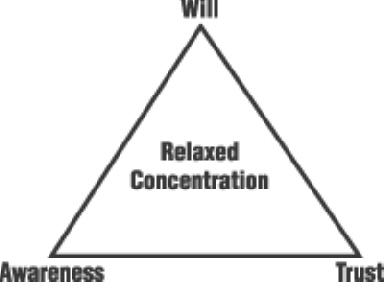
Those occasions when you’re playing and you feel yourself standing back from the music, allowing it to speak for itself, as if you are playing remotely, or floating above the piano, watching yourself play, are the most precious, and often signal the moment when a complete synergy of mind and body has taken place. It is at times like this when the most profound insights about the music might be revealed, or when we feel truly in touch with the composer’s intentions. When you feel like that, your concentration levels are at their most intense, you are “in the zone”. And yet, you feel detached, floating, at one remove….. In his excellent book, The Inner Game of Music, author Barry Green describes this as a state of “relaxed concentration”, a state achieved through “trust, will and awareness”.
from 'The Inner Game of Music'
Try to recall what it felt like at that moment. How did your body feel? Your hands? The notes under your fingers? Try to store that feeling away for next time. Put it in your memory box and bring it out the next time you practice that piece. Gradually, the more times you repeat this exercise, the whole piece will evolve into something new, better, finer, and you reach a depth of understanding hitherto not experienced.
Try it.
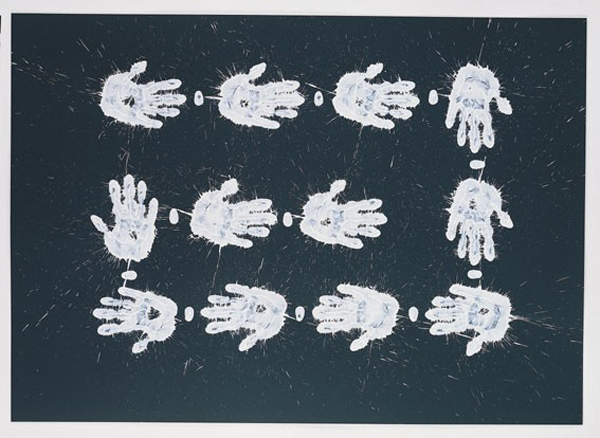
'Untitled' - Richard Long, 2005 (National Galleries of Scotland)
The Cross-Eyed Pianist is free to access and ad-free, and takes many hours every month to research, write, and maintain.
If you find joy and value in what I do, please consider making a donation to support the continuance of the site





 The Cross-Eyed Pianist