by Graham Fitch

I had the great privilege to embark on my postgraduate studies with Peter Wallfisch, studying with him from 1980 for two years (but returning on occasion thereafter). During my time with this remarkable man, my playing blossomed and I grew not only as a pianist but also as a musician. I look back on this chapter of my life with gratitude and a tremendous fondness for a teacher I came to love dearly. Last year, when I visited his widow, Anita Lasker, I walked into the studio where I had had my inspiring, magical lessons and  was overcome with emotion as so many wonderful memories flooded back.

Peter Wallfisch was born in Breslau in 1924, and had sought refuge from Hitler’s Germany in Jerusalem and Paris before settling in Britain in 1952. His tenure as a professor of piano at the RCM was from 1973 to 1991, during which time he influenced many notable pianists now active in the profession. He was head of a musical dynasty that includes his wife Anita Lasker-Wallfisch, (cellist and founder of the ECO), son Raphael (international concert cellist), daughter-in-law Elisabeth (noted violinist), grandsons Benjamin (composer and conductor) and Simon (cellist and tenor). Peter was a musicians’ musician who is remembered not only a solo pianist but as an ensemble musician. His lineage was the Germanic tradition from Bach right through to Reger and Krenek, but he also championed very many British composers (including Kenneth Leighton, whom he raved about) and other slightly unusual composers (such as Novak). He confessed to having a passion for organ music, and he was not overly keen on Chopin or Rachmaninov.

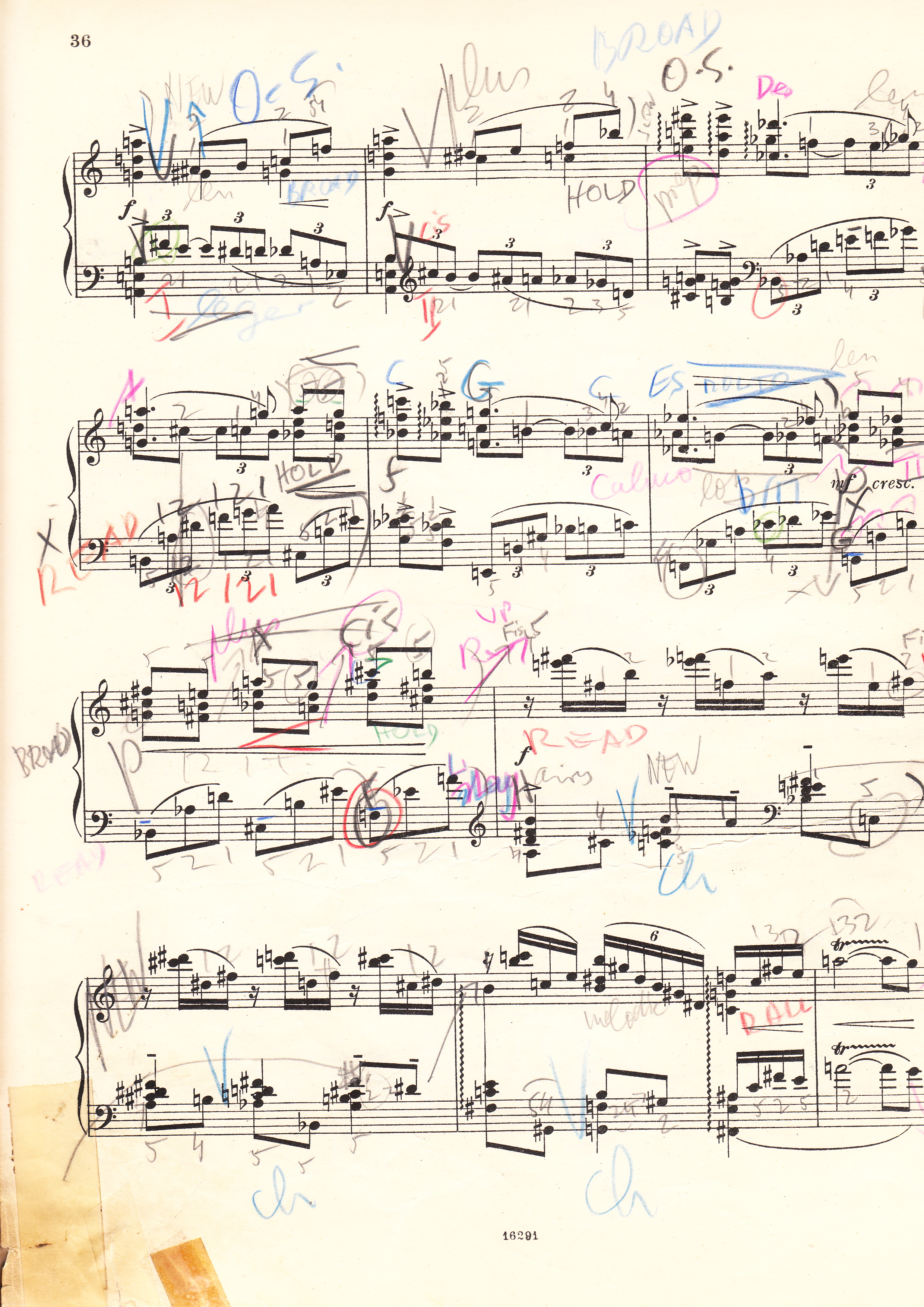
One time I arrived for my lesson and Peter was not in a good mood. Sensing this, I asked him if he was OK and he pointed to a stack of scores on his desk, bemoaning the fact that he had been roped into learning it for the BBC and for concert engagements. It turned out to be by Frank Bridge, whose music at that time had fallen into neglect. The following week, I asked him how he was getting on with it. His face lit up and he enthused for many minutes on the undiscovered qualities of this music and how wonderful it was. Peter was at the forefront of the revival of interest in Bridge’s music, which rubbed off onto me. He immediately suggested I learn the two pieces “In Autumn” and I had much success with them. Among my prize possessions is Peter’s score of the sonata, littered in his inimitable way with crayon and pencil markings that only he could make sense of, certainly a testament to a practical musician!

I was officially registered for lessons with Peter at the Royal College of Music, but after a while my lessons moved from room 68 at the RCM to Peter’s home in Kensal Rise. Not only did I occasionally get to stay for tea and wonderful conversation with Peter and Anita (and Millie the cat), but my good fortune extended to lessons which went on all afternoon.  Three hours was the norm, always without a break, and usually on just one work. He gave of himself unstintingly and generously and as I was walking down his garden path after the lesson, I felt that I had been given the ultimate secrets to the music we had just worked on. This went way beyond a mere piano lesson. There was one time I took a very half-baked Beethoven’s op. 109 sonata along, and yet after my lesson felt that I could almost have deputised for Barenboim that very night, such was the completeness of my understanding of Beethoven’s message. There were many such experiences where I left having had more than a lesson, but a Gestalt of the music – an experience of the essence of the whole picture even though my playing of it might yet be primitive. Pieces that stand out are the Brahms-Handel Variations, Bartok’s Third Concerto, Mendelssohn’s “Variations Sérieuses”, some Debussy and plenty of Bach, Mozart, Haydn and Beethoven…

It is difficult to describe how Peter taught. One thing I can say is he never, ever talked about piano playing as an activity in itself. His comments were always about the music. He would hear what I had brought in and would always give a totally honest appraisal of what he had heard. He was never one to mince his words, thus you could always rely on his reactions and comments as a very accurate barometer of how you’d done. If he didn’t like it, you would certainly know; if he did like it, he could ooze genuine enthusiasm and encouragement. You always knew where you stood with Peter.

Technical difficulties seemed to melt away, since through his lengthy verdicts and fabulous verbal descriptions of what he wanted to hear (he rarely demonstrated) you were literally infected with a mental and aural picture that left no doubt as to how the piece should go. There were so many times when, before he had finished talking, I was itching to play again because I knew exactly what he meant. After he had said what he needed, I would play again. What was difficult before now often wasn’t at all because I had an ultra clear picture of the sound, of the composer’s meaning. If you did ask for technical help – I mean specific pianistic help – he might even get annoyed. He really did not like talking about piano playing per se. Once I asked him what exercises he practised (I knew he had quite a warm-up ritual for himself). Again, he dismissed my question, saying that he did not want to burden me with it, nor did he like to do his dirty laundry in public.

There are SO many individual lessons I remember crystal clearly. During a lesson on op. 109 I missed a sforzando accent in the second movement and received a very painful dig in the ribs which taught me way better than words could have. Now, whenever I get to that place in the sonata, I feel a psychosomatic twinge of pain. There was the tail end of someone else’s lesson who crowed that he had managed to learn a Beethoven sonata in a week. Peter went red in the face and exploded: “How dare you say that! It took Beethoven months of time, sweat and blood to write that sonata, and you claim you can play it in one week!”. Another lesson that stands out for me was on a Bach Prelude and Fugue. After I finished he told me it was excellent and that he could not fault it. But I noticed a trace of disdain in his voice, and sure enough he said to stop it sounding sterile and boring, I had to find my own voice with the piece. When pushed, he made a few vague suggestions but would not be specific and it took a while before I figured out what he meant, that he expected me to take personal ownership of the piece.

Even after I had gone to America on my Fulbright Scholarship, I would return to Peter to play for him. I always received the same warm welcome and uncompromising advice. His influence is still with me to this day. I very often think of him, and I still miss him!

Graham Fitch is a London-based pianist, piano teacher, piano adjudicator, piano examiner, piano lecturer and writer/commentator on piano. www.grahamfitch.com

Obituary of Peter Wallfisch in The Independent


This question seems particularly pertinent as I help prepare another crop of students for their piano exams. The question was, in fact, put to me last week by a student of another teacher (Clarinet) who came to me for some extra aural training ahead of his Grade 5 exam next week. I found myself quoting from the ABRSM website when I said “Aural tests help to train your musical ear, and to help you make an important link between listening to music and playing music”.

I think most of us who took music exams as children would agree that, along with sight-reading, the aural tests were the most dreaded element of the graded music exam. I can still remember being “trained” by my music teacher at school, Mr Weaver, and, in my nervousness, finding it almost impossible to sing a simple major third or fifth. (I was also tested for perfect pitch when I was about 12, in front of the entire class, which was excruciating and cringe-makingly awful.) One of my students, Laurie, absolutely refuses to sing for me and so when we come to the part of the test, where he is required to sing an echo, we mime (or I sing it for him), on the strict understanding that he will sing at his exam!

Joking apart, as well as forming an integral part of the graded music exams, training the musical ear is a crucial process for the developing musician. Intelligent and informed listening lies at the heart of good music making, whether listening to others, or to oneself, and is fundamental to music training, especially for performance. The key aspects from the Prep or Initial stage are:

  • Identifying and clapping a pulse
  • Clapping a rhythm
  • Singing and echo or pitching notes in a sequence
  • Identifying simple features in an extract of music – e.g. detached or smooth playing, loud or soft

As one proceeds through the graded exams, additional skills are tested

  • Identifying a rhythmic or pitch change in an extract of music
  • Identifying features such as staccato, legato, dynamic, tempo or key changes
  • Singing and identifying intervals
  • Identifying cadences
  • Learning to appreciate music from different periods – e.g. Baroque, Classical, Romantic, Modern, Jazz

What bothered me while working with the other teacher’s student last week was that the child had no idea why he was required to take an aural test, hence my explanation about training the musical ear. Being able to identify a pulse is crucially important, for any musician, and those of us who have played in ensembles or orchestras can surely still remember the player/s who could not keep time. I regularly do pulse and rhythm exercises with my teacher, and anyone who has learnt ‘Bah-Ba-Doo-Bah’ (John Kember, ABRSM Grade 2 syllabus) with me this term has had to do a lot of clapping and counting to master the syncopation in this piece.

Singing is also incredibly useful as a musician, and I often sing (not especially well!) to demonstrate a line of melody or the shape of a phrase. So much music follows a “singing line”, and singing a phrase rather than playing it demonstrates “natural shaping” which comes from the innate rise and fall of the human voice. It’s a pity that so many students are reluctant to sing because I think if they were more prepared to try it, they would find phrasing music so much easier.

When I worked with the clarinet student last week, I was astonished at his lack of knowledge of music history and the distinct periods in classical music. He did not even realise that the piece he played for me was jazz! He came armed with a book on how to improve your aural, and, flicking through it, it fell open on a page about the main periods of classical music. Each one – Baroque, Classical, Romantic, Modern – had four bullet points identifying the key features. When I played an extract of a Gershwin Prelude (No 2 – the middle section) he reeled off the salient features of Baroque music – and my heart sank.

If one doesn’t develop an appreciation and understanding of different kinds of music – and not just ‘classical’ music, but jazz, rock, pop, world, ambient, electronic etc – how can one properly understand how to interpret and play a piece properly? One of the first things I do when looking at a new piece with a student is set the music in context. When we study Bach, we look at the kinds of keyboard instruments he was writing for (I have pictures loaded onto my iPad) and listen to Bach played on the harpsichord or organ. While working on a simplified version of Schubert’s ‘Trout’ with a student recently, I played both the sung version and the quintet to him. Result: the next week he was beginning to play the piece with clearer phrasing and a nice sense of the “song line”.

I was very fortunate when I was growing up: my parents were keen concert-goers and LP buyers, and of course there was live music in the house because my father played in both a wind ensemble and an orchestra. From a very early age, I went to concerts, and my tastes and knowledge developed quickly. Listening and playing were normal activities for me – and remain so today. But many children who are learning instruments now are doing just that – learning the instrument, without being taught an appreciation of music. Perhaps their parents are not interested in music, or the school is not encouraging an appreciation? I admit I’m on something of a mission to encourage my students to both play well and to love music: if just one or two of them remember what they did with me as students when they are browsing iTunes or similar when they’re older, and they download some Beethoven piano sonatas, or one of Schubert’s String Quartets, then I can consider my job well done.

So, there is a lot of point to aural – and it is important for us, as teachers, to explain WHY!

This brilliant video clip of a cat jumping in X-ray aptly and very clearly demonstrates a technique I was discussing and practising with my teacher today: keeping the wrists springy and the forearms soft and free of tension when our fingers make contact with the piano keyboard. Watch how supple and springy the cat’s skeleton is, with that “extra bounce”, which gives it the momentum to launch effortlessly into its next movement. Try translating this movement to the keyboard: practice on the fall first, allowing the arms to drop down without any tension so that the hand naturally “bounces back” as it hits the surface. As you allow the arm to fall, picture the long tendons in the shoulder stretching like rubber bands, allowing resistance-free movement through the whole arm.

What is so interesting about a technique like this is the difference it can make to the sound we produce, as well as enabling us to play in a more fluid, tension-free manner.

This exercise is not easy to explain, so while you are enjoying this video clip, I will be filming myself doing the arm exercises. Further video clips to follow….

A conversation with one of my adults students this week prompted this post. Sarah is a very confident woman in her mid-40s, who runs her own business, and who started having lessons with me, as a complete beginner, three years ago. She took Grade 1 last Spring and passed with a Merit. Spurred on by her success, she decided to study for Grade 2 and will take the exam in July. She’s worked really hard, and is playing far, far better than she was a year ago. Focussed and articulate about what she wants from her lessons, it surprised me when, at her lesson yesterday, she admitted she was having serious problems with the Bach/Petzold Minuet in G minor (ABRSM Grade 2/List A). She played it perfectly well, a little hesitant in places, but she made a good attempt at the mordents and other ornamentation, and was clearly thinking about how to shape the music.

“So, what’s the problem?” I asked when she had finished. “I thought that sounded really good.”

“It’s because it’s Bach!” she replied. “I can’t believe I’m actually learning music by Bach!”

So, somewhat in awe of the music, she was finding it hard to focus on her practising. I knew exactly what she meant: I had a similar experience when I started learning Chopin’s First Ballade last summer. Now, would all professional pianists, and those amateurs who have mastered such big, virtuoso works, please stand aside for a moment, and allow me to explain. When I first started taking lessons again as an adult, nearly three years ago, my confidence and self-esteem were pretty low. A brief, but unsettling experience with a less than savoury piano teacher in 2007 had not helped, plus I was getting no support from anyone, least of all my family, about my music. I was working entirely alone, with no one to critique my playing or reassure me I was “doing it right”. My current teacher is the most patient, skilled and supportive teacher I have ever had, and with her encouragement, I have overcome both my shyness about playing for others, and my inability to trust my musical self and tackle advanced repertoire. When she suggested I learn one of the Ballades or Scherzi, I knew she had not suggested it just to please me: she knew I could cope with it. I started learning the G minor Ballade that same afternoon…..

Playing it for my teacher at my next lesson (I’d learnt about a third of it by then), I was doing fine until I reached the beautiful, lyrical section before the restatement of the opening theme. I was really enjoying playing my teacher’s beautiful antique Bluthner, but then I remembered I was playing a Chopin Ballade, one of the big warhorses of the concert repertoire, and I found myself completely in awe of the music, and its composer. Tense and unable to focus, it all went to pieces…. Amazed at the sheer beauty and inventiveness of Chopin’s writing, I couldn’t quite believe I was actually playing the piece, to my teacher, on a Wednesday morning in north London: in my mind, I was playing to a full house at the Wigmore Hall, with the ghost of the composer at my elbow, nodding benignly as if to say “Yes! That is what I meant.” Such wide-eyed fantasising does no harm, now and then, but it can prevent one from getting to the heart of the music so that one can begin a serious study of it.

This, I think, was my student’s difficulty as well. In the early grades, the pieces are simple and often aimed at children, and many are written especially for the syllabus, I suspect. While some of the pieces are really imaginative (John Rowcroft’s ‘African Dance’ from the previous syllabus, for example), it is always refreshing to come across “real piano music”, and I think an early student can feel daunted, perhaps by the responsibility that is placed on one to interpret and play it well.

I pointed out to Sarah that the Minuet in G minor comes from the ‘Notebook for Anna Magdalena’, a collection of pieces, in two volumes, which Bach presented to his second wife. It is quite possible that these were pieces Mrs Bach, and other members of the family, played at home. This was domestic music, to be enjoyed by the family. These were not concert pieces, nor music for the church, though there are suites and partitas, and chorale settings amongst the works. With this in mind, I urged Sarah to stop being so much in awe of the piece and to simply enjoy playing it (while practising it carefully too, of course!). It is rather plaintive and elegant, and benefits from careful articulation and shaping. The ornaments are not too demanding, and offer a good introduction to Bach’s ornamentation in general.

Crass as this might sound, it’s important not to get too overwhelmed by the music. Allow yourself to stand back from it, give yourself some perspective. Marvel at the genius of the composer, but don’t be afraid of it! Study it, play it, and, most importantly, enjoy it.

Minuet in G minor – attr. Petzold