Guest post by Frances Jones


A few weeks ago I slipped on an icy pavement and fractured my right hand. There was a scary moment when I was told the break might be a serious one, and difficult to heal, but that proved to be a false alarm and the hand is almost back in normal use.

The injury, though, proved to have interesting consequences for my piano teaching, and got me thinking about motivation, a topic often in my thoughts concerning my students, who are currently between the ages of 4 and 11.

Because my right hand was immobile, I dictated homework notes to the older children to write in their practice diaries. (The younger ones made do with the squiggly efforts of my non-dominant hand.) Two particular children took this responsibility very seriously, to the extent that they are continuing to write their own notes and adhering to them, too. One of these children hadn’t been very motivated of late; she mostly did what was asked in terms of practice, but seemed to be going through the motions, rather than actually enjoying playing. Now, she makes annotations to the music, adding fingering or reminders of articulation and seems to be enjoying the piano once again. The difference in her playing is marked; there’s an expressive quality there that I hadn’t heard for months. There could be many different reasons, of course, for the change of attitude, but I think the shift in ownership has played a part. The child knows now that she is responsible for her own progress but I haven’t had to tell her that. The process has taught me a lesson, too; that for some children doing as much as possible for themselves is a real motivator. For others, it’s not important; they still have the intrinsic motivation they started out with.
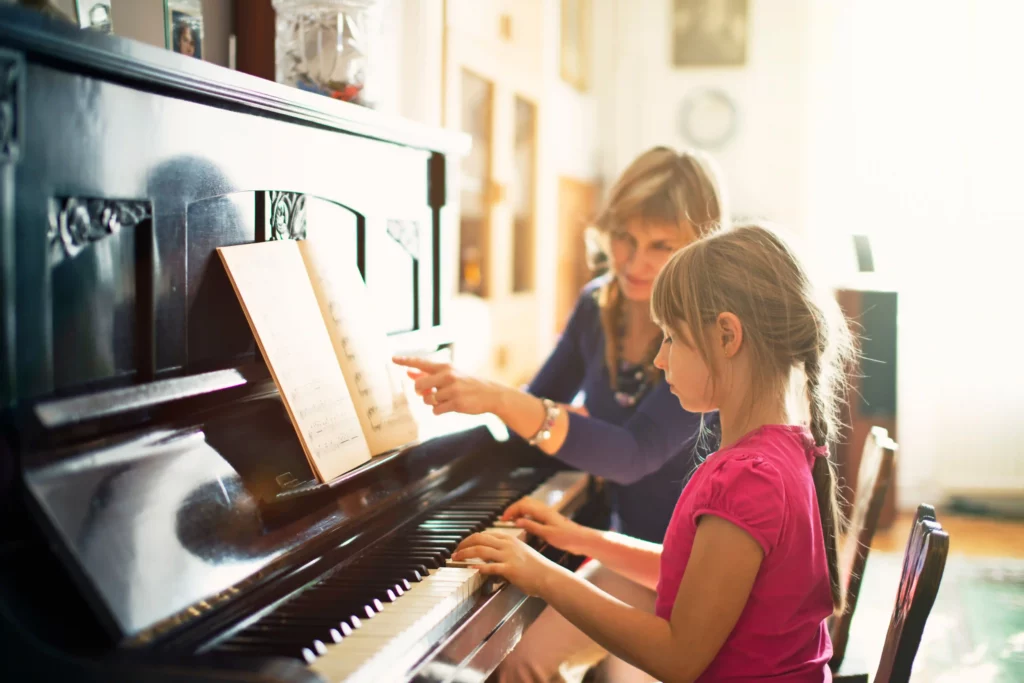
Over the years, I’ve found that most children are motivated to play at first because they like the sound of the piano and take pleasure from being able to create that sound. (Very occasionally, a child has no interest in the instrument but his parents wish him to learn. Honesty, or extrinsic motivation are the options here.) Keeping hold of that initial motivation is key, and all teachers of young children have their own thoughts on how to do this. Here are mine:

Performing. This depends on the child, but I have found in schools that most children love to play in assembly or to their class and will devote considerable time to practice if they have this goal.

Being the teacher. A pupil of six was thrilled to tell me recently that he had taught his younger sister how to play a tune. Some children enjoy teaching their friends. I say to children they can teach their mum/dad how to play and younger children often love it when their parents can play a duet part.

Composing/improvising. I do this from time to time in lessons and with some children it really absorbs their interest and allows them to enjoy and explore the range of the piano. Writing down their melody is a good way to revise or bring in notation.

Learning a well-known tune. Many children, especially older ones, really want to be able to play specific pieces. Mastering a manageable version of a song you like can be very rewarding and I think helps some children continue to play when they might otherwise have given up.

Stickers. My use of these is extremely judicious and only for those up to the age of 8. I find that if a child manages to do something he’s been trying to achieve, the satisfaction of accomplishment is reward enough. For the youngest, the excitement of playing the piano is similarly, quite a match for a humble sticker and that excitement must be retained. Having said that, some children love making collections and if a sticker helps a child practice, I would certainly advocate being generous.

Praise and positivity. There are different schools of thought on this. My view is that children really value praise when it is earned and therefore, used truthfully, it is immensely helpful to progress. I find this is particularly true with children who are in a cohort with many high-achievers and feel they are never going to catch up. Sometimes a child needs convincing they are playing well, even if it’s a simple tune.

As a teacher, I’m conscious of the need to retain that initial interest and enjoyment so the child doesn’t lose sight of why he is playing and practising. Even the most well-intentioned child (and adult) can suffer a dip in motivation whilst navigating the distractions of modern life. Frustrating, yes, but truly rewarding when a little creative thinking puts things back on track.

Frances Jones teaches piano in SW London. She has also taught and led music provision in London prep schools.

Renowned educator, writer and clarinetist Paul Harris, author of innumerable books on sight-reading, music theory and music teaching as well as original compositions, led a seminar based around the ideas set out in his seminal book T’he Virtuoso Teacher’ (Faber, 2012).

The book focuses on the core issues of being a teacher and the teaching process. By examining topics such as self-awareness and the importance of emotional intelligence, getting the best out of pupils, dealing with challenging pupils, asking the right questions and creating a master-plan taking the stress out of learning teaching for the right reasons, Paul Harris offers an inspirational and supportive read for all music teachers, encouraging everyone to consider themselves in a new and uplifted light. The book formed the basis of Paul’s presentation, with plenty of opportunities for discussion during the breaks and in a Q&A session at the end of the seminar. I read Paul’s book when it was first published and found it very empowering, yet much of what he suggests is both simple and easy to put into practice in the teaching environment.

These are my notes taken during the seminar; by no means comprehensive, I hope they will provide a useful overview of Paul’s approach and the philosophy of the Virtuoso Teacher.

Definition of a ‘Virtuoso Teacher’

  • Not someone who teaches virtuosi
  • Nor a virtuoso player themselves (as Paul said, virtuoso players may be fine instrumentalists, but are not necessarily the best teachers)
  • A virtuoso teacher takes teaching to a virtuoso level through being collaborative, imaginative, engaging, non-judgmental and energetic.

Just as a virtuoso performer has qualities such as a sense of communication, secure technique, and a sense of artistry so the virtuoso teacher has the same qualities. But instead of playing to an audience, the virtuoso teacher works with students.

The virtuoso teacher has a heightened awareness of what is happening, is mindful, has a profound understanding of the instrument, technique, musicality and a deep knowledge of our pupils. The virtuoso teacher encourages pupils to reach their own infinite potential.

WHAT WE DO

The special things….

  • Teach music for its own sake
  • Guide pupils
  • Show possibilities
  • Open minds
  • Enable pupils to become independent learners and teach themselves

The word “teach” comes from the Old English world tæcan (“tee-shan”) meaning to “show”, or “point out”, but not “tell”.

The virtuoso teacher does more than teaching the instrument and pieces: the virtuoso teacher encourage pupils to really know music and enable all pupils to achieve, taking into account the needs and desires of all our pupils.

For the virtuoso teacher the process is more important than the outcome (i.e. exam or competition results, assessments or performances, all of which are stressful situations and which lose the enjoyment of “now”). For the pupil, learning to play an instrument or sing should be a happy experience. Unhappy or stressed students don’t learn (physiologically, the brain stops releasing hormones which enable us to take in information when we are stressed). We develop our pupils’ self-responsibility and turn mistakes into opportunities. We share our love of music and encourage our students to develop this love too. We make our students confident and independent.

Personal qualities of a Virtuoso Teacher

  • An excellent communicator
  • Certain, but never absolutely sure
  • Open-minded
  • Adaptable and flexible
  • Still learning
  • Focused (on the pupil)
  • A good role model
  • Good-humoured
  • Patient
  • Proactive
  • Innovative
  • Having good judgment, but never judgmental
  • Kind and caring
  • Reflective

How we teach

The “process” of the lesson

  • Warming up (e.g. stretches away from the instrument or use an aspect of the first piece as a warm up exercise)
  • Find ingredients and connections within the piece
  • Offer achievable, well-explained instructions (done well, this is unlikely to lead to mistakes, or will reduce mistakes)
  • Give well-expressed, clear feedback
  • Ensure the lesson is energising and always moving forward

When giving feedback, first wait and then notice the way the pupil reacts to the feedback. Positive feedback motivates and allows us to be effective because it empowers the pupil. We need to nurture, not control. As a result, pupils are

  • Confident
  • Happy
  • Enthusiastic
  • Motivated
  • In sum, the “virtuoso pupil” knows how to learn.

Dispelling the “myth of difficult”

  • Learning how to achieve
  • Removing obstacles
  • Encourage through a thorough and meticulous approach
  • The quality of our students’ understanding is better than the quantity of their work.

High-satisfaction teaching allows the lesson to flow and for pupils to be musical. They will also make fewer mistakes, feel less stress, feel less constrained by structure, which allows them to achieve. Lessons become positive with a spirit of discovery.

  • Simultaneous learning and simultaneous practising:
  • Teaching proactively
  • Making connections using the “ingredients” of the piece
  • Positive
  • Non-judgmental

Pupils need to practise in a way which matches this

  • Integration – refer to practising during the lesson
  • Representation – make practising interesting and engaging
  • Connections – ask how the practising went in the intervening week between lessons

This enables pupils to see how lessons and practising join up.


Teaching a new piece using the Simultaneous Learning process

Know the ingredients of the piece:

  • Key
  • Rhythm
  • Pulse
  • Time signature
  • Dynamics
  • Character

Don’t overload the pupil with information but know how much the pupil can take in.

Allow the lesson to unfold around the ingredients using various element, e.g. improvisation based on a rhythm or short motif within the piece.

Use Q&A and demonstration. Talk about practising as you go along. Practising should be fun, engaging and collaborative.

  • Don’t hurry
  • Make connections
  • Empower the student
  • Check the student has understood all the instructions given
  • Teach the right things at the right time
  • Be imaginative
  • Encourage flow
  • Collaboration
  • Encourage students to know their music
  • Encourage students to become independent


WHO WE TEACH

We need to get to know our pupils (but never interrogate them!)

  • Interests
  • Prior learning/knowledge
  • Vocabulary (important – so that we can communicate with them at the right level)
  • Preferred learning style, i.e. visual, auditory or kinesthetic
  • Gender difference
  • Relative speed of learning
  • Level of motivation
  • Expectations (pupil’s and parents’)
  • Psychomotor skills (e.g. finger dexterity)
  • SEN
  • R/L brain development
  • Experience and background
  • Maturity
  • Parental involvement

Having this information allows us to personalize our teaching to be more effective.


Managing expectations

We live up and down to expectations (the ‘Pygmalion Effect’)

“As the teacher believes the student to be, so the student becomes” (Rosenthal & Jacobson)


  • We should have high but appropriate expectations and the student will live up to them.
  • We have different expectations for different students
  • Don’t base expectations on pre-determined criteria (e.g. exam results)
  • Don’t compare students, especially negatively
  • Discourage pupils from comparing themselves to their friends/peers – explain to a Grade 1 student that the Grade 7 student is not “better”, just “more advanced”
  • Focus on achievement rather than attainment: pupils can achieve continuously
  • Encourage self-comparison: “How am I doing?”
  • Encourage students to hear friends playing in a positive context: peer support is very important.
  • Celebrate every student’s strengths
  • Have positive and appropriate expectations
  • Create a positive teaching environment
  • Labels are not helpful – there are no “bad” pupils! (but there are plenty of bad teachers!)
  • All pupils are able – different, but able


Giving praise

It needs to be appropriate and appreciative. Judgmental praise causes dependency and builds up an ego which can produce anxiety


Examples of appreciative praise:

“I enjoyed that”

“that was really accurate/musical”

“That practise has really made a difference”


This allows pupils to draw their own conclusions about their playing


Praise what they are doing or their effort, not the ego or talent.


Praise followed by criticism is not helpful.


Sincere praise goes a long way and creates a sense of trust.


Using questions in lessons

Good questioning is very valuable and can be used to

  • Check knowledge and understanding
  • Encourage understanding
  • Encourage recall of facts and information
  • Diagnose difficulties and involve the pupil in the “cure” (e.g. tension, problematic fingering scheme etc)


Questions also encourage students to think, engage, apply and reflect. Use open-ended, thought-provoking questions, e.g. “What do you like about this piece?”


Getting the best out of our pupils


  • The way we are and how we respond to our pupils
  • The way we manage expectations (of pupils and parents)
  • The care we invest in teaching methods
  • The level of positivity and love of our subject
  • Ensuring pupils understand what they are doing


In conclusion


Our values and beliefs colour the way we are and drive our thinking and teaching. We should be certain, but never absolutely certain, and we should always look outwards.


The present

  • The Power of Now
  • Living in the moment
  • Grasp opportunities and run with them, while always keeping an eye on the future
  • Using aspects such as applied psychology and physiology (e.g. understanding the reasons for warming up before playing), and using technology to enhance our teaching (e.g. internet, apps).

Teaching now

  • Teach laterally and holistically
  • Be proactive
  • Take care of our personal accountability
  • Make connections
  • Understand and appreciate what our pupils need
  • Use wisdom – how do we use our knowledge? We guide our pupils to enable them to progress.
  • Be honest (i.e. honest evaluation of our students, and in our dealings with parents)
  • Have courage – take risks and be prepared to tackle issues
  • Give our students our unconditional support

The Virtuoso Teacher wants to create well-balanced musicians who are driven by a love of music and a desire to sustain this great art.


Never forgot – teaching is A PROFESSION!

More about Paul Harris and his publications and other resources here


What is your first memory of the piano?

I saw and played a piano when we were visiting one of my father’s colleagues at his family home. It was a long visit, and I had time to explore: I fell in love with it at first sight and although I was around 4 years old, I remember I sat and tried to play using my fingers. I was glued, and although my parents looked a bit embarrassed I had taken over somebody’s possession, they were clearly impressed. Apparently our hostess tried to impress on my parents I should start lessons.

Who or what inspired you to start teaching?

My piano teacher in Greece, the well-known concert pianist and pedagogue D. Toufexis, a Julliard graduate and former Lateiner pupil along with concert pianist Danae Kara, both staff at The American College of Greece, inspired me to maintain a portfolio career. I loved how I could go see them perform at major venues and festivals and then have the privilege of private conversations and lessons with them.

Who were your most memorable/significant teachers?

The teacher who inspired me to become a musician was the head teacher of a large, state primary school in a well-to-do leafy suburb of Athens. He was himself a frustrated violinist with real passion for music education. His class produced three concert pianists (me included), one musical theatre singer-actress, and a musicologist. Yet the school was an ordinary non-selective state one.

Who or what are the most important influences on your teaching?

I finished my studies at the conservatoire in Greece, yet I knew that I could not trust myself to teach. When I came back from my Master of Music studies in the US at West Chester University of Pennsylvania (1994), I felt I could tackle anything: intensive courses in piano pedagogy were compulsory and included teaching practicums under supervision. At the end of my studies, my teachers were very eager to impress on me the need for certain books which became my bibles, especially the Denes Agay books on Teaching Piano, and were packed in my already impossibly heavy suitcases. Greece at the time felt quite cut off in many ways, and I still remember sending and receiving letters to the US which took about a couple of months: this was the era before Internet and Amazon!

Most memorable/significant teaching experiences?

Despite having taught at all levels for at least 20 years, I still remember being 10 or 11 and helping my friend practice her sonatina. After about 20 minutes her mum couldn’t help herself anymore and stormed in with my mum to stop me from what she thought was merely distracting my friend. My friend whispered “thank you”, as I had helped her to repeat sections rather than play through mindlessly. Years after, when we met again, the first thing she remembered was how grateful she was for helping her practice that one time. I’m sure her mum is still not convinced, but I know it was the earliest confirmation that I could actually be of real help, and is certainly my fondest memory.

What are the most exciting/challenging aspects of teaching adults?

I’ve been teaching adults almost from the beginning of my career. Challenges, except for time constraints, include self-imposed limitations, mainly arising from clashes with self-image, and definitions of achievement and prospects. That’s why my best adult student to date is a hard working dad of three who is totally committed to his lessons because he sees it as personal growth.

What do you expect from your students?

A certain level of commitment: I can inspire, demonstrate and explain, but I can’t force them to practice. There needs to be an initial interest, and in the case of younger students, there has to be parental support.

What are your views on exams, festivals and competitions?

Exams and festivals can be great motivators while providing benchmarks of attainment. Competitions are both exciting and a necessary evil: as long as there are transparent selection processes they have a place in one’s development. I think it is important for a musician to enter any form of competition trying to achieve playing their personal best (rather than focusing on being better than the other competitors). At the same time it is important to come into contact with one’s peers. What I do not like is the message that one has to comply with what’s expected – and certainly there are pianists who are unhappy at the suggestion of modifying their affinities for certain repertoire. I also do not condone excessive emphasis on performativity at younger ages: young children and teenagers should not be criticised for being their awkward selves on stage, especially if this does not interfere with projecting the music.

What do you consider to be the most important concepts to impart to beginner students, and to advanced students?

Smart practice, healthy posture-technique, and fingering, along with reading notation and counting are all concepts presented from the very first lessons and reinforced throughout the studies. Style and phrasing, along with pedalling, however, take a lot of exposure to repertoire and are more gradually introduced.

What are your thoughts on the link between performance and teaching?

My preference is for teachers who teach by example, as I found it most exciting to watch my own teachers perform. I am therefore a performer who teaches pupils how to perform on the piano, rather than how to play the piano. To perform is more than just pressing keys as instructed through notation: it is to communicate without the burden of words. The process of learning to perform is a complicated one of empathy with the perceived intention of the composer, and of enculturation.

Who are your favourite pianists/pianist-teachers and why?

Martha Argerich is a firm favourite for her transcendental technique, as are the Labeque sisters. I saw the Labeque sisters perform live in Greece and their communication and poise were simply amazing. From my own teachers, Dimitri Toufexis taught me a lot about projecting phrasing through physical gestures, Danae Kara stepped in as my mentor at the early stages of my career and pushed for a totality of conception in extended works. Dr. Bedford introduced me to Alexander Technique and Tai Chi to focus the mind, and my dearest Dr McHugh taught me how to control my hands and the piano keys in what she termed “slow key-depression”. Martino Tirimo and Elena Riu will always occupy a special place for being so flattering and incisive as duet coaches.


Natalie Tsaldarakis is a concert pianist and member of the Ivory Duo Piano Ensemble. Natalie has also been active as a lecturer, piano teacher and examiner since the 1990s.

In 1994 Natalie was invited to membership by the American National Music Honour Society Pi Kappa Lambda for excellence in performance and she has been the recipient of numerous awards and prizes, including first and second place winners in piano competitions in the US, and Greece (MTNA Wurlitzer Collegiate Competition, West Chester State University Concerto Competition, the Pottstown Orchestra Competition, Deree College Faculty Development Award, WCU Graduate Development Award etc.).

Since 2005 Natalie has been based in London, UK. Between 1995 and until 2005, Natalie was artist teacher in residence at the American College of Greece as well as piano professor and examiner for Greek conservatoires of music including the National Conservatory of Greece.

Natalie has performed extensively at various venues and festivals in the UK and abroad, including the Southbank Centre, St John’s Smith Square, Oxford University, St-Martin-in-the-Fields, Glasgow City Halls, Sibelius Academy, Athens Concert Hall, Fairfield Halls, Winchester Cathedral.

Natalie has recorded both solo and with the Ivory Duo Piano Ensemble for the National Greek Radio (ERA-1, ERA-3), and has appeared on Greek television, and UK’s Resonance FM 104.4. The duo’s CD “Romantic Dance Music for Piano Duet” was requested by the Archive for Greek Music and Musicians (Lilian Voudouris Library, Athens Concert Hall) and hailed as an important musical event of international standing by the Greek specialist press.

http://natalie6784.wix.com/ivoryduopiano

https://m.youtube.com/Ntsaldaraki

http://www.twitter.com/Ntsaldaraki


This beautiful and instructive letter was sent by pianist Dinu Lipatti to one of his students. I particularly like his advice that one should “discover the complete emotional content by playing it a great deal in various different ways….” This is sound advice for pianists of all levels, amateur and professional. Too often there is a tendency to focus first on the technical aspects of a piece, without considering the emotional content. I firmly believe that technique should serve the music, enabling us to play with greater expression and emotional depth: playing which exhibits only high-facility technique can be lifeless and mechanical.

Lipatti is considered one of the greatest pianists of the 20th-century. He died tragically prematurely from Hodgkin’s Lymphoma at the age of 33 in December 1950, leaving behind little more than three and a half hours of recordings for EMI’s Columbia label. His long-standing international fame is due almost entirely to the widespread distribution of his recorded output: in the words of his producer Walter Legge, “small in output but of the purest gold.” Pianists today still revere Lipatti and many continue to pay tribute to him in recitals and other homages.



“What can I tell you about interpretation? I really ought to talk to you about it rather than write, as I should need thirty pages. In a very imperfect manner I could recapitulate the method which in stages guides us, as I believe, to the truth.

First, one should try to discover the complete emotional content of a work by playing it a great deal in various different ways before ever starting to play it ‘technically’. When saying ‘playing it a great deal’ I think above all of playing ‘mentally,’ as the work would be played by the most perfect of interpreters. Having lodged in one’s mind an impression of perfect beauty given by this imaginary interpretation — an impression constantly renewed and revivified by repetition of the performance in the silence of the night — we can go on to actual technical work by dissecting each difficulty into a thousand pieces in order to eliminate every physical and technical obstacle; and this process of dissection must not be of the whole work played right through but of every detail taken separately. The work should be done with a clear head and one should beware of injecting any sentiment.

Finally comes the last phase, when the piece, mastered technically throughout, must be built up architecturally into its overall lines and played right through so that it may be viewed from a distance. And the cold, clear-headed and insensitive being who presided over the whole of the preceding work on the material of which the music is made, takes part in this eventual performance as well as the artist full of emotion, of spirit, of life and warmth who has recreated it in his mind and has now discovered a new and greater power of expression.

Forgive me for expressing myself so badly about something so solemn. I hope it will not seem incomprehensible to you.”

Dinu Lipatti

Source: http://www.musicandhealth.co.uk/articles/Lipatti.html