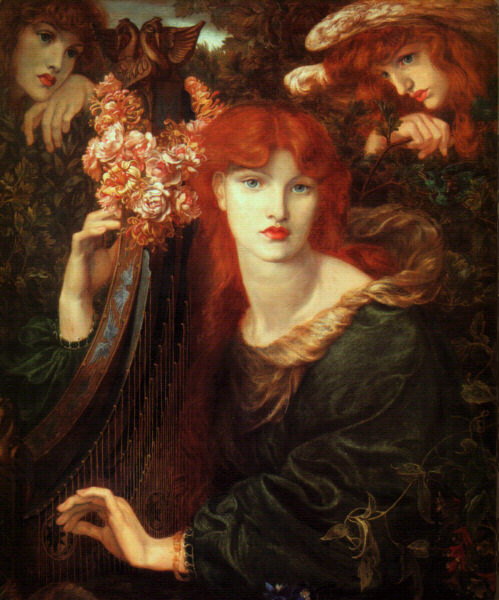
Originally conceived as songs for tenor, the piano versions of these pieces, which Liszt included in his second, Italian, year of his Années de Pélérinage, all retain a strong sense of the sung melodic line. All three are based on Sonnets, or Canzone, by the Italian Renaissance poet Francesco Petrarca (1304-1374). They are meditations on love, specifically the poet’s passionate love for Laura de Noves. In the first, Benedetto sia ‘l giorno (Blessed be the day…., Canzone LXI, sometimes erroneously noted as Sonnet 104), he prays for divine blessing on the joys and sufferings of love. The second, Pace non trovo(I find no peace….. Canzone CXXXIV; sometimes erroneously noted as Sonnet 47) is more agitated. In it, the poet ponders the confused state love has put him in. Enthralled to his lady, he feels imprisoned yet free, he burns with love, yet feels he is made of ice: in modern psychological parlance, a true state of ‘limerence’. The third, I’ vidi in terra angelici costumi (I Beheld on Earth Angelic Grace…., Canzone CLVI; sometimes incorrectly listed as Sonnet 123), is an ardent love poem in which the poet describes the perfect beauty and purity of his love and its effect on all of Heaven and Nature.
In Liszt’s piano transcriptions, his extreme sensitivity to Petrarch’s original text allows him to beautifully capture the atmosphere and sentiment of Petrarch’s words, but they do not take their cues directly from the text (a comparison with the scores of the original song versions is useful when studying these works). Rather, they reflect Liszt’s own response to the poetry in the same way as earlier pieces in the Italian Années, ‘Spozalizio’ and ‘Il penseroso’, convey the composer’s response to a painting and a sculpture by Raphael and Michelangelo respectively.
The ‘Sonetto 123’ was my first serious foray into Liszt’s music (apart from half-hearted dabbles with the ‘Consolations’): within the first few bars – measures of ethereal, floating triplets – I was hooked. I am now learning the ‘Sonetto 47’.
Although the song versions were originally conceived for a high tenor voice, Liszt later adapted them for baritone. I find Thomas Quasthoff gives a fine reading of all three Sonneti. Here he is in the Sonetto 47, and here is tenor John Aler in the same work:
I’ve listened to several recordings of the Années and find Wilhelm Kempff’s readings of the Tre Sonetti hard to beat. Lazar Berman’s recording is also very fine.
Some years ago, before I resumed playing the piano seriously and started taking lessons again, I would open a score, look at the forest of notes and think “I’ll never be able to play that!”. I’d visit my friend Michael, who owns a beautiful Steinway B (purchased when he retired, instead of the clichéd sports car), see Schumann’s Kreisleriana open on the music rack, and my heart would sink. “I’ll never be able to play that!”.
There are certain pieces which represent the high Himalayan peaks of the piano repertoire: the Rach 3, Liszt’s Transcendental Etudes, Ravel’s Gaspard de la Nuit, Balakirev’s Islamey, Chopin’s two sets of Etudes, to name but a few. Pieces which have become the preserve of the virtuoso pianist to showcase technical prowess and extreme pianism. We probably have Franz Liszt – he of the famously difficult Transcendental Etudes – to thank for the elevation of the pianist from salon ivory-tinkler, providing a pleasing accompaniment to drinks, supper and chat, to onstage superstar whose pianistic pyrotechnics caused ladies to faint and piano strings to break
About 18 months into my study with my current teacher, I heard Chopin’s Etude in C sharp minor, no. 7 from the Opus 25, on Radio Three’s Breakfast show, and was instantly entranced by its melancholic tone, the singing left hand cello-like melody (this Etude is nicknamed “the cello”), the floating chords in the right hand, in which the simplest secondary melody is embedded. I downloaded the score from Pianostreet and started to learn it. Eventually I performed it at a concert at my teacher’s house last year, and also on a 1920s Bluthner owned by Sir Alfred Beit, at Russborough in County Wicklow. “I can play a Chopin Etude” I told myself, when my confidence needed a boost. I felt I had at last entered that exclusive Himalayan club.
Playing the Russborough Bluthner
My teacher then suggested another Etude, this time the E major from the Opus 10, a piece I had always wanted to be able to play. This is one of the most famous of Chopin’s Etudes (along with the ‘Winter Wind’, the ‘Revolutionary’, the ‘Black Key’, the ‘Aeolian Harp’ and the ‘Butterfly’), which adds an extra degree of difficulty in the learning process. As my teacher said, “It’s so famous, and you want to play it well”. Aside from the dread sixths in the middle section (which, once analysed, unpicked, and put back together again, are not so fearsome – there is a pattern, yes, really!), it’s not as hard as it looks. Oh, all right, it is pretty difficult – allowing the right hand melody to sing above the accompaniment and achieving balance between the hands being the chief issues of this piece – but it is certainly not insurmountable, and my teacher would not have suggested I learn it if she did not think I could cope with it. This massive boost to my confidence has enabled me to go on to learn one of Chopin’s Ballades (the first, in G minor), some pieces by Liszt from the Années, and one of Messiaen’s Vingt Regards. Waiting patiently in my score library is Chopin’s Polonaise-Fantasie Opus 61, one or more of the Scherzi, more Liszt, Hindemith, more Messiaen…. Now, when I open a score, I do not immediately react negatively: “I’ll never be able to play that!” has been replaced with “OK, where do I start?”.
Analaysing the score, going through it with a pencil, looking for patterns and sequences, listening to other people playing it, and general familiarity with what the printed page looks like before you all assist in learning. There is also a physical-versus-mental aspect: convince yourself on first sight of a new piece that you can’t play it, and you probably won’t. But sit down and sight read through it, get your fingers round the notes, enjoy the architecture and melody of the piece, spend time with the music, inhabit it, and quite soon it will become familiar; eventually it will be like an old friend (which is how I feel about the Messiaen now, despite finding it utterly terrifying for the first few months of learning it!).
There are other practical considerations, of course. Some music is physically very difficult or tiring to play, although I dispute the claim that you need big hands to play Liszt or Rachmaninov. You don’t; just a strategy for getting around the music efficiently and comfortably. Some pieces do not lie comfortably under the hand; others are simply exhausting to play and sometimes one is practising only to improve stamina.
Young students often lack the confidence to pick up music on their own, without a teacher’s help to guide them through the score. When I start a student on a new piece, we go through it together. I ask the student to highlight any signs or terms they don’t understand, to mark patterns and sequences, and to generally take the music apart and separate it into manageable chunks. Thus, a page of score which at first appeared daunting can be quickly simplified, making the learning process easier. Of course, many young students want to be able to play the piece straight through, preferably loud and fast (!), and find the crucial detailed study dull and arduous. But working in this way reaps huge rewards: I find I can learn – and retain – music much more quickly now, and “tricks” learnt from, say, a Chopin Etude, can be applied to other music. The “dread sixths” passage of the Opus 10, No. 3 enabled me to devise a simple strategy for a similar section in Liszt’s Sonetto 123 del Petrarca. A case of “Well, hello! I’ve seen this before!”.
The piano repertoire is vast, hugely varied, and wonderful: don’t discount certain pieces because you think you’ll never be able to play them – but remember: sometimes the simplest pieces are the hardest!
I was browsing the sheet music in Blandford Forum’s Oxfam bookshop at the weekend. Tucked behind a vocal score was a slim volume of early piano music which brought a rush of involuntary memory (the so-called “Proustian Rush”), and which took me right back to Mrs Scott’s pink and mauve piano room in Sutton Coldfield, circa 1973. Mrs Scott was my first piano teacher, an elegant, and, to me, very elderly, white-haired lady, whose husband would silently bring her cups of tea in a bone china teacup and saucer while she was teaching. When I was a little girl, I would be dropped off at her house by car, or would walk there with my mother, but when I was older (around 10 or 11), I would cycle to her house, my music flung in the basket on the front of my bike. Sometimes my cat would follow me and as I pedalled along the road, he would dart across gardens. Fearing he would get so far and then be lost, I often had to take the cat home, lock him in the house and then pedal at high speed to get to my lesson on time. Mrs Scott was never terribly impressed if my lateness was caused by my pet!
The music which released this rush of memory was Felix Swinstead’s The Way Ahead. The volume was identical to the one I had, with the typeface suggesting a road, the long, lonely road of study, perhaps. The book contained pieces with trite titles such as ‘A Tender Flower’, ‘The Water Mill’ or ‘March Wind’. He also compiled and edited a number of other volumes which I probably had as a child – for example, Step by Step to the Classics and Work and Play.
Swinstead (1880-1959) was a pupil of renowned teacher Tobias Matthay, and is primarily remembered (just!) as a composer of educational music, though he did compose other music. His entire working life was spent at the Royal Academy of Music, from scholarship entry to full professorship and eventually retirement. He was also an examiner for the Associated Board, and his pieces still appear regularly in ABRSM exam repertoire lists as well as study books and albums of music for young players. ‘A Tender Flower’ is in the current ABRSM Grade 1 syllabus, though my Grade 1 students have tended to select Pauline Hall’s rather more racy ‘Tarantella’ as their list B piece!
Radio Three’s Breakfast programme is also cashing in on the ‘Proustian Rush’ by inviting listeners to contribute music which has a particular resonance for them: “…..a piece that evokes strong memories of childhood, or reminds you of long lost friends, or perhaps a piece you associate with a particular time in your life”. We all have pieces like this, tucked away in the recesses of our memory, which, on hearing, can take us to back to a certain place or point in our lives. Here is just a handful of my choices (links open in Spotify), though I am not sharing the actual memories!
As a postscript to this, I also came across the score of Cesar Franck’s Prelude, Chorale & Fugue in the same Oxfam bookshop. I opened it, read some of it and decided it was too advanced for me, and returned the score to the shelf. The next afternoon, I heard the piece performed in its entirety at an ‘at home’ recital given by the student of a friend of mine. A rather neat coincidence. (Incidentally, the student, who is working towards his Masters at the University of Cape Town, played the piece with huge conviction and impressive bravado.) Here is Richter playing the Chorale.
For further information on Radio Three’s Your Call feature click here.
Never underestimate the value of performing for others. The ability to get up and do it represents an important life skill, something from which my students will benefit when they enter adulthood (even if they are no longer playing the piano). It breeds confidence and self-reliance.
As pianists, we spend an inordinate, almost unhealthy amount of time alone with our instrument, with only dead composers for companions, while other musicians belong to ensembles and orchestras, and have the opportunity to strike ideas off one another and have a laugh together. The life of the pianist has always been rather rarefied: even the way we perform is different. While other instrumentalists face the audience, the pianist does not, thus adding to the mystique. Pianists are also the only ones who are expected to memorise the music, and the amount of notes one is required to process is far, far greater than, say, a ‘cellist, or a clarinet player. The pressure is on, before we have even sat down and played a single note!
We should never forget that music is for sharing, and between audience and performer and composer a wonderful continuous circle exists. Performing endorses what we do alone, the hours and hours, and days and days of solitary practise. It puts the music “out there”, validates it and singles it out for scrutiny, and as a performer, one has a sense of the awesome responsibility of the occasion, and the knowledge that, once begun, a performance cannot be withdrawn. Unexpected things can happen during a performance – and this is one of the aspects of live music that make it exciting. The most wonderful frisson can occur when one feels one’s performance has actually melded with the composer’s original idea, and that the audience have sensed this too. Performing is also a “cultural gift”, to oneself, and to those who love to listen to the piano.
Performing is an adventure, and a heroic act, not least because of the amount of preparation that is required. It is the natural extension of our love of the instrument and its literature, and it is a huge privilege to share this with others. Nervousness is the price one pays for this privilege, and enduring it and turning it around into a positive experience, is an act of self-mastery, another fundamental life skill, which encourages self-dependence, and a total reliance on our inner resources.
Performing also adds to one’s credibility. Whether a professional or an amateur, it is important to prove that you can actually do it, and, for the amateur pianist, the benefits of performing are immeasurable: you never really demonstrate your technique properly until you can demonstrate it in a performance. Music and technique are inseparable, and if you perform successfully, it proves you have practised correctly and thoughtfully, instead of simply note-bashing. This works conversely too, for if you are properly prepared, you should have nothing to fear when you perform. The benefits for younger students are even greater: preparing music for performance teaches them to complete a real task and to understand what is meant by “music making”. It encourages students to “play through”, glossing over errors rather than being bothered by them, instead of stop-start playing which prevents proper flow. It also teaches students to communicate a sense of the music, to “tell the story”, and to understand what the composer is trying to say. And if you haven’t performed a piece, how can you say it is truly “finished”?
In the hours after a performance, a special kind of depression can set in, compounded by a profound tiredness. A vast amount of energy has been expended in the experience of the performance, and the exhilaration of the concert floods every moment in the hours leading up to it. Suddenly, it is all over. It is at this low point that we must let the music take charge: the inexhaustible repertoire can only revive the spirit. As Seymour Bernstein says, in his excellent book ‘With Your Own Two Hands’, “for true musicians, depression is temporary because their music is permanent”. The only cure is to keep working, and to look forward to the next performance.
The Cross-Eyed Pianist is free to access and ad-free, and takes many hours every month to research, write, and maintain.
If you find joy and value in what I do, please consider making a donation to support the continuance of the site