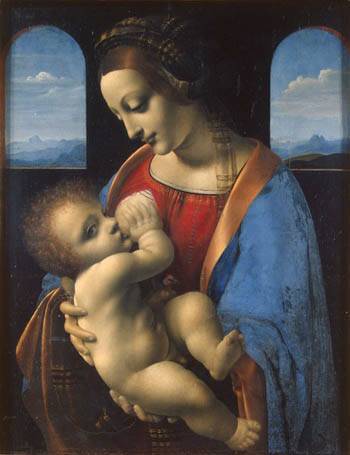
Madonna and Child (Madonna Litta) by Leonardo da Vinci 1452-1519

French composer, organist, ornithologist and devout Catholic Olivier Messiaen began his masterpiece Vingt Regards sur l’enfant Jésus in 1944, and the work was premiered in 1945 by Messiaen’s piano student and future wife, Yvonne Loriod. The French title roughly translates as ‘Twenty gazes/ contemplations on the infant Jesus’. The entire work is a meditation on the childhood of Jesus, and it utilises recurring “themes” or leitmotifs to highlight certain ideas, such as the Star, the Cross, and the Father.

Messiaen’s music is rhythmically complex (he was interested in the rhythms of ancient Greek and Hindu music) and draws inspiration from many sources, including Indonesian Gamelan music (which also interested and inspired Debussy), Japanese music, the landscape of Utah in the USA, and the legend of St Francis of Assisi. My own serious interest in Messiaen’s music began after I discovered he was a fellow synaesthete, who experienced colours when he heard or imagined music. He devised his own system of modes (scales) based on his synaesthesia, and in certain scores he actually notated the colours, to help the conductor in interpretation, rather than to express exactly which colours the listener should experience. He also wrote descriptions of the colours of chords, ranging from the simple “gold and brown” to the highly complex “blue-violet rocks, speckled with little grey cubes, cobalt blue, deep Prussian blue, highlighted by a bit of violet-purple, gold, red, ruby, and stars of mauve, black and white. Blue-violet is dominant”. My own synaesthesia manifests itself in a similar way to Messiaen’s, though each synaesthete’s experience is of course unique and personal, and I find his concept of colour in music – in the sense of real colours, as opposed to shadings of dynamics and articulation – entirely understandable. Indeed, my own score of the ‘Regard de la Vierge’ (No. 4 of the Vingt Regards) is littered with notes about colour.

As I teenager, I visited the Église de la Sainte-Trinité in Paris where Messiaen was organist (my mother had a penchant for visiting places with ‘artist associations’: the same trip to Paris included a fascinating tour of the studio of symbolist artist Gustave Moreau, and a pilgrimage to the Père Lachaise cemetery to see the tombs of Oscar Wilde and Fryderyk Chopin). As a pianist, I was for a long time fearful of attempting any of Messiaen’s music – indeed anything atonal (Schoenberg, Hindemith) I regarded with extreme trepidation – but I heard the ‘Regard de la Vierge’ played at a piano course I attended last year, and was very taken with it. Hearing the Quator pour le fin du temps (‘Quartet for the end of time’) at the Wigmore last winter (with Stephen Osborne on piano), a deeply arresting and emotional experience which left me in tears at the end of the concert, confirmed that this was a composer whose music I should explore.

Hearing a selection of his Preludes (1928/9) at a recent concert at the Wigmore Hall, I was struck by how close these pieces are to Debussy and Ravel, with their uncertain harmonies (chords chosen for timbre and colour rather than strict harmonic progression), and impressionistic titles, such as La Colombe (‘The Dove’) or Les sons impalpables du reve (‘The Impalpable Sounds of Dreams’). The Vingt Regards were composed some 15 years later, his compositional style had evolved a great deal, and by that time Messiaen had also experienced the full horror of the Second World War as a prisoner of war, after the fall of France to the Nazis in 1940. While his deeply-held faith undoubtedly informs this music, one does not have to be religious oneself to be affected by it. The sheer scale of it (20 movements, a work lasting around 2 hours), the sounds and images it suggests, it is music that expresses something far greater than us.

While each Regard is different, they are linked by the use of recurring motifs (Messiaen’s “themes” of all-embracing love, the Virgin, the Star, the Cross, God the Father), “flashes” (clusters of notes or fragments which reflect Messiaen’s belief that it was only possible to comprehend the totality of God in “flashes”), tolling bells and chimes, references to devotional texts, portentous passages, suggesting Jesus’s fate, repeating chord progressions, and birdsong. While Messiaen is absolutely specific in his writing, there is room for individual interpretation and variation, and, for me, this links the pieces back to the earlier Preludes, and the impressionist writings of Debussy and Ravel.

Messiaen prefaced his masterpiece with a detailed commentary, and each Regard has its own short explanatory paragraph which offer fascinating insights into his very personal visual, devotional and compositional landscape for these pieces, as well as offering useful pointers for performance.

In the ‘Regard de la Vierge’, the Virgin Mary contemplates the infant Jesus with a simple tender lullaby which demonstrates affection and recognition. A contrasting middle section, with birdsong, “flashes”, tolling bells and portentous double octaves interrupts Mary’s devoted gaze, and is a reminder of Jesus’s fate. The naive rocking theme is then restated with bell-like notes in the upper registers, as an expression of Mary’s intimate motherly response and God’s love for humankind.

Pianist Stephen Osborne is an acclaimed Messiaen-player, but for me Pierre-Laurent Aimard’s recording of the Vingt Regards is sublime, capturing the mysticism and magnitude of this great work.

Interestingly, while looking up something unrelated to Messiaen, I heard this track by Radiohead, Pyramid Song, which contains a piano riff which could easily have been lifted from one of the Vingt Regards.

Radiohead – Pyramid Song

Messiaen on Debussy and Colour

Regard de la Vierge, No. 4 of Vingt Regards, played by Pierre-Laurent Aimard

More on synaesthesia and music here

Say ‘Mazurka’ and most people will reply ‘Chopin’. Chopin wrote at least 69 pieces in this form: 45 published during his lifetime, 13 published posthumously, and a further 11, which are known but where the mss are in private hands or untraced. He took the rough Polish peasant dance and refined it, as he did with the Waltz and the Polonaise (also of Polish origin), elevating it to drawing room “art music”. His Mazurkas remain perennially popular; some are much more famous than others and are performed regularly (for example, Op. 7, No. 1, Op. 17 (1-3), Op. 33 No. 2) . I first came across the genre when, in my late teens, I was a Saturday pianist for the local ballet school in Rickmansworth, where I would belt out bouncy Mazurkas on a rather ropey upright, and a group of little girls in pink tutus would prance about the studio before curtseying to ‘Miss Frances’ at the end of the lesson.

Chopin’s Mazurkas show great range and variety. Some are lively, full of rhythmic vitality, others more soulful and melancholy. They are some of Chopin’s freshest and most original works, yet all retain features of their folk origins. One the last Mazurkas, indeed one of his final works, Op. 68, No. 4 in f minor, is one of the most plaintive and heart-rending pieces Chopin ever wrote, suffused with zal, with striking, sliding chromaticism, and an interesting marking (Chopin’s own) after the Trio, senza fine, literally “without end”, suggesting that instead of a regular da capo al fine, the piece should go on indefinitely, or simply fade away to nothing.

The Mazurka, or mazurek, originated in the Polish region of Mazrovia, near Warsaw, a dance in triple time, with an emphasis on the second or third beat. The true folk origins of the Mazurka are two other Polish musical forms, the slow, plaintive Kujawiak and the fast, lively Oberek. The mazurek always has either a triplet, trill, dotted quaver pair, or an ordinary quaver pair before two crotchets. A closer reading of Chopin’s Mazurkas will reveal these different aspects of the Mazurka: for example, the Op. 68, No. 4 is a Kujawiak, while the much-loved Op. 7, No. 1, draws direct influence from the Oberek.

Typical Mazurka rhythm

Chopin’s composition of Mazurkas suggested new ideas of nationalism in music, and influenced and inspired other composers, mostly eastern European, to support their national music. Franz Liszt was a big mover and shaker in this respect, claiming (somewhat inaccurately) that Chopin had been directly influenced by Polish national music. What is more likely is that Chopin heard national music of his homeland when he was growing up. When he left Poland, never to return because of the political climate, the Mazurka and the Polonaise became central genres in his compositional output, allowing him to retain a connection to his homeland.

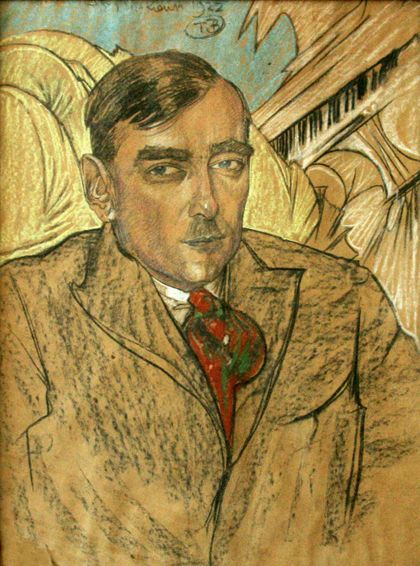
Karol Syzmanowski

Fellow countryman, Karol Szymanowski (1882-1937) wrote two sets of Mazurkas, Opus 50 and 62 (22 works in total). He drew musical influences from Chopin, but also from Wagner, Richard Strauss, Max Reger, Scriabin, Debussy, Ravel and nationalists Smetana and Bartok. I discovered Szymanowski’s music, in particular the Etudes for piano, after a friend said “If you love Chopin, you’ll like Szymanowski”. They were right. However, listen to his Masques or Metopes, and you could easily mistake him for Debussy or Ravel, with their misty, uncertain harmonies, flutters and shimmers of sound, and ambigous keys.

Szymanowski travelled extensively, and from the 1920s, he spent a great deal of time at the resort of Zakopane, in the Tatra highlands of Poland, where he discovered the local folk music or Górale. With its typical rustic fiddles and flutes, drone basses and pedal points, this became the template for his own music. Like Chopin, he was loyal to the idea of musical nationalism, but neither was he intimidated by it. So, while retaining many of the traditional features of the Mazurka in all its forms (Oberek, Kujawiak and Mazurek), he also extended it beyond the strict 4-phrase dance measure. As a result, Szymanowski’s Mazurkas defy the traditional symmetry of the dance, and instead expand and contract. The longest are just over three minutes long, the shortest just under two. Some are wistful, plaintive and meditative, others bounce and leap, some are witty and acidic, other are just rough and noisy. Within each one, tempos contract and expand, and one might find a slow Kujawiak-inspired passage right next to a section which is pure Oberek. It is these clever juxtapositions which give Szymanowski’s Mazurkas such life and piquancy.

I am including the first two of the Opus 50 Mazurkas in my Diploma programme. The first, a Kujawiak, opens with a plaintive descending figure, redolent of a rustic violin or shepherd’s flute, with a bagpipe-like drone on an open fifth in the left hand, before the introduction of distinctly Debussyan chords at bar 3. The opening melody is then repeated and embellished. The marking ‘molto rubato’ suggests plenty of freedom in the tempo here (while, of course, retaining an underlying sense of pulse), which adds to the wistful nature of this section. The organisation of material here suggests the typical Górale ensemble of first and second violins, and bass. The music then moves into more familiar Mazurka territory, with a repeated drone bass in the left hand and two strands of melody in the right hand, a hint of Górale polyphonic writing. At bar 25 a very characteristic Mazurka rhythm is introduced, repeated in octaves at bar 29, but marked ‘pp dolciss.’ (very soft and sweetly), which suggests a reminiscence, rather than a straight repeat. And this is what I love about these pieces – the way the composer takes distinctive elements of the form and then tweaks them to give subtle hints and nuances, as if the melody were heard from afar.

Interestingly, there is no full double bar between the first and the fourth of the Opus 50, which suggests all four should be played straight through, without a break, and I like to segue straight into the second from the first. The second is much more characteristic of Górale folk music, with off-beat drones, asymmetric phrasing, dissonance, falling melody, abrupt dynamic shifts, voice-crossing between the parts, and bouncy Oberek-inspired repeating rhythmic motifs. However, at bar 53, there is a section drawn directly from the Kujawiak, a plaintive, melancholy dance strongly redolent of Chopin’s f minor Mazurka, Op. 68, No.4. This is fleeting: the Oberek is restated, and once again the music sets off on a lively, astringent strut. But at bar 95, there is another ‘reminiscence’, in a section marked ‘sostenuto’. The opening melody reappears, shared between the hands and rising in pitch, while fading to pianissimo, before an emphatic, sfzorzando and accented closing chord.

Of all the Opus 50 Mazurkas, the first is probably the most popular for many pianists, including Artur Rubenstein, to whom it was dedicated.

(Links open in Spotify)

Vladimir Ashkenazy – Chopin: Mazurka No.1 in F sharp minor Op.6 No.1

Vladimir Ashkenazy – Chopin: Mazurka No.3 in E Op.6 No.3

Vladimir Ashkenazy – Chopin: Mazurka No.5 in B flat Op.7 No.1

Piotr Anderszewski – Szymanowski: 3 Masques, Op.34: Scheherazade/Shéhérazade (lento assai, languido)

Marc-André Hamelin plays Szymanowski’s Mazurkas Op. 50 Nos. 1 and 2

In our celebrity-obsessed, ‘image is everything’ times, it seems that the fledgling concert pianist’s path to the modern concert arena – the ‘Three C’s’ of Conservatoire, Competition and Concerto – has turned professional piano playing into a kind of Olympian activity whose creed is “faster, higher, louder”, and has reduced the vast and wonderful repertoire to a relatively small stable of over-played warhorses, most notably, perhaps, the ubiquitous Rachmaninov Third Concerto. Today’s young piano superstars are using technique as the be all and end all, rather than as a means to serve the music. Thus, while we might be impressed by flashy technical prowess and grand gestures, we are often being offered only superficial display.

Just as the four-minute mile has been shaved down by 17 seconds over the 50 years since Bannister’s record-breaking run, certain pieces in the standard piano repertoire seem to be getting faster – and/or louder. I ran an informal poll amongst my Twitter followers and Facebook friends to see what other people thought about this. As one person said, “….people are generally and more easily drawn to the more obvious things in life (just take a look at anything in the media today). Faster and louder is definitely more obvious than subtle and artistic. It also requires less work….”

Thus, certain pieces are wheeled out over and over again by young, ‘generic’ pianists, not because they are necessarily the hardest in the repertoire, but because they are the most impressive, both visually and aurally. And here I must admit that I was absolutely gob-smacked by the speed at which Marc-Andre Hamelin’s hands moved around the keyboard at his late-night Liszt Prom, even though I didn’t like the actual piece (Fantasia and Fugue on B-A-C-H) that much. But in his Benediction de Dieu dans la solitude, Hamelin proved that he is not just a brilliant technician: his account was ethereal, luminescent, profound and emotional, and it spoke of a long association with the music, something which younger players may not appreciate with their desire to rush from showpiece to showpiece.

My informal poll revealed a general consensus about certain works, acknowledged amongst pianists to be some of the most challenging in the repertoire, in terms of technical difficulty and/or length. These include, in no particular order (links open in Spotify):

Beethoven – Op. 106, ‘Hammerklavier’. The daring opening leap should, of course, be played with one hand!

Ravel – Gaspard de la Nuit

Stravinsky – Trois Mouvements de Petrushka

Chopin – Etudes (especially Op 10 Nos 1 & 2, Op 25 Nos 6 & 11)

Liszt – Transcendental Etudes (especially Feux Follets, Wilde Jagd)

Liszt – B minor Sonata

Brahms – Paganini Variations

Rachmaninov – 3rd Concerto

Prokofiev – 2nd Concerto

Bartok – 2nd Concerto

Alkan – Concert for Solo Piano

Messiaen – Vingt Regards sur l’enfant Jesus

Godowsky – transcriptions of Chopin Etudes

Sorabji – Opus clavicembalisticum (a piece which lasts around 4 hours)

Of course, while being hugely technically and physically demanding, many of these works, when played well, sound effortless (which, of course, is what we as pianists are all striving for!). And yet even the simplest piece, such as Mozart’s Adagio for Glass Harmonica, which I heard played as an encore at an eccentric little arts venue in Highgate some years ago, can sound sophisticated and refined – ‘Olympian’ even – in the right hands!

As a postscript, my own personal ‘Olympian’ works include:

Chopin – Etude Opus 10, No. 3. As my teacher said, the difficulty lies less in the technical demands, and more in the fact that this Etude is so well known, so one wants to do it justice.

Messiaen – Regard de la Vierge, no. IV of the ‘Vingt Regards’. For someone who had not really attempted any true atonal music before, the difficulty in this piece lay, initially, in “tuning” my ear into the discordant harmonies. Also, at first sight it looks utterly horrendous on the page!

Debussy – Prelude & Sarabande from ‘Pour le Piano’. The Prelude requires playful, fleet and pristine fingers, while the big, hand-filling chords of the Sarabande presented their own problem for the tenosynovitis in my right hand. Exercises and solid technique have enabled me to play this piece comfortably and without pain.

More on ‘Pianistic Everests’ from Tom Service

I’ve been playing and listening to Schubert’s  Opus 90 Impromptus since I was about 14, when my mother fell in love with Brendel playing the fourth of the set, in A flat, and insisted that I learn it. So, armed with a Peters edition of the score, I set off to my teacher’s house on my bicycle and made a fair attempt at wrecking Schubert’s sublime, ethereal semiquavers. In retrospective, Schubert’s late piano works are perhaps not best tackled by a precocious teenager. These are works born out of the tumult of Winterreise, and, in my humble opinion, are best tackled by a musician who has lived with the music, and the composer (albeit deceased), for a long time. Sure, one can process the notes, but these works are imbued with profound, complex and mixed emotions, and only a hefty degree of ‘life experience’ can truly inform one’s playing and interpretation of this music.

Schubert famously and tragically died young, at 31, possibly from complications arising from syphilis, yet in his short life he, like Mozart, and Chopin, and Mendelssohn, produced a phenomenal amount of work, not all of it complete, much of it sublimely beautiful, absorbing and endlessly fascinating. And so, one can say that the music which came post-Winterreise – the late piano sonatas, the two sets of Impromptus, the D946 Klavierstucke – are most certainly “mature” works.

I learnt the E flat Impromptu (no.2) properly for my ATCL Diploma. My teacher cautioned me against learning, or rather re-learning something I had learnt in my teens, as despite the distance of many years, old mistakes would surely remain. So, my strategy for studying this piece some 30 years since I first encountered it, was to treat it as a completely new venture. I threw out my dog-eared Edition Peters score and purchased a new Henle edition. Of course, the fingers do remember what they learnt before, and in one or two places, I felt them straying into the forbidden territory of bad habits and sloppy or clumsy passage work, but, on the whole, I managed to avoid such errors, mainly by practising the less certain measures very slowly, in the manner of a Chopin Nocturne. This technique was been particularly helpful for the trio section, which, in the past, I had a tendency to gallop through, over-emphasising the fortissimos and sforzandos, and not paying enough close attention to the melodic line which is still evident, despite the anger and torment. This ‘Chopinesque’ treatment has revealed some really beautiful moments – I always knew they were there, but allowing myself time to hear and consider them has enabled me to shape the music in a different way.

The Opus 90 Impromptus are often performed as a set, though sometimes a single one will be offered in a programme, or as an encore (Schubert himself told his publishers that the works could be issued singly or in a set), and the four pieces do present a kind of journey (‘Reise’), both musical and metaphorical, when considered together. Much has been written on the connections between the works, and it is easy to drown in a sea of complex musical analysis and confusing hypothetical debate as to whether the pieces share connections and organised structures. Indeed, Schumann made the somewhat muddled assertion that the second set, the Opus 142, is a sonata “in disguise”.

The first of the Opus 90, in C minor, opens with a bare, arresting G octave, and the ensuing lonely dotted melody sets the tone of the whole piece. In one recording I have, the work freezes, calling to mind the exiled fremdling (traveller) of songs such as ‘Gute Nacht’, from Winterreise. The chill never really thaws as the music continually struggles to break free of that portentous, restraining G: it never truly succeeds, despite the lyrical and nostalgic A-flat sections. The warm, major key offers little real solace, as the harmonic progressions constantly drag the ear away from the resolution it craves, and any pleasant recollections are quickly forgotten by the return of the chilling tread of the opening motif, the tyranny of the G, and a horrifying attempt to finally break free.

The E-flat Impromptu suggests an etude, with its swirling, tumbling triplets, which need careful articulation to sound dancing, fluid and limpid. The opening scalic melody, repeated not once but twice, reflects the composer’s ongoing crisis, the fremdling’s agonised progress, and despite its serpentine coiling, its attempts to slip away, remains firmly tethered by an insistent, repetitive bass line.

The streaming, scalic figures of the opening require wrist flexibility and suppleness, the wrist acting as a shock absorber to help shape the phrasing here. While the music is marked ‘Allegro’, there needs to be some give-and-take within the phrases, signaling shifts in mood and tone. There are measures of great charm and true Schubertian “prettiness”, but these are quickly offset by the darker, minor sections. The longer melodic lines must be shaped and preserved at all times: despite the tempo, this is not a moto perpetuo exercise in the manner of Czerny! It is an Impromptu, and by its very name it suggests romanticism rather than rigour.

As the RH ascends high into the upper registers, marked forte, the tone grows more hysterical and desperate, before the music descends to an angry, accented section, preparation for the drama and anguish of the Trio. Here, the 3/4 time signature suggests a rough, bohemian waltz, with a figure of widely-spaced bare octaves, and stamping off-beat accented triplets, alternating with a division of the beat into quavers, a stark contrast to the flowing triplets of the earlier sections. There are some moments of great melodic beauty and poignancy here, but the roughness and tension is never really smoothed, while a sobbing, repeated triplet figure acts as a bridge, leading us back to the opening material. The pieces ends, emphatically, in the minor key, signalling once again the confusion of Schubert’s lonely traveller.

The third Impromptu, in G-flat major, is probably the best-loved of the set, with its serene, nocturne-like melody, redolent of Schubert’s Ave Maria, and its fluttering harp-like broken chords, which soothe after the torment of the previous piece. There are storms – bass trills, and a shadowy, frequently-modulating middle section – before the music returns to the same flowing calmness of the opening.

And so to my favourite, the No. 4, in A-flat, and here at last all the uncertain tonalities of the preceding movements find a home. This is not prefigured at the outset, rather the protagonist, the meandering fremdling of these four pieces, must strive for eventual and gradual disclosure: the piece opens in A-flat minor, though it is written in the major, with accidentals, and the harmonic ambiguity lingers until bar 31, when the graceful, cascading semiquaver figure is at last heard in A-flat major, beneath which the left hand has a fragile, ‘cello-like melody. At the centre of the piece is a lyrical trio reminscent of Schubert’s ‘Wanderer’ fantasy, after which the sense of alienation and tension from the earlier pieces is swept aside by the gradual acceleration of all the elements and the home key, A flat, becomes fully dominant, while a life-affirming dance-like figure takes over in the bass. The final cadence is an emphatic A-flat major descent and two forceful closing chords. Home at last.

It may be fanciful to assign such complex musical and thematic considerations to these pieces, but play them, or hear them, as a set, and I think the sense of a journey, and its eventual completion is evident, if only in the progressive tonalities of each piece. In any event, these are poetic, timeless, and very personal works, which display a gravity and intensity far beyond the typical nineteenth-century drawing room Albumblatt or klavierstück.

Further reading:

Fisk, Charles – Returning Cycles: Contexts for the Intepretation of Schubert’s Impromptus and Last Sonatas. University of California Press. 2001

Daverio, John – Crossing Paths: Schubert, Schumann and Brahms. Oxford University Press, USA. 2008

Ian Bostridge with Julius Drake (piano) – from the film of Winterreise by David Alden