Guest post by Frances Jones


A few weeks ago I slipped on an icy pavement and fractured my right hand. There was a scary moment when I was told the break might be a serious one, and difficult to heal, but that proved to be a false alarm and the hand is almost back in normal use.

The injury, though, proved to have interesting consequences for my piano teaching, and got me thinking about motivation, a topic often in my thoughts concerning my students, who are currently between the ages of 4 and 11.

Because my right hand was immobile, I dictated homework notes to the older children to write in their practice diaries. (The younger ones made do with the squiggly efforts of my non-dominant hand.) Two particular children took this responsibility very seriously, to the extent that they are continuing to write their own notes and adhering to them, too. One of these children hadn’t been very motivated of late; she mostly did what was asked in terms of practice, but seemed to be going through the motions, rather than actually enjoying playing. Now, she makes annotations to the music, adding fingering or reminders of articulation and seems to be enjoying the piano once again. The difference in her playing is marked; there’s an expressive quality there that I hadn’t heard for months. There could be many different reasons, of course, for the change of attitude, but I think the shift in ownership has played a part. The child knows now that she is responsible for her own progress but I haven’t had to tell her that. The process has taught me a lesson, too; that for some children doing as much as possible for themselves is a real motivator. For others, it’s not important; they still have the intrinsic motivation they started out with.
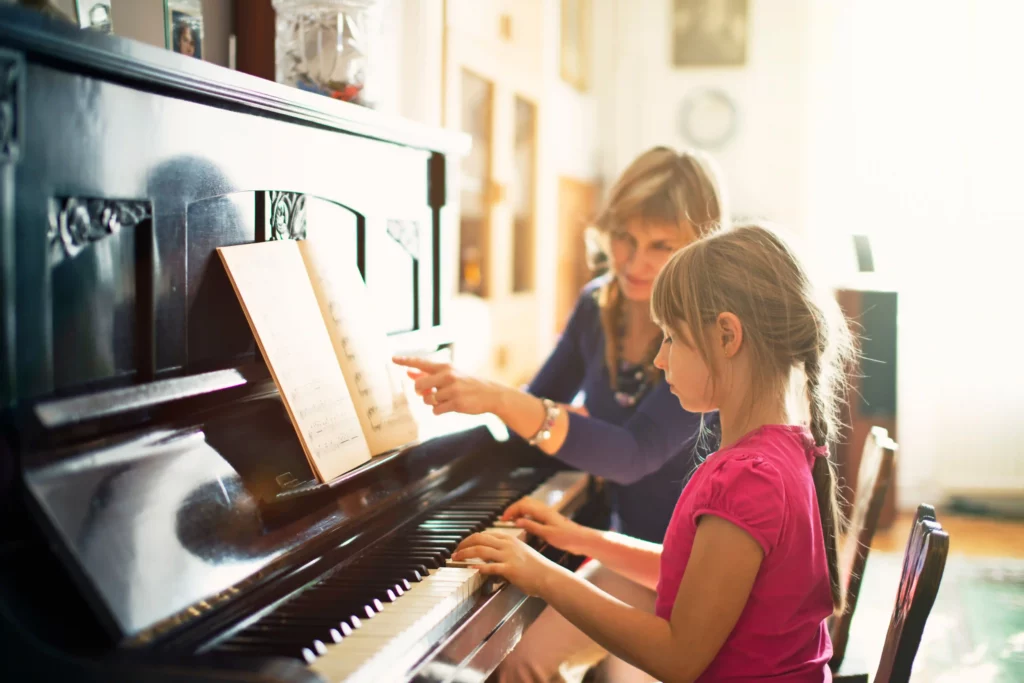
Over the years, I’ve found that most children are motivated to play at first because they like the sound of the piano and take pleasure from being able to create that sound. (Very occasionally, a child has no interest in the instrument but his parents wish him to learn. Honesty, or extrinsic motivation are the options here.) Keeping hold of that initial motivation is key, and all teachers of young children have their own thoughts on how to do this. Here are mine:

Performing. This depends on the child, but I have found in schools that most children love to play in assembly or to their class and will devote considerable time to practice if they have this goal.

Being the teacher. A pupil of six was thrilled to tell me recently that he had taught his younger sister how to play a tune. Some children enjoy teaching their friends. I say to children they can teach their mum/dad how to play and younger children often love it when their parents can play a duet part.

Composing/improvising. I do this from time to time in lessons and with some children it really absorbs their interest and allows them to enjoy and explore the range of the piano. Writing down their melody is a good way to revise or bring in notation.

Learning a well-known tune. Many children, especially older ones, really want to be able to play specific pieces. Mastering a manageable version of a song you like can be very rewarding and I think helps some children continue to play when they might otherwise have given up.

Stickers. My use of these is extremely judicious and only for those up to the age of 8. I find that if a child manages to do something he’s been trying to achieve, the satisfaction of accomplishment is reward enough. For the youngest, the excitement of playing the piano is similarly, quite a match for a humble sticker and that excitement must be retained. Having said that, some children love making collections and if a sticker helps a child practice, I would certainly advocate being generous.

Praise and positivity. There are different schools of thought on this. My view is that children really value praise when it is earned and therefore, used truthfully, it is immensely helpful to progress. I find this is particularly true with children who are in a cohort with many high-achievers and feel they are never going to catch up. Sometimes a child needs convincing they are playing well, even if it’s a simple tune.

As a teacher, I’m conscious of the need to retain that initial interest and enjoyment so the child doesn’t lose sight of why he is playing and practising. Even the most well-intentioned child (and adult) can suffer a dip in motivation whilst navigating the distractions of modern life. Frustrating, yes, but truly rewarding when a little creative thinking puts things back on track.

Frances Jones teaches piano in SW London. She has also taught and led music provision in London prep schools.
Do Not Mistake Activity for Progress: A Lesson for Musicians

The phrase “Do not mistake activity for progress” serves as a powerful reminder that being busy is not the same as being effective. Nowhere is this more relevant than in the life of a musician, where countless hours are spent practicing, refining technique, and mastering pieces. A romantic misconception persists, amongst musicians themselves as well as the general public, that musicians must spend hours and hours in the practice room to achieve perfection.

This article explores how the distinction between mere activity and genuine progress is particularly important for musicians, and how understanding this difference by employing focussed, thoughtful practice – quality rather than quantity – can lead to more productive and meaningful practice and results.

For many musicians, the act of practicing can become habitual. Sitting down you’re your instrument, playing through scales, or repeating pieces from memory may feel productive because it takes time and effort. But if these routines are executed without thoughtful engagement, they may offer little return in terms of technical and artistic development. In other words, you can be very active without actually improving. This is where the warning not to conflate activity with progress becomes critical. Just because a musician is practicing does not mean they are practicing well.

Effective practice requires focus, intention, and feedback. It’s not just about the quantity of time spent, but the quality of that time. For example, a violinist who practices a difficult passage for thirty minutes without addressing the underlying technical issues – such as bowing technique, intonation, or rhythm – is likely to repeat and reinforce mistakes. This is, in effect, simply “going through the motions” rather than engaging in deep, thoughtful, considered practicing. In contrast, a musician who spends just ten minutes isolating and correcting these problems may make far more progress. Thus, mindful, goal-oriented practice can achieve more in less time than mindless repetition.

The concept of deliberate practice, popularised by psychologist Anders Ericsson, is particularly useful in this context. Deliberate practice involves working just beyond one’s current abilities, identifying weaknesses, setting specific goals, and seeking constructive feedback. For musicians, this might mean slowing down a difficult section, using a metronome, recording oneself for critique, or working with a teacher, mentor or even a trusted colleague or friend to identify areas for improvement. Each of these activities is targeted and purposeful, aimed at achieving real growth rather than simply filling practice hours.

In addition, mistaking activity for progress can lead to frustration, burnout and even injury. (‘over-practicing’ is a real issue!). Musicians may feel that despite spending many hours practicing, they are not advancing, which can be discouraging and demotivating. Understanding that not all practice is equal allows you to assess the effectiveness of your practice routines and make the necessary adjustments. It encourages reflection, a crucial aspect of productive practicing: What am I trying to achieve? Is this exercise helping me reach that goal? What could I change to improve my results?

By focusing on the quality rather than the quantity of practice, musicians can ensure that their activity translates into meaningful progress. Ultimately, it is not how much one practices, but how one practices, that leads to mastery.

Guest post by Dakota Gale, the latest article in his series aimed at amateur adult pianists


I clearly remember the first time I rode Tyler’s, a popular bike trail near me. I walked some rocky uphill ramps, awkwardly landed jumps, and generally hacked my way down it like a noob.

I still had a hell of a fine time.

These days, I’ve ridden Tyler’s dozens of times and know every major feature. I fly down that sucker.

But is Tyler’s more fun, exciting or fulfilling now versus my first time? 

In general, is there a way to develop appreciation and deeper comprehension rather than boredom for a repeated experience?

Travel to the same places. Hobbies we’ve done for years. Meals we’ve made for a decade.

Or piano pieces!

Navigating the creative gamut

Like a new bike trail, the first time I play a piano piece my brain scrabbles to survive, jamming the notes into my brain. I’m walking super rocky sections and scoping out switchbacks, one measure and phrase at a time.

Take Schubert’s Serenade, a song I’ve always loved that I started playing. In my initial efforts, I pushed through the technical challenges of the piece and could “play” it. Then I tabled it for a month, letting the music sink into my synapses. Cue round two, with more nuance and expression…and yet I was barely getting started.

Bridging that gap between what I CAN do and what I WANT to do is the hardest part. With any new piece, I listen to recordings and think, “yup, do that, fingers!” Then I sit down and create some monotone pabulum akin to playing bongo drums with wet laundry. *sigh*

The gap between my expectations and my abilities is frustrating sometimes. Like some truculent kid, I want to play it like a pro, now now now!

After I turn my pre-frontal cortex back on, I can (usually) reframe things. Because truly, I find this so motivating: I’m going to grow not just with new pieces, but enjoy a deep satisfaction revisiting piano works for the rest of my life. Something fresh to discover, to experience.

And dang it, I AM making progress. Even if I’m no master, there’s magic in the journey and daily satisfaction in the learning. I don’t need to be pro to have fun. (Maybe it’s more fun not worrying about earning a living with it?)

Plus, pushing myself on challenging songs pushes me to greater heights on those I already play. It’s the same thing that happens when I ride technical trails on my bike. I may not slip effortlessly through the toughest moves, but that difficulty makes other trails feel even more cruisier in comparison.

Unlike during piano pieces, sometimes I pause mid-climb on a bike to eat…

As piano, as life

I love how this mindset so easily translates to other endeavors or pastimes. We’re different people when we revisit a city or national park, reread a book, or play an old song. Depth, additional context, a slower pace…it all modifies the experience and likely results in a deeper appreciation.

With all this in mind, I’m continuing to actively push myself to share not-perfect work like my beginner drawings and music recordings. (Sharing my writing on my blog starting a decade ago was an early effort in that arena.) 

It’s tough because I want the work to be better, to make insane progress overnight. Sometimes I shake my head at how hard it is to take what’s in my brain and put it on paper or piano.

Whatever. There’s a reason every book on creativity decries perfectionism and Ira Glass from This American Life talks about “The Gap,” that space between what we envision and what appears in reality. I’ll probably always find blemishes and wish-it-were-different aspects of ANYthing I create.

The good news? It creates constant motivation to keep improving, growing, seeking.

That’s a beautiful thing.

As for Schubert’s Serenade? Maybe it’s not perfect, but I’m looking forward to a lifetime of it evolving beneath my fingers.

And if I get frustrated, I can always go rip down Tyler’s on my mountain bike.


When he isn’t playing piano, Dakota Gale enjoys exploring the great outdoors, learning languages and drawing. He also writes about reclaiming creativity as an adult and ditching tired personal paradigms in his newsletter, Traipsing About. He can often be spotted camping and exploring mountain bike trails around the Pacific Northwest.

I haven’t touched the piano for months. I have a beautiful early 20th-century Bechstein model A grand piano which has been sitting, untouched, in my piano room/office. There is music open on the stand – Schubert’s Piano Sonata in A, D664 – suggesting intent, but I have not played it seriously in over six months.

Why? Lack of motivation, lack of time, yes. But also something which I think is particular to the amateur musician – the knowledge that, unlike the professional musician who must practice regularly to maintain their skill and artistry, one can come back to the instrument at any time and pick up where one left off.

But it can be hard and the first line of that wise saying of violinist Jascha Heifertz – “If I don’t practice one day, I know it…” holds true as much for the amateur as for the  professional musician. The more time passes, the harder it becomes to start over again.

But it’s not impossible.

Rekindling the habit of practicing and playing the piano after a pause, however long, can be both challenging and rewarding. The key to a successful return lies in setting realistic goals, cultivating patience, and reviving your passion for music. Here’s a guide to help you navigate this journey back to the piano:

Set Realistic Goals

One of the first steps in returning to piano practice is setting achievable goals. Begin by assessing your current skill level and recognising that you may not be able to play at the same proficiency as before. Setting short-term goals that focus on gradual improvement, such as playing music that is already well-learnt or attempting a short piece or study, help you reacquaint yourself with the instrument, build confidence and provide a clear sense of progress.

Establish a Routine

Consistency is crucial in developing any skill, and piano playing is no exception. Create a practice schedule that fits comfortably into your daily routine. Practice “little and often”: even 15 to 30 minutes a day can make a significant difference over time. Ensure your practice sessions are regular, but also be flexible and kind to yourself if the demands of daily life/work interrupt your schedule.

Revisit Familiar Pieces

Playing pieces you were once comfortable with can be immensely satisfying and a great confidence booster. It allows you to gauge how much you remember and where you need to focus your practice. These familiar pieces can act as a bridge, easing you back into more challenging repertoire while providing a sense of accomplishment.

Explore New Repertoire

While revisiting old favourites is comforting, exploring new music can really reignite your interest. Choose pieces that inspire you and reflect your musical tastes. Don’t feel you have to learn certain pieces because they are good for you; play the music that interests you. Learning new repertoire not only keeps practice sessions interesting but also broadens your musical horizons and challenges your skills in different ways.

Seek Guidance and Support

If you have taken a long break from the instrument, consider taking lessons, even if only temporarily. A teacher can provide personalised guidance, help you set realistic goals, and correct any bad habits that may have formed during your hiatus. Additionally, joining a music meetup group can offer support, motivation, and opportunities to share your progress with others.

Be Patient and Positive

Returning to your instrument after a break requires patience and a positive mindset. Progress may be slow at first, and you might feel frustrated by the gap between your past abilities and your current performance. Set realistic goals and celebrate small victories – and, above all, remind yourself of the joy that playing the piano brings. With time and persistence, your skills will improve, and the music will flow more naturally.

Enjoy the Process

Ultimately, the journey back to the piano should be enjoyable. Embrace the process of relearning and rediscovering your love for the instrument. Allow yourself to experiment, make mistakes, and have fun. Remember, the ultimate goal is the joy and fulfilment that comes from making music.

Happy practicing!


This site takes many hours each month to maintian and update. If you find value and pleasure in what I do, why not