Who or what inspired you to take up the piano and pursue a career in music? 

My mother is a piano teacher. I used to crawl under the piano when my mother was teaching – I am talking about when I was not even a year old.  So, it was totally natural for me to take up piano lessons.  As for pursuing a career, I am still looking for the secret to succeed.  Quite honestly, I still feel like a music college student because the basics of my life have been the same (whether piano practise is done or not is a major issue of the day).

Who or what were the most important influences on your musical life and career? 

My mother Michiko for a start.  As for teachers, I am really grateful to two teachers, Mr. Hironaka who taught me in Japan and Benjamin Kaplan who coped with me in London.  Ben was the one who told me how to look at the music, how to analyse, and how to perform.

What have been the greatest challenges of your career so far? 

I cannot think of anything much off the top of my head. Coming from a family with a piano teacher with absolutely no connection to any ‘important’ people in Japan, let alone outside Japan, I feel I have done pretty OK.

Which performance/recordings are you most proud of? 

Recordings…. Takemitsu piano music because it was the first CD of the journey with Robert von Bahr and BIS (now, I have recorded 33 CDs with them!!!!).  I am proud of the most recent recording, SATIE with an 1890 Erard Piano.  I was asked to perform a recital on an Erard piano once.  I was reluctant because I am not a period instrument specialist, but the piano was so wonderful that I fell in love immediately.  As soon as I played the concert, I grabbed the arm of the owner of the instrument.  I asked him if I could use the piano for a CD recording. I am totally fascinated by Erik Satie at the moment. His music is raw, but the ideas he came up with are 20-30 years ahead of his time. I feel privileged to have this opportunity to re-discover his ability, to look into his musicality with more respect. Satie has been underestimated for a long time. Having the Erard for the recording has helped me to realise his genius approach, just because I love this particular instrument so very much!!

Which particular works do you think you perform best? 

Debussy, Takemitsu for sure because I like working on ‘beauty of sound’ at the piano.  And some Rachmaninov.  I say this because every time I work with Russian orchestra, they tell me I have a ‘quasi-Russian’ heart.  Personally, I like performing Schumann and Liszt very much and I have been including their pieces in my solo recitals this year because 2016 is marks anniversaries of their deaths [Schumann 1856, Liszt 1886]. They show me the depth of piano music. Very often, I am totally emotional and shaken by their music when I walk off the stage after a performance.

How do you make your repertoire choices from season to season? 

Nowadays, it is important to know ‘anniversaries’ of composers or any musical events.  When I find my favourite composers’ anniversaries, I feel as though I won a lottery.  It doesn’t mean I am worked up with it.  In reality, I speak to the promoters of concerts and build programmes.  So, each concert is unique.

Do you have a favourite concert venue to perform in and why? 

I am one of the advisors of Muza Kawasaki Symphony Hall in Japan.  It is a magnificent concert hall.  Of course, Royal Festival Hall, Barbican, Wigmore, Cadogan, Kings Place in London are all very special to me.   Personally, I am happy wherever I am taken.  A school classroom can be a wonderful venue if I establish rapport with the audience.

Who are your favourite musicians? 

I like my close colleagues rather than superstars in the world. I get excited when I get to see what is so amazing about them close up – Peter Donohoe, Martin Roscoe, Kathryn Stott, Ronan O’Hora, Charles Owen, Katya Apekisheva to name a few.

What is your most memorable concert experience? 

When a huge black hairy spider came out from ‘between keys’ on the piano after I finished playing the first item.  The spider looked massive and dramatic against very white keys!

What do you consider to be the most important ideas and concepts to impart to aspiring musicians? 

One has to go through very tough practising.  It is important to have that level of work to get out there.  On top of it, there are many things one has to have in order to make career. Noticing a moment of ‘chance’ is important. I am talking about all yjr practical bits. Of course, talent and enthusiasm have to be there too.

Where would you like to be in 10 years’ time?

The same… if I can still manage the same things in 10 years from now, I would be delighted.

What is your idea of perfect happiness? 

Happiness is something every individual decides. I am happy when I am pottering around the house. Equally, I am very happy when I receive some good feedback from the audience. I nearly forgot to say this… I am very happy when a performance has gone well. But even happier when I have done my piano practice according to my plan (most of the time, everything gets delayed, I don’t complete my plan)

What is your most treasured possession?

I have been keeping my diary for the last 30 some years, nothing detailed, it is more like a log, just a record what I have done that day. I often think what would be my luxury on a desert island. Nail clippers!


Noriko Ogawa has achieved considerable renown throughout the world since her success at the Leeds International Piano Competition. Noriko’s “ravishingly poetic playing” (Telegraph) sets her apart from her contemporaries and acclaim for her complete Debussy series with BIS Records, confirms her as a fine Debussy specialist. Her Images Book I and II were chosen as the top recommendation ‘exquisite delicacy’, BBC Radio 3’s CD Review, January 2014. Noriko’s latest recording for BIS records is of solo piano music by Eric Satie.

Noriko appears with all the major European, Japanese and US orchestras including the Polish National Radio Symphony Orchestra, Tchaikovsky Symphony Orchestra of Moscow Radio, BBC Philharmonic Orchestra, Czech National Symphony Orchestra, St. Petersburg Symphony Orchestra, as well as the BBC Symphony Orchestra for the world premiere of Richard Dubugnon’s Piano Concerto. Noriko made her BBC Proms debut in August 2013 and appeared again in 2014 with the Endymion Ensemble. She was the Artistic Director for the Reflections on Debussy Festival 2012 at Bridgewater Hall. In 2015 she continued as Associate Artist for Ravel and Rachmaninov Festival.

As a recitalist and chamber musician, with her piano duet partner Kathryn Stott, Noriko has performed Malcolm Arnold’s Concerto for Two Pianos at the 2013 BBC Proms.

Noriko regularly judges the BBC Young Musician, Munich International Piano Competition, Honens International Piano Competition and the Scottish International Piano Competition. Noriko has been appointed as Chairperson of the Jury for Japan’s prestigious 10th Hamamatsu International Piano Competition in 2018.

Noriko’s Japanese translation of Susan Tomes’s book Out of Silence – a pianist’s yearbook has been reprinted due to popular demand.

Noriko is passionate about charity work, after the tsunami in Japan in 2011, she has raised over £40,000 for the British Red Cross Japan Tsunami Fund. Noriko founded Jamie’s Concerts a series for autistic children and parents and is a Cultural Ambassador for the National Autistic Society.

Noriko is a professor at Guildhall School of Music and Drama.
norikoogawa.co.uk

marianna-photoWho or what inspired you to take up the piano, and pursue a career in music? 
I was born into a musical family and was surrounded by music all the time when I was growing up. Both of my parents are musicians, therefore it was assumed I would follow the same path. They only asked me if I wanted to play piano or violin, and I picked piano. Honestly, I never regretted my choice. I started my piano lessons under my mother´s guidance, and continued until I was 17 years old, when I began my education at the Royal College of Music in London, studying with wonderful Irina Zaritskaya.

Who or what have been the most important influences on your musical life and career? 

When I moved to Spain with my family, I met the pianist Krystian Zimerman, and was inspired by his interpretations of Chopin’s Ballades and Concertos, and Liszt Sonata. I also had a chance to hear him live several times in my hometown in Spain performing with orchestra. He introduced me to music I had never heard before, and I was so stunned by its beauty that I was desperate to get those scores out and start learning. I think I sight-read everything we had at home, and it got to the point that my mother had to hide music from me, as I did not want to practice works she assigned. That was probably the time when I realized I wanted to devote my life to music. I always felt that knowing that pianist at that age was crucial for my development. Later, as I grew up, my attention shifted to other musicians. I admire Grigory Sokolov. I should not dare to say he is my influence, but he is the type of musician whose artistry resonates with me most. He fills each note with meaning when he plays, each silence has a meaning, and each note has its beginning and its end! Every single phrase is preciously delineated, well thought and deeply felt. His musicianship is so powerful that he takes control over you and is capable of hypnotizing you. He neither tries to impress, but remains authentic. I think his performances are transcendental experiences, at least for me, and he is an artist who speaks from his truest self.

What have been the greatest challenges of your career so far? 

I think everybody has to go through some challenges, but personally I tend to be quite private about difficulties I go through. What I can share, perhaps, is that I learned how to remain true to myself no matter what others think of me and expect from me. I found it quite challenging because I am a vulnerable person. When you are surrounded by many musicians and participating in competitions, the pressure grows even greater. Very often your thoughts can be scattered around in your mind about other contestants, and whether the impression you left on the jury was positive or negative. With a bit of experience I realized that all these thoughts are very distracting, they separate you from who you are, and don’t let you express yourself authentically. Eventually, during my competition performances, I was able to attain the freedom I feel when I perform any public recital.

Which performance/recordings are you most proud of?  

I am not sure the word “proud” is the most appropriate; I am a perfectionist and always feel I can do better. However, I would probably say that I am happy with my most recent album dedicated to Rachmaninoff.

Tell us more about your new recording…

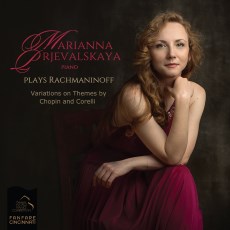
The album features Variations on themes by Chopin and Corelli. I was dreaming about this project because Rachmaninoff is a composer whose music I find very close to my heart and my soul. I have to say that I had an absolutely awesome team: I was lucky to work with an amazing producer Elaine Martone, who was extremely supportive, encouraging and inspiring during the recording sessions. Chelsea VandeDrink is a fantastic recording engineer who did her work fabulously, and Anilda Carrasquillo created a booklet I could only dream about. I felt that it was a very strong team, and it was an excellent experience to work with these people, with whom I created a strong bond and most importantly, a lasting friendship. This CD was possible thanks to the Cincinnati World Piano Competition, which I won in 2013.

What is the particular appeal of these works by Rachmaninoff for you? 

I have always felt a close relationship with this composer, and considered recording some of his compositions a long time ago, but then in my twenties discovered his Variations on a Theme of Chopin Op.22, a work that unfortunately is not often performed. I was fascinated by the incredible variety of moods and emotions Rachmaninoff reveals in this music, as well as by the way he transforms the theme throughout the composition, making it barely recognizable. It is a work with endless possibilities for a pianist to display his or her mastery.

I often think that composition’s fate grows from the roots. What I mean in this case is that the work had a very moderate reception when Rachmaninoff premiered it in 1903 in Moscow. The preludes Op.23, written during the same summer, enjoyed a bigger success, and his other major hits, like his second sonata, or the second concerto, for example, completely overshadowed this composition. Even though nowadays you may find a few recordings, I feel pianists are afraid of its length and that it might not be an easy piece for the audience. This set of variations lasts about half an hour, but isn’t the Liszt Sonata thirty minutes long? Any late Schubert sonata would be even longer! When I performed this work in the semifinals of Seoul International Piano Competition in 2008, one jury member asked me at the end of the competition why I chose this piece and told me that it is inappropriate for a competition, and that instead I should have played the second sonata. I made to the finals anyway, but am still puzzled why this composition is not appreciated. It is an actual gem in the piano repertoire!

Regarding the Variations on a Theme of Corelli I have to say that at the time I was making my decision what else would go together with Chopin variations, it happened I was working on Corelli variations, and thought both sets would work greatly together. Thirty years separate both pieces and they are incredibly different. The Corelli Variations exhibit a stylistic growth and some kind of a structural compactness: he expresses his ideas in a more concise way, somewhat similar to a mature person who prefers to speak less, but whose choice of vocabulary is very accurate. I do love this composition, but in a different way.

Which particular works do you think you play best? 

Works that speak to me emotionally. But not necessarily has to be from the same period. I played Scarlatti sonatas that were very precious to me. I felt a particular affinity with Haydn Andante and Variations in F minor that I recorded for NAXOS a few years ago, for example. My attention usually shifts to different composers at different periods of my life. There were years when I felt too attached to Chopin, but thought I would never understand Schumann for his crazy and hectic romanticism. A few years later I felt I only wanted to play Schumann, and it was never enough of him. To name a few that deeply belong to my heart: Schubert Sonatas D.845 and D.959, Schumann F sharp minor Sonata Op.11, Brahms Intermezzi Op.117, Liszt Sonata, Debussy Preludes Book II, obviously Rachmaninoff, including the second Sonata, Prokofiev Sonata No.8 Op.84, among many others.

How do you make your repertoire choices from season to season? 

I feel that every time I go through a difficult internal process before I make my repertoire choices. I always play what I want, what I like most and what I feel is right for me at this moment. What it means is that for some reason, on some kind of subconscious level, a particular piece rings my doorbell. It happens when I constantly hear this music in my head, and it does not cease until I take the score and start learning it. It is as though the piece was being chosen by itself, asking to be played. I find it very interesting. And what is even more surprising is that I usually never misunderstand the signal. If I feel the need to play a particular composition, it means I feel something very special for it, a very strong emotional connection. I should probably say I am lucky, because I usually build my own recital programs, however I wish I had the same freedom to choose concerti I want to play with orchestras.

I have also had other experiences. I forced myself to play something that did not seem the right choice, and all of a sudden, when the work began, I realized that I made a huge discovery, a work that I never thought I would enjoy became one of my favourites.

My former teacher Boris Berman told me one day: “Try to learn to love a piece you do not like.” At that time I did not understand how that was possible, I neither wanted to try. I guess now I know what he meant.

Do you have a favourite concert venue to perform in and why? 

I can name several venues where I felt particularly good. A concert hall in Malaga, Sala Maria Cristina was a very special venue where I played all Schumann recital. I loved their Steinway, and the decoration of the hall and its acoustic were very inspiring. I enjoyed immensely performing at Weill Hall in New York, as well as remember wonderful experiences performing at the Mozarteum in Salzburg and Minato Mirai Hall in Yokohama.

Favourite pieces to perform? Listen to? 

This questions is partially related to my choice of repertoire. I prefer to perform works that are emotionally intense and that speak to me most. Compositions I choose to play become my favourite pieces to perform. I do like listening to music, in fact I only listen to classical music, and I should probably feel ashamed that I do not listen to anything else. It all depends on my mood. One day I might want to hear a Baroque ensemble, another evening I want to listen to Schubert’s Lieder or Brahms, or may be Haydn’s symphonies.

Who are your favourite musicians? 

If we talk about living pianists, I would name Grigory Sokolov, Murray Perahia, Mitsuko Uchida, Radu Lupu, Evgeny Kissin, András Schiff.

What is your most memorable concert experience? 

I have several. I will never forget my experience performing Brahms d minor piano concerto with Kazufumi Yamashita and Sendai Philharmonic Orchestra in the final round of Sendai International Piano Competition in 2010. It is an exceptionally rare experience when you feel that the orchestra, conductor and yourself blend into one organic whole, and music drives you with its force somewhere beyond reality. And I give thanks to this conductor for making me feel that way. A similar experience occurred performing Chopin e minor concerto with Stamatia Karampini, she made me to forget that I was not playing alone, and with Chopin that is really dangerous, because the conductor and the orchestra have to be constantly alert, Chopin´s rubato is unpredictable and too fragile to foresee. I have also enjoyed tremendously performing with Roberto Trevino and Cincinnati Symphony, and with Carlos Prieto and David Danzmayr and Louisiana Philharmonic. My solo memorable experience was probably my Weill Hall debut and a recital I performed in Baltimore with Schubert A major Sonata D.959, a work I have a very intimate connection with; in fact all Schubert occupies a very special place in my heart. I am not sure what happened that evening, but I was watching my hands and thought I am witnessing my own playing. My intensions were shaping phrases with no effort, and music was being created in the moment. That state of mind is not something you can experience every time you go to play on stage.

What do you consider to be the most important ideas and concepts to impart to aspiring musicians? 

I think the most important advice I would give is to stay true to yourself, avoid being influenced by others and do not give up.

Where would you like to be in 10 years’ time? 

I am not sure I can answer this question. I like the idea of not knowing what is ahead in my life. I have learned not to rush things, and that everything comes at its right time. I try to enjoy living in the present moment.

What is your idea of perfect happiness? 

To feel internal harmony and see my family healthy and happy. 

What is your most treasured possession? 

The ability to feel and understand music.

What do you enjoy doing most? 

Playing the piano.

What is your present state of mind? 

I feel pretty balanced and in peace with myself.

cincinnati_disk_230Marianna Prjevalskaya’s all-Rachmaninoff CD is available now. The recording features two works for solo piano: Variations on a Theme of Chopin, Op.22, and Variations on a Theme of Corelli, Op.42. (Fanfare Cincinnati FC-008) Marianna Prjevalskaya plays Rachmaninoff

Born to a musical family, Marianna benefited from early lessons with her mother from age six, her principal mentor for more than eleven years. She continued her studies at the Royal College of Music in London with Irina Zaritskaya and Kevin Kenner. In 2003 Marianna moved to the United States where she joined the Toradze Piano Studio at Indiana University. She also holds an Artist Diploma and Master of Music from Yale School of Music, where she studied with Boris Berman. Currently Marianna is a doctoral candidate at Peabody Conservatory of Music where she studied with Boris Slutsky. At diverse festivals, she has studied with renowned pianists such as Liliya Zilbernstein, Emmanuel Ax, John O’Conor, Leon Fleisher, Choong-Mo Kang, Richard Goode, Peter Frankl and Piotr Paleczny, among others.

www.prjevalskaya.com

Benjamin Ellin, the award-winning and critically acclaimed British conductor and composer, has been commissioned to create a classical composition focusing on the concept of peace and this year’s centenary of the Battle of the Somme.  The resulting Oratorio One Before Zero is one movement for orchestra, solo baritone, solo mezzo soprano and boys’ choir.

somme-hero-image
(picture source: 1914.org)

This large-scale musical narrative work is inspired by the moment before battle, before zero, zero hour, the time at which hostilities commence.  Benjamin Ellin explains: “It’s the time when all that is known can be turned upside down and where a world of emotions dominates the mind and soul of any soldier”.

The work is in English, French and German and aims to illustrate musically and linguistically how the race to war, the loss of life and the destruction of humanity affected all sides in this devastating war.

Benjamin explains the inspiration behind the new work: “The Imperial War Museum provided a great deal of the research materials that helped inform my understanding of the period and I used the archives of Royds Hall School in Huddersfield which was a military hospital during WW1.  I enlisted the talented writer Ben Maier to help me ensure the work flows as a  continuous and complete line. The work has a personal connection too. My great relative, Private Samuel Vincent Boot (No. 19463) was killed in WW1.  I used his army number to develop a lot of musical material and develop the narrative.”

The performance will take place on 11th November 2016 at the renowned Maison de la Culture in Amiens in Northern France which is located just behind where the front line was established in WW1.  A second performance is scheduled on 12th November 2016 in Beauvais, Maladrerie Saint-Lazare.

benjamin_ellin

In this Meet the Artist interview, Benjamin discusses his musical influences, the challenges of his career as a composer, and the creation of ‘One Before Zero’.

Who or what inspired you to take up composing, and pursue a career in music? 

I heard a performance of the Nutcracker at the Royal Ballet as a young boy – my mother took each of us (myself and my two older sisters) to see a ballet when we were young by way of a musical intro – and I was hooked. I persuaded her to buy me the tape recording in the shop and listened to it constantly. Whenever I hear a great piece of music, in whatever genre, I just want to write music or do something creative.

Who or what were the most significant influences on your musical life and career as a composer? 

There isn’t one single thing. My initial musical impulse often comes from the environment I am in or the world events of our time. I also love the sounds that are around us generally and how they often turn in to little musical ideas all by themselves. For instance, one of the tracks from the TAFAHUM album ‘Osmosis’ is inspired by the sound of the Victoria Line tube at Highbury and Islington; the piece is called Three Fishes Laughing.

What have been the greatest challenges/frustrations of your career so far?  

Being pigeonholed really – or people trying to. For me, music is genuinely indivisible and once you try to put people in to boxes you are missing the point. Sadly it seems, at times, this obsession is a by-product of lazy elements of the ‘business’, but I have always believed that the most inspiring characters around do more than one thing and I genuinely just happen to love and feed off different musical arenas.

What are the special challenges/pleasures of working on a commissioned piece? 

The shape of a piece is very important. Once the overall structure is set in your mind, even if it changes slightly in the process of being realised, you can really start to write it out. For ‘One Before Zero’ that really was the main issue; deciding on the form and arch because after that a lot of decisions have been made for you. The challenge is knowing what to not use or not do and structure helps that process of illumination a lot. Pleasures? I love harmony and the juxtaposition of chords and the resonances they have; that and treating the audience to the theatrical elements of music so they are – hopefully – truly gripped and engaged.

What are the special challenges/pleasures of working with particular musicians, singers, ensembles and orchestras? 

If you have a relationship with a performer or a group then you can try and build the musical material around them in subtle ways; this is a joy. A challenge is to always respect the skill and talent of the musicians. They have to play your music and you hope that they actually want to. I don’t believe music is all about the composer in an egotistical way but always about the collective.

Of which works are you most proud? 

I am proud of my Violin Concerto which was premiered last year with the Philharmonia Orchestra, my Trombone Concerto for Joseph Alessi, my tracks on the TAFAHUM album ‘Osmosis’ and the works I have written in conjunction with Violist Rivka Golani and the people of the Siksika nation in Canada – amongst others…

How would you characterise your compositional language?

That is a difficult question – in fact, all these questions are! In short a mix of Stravinsky, Shostakovich, Britten, Vaughan Williams and the jazz world of Miles Davis and Count Basie amongst others. Jazz and blues were major influences growing up in that they were the main style of music that I heard and I still love them. In general, as a composer, I don’t seek to reinvent the wheel but I’ll always express myself as honestly and boldly as I can.

How do you work? 

It largely depends on the piece or the commission. Sometimes a solid idea for a gesture within a piece starts the process and other times I have to work relatively slowly. Waiting for inspiration is all well and good, but sometimes it doesn’t always flow and you have to then rely on your technique – however good it is – when a deadline is there! I also like to sow ideas in my mind and let my subconscious chew them over for a bit; they nearly always find a way of becoming a key part of the process.

Please tell us more about your new work ‘One Before Zero’, to be premiered on Remembrance Day. 

In short it is a large oratorio for orchestra, solo baritone, solo mezzo and SATB male choir to commemorate the Battle of the Somme.

Not so short, well, subconscious played a major part here too. I first worked in Amiens several seasons ago when I wrote two smaller pieces for a new festival there. As soon as I went on a research trip I was hooked on the area, the cathedral and the history of World War 1. I knew I wanted to write something about it and that was a good start for mental gestation! Then I had the chance to work with the orchestra in Picardie as both a composer (I wrote a new work for them) and also as a conductor in several performances. Therefore I got to know the players a little and I also got to work with their Music Director Arie. By the time the commission came I had soaked a lot up about the people, the area and so I could start from a decent place. The desired use of an all male SATB choir provided another set of options for the work as it was clear to me that the choir should be the soldiers and the baritone soloist is one of them whilst the mezzo represents the home front, picking up the pieces and trying to make sense of everything that was going on through the mirage of propaganda and misinformation through media…how things change!

Then, after lots of reading and textual research I decided on the structure of the piece. The soldier (baritone solo), drained, exhausted and battle-hardened from war stands at the front of the stage. Gazing out at the audience he begins to question who are the people across the stretch of no man’s land in front of him who he will shortly be ordered to attack, to kill, or indeed be killed by. Who are they? Are they anything like him? How did he get to this point where a mere order from a higher rank can result in him, a hitherto ordinary man, attacking with such aggression and ferociousness.

This awakening marks the start of the work. The title itself (ONE BEFORE ZERO)  underlines the importance of this moment before battle, before zero, zero hour  – the time at which hostilities commence – when all that is known can be turned upside down and where a world of emotions can surely fly through the mind and soul of any soldier.

The text is also a mixture of source letters, propaganda and diary entries from the time and also a number of commissioned texts by Ben Maier – a writer who I work with regularly. The new texts help knit everything together and I wanted to move away from using war poetry as it had already been done several times. The piece is in three languages, English, French and German as the aim of the piece is to underline the human cost on all sides of this conflict.

What is your most memorable concert experience? 

Again, there have been many for all sorts of reasons. I think my first concert as a conductor at the Philharmonic in St Petersburg was very special. I studied in St Petersburg and saw a concert there during my studies with the St Petersburg Philharmonic. Amazing. Then, years later when I used to do stage managing I stage managed a concert with the EUYO and Ashkenazy there. A few years after that I made my debut as  conductor and with one of my own pieces, WHITE CRUCIFIXION, so it was a powerful feeling of full cycle!

What do you consider to be the most important ideas and concepts to impart to aspiring musicians?

Be really honest with yourself about what you are trying to do, what you love and what you are doing. Lots of people will try and knock you down, directly or just through ignorance. If you genuinely love what you do, no matter what, then just keep going – however hard it gets. Take what you do seriously, but never take yourself seriously so that it becomes destructive – ego is the ugliest trait in people and especially in music.

Where would you like to be in 10 years’ time?  

Music Director of a Professional Orchestra, writing a small handful of film scores a year, touring and collaborating with Tafahum, guest conducting with a handful of organisations and carving out commissions that I am interested in.

What is your idea of perfect happiness?  

Now, as a father, a good afternoon picnic with my wife and children followed by prating around with them, and possibly some creative work in the garden with my daughter helping.

What is your most treasured possession?  

I would say my family, but they are not a possession, so, therefore, I don’t have one.

What do you enjoy doing most?  

Lots of things and as much as I can. I learn about other things from doing something seemingly different so I love variety in work and in life.

What is your present state of mind? 

A mixture of love, contentment, frustration at the world and hope in the many beautiful things that still manage to exist.

‘One Before Zero’, a new oratorio in one movement commissioned by l’Orchestre de Picardie for the Network ONE® – an Orchestra Network for Europe – to commemorate the centenary of the Battle of the Somme will be premiered in France on Remembrance Day, 11th November 2016. Further information and tickets

Award-winning and critically acclaimed British conductor and composer Benjamin Ellin is currently Music Director of Thursford Productions, Founder of the Contemporary Fusion ensemble Tafahum, Principal Conductor of the Slaithwaite Philharmonic Orchestra, Music Director of Focus Opera and President of Pembroke Academy of Music, London.

His belief in the positive power of music within society is reflected in the wide-ranging projects of which he is currently a major figurehead. From his own ensemble Tafahum, major projects and collaborations at London’s Southbank Centre, his own commissioned works with the First Nation communities of Alberta, Canada to his commitment to outreach and development work as well as appearing on stage with leading ensembles across the globe, Ellin’s belief in a musical world without boundaries is equalled by a tireless commitment as a guest artist and as a Music Director.

www.benjaminellin.com

Established in 2012, the weekly Meet the Artist interview slot, in which musicians and composers reflect on various aspects of their creative lives, has gone from strength to strength and is now an integral and very popular part of The Cross-Eyed Pianist’s content. To celebrate this, Meet the Artist now has its own dedicated website.

Meet the Artist interviews will continue to appear on this site every Thursday, while the new site will act as a supplement with a growing catalogue of interviews with both well-known classical musicians and composers and young and up-and-coming artists. Do consider following the site in order to receive updates every time a new interview is released. In addition to interviews there will also be news, reviews and other articles relating to the artists featured on the site.

I feel very privileged to have the opportunity to share so many fascinating and often unexpected insights from such a wonderful range of musicians and composers, and I would like to take this opportunity to thank everyone who has taken part in the Meet the Artist project so far for their contributions to the series.

header