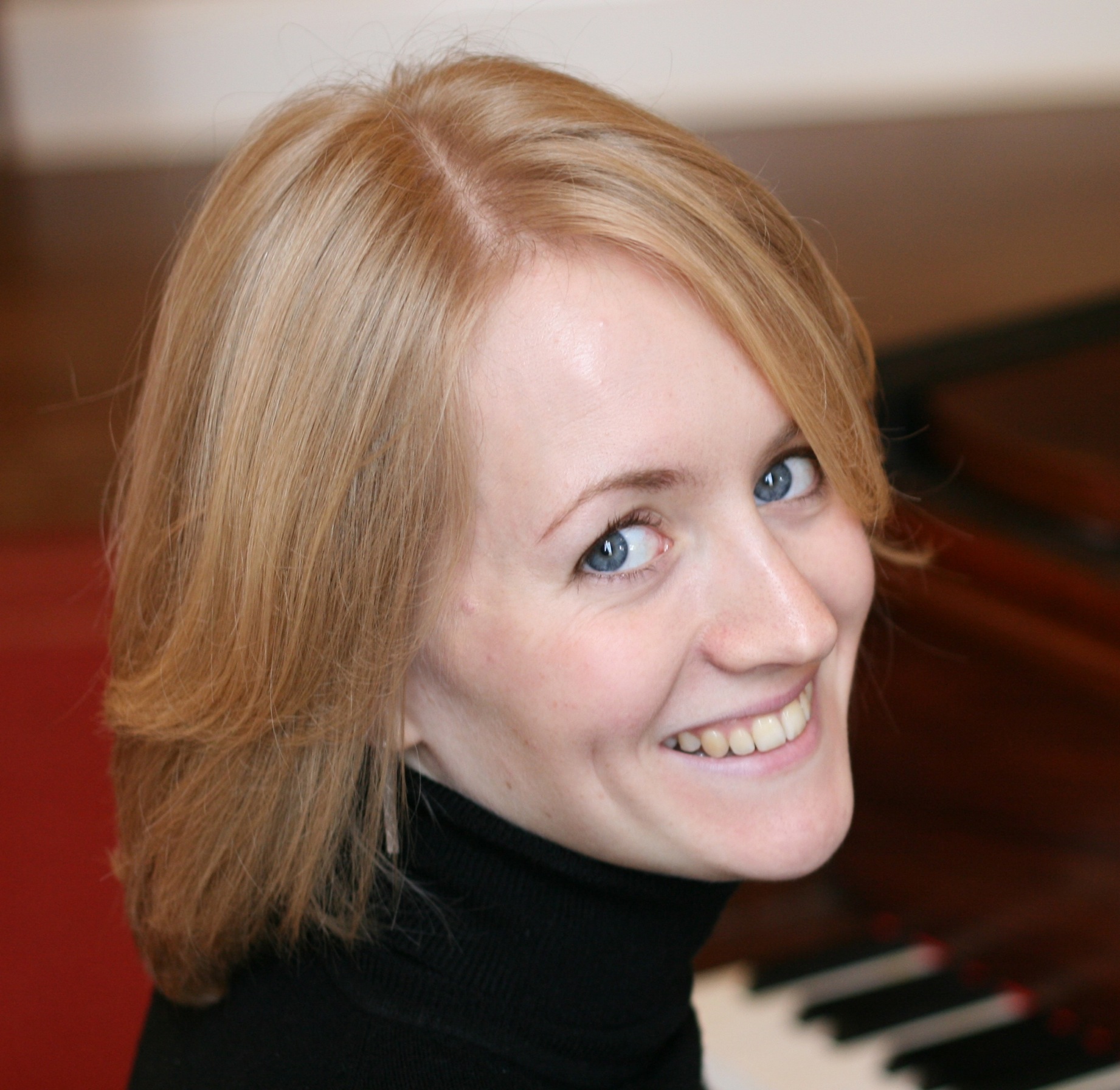
elspeth_wyllie-320x439Who or what inspired you to take up the piano, and pursue a career in music?

I didn’t plan on becoming a pianist or a professional performer until studying with Raymond Fisher while at university; he gave me the technique and self-belief to give it a go. Before that, I got a huge buzz from being surrounded by other enthusiasts and immersed in music day in, day out at music school. I’d studied recorder and clarinet too, but gradually came to realise that the piano appealed the most – because of the wealth of repertoire and playing opportunities it offers. My family wasn’t particularly musical, but my mum could strum a guitar so we sang lots of songs when I was pretty small, and I loved listening to records.

Who or what were the most important influences on your playing?

Obviously my teachers – I’m very grateful for my time with Richard Beauchamp who is disarmingly modest, open-minded and curious. The quality and quantity of chamber music on offer at school has undoubtedly given me a passion for collaborative playing. I like to think I have a reasonably open-minded attitude and curiosity for all arts and music – growing up in Edinburgh with it’s annual festivals and inspiring live performances of music, dance, theatre and wealth of art exhibitions has helped that.

What have been the greatest challenges of your career so far?

Staying focused and productive in personal practice, balancing commitments between different projects, being efficient with admin, and working out what’s next in a field that offers such huge flexibility for developing your career.

Which performances/recordings are you most proud of?

The projects where there’s a shared attitude and natural understanding with the people I’m working with, or in new projects that involve an element of challenge or risk and stretch you further than you thought possible. Specific things I’m really proud of: solo performances of Beethoven’s Choral Fantasy and Elgar’s Enigma Variations, duo performances of Bowen’s Sonata for flute and piano with Claire Overbury, Amalie Trio’s school workshops about the drama and skills of chamber music, and my recent debut recording bringing together lots of colleagues, Enigmas.

Do you have a favourite concert venue to perform in?

Anywhere with a decent piano that’s not too cold, and an open-minded audience!

Favourite pieces to perform? Listen to?

To listen to: Barber’s Violin Concerto, Mozart’s Clarinet Quintet, Schubert’s three last piano sonatas, any of Brahms’ violin sonatas… Mind you, I don’t often listen to classical music in my downtime. I dance and sing along to bands like Snarky Puppy, the Divine Comedy, Count Basie and Stornoway, or listen to Cerys Matthews and Craig Charles on Radio 6 Music. To perform, I love finding compelling repertoire that’s less well-known: trios by Nicolai Kapustin and William Bolcom, an Azerbaijani suite by Fikret Amirov, songs by Bernard Stevens. I love it when the audience hasn’t heard of a piece or composer but enjoys the discovery. It’s way more interesting to me than being the 3000th person to play Beethoven’s Ghost Trio, however good the piece is!

Who are your favourite musicians?

Those who find endless expressive nuance without distorting the overall shape of the music, and who prioritise the music and avoid any on-stage presence of ego. I’ve been blown away by concerts and recordings by Adrian Brendel, Imogen Cooper, Stephen Hough, Kathryn Stott and Steven Osborne, and outside the classical world by the creativity of Stornoway and Chick Corea, and the skill of Courtney Pine and Joshua Redman.

What is your most memorable concert experience?

Hmm. They’re often memorable for the wrong reason. Performing extremely badly but with total swagger aged 7, with two painfully-bandaged knees due to a pre-performance backyard incident! Nerve-wrackingly page-turning for Martha Argerich and Nelson Goerner in the Edinburgh Festival. Good ones: Beethoven’s Choral Fantasy (from memory, which is unusual for me), Enesco’s Violin Sonata no. 3 in my final recital at music college, the rapport with new colleagues in our very first performance together of Mendelssohn’s Piano Trio in C minor.

What do you consider to be the most important ideas and concepts to impart to aspiring musicians?

Play pieces you really believe in, and nothing beats being properly prepared.

Where would you like to be in 10 years’ time?

Performing more frequently with my regular chamber music partners and doing more 1-1 coaching with adults – I enjoy accompanying and working with them to release potential musical expression and overcome frustrations. I also love working with choirs, so continuing to develop that alongside my performing work.

What is your idea of perfect happiness?

A productive days’ work, or being outside somewhere rural in good weather, or good food in relaxed company.

Elspeth Wyllie performs throughout the UK and abroad as a solo pianist, chamber musician and accompanist. She has appeared at the Purcell Room, Fairfield Halls, The Brunton, and on Classics Unwrapped for BBC Radio Scotland. She is a founder member of the Métier Ensemble (with flautist Claire Overbury and cellist Sophie Rivlin) and the Amalie Trio (with mezzo-soprano Catherine Backhouse and violist Alexa Beattie), performing regularly with them and in projects with other musicians from major ensembles, orchestras and opera companies.

In addition to chamber music, Elspeth rehearses and performs with choirs. Particular highlights have been a performance of Beethoven’s Choral Fantasy and piano duo performances of Brahms Ein Deutsches Requiem and Liebeslieder Walzer. Her experience includes engagements with the BBC Symphony Chorus, the National Children’s Choir of Great Britain, and animateur Gareth Malone, as well as regular work with Clapham’s Festival Chorus and several other amateur choirs. Elspeth also teaches, coaches and accompanies, both privately and for workshops and courses. In the studio, she has recorded sessions at Abbey Road, AIR and Dean Street Studios, and for Novello publications.

Elspeth studied piano with Richard Beauchamp and Audrey Innes at St Mary’s Music School in Edinburgh, and continued with Raymond Fischer while reading music at the University of Oxford. She completed her professional training with a PGDip from the Royal Academy of Music, London, studying piano and accompaniment with Andrew West and Colin Stone and winning many prizes, including the RAM Club Prize for Accompaniment, the Vivien Langrish Prize, Evelyn German Prize and J E Reckitt Award. She was supported during her studies by the Oldhurst Charitable Trust and was shortlisted for the 2011 Park Lane Group Award with duo partner Claire Overbury. She has enjoyed lessons and masterclasses with many wonderful musicians, including Julius Drake, Susan Tomes, Adrian Brendel and Tasmin Little.

‘Enigmas: solo piano and chamber works’ is released by Divine Art Records on 19 May 2017

www.elspethwyllie.co.uk

Pianist Peter Donohoe (picture credit Sussie Ahlburg)

Who or what inspired you to take up you the piano and make it your career? 

I didn’t really make it my career. It kind of chose me, after many years of vacillating between instruments and other musical disciplines (like composition, musicology etc). Looking back to the beginning the most formative influences were countless people – in a kind of chronological order:

  1. My mother, who was an amateur pianist.
  2. My father, with whom I argued so much that it embarrasses me to remember, but he was right…. and I am still learning from his life lessons.
  3. Alan Taylor, who was the music teacher at my primary school.
  4. All my subsequent piano teachers (Alfred Williams, Donald Clarke, Derek Wyndham, Yvonne Loriod, Olivier Messiaen – more importantly than any pianistic or teaching qualities – they were all wonderful people.)
  5. My percussion teacher, Gilbert Webster – an extraordinary man, with enormous experience at the very highest level (amongst other things he had been the BBC SO’s principal percussionist during the Boulez era). He was the man who, more than any other, showed me how to practise – whatever the instrument.
  6. All my friends, who argued with me when I was convinced that a career as solo pianist was not for me, because I didn’t think I was good enough.
  7. My wife, Elaine, who is herself a professional pianist, critic and supporter.
  8. Martin Roscoe, my two-piano partner of 40 years, and our Best Man.
  9. All the conductors who invited me to work them in my early days, particularly James Loughran, Edward Downes, Charles Groves and Simon Rattle.

Who or what are the most important influences on your playing?

  1. The composers whose works I am trying to communicate to the public.
  2. The public itself.

What have been the greatest challenges of your career so far?

  1. Taking the plunge in my early 20s and deciding after all to be a solo pianist.
  2. Maintaining the natural sense of British taste and reserve at the same as learning to be emotionally open, and keeping the balance between the two.
  3. Playing Bach.
  4. Standing in for Daniel Barenboim playing Bach.

What are the particular challenges/excitements of working with an orchestra/ensemble? 

Exploring the characters of everyone one works with, and making the most of those characters, rather than going in with a fixed ideal and trying to make everyone fit in with it.

Which recordings are you most proud of?

I don’t know, because I don’t listen to them once I have swallowed my disappointments and approved them. I suspect that the live recording of the Busoni Concerto from the 1988 Proms might be the one I would be least disappointed with.

Do you have a favourite concert venue? 

Many in diverse places and for diverse reasons. If I had to choose – the Bolshoisal in the Moscow Conservatory – a great hall, with a great atmosphere, and many wonderful memories.

 Who are your favourite musicians? 

The ones I am working with at the time. That might seem like a pretentious answer, but it is a good way to look at things. There have been several over the years whom I could name, but better if their identity is not revealed for the sake of the others.

What is your most memorable concert experience?  

That depends on the reason it is memorable….

The one that was the most thrilling to listen to was possibly Richter and the Borodin String Quartet playing Brahms 2nd Piano Quartet in Moscow in 1987. Other contenders would be Bernard Haitink and the LPO playing Bruckner’s 8th Symphony, Charles Groves and the BBC SO playing Messiaen’s Turangalila Symphony with Jeanne Loriod and John Ogdon in the 1970 Proms, Emerson Lake and Palmer on tour in 1971, Reginald Goodall conducting Wagner at ENO in the 1970s, and a concert given by the Red Army Chorus in Moscow in 1983.

Of my own performances:

  1. The formative ones were Beethoven Piano Concerto 3 with the Chetham’s Symphony Orchestra when I was 12, singing in Bach’s Mass in B minor in Manchester Cathedral when I was 17, my London debut at the 1979 Proms and my US debut at the Hollywood Bowl in 1983.
  2. The most significant and life-changing was the final of the Tchaikovsky Competition in 1982.
  3. The most nerve-wracking was when I conducted Stravinsky’s Rite of Spring with the Hull Philharmonic Orchestra in 2007.
  4. The strangest, although very rewarding, was giving the first ever classical recital in Papua New Guinea in 2006.
  5. The one that went the least well is best left unmentioned, although there are many contenders!

What is your favourite music to play? To listen to?  

Far too many composers and pieces to mention. Much easier to think of pieces of music that I don’t like to play or listen to, and I daren’t name them for the sake of those who disagree – although there are actually very few.

What do you consider to be the most important ideas and concepts to impart to aspiring musicians/students?

  1. That we are all part of a culture that is far bigger than we are.
  2. That the greatness of the music and sharing that greatness with the listeners are both far more important than our commercial success and our ego.
  3. That we need to identify in our own minds exactly why we really want to be performing musicians, and what we feel is the true role of music in modern society.

What are you working on at the moment?  

Bach’s complete 48 Preludes and Fugues has been my main project since 2005, but there are many other less all-emcompassing and to some degree more familiar ones.

Where would you like to be in 10 years’ time?

Where I am now, but with more memories and experiences from which to draw.

In the years since his unprecedented success as Silver Medal winner of the 1982 7th International Tchaikovsky Competition in Moscow, Peter Donohoe has built an extraordinary world-wide  career, encompassing a huge repertoire and over forty years’ experience as a pianist, as well as continually exploring many other avenues in music-making. He is acclaimed as one of the foremost pianists of our time, for his musicianship, stylistic versatility and commanding technique. Read Peter’s full biography here.

www.peter-donohoe.com

Peter Donohoe opens the autumn season at Sutton House Music Society with a concert on Sunday 21st October 2012.

www.shms.org.uk

Who or what inspired you to take up singing, and make it your career?

I’ve always sung, since I was a little girl, and I’ve always loved music. So singing as a job seemed like a natural step. However, I didn’t follow a logical route, as I first became a Barrister, after reading Law at Cambridge University. But the lure of singing was too great in the end, and so I accepted a place at the Royal College of Music and I’ve never looked back.

Who or what were the most important influences on your singing?

My most important influence has been my wonderful teacher, Lillian Watson. She has brought me to where I am today and I owe her everything. I have also been very lucky and have come into contact with some amazing artists who have guided me: Sir Thomas Allen, who gave me my first role as Mrs Herring in his production of Albert Herring at the RCM; Christa Ludwig, who has given a number of masterclasses I was fortunate enough to participate in; the late great Philip Langridge, who coached me in song and presentation; and currently Dame Anne Evans, who is guiding me through all of the Wagner roles I am learning.

What have been the greatest challenges of your career so far?

Balancing being a wife and mother with a career that often takes me far away from home.

Which performances / recordings are you most proud of?

Every performance or recording is a learning experience, and so as long as I’ve given my best I’m proud of all of them. But I suppose if I had to select one, I would say my debut at the Salzburg Festival in Mozart’s La Betulia Liberata.

Do you have a favourite concert venue to perform in?

The Wigmore Hall. There’s no better acoustic to perform in – it’s a beautiful space.

Favourite pieces to perform? Listen to?

In oratorio, I love Mahler 2 and Das Lied von der Erde, Elgar’s Dream of Gerontius, Verdi’s Requiem and Bach’s St Matthew Passion. I also love song repertoire, especially by Schubert, Brahms Britten and Mahler, and in opera I love singing Wagner. My favourite pieces to listen to are Bach’s Goldberg Variations, Elgar’s Cello Concerto, Mozart’s Requiem and anything by Mumford and Sons!

Who are your favourite musicians?

Christa Ludwig, Dame Janet Baker, Sir John Tomlinson, and Stephen Hough.

What is your most memorable concert experience?

Singing Bach’s St Matthew Passion with the Dallas Symphony under Van Zweden. It was simply wonderful.

What do you consider to be the most important ideas and concepts to impart to aspiring musicians?

Always be true to yourself, and work hard. Preparation is everything!

What is your most treasured possession?

My home. I spend a lot of my time away, so time at home with my family is precious.

Tim Benjamin (photo credit: Gabrielle Turner)

Who or what inspired you to take up composing and make it your career?

It was my first instrument, the trombone, that led me to composition. I was unhappy with the exercises I’d been set to practice after my first few lessons, so I decided to write some alternatives. I found this much more interesting than practicing, and so that’s how I started composing!

After that I couldn’t get enough of it. I would write alternative harmonisations of hymns while not singing in the choir at church, and I went through one phase of about a year of writing a new little piece every day (for the exercise rather than for performance).

Although things like this account for about my first 7 or 8 years of composing, I only became “seriously” interested when the composer Steve Martland visited my school for a BBC education project and decided to take me under his wing and encourage me. So I’d say he was one of my first inspirations to make a serious go of it.

Who or what are the most important influences on your composing?

The most direct influences are other composers, in particular the German late romantic / early modern tradition, from Wagner through Mahler to Schoenberg, and in particular Berg. Not a huge amount of newer music, but certainly that of Messiaen, Xenakis, Andriessen among relatively recent composers. But I am also influenced by music that I play (I do a lot of playing, at an amateur and occasionally professional level), which can be anything from wind/brass band music to jazz standards to a wide variety of orchestral and chamber music. Music that I play has a habit of finding its way, heavily filtered, into music that I write. At the moment for example Schubert’s “Death and the Maiden” is spending a lot of time in my head as we’re learning it in the quartet in which I play viola!

What have been the greatest challenges of your career so far?

I hesitate to describe my composing as “a career” as that implies there is a) some structure to it and b) some financial reward, whereas in reality there is neither. The greatest challenge is probably the same for any composer – to simply keep writing, and find a reason to keep writing, in the face of public indifference! And of course, to persuade people to perform your music.

What are the particular challenges/excitements of working with an orchestra/ensemble?

Without question, the first moment of hearing your piece come alive. While it’s the first time the players might have seen it, you the composer have come to know the piece intimately from its first sketches, so you have to be patient and wait for it to emerge. Sometimes the reality can turn out to be quite different to what you imagined, but over time you try to get better at accurately imagining during the composing process.

I really like the process of working with performers. It’s the unexpected touches they put in that really bring a piece to life – their “interpretation”, notes that are fractionally late, rhythms slightly slower than written, their frustrations with it, or whatever; it’s the unplanned bits that make music come to life and make it infinitely more exciting than hearing a computer play it!

Which recordings are you most proud of?

I haven’t got many recordings of my pieces, but I usually get at least one for each piece that’s performed. The one I’m most proud of would be the London Sinfonietta playing my piece Antagony, which won the 1993/94 BBC Young Musician of the Year award for composers – I was 17 at the time and writing a 20 minute piece for two wind bands, amplified strings, and 6 percussionists seemed quite practical. Fortunately, for the BBC and the Sinfonietta, and conductor Martyn Brabbins, this posed no problem! And today I have a great recording and a great memory of a special occasion.

Do you have a favourite concert venue?

The Purcell Room at the Southbank Centre – I first played there in a brass ensemble at 15 and have played there (and heard my music played there) many times since. There’s something timeless about the backstage area and things like the odd signs for performers in Russian that they used to have that’s really special, and the staff are really friendly and professional. I also think that the leather seats in the auditorium are the most comfortable in any concert hall in the UK. I’d much rather my listeners were comfortable when being confronted with my music!

Who are your favourite musicians?

They are the ones I play with most regularly – my quartet, local brass band, etc. They are definitely not well-known international concert artists but some of them are really outstanding musicians and great fun to play with!

What is your most memorable concert experience?

Hearing Louis Andriessen’s De Snelheid and Stravinsky’s Oedipus Rex played by (I think) the BBC Symphony Orchestra at the Royal Festival Hall when I was a teenager. I was brought there by Steve Martland (see above) and it was the moment when I vividly remember thinking “THIS is what I want to do with my life”.

What is your favourite music to play? To listen to?

To play – perhaps boringly, I really enjoy playing the music of the old masters: Bach, Beethoven, Mozart, Schubert, etc. There’s a reason why they are considered great composers and it’s so clear every time you play their music. There’s also so much that can be learnt by playing music like that!

To listen to – I have very broad tastes but I actually don’t listen to a huge amount of music. At the moment I enjoy listening to random avant-garde electronic music by people on Soundcloud or to odd online classical music radio stations and just seeing what’s on. I’m a great believer in serendipity!

What do you consider to be the most important ideas and concepts to impart to aspiring musicians/students?

To follow what you want to do; don’t get put off by public indifference and by chasing easy fame by playing (or writing) crowd-pleasers. If you aren’t moved by what you do then no-one else will be.

What are you working on at the moment?

An opera about the Suffragette Emily Wilding Davison, for premiere in July 2013, 100 years after her famous / notorious death under a racehorse while protesting at the Derby. Please have a look at: http://www.emilyopera.co.uk!

Where would you like to be in 10 years’ time?

Taking a curtain call to a rapturous audience at Bayreuth after the successful premiere of my latest opera. Failing that I’ll settle for being happy, healthy and not too poor in some part of the world with nice landscape!

What is your idea of perfect happiness?

Being outdoors somewhere spectacular without any worries about anything or anyone.

What is your most treasured possession?

My brain.

What do you enjoy doing most?

Other than carefree time with my wife and daughter, I’d say playing great music with other people – music that everyone finds challenging but just within their technical ability…

What is your present state of mind?

A state of constant restlessness.

Tim Benjamin (b. 1975) is an Anglo-French composer, and has studied with Anthony Gilbert at the Royal Northern College of Music, privately with Steve Martland, and with Robert Saxton at Oxford University where he received a doctorate. He is the founder and Director of the critically acclaimed contemporary music group Radius.

Tim Benjamin was winner of the BBC Young Musician of the Year Composer’s Award in 1993, at the age of 17, with his work Antagony. He also won the Stephen Oliver Trust’s Prize for Contemporary Opera, for his first opera The Bridge. Benjamin’s music has been widely performed, by groups including the London Sinfonietta, the BBC Philharmonic Orchestra, and at the BOC Covent Garden Festival, and broadcast on BBC 2 and BBC Radio 3.

Past commissioners include the European Community Chamber Orchestra (Möbius), the Segovia Trio (Hypocrisy), the BBC Philharmonic Orchestra (Un Jeu de Tarot), the London Design Festival (The Corley Conspiracy), and CNIPAL (Le Gâteau d’Anniversaire). Tim Benjamin lives and works in Todmorden, Yorkshire, and also plays the trombone.

Tim Benjamin is also the co-founder of Clements Theory, the leading e-learning resource for ABRSM and Trinity Guildhall Grade 5 Theory. Tim has written a comprehensive set of Grade 5 Theory study guides which are used on the website, and he also designed and edited many of the questions. Further information here

www.timbenjamin.com


