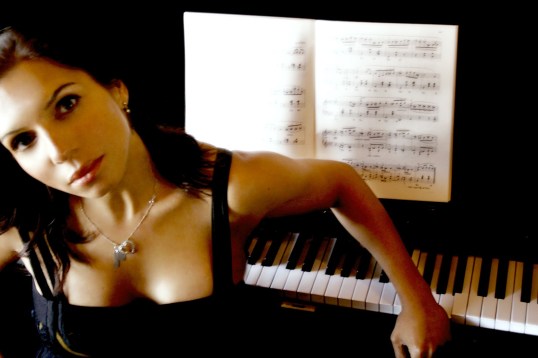
Who or what inspired you to take up the piano and make it your career?

My recorder teacher and my godfather were jointly the ones who nudged me towards getting my first piano lesson at the age of seven. None of my family play and I wasn’t brought up listening to a great deal of Classical music, but as soon as I started lessons, I took to it like a duck to water and digested every new thing I learnt with a great enthusiasm. Surprisingly, for once, my habit of impetuously discarding the latest hobby in exchange for a new one didn’t happen; something was a little different about playing the piano, and it stuck with me and I with it. I still can’t quite put my finger on what it is I love so much about playing. Maybe it is the very essence of intangibility itself; the idea of crafting something so magical and beautiful for an instant, passing moment. Who knows? But it captivated me then and still does now, and that’s why I have chosen to pursue music as a career.

Who or what are the most important influences on your playing?

My teachers, for me, have always been the most wonderful influence on my playing, not because they have dictated what I do – what does anyone actually learn from that, after all? – but because I have been lucky enough to have grown up and continued to study with teachers who have encouraged me to question everything I do and to do it my own way. I think finding your own path of understanding with music is essential because, at the end of the day, it’s an art form and art is a very personal thing.

What have been the greatest challenges of your career so far?

Starting to make the leap from amateur to professional has definitely been a difficult one – playing for family and friends and people in the local area who support you is one thing; playing for a new and unfamiliar audience in a venue you’ve never been in, and knowing your reputation is at stake, is entirely another. As with any transition, it requires gently testing the water at times, and at others just jumping on in and not fearing the consequences. I seem to have struck the balance fairly successfully so far, but it is most definitely a tricky one to strike!

What are the particular challenges/excitements of working with an ensemble?

Ensemble playing is (mostly) a wonderful experience for me because as pianists, we spend far too much time cooped up on our own, and getting to explore music with other people is a refreshing change! A spectrum of different but equally valid viewpoints to consider is exciting beyond measure, but of course, with conflicting viewpoints comes scope for disagreement and if you’re not working with open-minded individuals, deciding anything new can be like banging your head against a brick wall. I seem to generally have been lucky on this front so far, but I do have one or two unsatisfying experiences of working with less flexible musicians. It seems to me that the vital thing is to have the same vision of where the music is heading and what it’s about. If you can connect with others musically and conceptually in the macro sense, the little details fall into place pretty much seamlessly.

Do you have a favourite concert venue?

I absolutely delight in going to watch concerts at the Royal Festival Hall; it is quite simply my favourite venue in the whole of London. I particularly enjoy sitting in the choir seats when an orchestra is playing because you can feel the buzz of the excitement from being in such close proximity to the performers and see every nuance on the conductor’s face. To play in the Royal Festival Hall would be an absolute dream-come-true, and is something I aspire one day to do.

Who are your favourite musicians?

I have to say I think Marin Alsop is an incredible musician. I went to see her for the first time last year conducting Liszt 1 and Liszt 2 with Stephen Hough and was so bowled over I bought a ticket for her next concert two days later! She’s incredibly animated and passionate about what she does, and I find that inspiring. I also adore Murray Perahia’s recordings of Mozart – he just captures the cheeky yet graceful nature touch that Mozart playing requires sublimely and his recordings are always an absolute joy to listen to.

What is your most memorable concert experience?

It’d probably have to be the Medway Young Musicians Awards Finals 2006, the first year I got into the finals, which take place in The Brook Theatre in Chatham. It’s not exactly a large venue, but monumental to a fourteen-year-old who used to practise on a Clavinova in her dining room, and stepping onto a real stage with a real spotlight and performing live to an audience was absolutely captivating. The playing itself didn’t go so well from what I remember – I played Joplin’s ‘Maple Leaf Rag’ and made a bit of a mess of it due to being wracked with nerves – but the experience itself was addictive beyond measure and that’s probably the first time I was truly awakened to how thrilling a performance experience can be.

What is your favourite music to play? To listen to?

My favourite music to play has probably got to be Mozart or Purcell, Mozart for its deceptive simplicity (such detail and intricacy hidden within such seemingly uncomplicated music!) and Purcell for the tortuously beautiful harmonies. To listen to, I’m currently obsessed with Tchaikovsky’s later symphonies (the first three are indeed delicious, but 4, 5 and 6 absolutely blow my mind) and I also love Louise Farrenc – I think she’s sorely underrated as a composer, and it’s a shame more of her works aren’t played and recorded.

What do you consider to be the most important ideas and concepts to impart to aspiring musicians/students?

I think the concept that music is an art and not just a skill and, as a result, is something that you mature into; the process simply cannot be rushed or artificially induced. By all means, practise hard, listen, play, perform, read as much as you can, broaden your mind in every possible direction, but don’t expect to magically blossom into a fully-formed artist overnight. Allow yourself time to grow and while challenging yourself at every turn, don’t have completely unrealistic expectations you’ll fall short of and grow bitter about. I myself am only a young pianist, and I know that with time to grow and mature, I’ll have a deeper insight into what I’m doing and a broader base of knowledge and experience to draw from when approaching new music, but that’s something I accept and feel strongly is an important part of the process. If there was a magical ‘cure-all’ solution to all our technical and musical problems, the beauty in the process of feeling your way into music would be completely meaningless. We have to take it for what it is and, though it can be frustrating at times, it’s ultimately more rewarding for it.

What are you working on at the moment?

At the moment, I’m tackling the Strauss Cello Sonata, among other things, with my duo partner cellist Daniel Edwards. We’ve just aired the programme for the first time, and have concerts coming up in Birmingham and London over the coming fortnight. I’m also starting a new programme for a recital at the Maritime Museum, inspired by the current Ansel Adams exhibition: the programme will be officially announced shortly, but it’s going to be an interesting mix of miniatures including some rarely played pieces by MacDowell.

Where would you like to be in 10 years’ time?

Tricky one. Not sure I know how to answer that! I would like to think I’d be a better musician and have a better sense of self. But as to where that will take me? On to bigger and better things is the most specific answer I can give. I don’t like the idea of being too single-minded about the future; I’d far rather make sure I’m prepared as I can be and just see where it all takes me and what exciting directions I end up going in.

What is your most treasured possession?

My piano, of course, though primarily for sentimental reasons. It was given to me by a gentleman whose wife sadly passed away, and he let me have it on a long-term loan since he personally had no use for it. A few months later, after I had sent him a few update letters and CDs to show my gratitude and so that he could see how I was getting on, he sent me a letter and told me wanted to give me the piano as a gift as he wished it to go to a young musician who would use it regularly and treat it well. I’ve simply never been so touched and surprised, and the gesture was made even more wonderful by the fact that the letter arrived about two days before my birthday – a coincidence, but a fantastic one. We still keep in touch with each other, and if you’re reading this, Michael, thank you very much, I am forever indebted to you!

What do you enjoy doing most?

I assume you mean aside from music? Learning, in whatever shape or form that comes. When I’m not devouring music, I love devouring books. I also love talking (anyone who has ever met me face to face will tell you that, I’m sure!), giving speeches to audiences is something that lights my candle – I’m most definitely a performer at heart! Writing is also a passion of mine. I used to write a lot of poetry, but sadly don’t find the time so much nowadays. But obviously I still get to exercise my pen a lot, what with reviewing for Bachtrack and writing for various other websites and blogs.

Madelaine’s full biography, and details of forthcoming concerts and her writing can be found at

www.madelainejones.co.uk

Madelaine performing at Normansfield Theatre, 20 May 2012

Nina Kotova

Who or what inspired you to take up the ‘cello, and make it your career?

Listening to my father play double bass as a soloist made me consider becoming a musician. Cello as an instrument was chosen for me by my parents.

Who or what were the most important influences on your playing/composing?

Composing has come easily to me as the method of expression when I started reading music scores at age 7.

What have been the greatest challenges of your career so far?

It is a challenge to understand the laws of interaction and the conflict between the world of musicians and the world of classical music management.

Which performances/compositions/recordings are you most proud of?

Considering how much we value each performance, performances that were the most important were the ones that brought the sense of accomplishment.

The audience today is taught to be guided mostly by physical expressions during performance instead of detecting the hidden movements of a soul. It would be incorrect to be solely guided by the reaction of the audience.

What do you consider your most important achievement?

Although I consider premièring and recording my Cello Concerto ten years ago an achievement, I think that the most important achievements are in the future.

Do you have a favourite concert venue to perform in?

Concert venues with the best acoustics are definitely preferred.

Favourite pieces to perform? Listen to?

I have absolutely no favorites. To have favorites would mean to put artificially-created limitations on yourself. It is a powerful feeling to consider it all possible (even mastering less interesting works).

Who are your favourite musicians?

Musicians who are capable of giving their crystal clear souls away to the maximum are the musicians for whom I feel the most respect.

What is your most memorable concert experience?

The Red Square, Carnegie Hall, Berliner Philharmoniker.

What do you consider to be the most important ideas and concepts to impart to aspiring musicians?

Focusing on the inner expression in music and not the purely physical effect will eventually bring the art of performance into a more balanced state.

Creating your own creative world around yourself, learning and understanding how concerts venues and management work, meet people, establish relationships, create opportunities for yourself to perform.

Music says what a word is incapable of expressing. It uses the language of sound, pattern and form and masterful emotional input of the individuals involved .

Discussing the emotional charge as well as realizing what emotions music evokes in you is going to help you to appreciate classical music.

The most important thing is to cultivate the taste from the youngest age, develop curiosity to the arts and study.

What are you working on at the moment?

I often come back to the standard ‘cello repertoire, which is indispensable in putting recital programs together and performances with an orchestra as a soloist.

This season I am also premiering another newly completed concerto written by an American composer for ‘cello and orchestra.

Where would you like to be in 10 years’ time?

I have received a very specialized type of education in the classical music – to keep unraveling my talents, achieving and fulfilling myself in other sectors of art.

What is your idea of perfect happiness?

Balance. A sense of accomplishment.

What is your most treasured possession?

My talent.

What do you enjoy doing most?

Being with my family.

What is your present state of mind?

Lev Tolstoy: ”But my life is now”

Russian-born cellist Nina Kotova has been hailed “passionate and inspiring”. According to Newsweek magazine, “she‘s a fantastically gifted cellist.” “Very expressive, imaginative, and she has a powerful stage presence.” Time magazine states: “She is a musician of high seriousness and real talent”.

Ms. Kotova studied at the Moscow Conservatory and Musikhochschule in Cologne, Germany, giving her first performance as a soloist with orchestra at age 11. She made her Western debut in Prague with the Prague Radio Orchestra in 1986 after winning the Prague International Competition, and followed with debuts at Wigmore Hall, the Barbican Centre in London, Carnegie Hall in New York and the Concertgebouw in Amsterdam.

Ms. Kotova has since then performed as a soloist with symphony orchestras across the globe including the Czech Philharmonic, the Russian National Orchestra, the State Symphony Orchestra, the China Philharmonic, the Royal Philharmonic and the Royal Opera House orchestras, the BBC Orchestra, the Budapest Symphony Orchestra, the Dallas Symphony Orchestra, the Hong Kong Philharmonic, the Gulbenkian Symphony Orchestra in Lisbon, and the Mozarteum Orchestra in Salzburg. She has performed on the Red Square in Moscow, for the Imperial family of Japan, and at Buckingham Palace. Upcoming highlights include performances in South America and the Al Bustan Festival.

Ms. Kotova has collaborated with musicians such as violinists Sarah Chang, Joshua Bell and Nikolaj Znaider, flautist Sir James Galway and pianists Jean-Yves Thibaudet, Lang Lang and Hélène Grimaud, with Sting, and conductors Teodor Currentzis, Stephane Deneve, Vladimir Jurowski, Claus Peter Flor, Nicola Luisotti, Antonio Pappano, Libor Pesek and Tamas Vasary.

As a composer Nina Kotova has written numerous works for cello and orchestra. Her first Cello Concerto premiered in San Francisco in 2000. The San Francisco Chronicle reported that “Like Wolfgang Rihm in 1974, so Kotova in 2000 stands in defiance of both the emotional austerity of last century’s modernism and the new simplicity of so much recent music.”

Although perhaps most acclaimed for her performances and recording of the Dvorak Cello Concerto, Ms. Kotova has a keen interest in expanding the repertoire available for cello. A composer herself and a champion of contemporary music, Ms. Kotova commissioned several leading composers to write a Cello Concerto for her, including another recent collaborator composer Christopher Theofanidis. In 2009 Ms. Kotova performed the world premiere of the Theofanidis Cello Concerto with the Dallas Symphony Orchestra, following with the Asian premiere of the work in Singapore with the Netherlands Radio Philharmonic Orchestra conducted by Jaap Van Zweden.

Ms. Kotova co-founded The Tuscan Sun Festival in Cortona in Italy and Festival Del Sole in Napa Valley. She calls the Festivals “a mecca and meeting place for artists and admirers of the arts alike”.

Now performing with the instrument that Jacqueline du Pré made famous in the early 1960s and that Lynn Harrell played over the last two decades, she explains, “The cello is a unique instrument with the capability to reflect the most mysterious qualities of the human soul. As a solo instrument, the cello must have new works written for it that emphasize its virtuosity, powerful energy and lyrical impact.”

Ms. Kotova has taught as a visiting artist at the University of Texas and has been the subject of numerous features in Time, Newsweek, Vogue, Elle and the Wall Street Journal, as well as being on the covers of Classic FM, Gramophone China, Il Venerdi Italia and Reader’s Digest and appearing on television on A&E “Breakfast with the Arts” and the “Charlie Rose Show”.

She is carrying on the tradition of not only her legendary father, Russian double-bassist Ivan Kotov (1950-1985), but her teachers and mentors, which include Igor Gavrysh, Valentin Feigin, Boris Pergamenschikov and Mstislav Rostropovich.

An internationally acclaimed and celebrated performer and composer, Ms. Kotova is well on her way to inspiring today’s musical community-classical and beyond. In addition to a CD release of her own Cello Concerto recorded with the Philharmonia of Russia conducted by Constantine Orbelian (Delos, 2002), other recordings include her chart topping, self-titled debut album (Philips Classics, 1999), a recent recording of the Dvorak Cello Concerto with the Philharmonia Orchestra conducted by Andrew Litton (Sony Classics, 2006) and inclusion on the compilation Masters of the Bow (Deutsche Grammophon, 2003), which pays homage to the greatest cellists of the last 50 years.

www.ninakotova.com

Who or what inspired you to take up composing, and make it your career?

Music has been something that I’ve always done and has been a part of my life as long as I can remember. When I turned13 I suddenly turned round and said that I wanted to learn the saxophone, despite never showing an interest in woodwind instruments before, and after a lot of badgering my parents eventually relented. I guess it never crossed their minds then that I would stick to it nor pursue a career in music. I was never a foot on the monitor, look at me person so I guess they were as surprised as I was that when I was bitten by the music bug I couldn’t give it up.

Composing was another surprise for me too. I’d always felt lost composing at school and university and I was never inspired to write anything other than the tasks we were set, and I dropped composing modules in favour of performance as soon as I could. But after university I found I needed to write new pieces for my students to challenge a specific area of their playing and it was this that got me writing again. All of sudden I was inspired and couldn’t stop.

Who or what were the most important influences on your composing?

My playing and composing has been influenced a lot by the different genres I love to play and listen too. I have a deep love of jazz, ska and classical music – especially ska and reggae! And its these styles that I like to mix together to make my own sound.

What have been the greatest challenges of your career so far?

The greatest challenge so far was standing up and conducting the premier of my first orchestral piece I wrote in 2011. It was absolutely terrifying but I loved every minute of it!

Which performances/compositions/recordings are you most proud of?

My favourite piece that I’ve written do date is ‘Do Dodos Dance’ – I wrote it for the twtrsymphony who will be getting a woodwind trio to record this soon. It is quite a funny piece and it always makes me laugh listening back to it!

Do you have a favourite concert venue to perform in?

I’ve played at all sorts of venues and one of my favourites in the Square in Harlow – nice stage, brilliant sound guy and with air conditioning 🙂

Favourite pieces to perform? Listen to?

My favourite classical piece was one a friend reminded me of a couple of days ago – the wonderful ‘Song for Tony’ for sax quartet, was one piece I’ve loved performing before. My favourite piece to listen to (and play, but I don’t think I’ve every been with a group who’ve played it as good as the originals) is ‘Echo 4+2’ by Bad Manners.

Who are your favourite musicians?

One of my favourites is Ludiovico Einaudi – love his piano pieces. My other favourites are a lot of my contemporaries who I tweet with, and a big love for Mozart and things my hands will reach to play on the piano.

What is your most memorable concert experience?

Most memorable concert would be performing at the Secret Garden Festival this year with the ska band I work with. It was rather muddy and hot! But an amazing atmosphere and great crowd!

What do you consider to be the most important ideas and concepts to impart to aspiring musicians?

Aspiring musicians need to be thick-skinned and not take any one else’s beliefs, comments or criticisms to heart. You need to be passionate about what you do and be happy with what you do. If you love it, someone else will. And remember to treat people how you’d like to be treated. Above all keep writing/performing/listening/reading and developing.

What are you working on at the moment?

At the moment I’m gearing up to go to Italy in November and tour around for the Donne in Musica female concerts they’ve arranged. I will be performing my new solo sax piece ‘My Life in Music’. Compositionally I’m working on some new educational string pieces as well as working on a new wind band for a local wind band to play next year.

What is your idea of perfect happiness?

My idea of perfect happiness would be to be able carry on writing music for groups of all shapes and sizes and to hear my music performed. That an a big cup of tea.

Rachael Forsyth is a freelance composer, music teacher and all round woodwind player based in North London. She has gigged extensively with bands around the UK and her main musical loves are for classical music and ska. As a composer she writes lots of pieces she knows students will love to play as well as working on large scale orchestral and piano based pieces. Rachael has been invited to Italy in the Autumn to perform a solo saxophone piece on a tour around Rome. Highlights for her for the last year have been conducting the premier of her first orchestral piece in November 2011 and being given the opportunity to write a woodwind trio piece that is due to be recorded and released later this year. Her current projects include writing material for music exam boards, writing solo saxophone pieces as well as writing a Wind Band piece to be performed next year.

Links:

www.rachaelforsyth.co.uk

www.roorecordsmusic.co.uk

www.reverbnation.com/rachaelforsyth

Twitter @rachaelcomposes or @roorecordsmusic

Who or what inspired you to take up the piano, and make it your career?

I started at the piano as a toddler and simply never stopped! I just never found anything I loved as much. In my teens, I had passing fantasies about being an archaeologist or an actor “when I grew up”, and then I realized that I could incorporate aspects of both of those careers into my musical path. My work involves a lot of archaeological excavation of the repertoire in search of historical narrative and context, and I think that I channel my inner actress into the task of interpreting the emotions and messages of the composers whose works I perform.

Who or what were the most important influences on your playing/composing?

It’s been a collage of many things: my very first teacher, Maria Cisyk, was my first love! She was a wonderful woman who integrated a true understanding of and curiosity about music into the first steps at the piano. As soon as I could cover a five-finger position, she had me playing little and Bach and Bartok pieces, and learning the stories behind them so that I had a sense, from the very beginning, of the scope of a history and a tradition in music.

A little later I went on to work with Adolph Baller, a wonderful Austrian pianist with whom I studied at Stanford when I was still very young. He gave me, again, another layer of understanding about the importance of tradition. Having come out of the Viennese tradition himself – he studied with a former student of Franz Liszt! – he was a direct link to the European Romantic school that I, an adolescent in California, could only vaguely imagine. Tragically, Baller had suffered tremendously during the Nazi regime (he was interred in a concentration camp and his fingers were broken), before escaping to the U.S., where he was able to rehabilitate his hands and resume his career as Yehudi Menuhin’s accompanist and a member of the Alma Trio. His story gave me some insights into the power that music can have in a life, the strength that can be found in one’s calling throughout personal tragedy and upheaval. That was an important turning point.

Later on, as a teenager, I studied myself at the Hochschule in Vienna and the Mozarteum in Salzburg with the great Hans Graf, and was able to touch that grand tradition for myself, which brought everything full circle. I remember a winter morning in Vienna, the first heavy snow of the year, when an Argentine classmate came running into Graf’s class saying “I went to the Mozart house and I walked in Mozart’s snow!” That’s how it felt for me during those years, working in the birthplace of the tradition, treading the same ground as the composer whose works I was studying. Very magical.

What have been the greatest challenges of your career so far?

I think that I’ve come of age in a challenging time to be a musician, but also a very liberating one. So I see the challenges also as advantages. The limited opportunities in the concert world (especially in the U.S. where funding for the arts is such a tremendous issue) present a constant difficulty, but ultimately that difficulty has been an inspiration to me to develop a real creativity and innovative spirit in my approach to presentation and programming, to build a unique profile as an artist, to identify what it is that I have to offer and share with audiences that is uniquely mine, my genuine voice in the world. I think we are living in a time when an artist with something significant to say can take a significant amount of control in determining how, when and where he or she is heard. There is a really interesting and diverse mix of artistic personas on the concert stage these days, reflecting a commitment to different ways and means of musical expression. I think it’s very exciting.

And then of course there have been the challenges of combining my professional and personal lives – the same challenges we all face as musicians, finding ways to integrate my roles in my family and in the professional world. Being a mother of two young children has meant making some choices. But that too, I think, has been a very positive thing for me. I’m certainly a more centered, more thoughtful musician than I was when I was younger, and obsessed solely with the day-to-day mechanics of being a pianist, practicing 6 hours a day. Having a wider landscape to tend has been very good for me. I’ve built a career that encompasses performing and recording, writing, and also concert curating and presenting, which I love to do. Being active as a concert and festival curator/presenter allows me more space to bring my many (too many??) ideas to life! It’s important to me to have some impact in shaping the future of an art form that is changing so quickly, and has so much potential to reach new audiences in new ways.

Which performances/compositions/recordings are you most proud of?

I’m proudest of the multi-faceted projects I’ve created and produced from start to finish, which have encompassed everything from commissioning and premiering new works, to writing and delivering narrative commentary from the stage, co-producing multimedia/visual enhancements, and self-producing and releasing recordings on my own label (Tritone).

Some favourite examples are:

13 WAYS of Looking at the Goldberg: 13 new re-imaginings of Bach’s Goldberg Variations. World premiere recording released on the Tritone label in 2010

Long Time Coming: A full-length multimedia concert featuring works by Duke Ellington and a new commission from composer David Sanford

The Americans: A retrospective of concert music influenced by the American vernacular

Do you have a favourite concert venue to perform in?

I love playing the Kennedy Center in Washington DC. They treat artists so well (my son wants me to go back so we can “ride in the limo”!), but more than that, the place evokes for me something very powerful about respect for and pride in the arts. It’s just a beautiful place to be and to perform.

Favourite pieces to perform? Listen to?

Whatever I’m working on at the moment! And some “comfort food” pieces that go way back for me, that I turn to when I need to sort of musically meditate and center myself: the Chopin Nocturnes, Schumann’s Davidsbundlertanze, Bach’s Goldbergs, some favourite pieces by Barber, Ives, and Prokofiev…

Who are your favourite musicians?

Arthur Rubinstein, Billie Holiday, Richard Goode, Nat “King” Cole, Chet Baker, Etta James, Charles Aznavour, the Beatles, Pablo Casals, my son playing the trumpet, Lucio Dalla… you see it’s pretty all over the place!

What is your most memorable concert experience?

Hearing Rudolf Serkin under the big tent at Tanglewood in the late ‘80s, just a few years before his death. I was a kid watching a legend and knowing deep in my bones just how precious the moment was. Again, to me he represented the magic of the tradition.

What do you consider to be the most important ideas and concepts to impart to aspiring musicians?

Know what your music means to you. Find your voice. Learn what you alone have to give. Don’t try to be like anyone else. Be flexible in your thinking and let your path take you in unexpected directions. The future can surprise you.

What are you working on at the moment?

My next recording, Exiles’ Café, will be released on the Steinway & Sons label on 26 February 2013. It’s a collection of 19th and 20th century music by composers in exile, or written in response to the experience of exile and diaspora. I’ve positioned music by composers displaced by World War II (Erich Wolfgang Korngold, Bohuslav Martinu, Darius Milhaud, and Kurt Weill) alongside works by earlier composers such as Chopin, Rachmaninoff, and Prokofiev, who were likewise political exiles in their own time. I’ve also included the Africa Suite by African American composer William Grant Still, representing the permanent wandering of the African Diaspora, and some preludes by the American composer and novelist Paul Bowles, who lived in self-imposed exile in Tangiers for the latter part of his life. The central, big piece on the album is Korngold’s 2nd Sonata, which he wrote in 1910 when he was a thirteen year old prodigy! It’s a massive, late-Romantic, very Straussian work, just absolutely gorgeous and lush.

The project illustrates the global currents of diaspora and exile, which create artistic confluence among people from many different backgrounds of time and place. I think the theme of displacement is one with which everyone is familiar at some level, and also I think that this goes back to my answer to your earlier question, which touched on my deep emotions about the tradition that has built our concert repertoire. Often it has been breaks in that tradition that have actually carried it forward – the historical and political situations that have carried composers from one place to another (Chopin from Poland to France, Rachmaninoff out of Russia, Korngold to Hollywood where he made a legendary career as a film composer and defined the future of that genre) have influenced the development of concert music in a profound way. So once again challenges sometimes prove essential!

Exile’s Cafe

What is your present state of mind?

It’s a hugely exciting time for me. I’m watching several musical projects come to full maturity and thrive, and I’m embarking on new ones. I feel that I’ve arrived at a time in my life when my musical/professional priorities are clear to me. I know what I want to do, and I’m ready for new challenges. I feel lucky every single day to be making a life in music, really. It’s an amazing thing.

Lara Downes’ biography

Lara Downes’ website

Pre-order Exiles’ Café here

New projects from Lara Downes:

“I’m launching a new concert series in San Francisco in April. The Artist Sessions will be held at a historic jazz club called Yoshi’s, where the atmosphere is very modern and informal, and the audience is diverse and “downtown”. The concerts will be unique in the sense that they will be presented as immersive encounters with the artists – each evening will be begin with an onstage conversation between the guest artist and myself, and will conclude with an audience talk-back session. I want audiences and artists to come together as people, and for listeners to find context and connection in the work being presented. The first Spring Preview season will feature performances by Christopher O’Riley and myself, and then a full Fall season will resume in September (series guests will be announced in April).
http://www.sfcv.org/article/lara-downes-pianist-entrepreneur-innovator
http://tinyurl.com/TheArtistSessions

Lara has just opened an online piano studio where she can meet students from around the world. Sessions can be held from anywhere with wifi and a webcam. Further information here