BAFTA award winning comedian, impressionist, actor and pianist Alistair McGowan shares his thoughts on what drew him to the piano, the pleasures and challenges of practising, the inspiration of other pianists, and how the piano has enriched his life…..

What are you first memories of the piano?

My mother was always playing the piano when I was young. She was the accompanist at the Evesham Amateur Operatic and Dramatic Society and was always practising the score for their latest Rodgers and Hammerstein or Gilbert and Sullivan. She also played a few classical pieces which I would often ask her to play to get me to sleep. 

My older sister, Kay, learnt to Grade Eight. She didn’t touch the piano after her final exam. She is making noises about playing again and I really hope she does go back to it. She was very good!

Did you have piano lessons as a child?

I did two years and passed two grades but stopped when I was 9. I regretted it for the rest of my life and finally took up the piano again for a couple of years in my 30s until my TV show, ‘The Big Impression ’ got in the way. 

Clearing out my mother’s things after her death, I came upon my breakdowns of my Grade exams hoping there would be mention of ‘shows great promise’ but sadly they just talked of a lack of rhythm and expression!

I have really thrown myself at it again since 2016. I first conceived and performed a show about Erik Satie, then from 2018, toured with ‘The Piano Show’ (15 short pieces interspersed with stand-up routines and impressions) and released two CDs, the first of which through Sony Classical somehow briefly, in 2017, got to the top of the classical chart!

And now, I’ve put together the inaugural Ludlow Piano Festival. I’m not sure which has been the hardest but all have been incredibly rewarding !

What kind of repertoire do you enjoy playing, and listening to? 

I’ve always been drawn to Satie and Debussy; I keep finding new Debussy pieces I want to play. I just love losing myself in those chords and those incredible sound worlds he creates. I do like a good tune as well though! I am constantly writing down the names of pieces I hear on Radio 3 – Poulenc, Hahn, Scott, Bowen, Rachmaninov. And I adore John Field’s Nocturnes. 
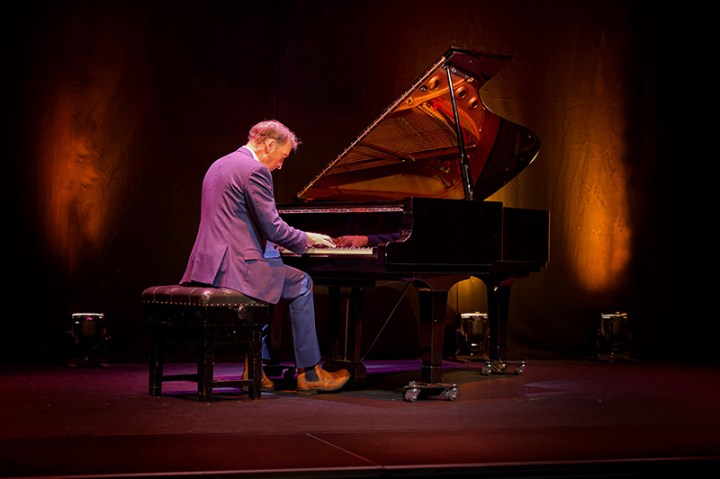
Alistair McGowan

How do you make the time to practise? 

At first, it was a struggle fitting things in around other work. But I watch less television in general with no regret and play less sport too. Partly because my body doesn’t let me now!

Do you enjoy practising? 

I have to force myself to do scales and arpeggios and Hanon exercises but otherwise, yes. I had some very good advice from fellow comic, Rainer Hersch, who suggested putting a watch by the piano and making sure that every fifteen minutes you change what you’re practising. I try to do that. 

But, generally, I get so lost in hearing a piece come together that it’s never a chore. 

Have you participated in any masterclasses or piano courses? 

I have attended weekend courses with Paul Roberts in Sussex. And I went on his week-long piano course in France and then attended four courses in subsequent years with James Lisney and latterly Charles Owen at the delightful La Balie (in south-west France, now, sadly, no longer happening). I’ve also recently done week in West Cork with James at Castle Townshend

As well as learning from such inspirational players and teachers, it’s great to meet other amateur pianists who share your passion. 

What have you gained/learnt from this experience?

I do feel I’ve enriched my life and my soul. And I have been a little surprised by how much I have enjoyed regularly turning my back on the modern world.

As an adult amateur pianist, what are the special challenges of preparing for a performance? 

Not letting the occasion distract you from listening to the sound you are making with every note. I have moments of being very focused but often hear myself or my late mother saying ‘What on earth do you think you’re doing?’. If you can keep that voice out of your head, you will generally be fine!

Also, if you breathe and practise breathing it practise, it helps. As does a touch of lavender under the nose. 

Most importantly, if you think of wanting your audience to hear the piece of music you’re playing and not to hear how well you play it, it takes your ‘self’ out of the equation and some how makes things less nerve-wracking. 

How did you prepare the pieces featured on your recordings? 

I worked very hard, bringing each of them to the boil in turn with my mentor Anthony Hewitt practically conducting me. I also went to listen to a good few pianists in concert and learnt a lot from hearing James Lisney, Lucy Parham, Viv McLean and, of course, Anthony. 

Recording yourself to see what you’re getting wrong – and what you’re getting right – is also a great help these days. 

And how did you find the experience of recording the music?

It was like a lesson, an exam, a recital and the greatest pleasure all at the same time – immensely draining and yet utterly thrilling to hear the music I had learnt and loved coming out of the best pianos in the world!

It was also terrifying knowing that this was the one chance to get each piece recorded. I read a wonderful book called ‘Piano Notes’ by Charles Rosen which has a very helpful chapter on the challenge of recording and refers especially to the need to not worry about mistakes. They can be covered. My teacher/mentor, Anthony Hewitt, was wonderfully helpful (and still conducting!) at the recordings. My producer, Chris Hazel, was unbelievably supportive, helpful and strict!

I had to pinch myself after each recording. I couldn’t believe what I was being allowed to do.

What advice would you give to other adults who are considering taking up the piano or resuming piano lessons? 

I think learning how to learn is as important as learning how to play; it’s important to get the most from your playing time. Setting goals is also important. Perhaps organise small recitals at home, before friends, in order to give yourself a deadline.

If you could play one piece, what would it be? 

Ah! That changes all the time. I have an eye on Debussy’s ‘Ballade Esclave’ – but think that’s still a few years away!

Alistair McGowan’s new show ‘3-in-1’, combining music, poetry and impressions, is at London’s 1901 Arts Club on Wednesday 22 January. Info/tickets here.


This site is free to access and ad-free, and takes many hours to research, write, and maintain. If you find joy and value in what I do, please consider making a donation to support the continuance of this site

Make A Donation

As the Royal Choral Society prepares to sing Handel’s Messiah on Good Friday, one of London’s great Easter traditions, I spoke to conductor Richard Cooke about his influences and inspirations, and how one keeps a work like Messiah fresh and exciting after conducting it for over 25 years.


Who or what inspired you to take up conducting and pursue a career in music?

I was a chorister at St Paul’s Cathedral from the age of 8 to 13. Some pieces we sang as anthems really inspired me, especially Recordare from Mozart’s Requiem, (which we sang in English to a truly terrible translation – *see below). This became my favourite piece of music from the age of 8, and it still is one of them. Also movements from Brahms’ Requiem, which I used to ‘conduct’ whilst listening to my mother’s record player. Seemed like fun.

Who or what are the most significant influences on your musical life?

Those five years at St. Paul’s were massively formative, though the choir was really not good! I could sight-sing music from the age of 11. I then had 4 years in Cambridge singing in King’s under David Willcocks, and after that I was teaching at Tiffin School for seven years. My colleague David Nield who was Director of Music (I was Director of Choral Music) made a huge and transformative impact on my life.

What, for you, is the most challenging part of being a conductor? And the most fulfilling?

My musical life has been choral conducting. The great challenge is to be an orchestral conductor when choirs sing concerts with orchestras. I try to conduct choirs ‘orchestrally’ so that they think that way when it all comes together. The most fulfilling thing is to come away from conducting a great work and feel good. Rare! There is usually something I would wish to have done better – it can be only a moment, but it’s there.

As a conductor, how do you communicate your ideas about a work to the orchestra?

Talk as little as possible. Show them what you want and be faithful to what one considers were the composer’s intentions.

Tell us more about the experience of conducting Handel’s Messiah…..

How do you keep such a well-known, well-loved work fresh for both performers and audience, especially in a large venue like the Royal Albert Hall?

This is the same for any professional. I saw an actor being interviewed about how he felt performing Hamlet 25 times and that was the same. You have to make each performance as unique as it is for the audience. This is easy. I have been fortunate to conduct this concert every year for about 27 years and I tell myself and the choir that it has to reach the audience as if it were brand new each time. The Royal Philharmonic Orchestra is wonderful in this respect too. I feel it has become bigger for me with the passing years.

What for you are the particular pleasures and challenges of conducting Messiah?

One has different soloists to engage with which is (nearly) always a pleasure, and the work slowly rises to its climactic end – particularly so in the Royal Albert Hall. That final 30 minutes is an inspirational and uplifting experience every time.

The main challenge is the choral writing in Part 1 where the choir is exposed to fast semiquaver ‘runs’ without orchestral support. From the beginning of Part 2 to the very end of Part 3, the strings play these demanding passages with the choir, and the support they provide is always reassuring. Mozart ‘solved’ this problem in his re-harmonised version of Messiah by giving all the fast-running sections in Part 1 to the soloists, with the choir joining only at the very end of each chorus. The only real challenge after that is never to coast along on ‘automatic pilot’.

Is there one work which you would love to conduct?

There are several I would like to return to, all of which are hugely expensive, including Berlioz’s Grande Messe des Morts and Damnation of Faust. A work which I wished I had been able to do is Honegger’s Jeanne d’Arc au Bûcher (Joan of Arc at the Stake), but promoters just smile when they see how much it would cost!

Do you have a favourite concert venue to perform in?

I love conducting in the Royal Albert Hall and Canterbury Cathedral, though each has its challenges with the acoustic. I have other favourites – Birmingham, Bridgewater Hall, Liverpool, Gothenburg. A very beautiful venue for concerts is Lund Domkyrkan (Cathedral) in Sweden. I conduct a concert there each summer.

What do you do off stage that provides inspiration on stage?

The direct reply to that has to be preparing the music and how one is going to interpret it, assuming you are not looking for an answer like ‘take a cold shower’ or ‘walk up a Scottish Munro’.

What do you feel needs to be done to grow classical music audiences?

A massive and prolonged revolution in schools. I work with children and it is the most inspirational thing to see how they engage when challenged. Schools are very under-nourished in music, and children are underestimated. Music provision has been declining for decades and there is a misconception that classical music is elitist. Becoming an elite performer does not make it ‘elitist’. There are elite sportspeople. I don’t think Joe Root or Marcus Rashford are elitist but they are elite.

As a musician, what is your definition of success?

Um…..I’m enjoying still being able to do what I do and have done for my whole life. My hobby is my career and whether I am successful or not is for others to judge.

What advice would you give to young or aspiring conductors/musicians?

I don’t presume to advise other than to say that you have always to prepare and work as much as is needed to master in detail whatever you aspire to.

What’s the one thing we’re not talking about in the music industry which you feel we should be?

The inadequacy of classical music provision in state schools and the value and enhancement it brings to children’s lives and well-being.

Where would you like to be in 10 years’ time?

Where I am now. Maybe optimistic!

What is your idea of perfect happiness?

Not sure but I’m perfectly happy

What is your most treasured possession?

Apart from family and friends I don’t really have one, but it feels special when I dig out a great score like Beethoven Missa Solemnis to prepare for another performance.

What is your present state of mind?

Sober

*Final stanza of Recordare from Mozart’s Requiem, early Novello edition:

“In thy favor’d sheep’s position

Keep me from the goat’s condition,

On thy right complete fruition”.

(I’m quite sure that if I had sung these words as an adult, the last word by many around me would have been change to ‘coition’.)

Richard Cooke conducts the Royal Choral Society in Handel’s Messiah on Good Friday, 7th April, at the Royal Albert Hall. The choir, which is celebrating its 150th anniversary, has performed Messiah every Good Friday since 1876. Only the 1940 Blitz and the 2020 Covid pandemic have prevented the performance of one of the UK’s favourite choral works.

Tickets and information


Richard Cooke was appointed Conductor of the Royal Choral Society in 1995, becoming Music Director in 1998, and has appeared with us in many concerts in the Royal Festival and Royal Albert Halls. Most notable of these have been their annual Good Friday performances of Handel’s Messiah, and spectacular Christmas Carol concerts. He has directed concerts with the RCS in the cathedrals of Peterborough, Winchester, Salisbury and Southwark. He has also recorded Orff’s Carmina Burana with the RCS together with the Royal Philharmonic Orchestra.

Read more

Image credit: Kevin Day

To coincide with the release of her new recording of Mozart Piano Sonatas Vols 2 and 3, I caught up with pianist Orli Shaham to find out more about her influences and inspirations and why one of her most treasured possessions features Snoopy the dog…..

Who or what inspired you to pursue a career in music and who or what have been the most important influences on your musical life and career?

It was my parents and my older brothers who inspired me to start music more than anybody else. My parents listened to a lot of music, and my older brothers were just enough older that they were beginning to be accomplished at instruments when I was coming into consciousness. I just really wanted to be part of that and be able to play with them and do the same sort of things that they were doing. That was very much the source of the initial inspiration. I also went to an untold number of conservatory concerts to listen to my brothers perform, and then also heard the 49 other pianists or violinists who were on the same program. That was hugely inspirational too.

A big part of my influences are the people in my life who also love music and who also play music. For me, that’s changed over time from being my elders to being my children and my students. I find them all incredibly inspiring.

Which performances/recordings are you most proud of?

Ultimately, it’s always the last project you just finished that you’re most proud of, because on some level you feel like it’s better than everything you’ve done before. I have certain highlights throughout my career that I think back on quite fondly. At the moment, I’m riding high on recording the complete Mozart sonatas. That was a monumental mountain to climb. I loved every minute of it, and I learned so much from doing it.

Which particular works/composers do you think you perform best?

I would say whatever I’m doing at the moment, which this year has included a lot of Mozart, and a lot of Clara Schumann and her compatriots. With any luck, we keep getting better at all of them – that’s the hope.

How do you make your repertoire choices from season to season?

That’s a really tough one because you have to choose repertoire quite far in advance. I have to project what I think I will feel like playing 18 months from today. Eighteen months is a long way to plan for your emotional state. These days, 18 minutes is a pretty long way.

I’m so lucky to be a pianist; I have so much repertoire to choose from. I have a list that I haven’t even begun to skim the surface of, of pieces that I would like to play. So I just go down that list based on what I think would work best next.

Do you have a favourite concert venue to perform in and why?

I have a favorite concert venue to record in, but I’ve never actually performed there. It’s Mechanics Hall in Worcester, Massachusetts. I love recording there because there’s something about the atmosphere of the building that makes me feel like it’s all about whatever I’m creating on stage (and also there’s an enormous painting of George Washington and the rear end of his horse looking down on me from high above the stage). The hall has an incredible sound. For pianists, performing or recording at a venue is intricately tied up with the venue’s piano. I really love the instrument at Mechanics Hall, as well as the technician who takes care of it. Any time I sit down at that keyboard, I’m inspired to experiment.

What is your most memorable concert experience?

That’s a very long list. One that I happen to be thinking about recently was with David Robertson and the St. Louis Symphony. I played John Adams’ Century Rolls in Carnegie Hall. The way schedules worked out, the composer couldn’t come to hear any of our performances before that; the first time he could come and hear it was at the Carnegie concert. I was only the second pianist to play that concerto at the time, and there was a great deal of nervous energy.

The orchestra did a magnificent job, and David was incredible. Everything worked, and it was fabulous. When John came on stage for his composer’s bow, he leaned in to me and said, “You got it, you really got it.” There’s really no better feeling as a performer, than for the composer to say, “You got it.” That’s what it’s all about.

I should add that I’m very much looking forward to playing John Adams’ second piano concerto, Why Must the Devil Have All the Good Tunes? in Finland next season, with the Finnish Radio Symphony Orchestra, and the self-same David Robertson conducting.

What have been the greatest challenges of your career so far?

Being a mother of infant twins was a big challenge. We’ve made it through to the other side – those twins are about to turn 15. Things are a lot a lot less intense than they were 15 years ago around this time. I think it’s true for many parents, certainly for a lot of mothers, that it’s tricky figuring out how to keep your commitment to music while also juggling a commitment to family, both of which are all-consuming.

What do you do off stage that provides inspiration on stage?

I do things that have to do with music, like teaching and listening to repertoire other than what I’m working on, which is very inspiring. I also specifically do things that don’t have to do with music. I’m inspired by books I am reading, or TV shows I am watching, or meditation or cooking, that really allow me to get inside my own head in a different way than when I’m getting inside a composer’s head.

As a musician, what is your definition of success?

The not so trite answer is that we musicians don’t have such a definition, because we never think that what we’re doing is good enough, so it can’t possibly be considered a success. Knowing that there will never be a feeling of complete and total success, I set very specific goals for myself, and if I can make those work for an entire performance, then I feel it’s been a success.

Those are often really small things. I had a shoulder injury a few years ago and one of the things that I’ve been working on is maintaining a certain level of muscle relaxation in my upper back, even in performance, from the beginning to the end. That’s no small feat. It has nothing to do with the actual music making, and it has everything to do with the actual music making. When I achieve that, I feel a huge sense of pride, because I know that’s something I wasn’t able to do before.

What advice would you give to young/aspiring musicians?

My biggest piece of advice is that whether other people give you the opportunities you’re hoping for is completely out of your control. But whether you feel that you are constantly improving is entirely in your control, and that way of approaching things will sustain you through the lulls and heartbreaks of a career.

What do you feel needs to be done to grow classical music’s audiences?

There are really two sides to that question. One, how do we get the next generation to understand that classical music is for them? That’s in part why I started Orli Shaham’s Bach Yard, to get to children at the ripe old age of three or four years old. The other side of it is making sure that what you’re presenting to the audience is relevant to their lives in some way. That may have to do with repertoire choices, it might have to do with venue choices, perhaps programme lengths, and the way that you introduce a programme to an audience and explain to them how it connects to them. It’s all about humanizing the musicians and the composers and making people feel that this is something that is actually designed for them and that they can partake of whether they’re three or 30 or 99 years old.

What’s the one thing in the music industry we’re not talking about which you think we should be?

It’s the question of what’s in it for them: What’s in it for your audience? What’s in it for the students? What are they going to get out of that and through their lives? What’s in it for a subscriber or a single ticket buyer? Why are we actually doing this? Because we in the industry get so caught up in the fact that we love it so much, we see what it’s doing for us that we forget to think about the perspective of the people we’re trying to offer it to.

What is your most treasured possession?

I have two favourite possessions. One of them is the Steinway B that’s been with me since 1997, 25 years. I don’t know how I would get it out of the apartment if there’s a fire.

My other favourite possession is the cartoon that Charles Schulz made for me in 1997 – also 25 years ago. It’s a one-panel strip where Schroeder is playing the Beethoven’s “Pathetique” sonata and the final bar line is missing, so the notes are all falling on the ground with their stems up. Poor Snoopy is trying to walk across the floor and the note stems are pricking his little feet, and he’s saying, “Ouch!”


Volumes 2 and 3 of Orli Shaham’s recording of the complete Mozart Piano Sonatas are available now on the Canary Classics label.


A consummate musician recognized for her grace, subtlety, and brilliance, the pianist Orli Shaham is hailed by critics on four continents. The New York Times called her a “brilliant pianist,” The Chicago Tribune referred to her as “a first-rate Mozartean,” and London’s Guardian said Ms. Shaham’s playing at the Proms was “perfection.”

Orli Shaham has performed with many of the major orchestras around the world, and has appeared in recital internationally, from Carnegie Hall to the Sydney Opera House. She is Artistic Director of Pacific Symphony’s chamber series Café Ludwig in California since 2007, and Artistic Director of the interactive children’s concert series, Orli Shaham’s Bach Yard, which she founded in 2010.

Read more


Image credit: Karjaka Studios


Who or what are the most significant influences on your musical life and career as a composer?

I didn’t begin to compose until I was sixteen. At that time I had given up piano lessons (I learned the piano between seven and thirteen) and attended a school where there was no music teacher, so composing was something I had to teach myself, or rather with the collaboration of my younger brother Colin, who also began to compose shortly after me. What made me start to compose was hearing Beethoven’s Ninth Symphony for the first time, and thinking that this was the most wonderful music I’d ever heard and that I must write a symphony of my own – so I did, and spent the next two years writing one, and when I’d finished, writing another. Beethoven is still my favourite composer, the ideal of everything I believe in. Meanwhile Mahler, all of whose works I’d got to know, became a huge influence, not just the music itself, but also what he stood for as a composer in Beethoven’s succession. Many other composers too were influential, Sibelius and Stravinsky pre-eminently, as I spent all my spare time listening to music and studying scores.

When I left university – where I read Classics as Music wasn’t possible as I hadn’t got music A level), I had the great good fortune to have got to know Deryck Cooke, who had made the performing version of Mahler’s Tenth Symphony and whom Colin and I later helped with a comprehensive revision. Deryck introduced me to a number of significant people in the musical world, among them Donald Mitchell, who had just founded Faber Music, mainly to publish Britten’s music. I began working freelance for Faber Music and quite soon Britten needed someone to help him with editorial work. Donald suggested me, and I then worked part time for Britten for four years. As the greatest living composer in this country, he was probably the most important influence in my life. He didn’t give composition lessons but I learned from him how to be a composer – see your later question, how do you work?

Other important influences were Michael Tippett, whom I also got to know and on whose music I wrote a short book – I liked his music even more than I liked Britten’s; Nicholas Maw, who became a friend and an unofficial teacher – I thought him the best of the younger composers; and the Australian composer Peter Sculthorpe, whom I met in England in 1974 and who became a close friend until his death in 2014. I visited many him many times in Australia and we collaborated on three film scores. Peter said that the music of the whole world was tonal, so why we should we pay attention to a few central European composers who said tonality was no longer possible? From Australia I saw music in a new light.

What have been the greatest challenges of your career so far?

The greatest challenge was getting my music played when I was young. As I hadn’t been to a music college I knew virtually no musicians. But I did send the score of a string quartet to the BBC when I was about 23 – they then had a reading panel – and it was played and broadcast; and when I was 26 I sent two orchestral songs to the Society for the Promotion of New Music (which sadly no longer exists) and they were performed at the Royal Festival Hall by Jane Manning with the London Philharmonic Orchestra conducted by Norman Del Mar (who became a friend and who commissioned my Symphony No.1 – I’d withdrawn my three earlier ones). That was a big step forward. However, I didn’t get a full publishing contract from Faber until 1982.

What are the special challenges/pleasures of working on a commissioned piece?

It’s easier, I find, to write a piece if you are given some limitations – i.e. how long it should be, the instrumentation, etc. I wouldn’t want too precise instructions, but that rarely happens.

What are the special challenges/pleasures of working with particular musicians, singers, ensembles or orchestras?

I much prefer writing for musicians I know (as Britten almost always did). I recently wrote an Oboe Sonata for Nicholas Daniel, someone I know well and for whom I wrote a Concerto. He has a very individual sound, a wonderful ability to play long sustained passages without taking breath, and extraordinary virtuosity. It was a real pleasure writing for him and hearing his special sound in my head.

The same with singers, of course, and with string players. I’ve written two CDs worth of solo violin music for my violinist friend Peter Sheppard Skaerved, and his Kreutzer Quartet are recording all fifteen (so far) of my string quartets, of which five were written especially for them. They know exactly what to do with my music as they’ve played so much of it. I’m not a string player but Peter has taught me so much about string technique. And with orchestras, I have a special relationship with the BBC Philharmonic, for whom I’ve written three of the last four of my ten symphonies. I can write for them knowing just how they will sound, and I’m also careful not to write anything that they won’t enjoy playing.

Of which works are you most proud?

I enjoy listening to my own music – well, if the composer doesn’t like his own music he shouldn’t expect anyone else to! There are quite a few pieces I’m proud of; for instance among my symphonies, No.8, several of my string quartets; also my Cello Concerto, Concerto in Azzurro, written for Steven Isserlis and recorded on CD by Guy Johnston. The piece I’m most proud of is my choral and orchestral piece Vespers, of which there is a splendid recording by the Bach Choir and the Bournemouth Symphony Orchestra conducted by David Hill. And in the last two years I’ve composed my first opera, which hasn’t yet had a stage performance, only a run-through with piano, but I hope I’ll be proud of it if and when I hear it with orchestra.

How would you characterise your compositional language?

It’s tonal, though usually not in a traditional way. I use very wide-ranging harmony. I use counterpoint modelled on the way the great masters of the past used it, and above all I try to write memorable melodies. I think the loss of memorable melody in most contemporary music is very sad.

How do you work?

When I’m composing, I like to work every day from after breakfast until lunch. I may go back for a while in the late afternoon. I learned regular hours from Britten. But I’m always thinking about the piece I’m writing, and I quite often wake up at night with ideas.

I try to start a piece well in advance of the deadline (another thing I learned from Britten: always meet deadlines). I think a lot about what character the piece will have, and its shape, and then I have the first musical idea, generally a melodic idea, and after that I may leave the piece to grow inside my head for some while before I start it properly. Once I’ve started, I don’t often get stuck – just for a day or two perhaps. I revise a lot while I’m writing, and don’t usually write more than ten to twenty bars a day, though sometimes more when I’ve almost reached the end.

As a musician, what is your definition of success?

My music is concerned with my feelings about life, expressed to the best of my ability in melody, harmony and counterpoint, and in a form that I hope conveys what I intended. I’m happy if I think I’ve done my best with these aims. I also hope that the musicians, who work so hard to bring my pieces to life, will enjoy playing what I have written.

What advice would you give to young/aspiring composers?

Don’t write pieces that present impossible difficulties to players. Also, be patient, it may take a long time before you can get your pieces played regularly. And find your own voice, don’t get led astray by fashion.

What do you feel needs to be done to grow classical music’s audiences?

Of course it worries me that a lot of people who are brought up on a constant diet of pop music find classical music difficult, and especially modern classical music. Because of this, audiences for contemporary music are almost always small. It’s this that worries me most: I feel that a lot of new music today supplies very little to move audiences, if it’s written in a virtually incomprehensible language, and often a very aggressive, off-putting one. And then, except (rightly) for the Kanneh-Mason family, none of the brilliant young musicians around now are being praised by the mass media, which now largely ignores classical music. Their extraordinary talent should be widely celebrated.

What’s the one thing in the music industry we’re not talking about but you really think we should be?

I’m worried that decisions about what new music to programme, by the BBC for instance, are no longer based purely on quality, which I think they should, but on other criteria. I’m very happy to hear music by women composers, but it must be good music. To play it just because it’s by a woman is in fact insulting.

What next – where would you like to be in 10 years?

Still alive – as long as I can keep my current good health, and still composing reasonably well, if I’m still able to.

What is your idea of perfect happiness?

Sharing a meal at home with my wife.

What do you enjoy doing most?

Apart from composing: reading, drinking good wine, walking in the countryside, and watching and listening to birds.


With a singular body of work spanning almost 60 years, David Matthews has established an international reputation as one of the leading symphonists of our time. Born in London in 1943, he began composing at the age of sixteen. He read Classics at the University of Nottingham – where he has more recently been made an Honorary Doctor of Music – and afterwards studied composition privately with Anthony Milner. He was also helped by the advice and encouragement of Nicholas Maw and spent three years as an assistant to Benjamin Britten in the late 1960s. In the 1970s a friendship with the Australian composer Peter Sculthorpe (leading to collaboration and numerous trips to Sydney) helped Matthews find his own distinctive voice.

Read more

David Matthews’ website


