The Writings on the Score

As a writer, the marks I make on paper, or via the word-processing programme on my laptop, are the outward signifiers of my creativity. When I publish an article or essay those marks are made public, put out there and held up for scrutiny.

I am also a musician, a pianist in fact, a role, which, like writing, is largely undertaken in isolation. The outward signifier of my musical creativity comes when I perform for others; like my writing, the work, the graft, the practising is done alone.

The tools of the musician’s craft, in addition to their instrument and intent, are the “text”, the “literature” contained within  musical scores, and these documents provide the map for our musical journeys. On a most basic level, the markings we make on the score relate to fingering schemes, dynamics and marks of expression, pedalling and so forth. Learning music is a complex mental and physical process, and anything that assists in that process is useful. Often it is simply not possible to remember all the details in the music, and annotations provide a useful aide memoir and an immediate mnemonic for the practice of practising. These marks are our individual “hieroglyphs”, and our own secret code, through which our scores become precious, often highly personal documents.

Our writings on the score reveal our individual working processes and practice patterns, our attempts to dig away at the surface of the music, to look beyond the notes to find a deeper meaning. The permanence of a pencil mark is such that, until we choose to erase that mark, it remains there on the page in front of our eyes.

The markings and annotations we make on our scores may also be deeply associated with memories – of significant teachers or mentors, special concerts and venues, colleagues and friends, and may even correspond to certain periods in our lives. Returning to the piano after a 20-year absence, I came upon an earlier teacher’s markings in my dog-eared edition of Bach’s ‘48’. In a curiously potent Proustian rush, I was a gauche teenager again, back in Mrs Murdoch’s living room, her big Steinway stretched out before me, the book of Preludes and Fugues open on the music desk. Returning to a score after a break from it, one reacquaints oneself not only with the dots upon the staves; in the interim, the annotations have become a snapshot of another time and place.

Looking at another musician’s annotated score is an act of voyeurism: a score liberally marked with someone else’s fingering and comments might reveal someone’s deepest insecurities and frustrations, their unspoken hopes and most secret desires…..


This site is free to access and ad-free, and takes many hours to research, write, and maintain. If you find joy and value in what I do, please consider making a donation to support the continuance of this site

Make A Donation


Following on from his comprehensive Indian Raags Made Easy, a guide to playing Indian classical music on the piano (review here), composer John Pitts has now turned his attention to the distinctive and beautiful music for gamelan orchestra from the Indonesian island of Java. This was the music which so intrigued Claude Debussy when he first encountered a gamelan orchestra at the 1889 Paris Exposition Universelle, whose delicate, shimmering timbres are found in works like Pagodes.

In Extreme Heterophony: a study in Javanese Gamelan for one or more pianists, John Pitts offer a carefully-researched and clearly presented guide to the instruments and music of Java, with detailed explanations of the sounds, tunings, scales, metres and rhythms, using Western staff notation and terminology.

“Extreme Heterophony” refers to a foundational principle of how this music is constructed – akin to a theme and variations, but where c.10 types of related but widely diverse, decorative variations are all performed simultaneously – creating a rich, vibrant, exciting texture – and where the theme itself isn’t directly played. – John Pitts

This large-format book offers a deep dive in to the world of the gamelan, from descriptions of the instruments themselves to the use of melody, rubato, textural and rhythmic density, structure of performances, and notation. The author then goes on to explain the individual instruments (for example, the gambang, a xylophone, the “gender” barung, a metallophone, or the suling, a bamboo flute), their role and distinctive sounds within the gamelan orchestra, and how these roles and sounds translate to the piano, or a group of pianos.

The music, which makes up the greater part of the book, is adapted by John Pitts, each piece with a short introduction, clear directions and prompts to support the player/s. The pieces can be played at one piano, in duos or multiple duets at two or up to seven pianos. John Pitts’ website includes downloadable backing tracks to play along with, plus other useful resources for those who want to explore the music of Java in more detail.

This detailed, well-researched handbook is a fascinating introduction to the alluring soundworld of Javanese gamelan. The book is available in the UK/US from Amazon in printed book and Kindle format, and also as a PDF.
John Pitts website

bringing the very best classical chamber music to London audiences at affordable prices

The innovative and now well-established London Chamber Music Society (LCMS) series returns to Kings Place with a generous and varied programme of Sunday concerts beginning on Sunday 23 January.

Old friends and new ones, including Solem Quartet, Rossetti Ensemble, and the Chamber Ensemble of London, are welcomed for this fine series of concerts with leading international artists. On 30 January, the Chilingirian Quartet, one of the cornerstones of British chamber music, celebrate their remarkable 50-year career in a concert culminating in the First String Sextet by Brahms. Other highlights include wind soloists from the Philharmonia Orchestra on 23 January, with pianist Andrew Brownell, in a programme featuring French music and the Sextet by 19th-century composer Louise Farrenc.

More in the French vein comes with violinist Philippe Graffin, who is joined by his compatriot, oboist Capucine Prin, on 15 May in a concert of oboe quartets as well as a fascinating new arrangement of Debussy’s Prélude à l’après-midi d’un faune. Further highlights include Finzi’s Dies natalis on 20 March, in a concert of string orchestra works with the Northern Chords Festival Orchestra. There is more wonderful string music on 1 May, with violinist Peter Fisher and the Chamber Ensemble of London, joined by pianist Margaret Fingerhut in Finzi’s ever-popular Eclogue and also music by Vaughan Williams and Britten’s Simple Symphony. As well as the Solem and Chilingirian quartets, on 3 April the Navarra Quartet perform Dvořák’s String Quartet in G, and a new work by the American-Irish composer Jane O’Leary.

This season also celebrates the work of the remarkable Anglo-American composer Rebecca Clarke. The Fitzwilliam Quartet perform Clarke’s short quartet movement, ‘Poem’, on 8 May, in a concert that also features, with Anna Tilbrook, the mighty piano quintet by Brahms. Other trios include clarinettist Mark Simpson, cellist Leonard Elschenbroich and pianist Richard Uttley on 20 February, to include Simpson’s own Echoes & Embers, and the Barbican Trio on 24 April, in trios by Brahms and Saint-Saens.

This season’s coffee concert, on 13 March, is given by cellist Thomas Carroll and pianist Anthony Hewitt, with music by Prokofiev and Rachmaninov’s ever-popular cello sonata in G minor, with its beautiful long romantic lines. Linos Piano Trio open the LCMS 2022/23 season on 2 October.

All concerts take place in Hall 1 at Kings Place and start at the very civilised time of 6.30pm, apart from the coffee concert on 13 March, which begins at 11.30am.

For full details of this season’s concerts & to book tickets, please visit:

www.londonchambermusic.org.uk/

Chilingirian Quartet

The London Chamber Music Society boasts a proud history of Victorian music making in London with the regular Sunday Concerts that developed at South Place and then the Conway Hall from the 1920s. The LCMS continues that rich legacy at Kings Place, its home from 2008, with London Chamber Music Sundays – a diverse annual season of high-quality classical chamber music, ranging from duos and trios to chamber orchestras, coming from the UK, Europe and beyond. Many of Britain’s most celebrated ensembles have regularly appeared in the Series, from the Brosa and Amadeus string quartets of the past, to the Chilingirian and Carducci quartets today.

Artistic Director: Peter Fribbins

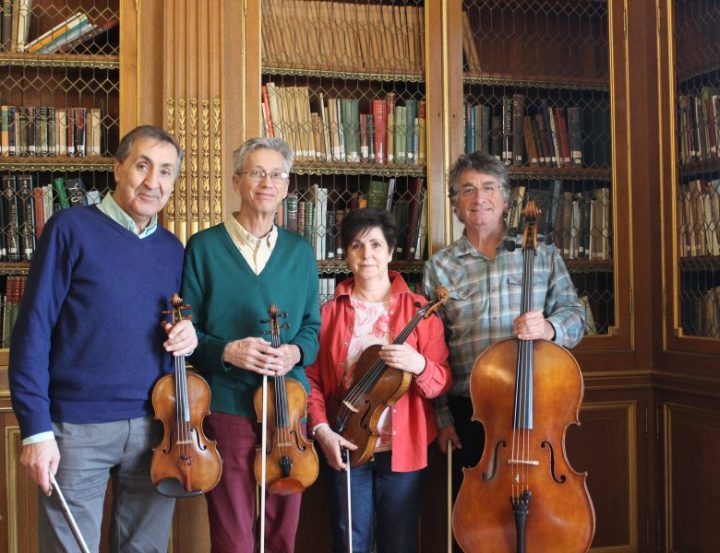
Header image: Solem Quartet

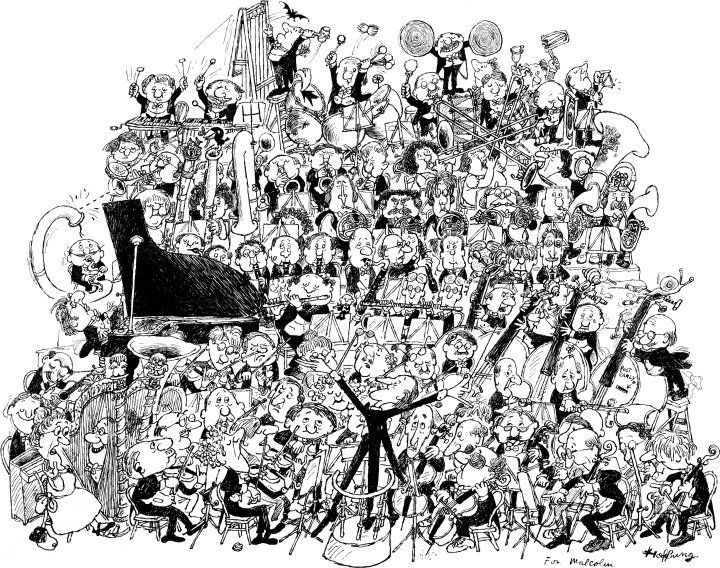
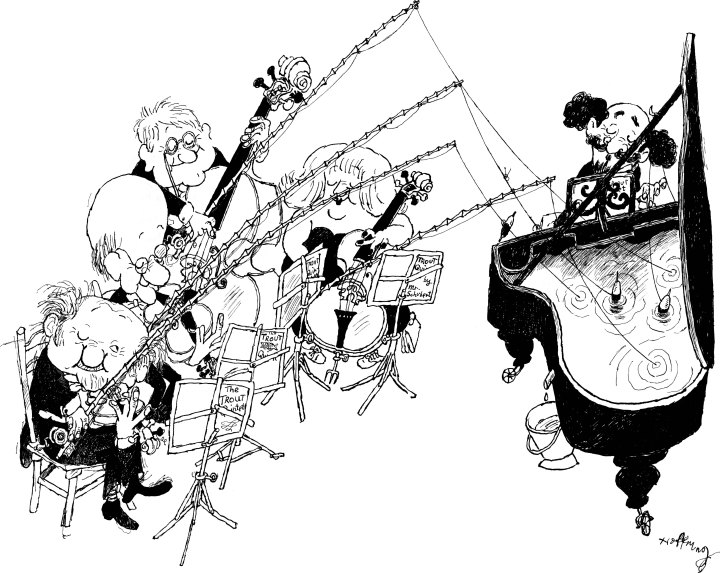
In collaboration with Gerard Hoffnung’s estate, over 50 intricately detailed, music-inspired fine art prints are now available at fine art print dealer and picture framers King & McGaw.

Satisfyingly simple and endearingly witty, artist and musician Gerard Hoffnung’s (1925–1959) illustrations are appreciated for their charming depictions of humorous characters and whimsical representations of musical instruments; from a cheerful lady playing a violin cat, two gentlemen straddling a double bass, to an elderly dame playing a flute that doubles as a washing line. An artist, tuba player, humourist,
broadcaster and raconteur, it is perhaps not surprising that Hoffnung’s work should spill over so far beyond his lifespan. Indeed, his legacy continues to delight succeeding generations around the world even now, more than sixty years after his death.

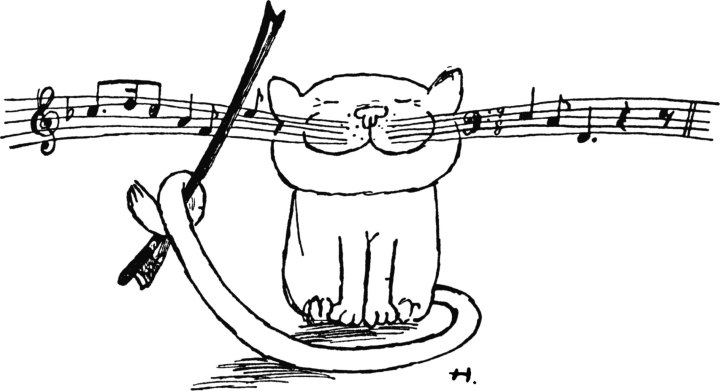
Incredibly imaginative, the titles of the playful works alone – ‘Cat with Musical Whiskers’, ‘Cymbal Player with Bandaged Nose’, ‘Tubular Bell Accident’, amongst others – will bring extraordinary scenes to life.

Hoffnung’s genius was to communicate his richly comic vision of the world through words, drawings and music. Bursting onto London’s musical scene at The Royal Festival Hall in the mid-1950s, the musician-cum-illustrator captured the interest of the music industry, and the population, to which he carved a prolific working career. His ability to have those around him in floods of laughter is ever present through
his drawings, which keeps his joyous spirit alive. When the collection of Hoffnung’s cartoons was exhibited at the Edinburgh Festival, The Guardian wrote: “…never before at an Edinburgh exhibition can so many visitors have been heard giving way to uninhibited laughter as the crowds filing through the Hoffnung exhibition […] in all, this exhibition is guaranteed to keep you happy for as long as you have the time to spare.”

King & McGaw are privileged to offer these works produced to an exceptional museum quality standard, each framed by hand. Brilliant as standalone pieces, these prints can also be appreciated as collectors’ items with a myriad of animated scenes to form your very own Hoffnung gallery at home. Beautifully presented in bespoke frames, they’re perfect for the devoted musician, lover of orchestras, or admirer of light-hearted illustrations.

Explore the collection

Gerard Hoffnung’s biography

[Source: press release]