Guest post by Howard Smith
Edward Gregson (b.1945), is an English composer of instrumental and choral music, particularly for brass and wind ensembles, as well as music for the theatre, film, and television. He was principal of the Royal Northern College of Music and studied piano with Alan Bush at the Royal Academy, winning several prizes for composition. Gregson retired from academic life in 2008 to concentrate on composition. He continues to sit on a number of Boards relating to music education. He is a fellow at the RNCM, as well as at the Royal Academy of Music and the Royal College of Music. A major retrospective of his music was held in Manchester in 2002.
Gregson’s Complete Music for Solo Piano has recently been recorded by Murray McLachlan on the NAXOS label. It includes the composer’s Album For My Friends (2011), Three Etudes (2020) , Four Pictures for piano duet (1982), Six Little Pieces (1982, rev. 1993) and the remarkable Piano Sonata in one movement (1983). Hidden among these works lies the utterly bewitching Friday a.m.
EMOTIONAL IMPACT
How to describe a piece of music? Written in 1981, Gregson states that Friday a.m. was his response to the ‘emotional impact’ of listening to the Adagietto from Mahler’s 5th Symphony. Indeed, Gregson does borrow from the first few notes of that glorious melody but thereafter heads in an entirely different direction. Murray McLachlan has described this as a ‘gradual metamorphosis into a lighter style, reminiscent of jazz, as though moving from a philharmonic hall in central Europe to a Manhattan Jazz club around 2am, when everything is subdued and transient.’ It’s a wonderful allusion. But there is nothing subdued about many of the passages of this music. Mahlerian it is. Lounge Jazz it is not, although as I will show, the music pays homage to many Jazz idioms. And does so with great subtlety; without the slightest trace of irony or pastiche.
Having fallen in love with the piece on CD, I never expected to hear a live performance. Imagine how surprised and delighted I was that Murray McLachlan included it in his recital at the 2021 Chetham’s International Piano Summer School. His performance cemented my obsession with the music. Most striking, McLachlan’s ‘poco a poco stringendo’ starting at bar 39 as the music builds to the ‘ma appassionato’ in bar 48 was electrifying. I was hooked. I promptly placed the piece on my ‘must play’ list, even though the music lies beyond my current ‘grade’ when played to the max.
THE MUSIC AND ITS HARMONY
Friday a.m. comes in at roughly six and half minutes of delicious harmony and melody. Primarily in the key of G, in common time, there are several contrasting sections. Each, however, reuses idioms, arpeggios and motifs that pervade the music from beginning to end.
We know this is ‘about’ Jazz, but is not Jazz, from the outset. Gregson outlines in 3rds the chords C major 7 in bar 1, C major 9 in bar 2 and C major 11 in bar 3. Core Jazz colours. This then slides, via a G Minor+Major 7 chord (over Eb) to A minor 9 (over 11), to rest on a C Lydian arpeggio (sharp 4, F#) in bar 6: n effect, D7 / C (4th inversion). This concludes (molto rit.) what I call the PRELUDE to Friday a.m., which later becomes an emotional REFRAIN at bar 57 over an expanded harmony. Clever.
We leave bar 6 via the simple device of three ascending notes, D, E, F# sitting over an equally simple interval of a second, C+D, in the LH. The Dominant of G leads to our home key, G and the melody is laid out before us, recalling the Mahler theme. Gregson’s development of the theme takes us firmly into the realm of filmic music. There is great romance here. The harmony progresses as expected, from G, to C, to B-7, A minor, to G major 9. Here, and elsewhere, Gregson layers in Jazz colours. C is C6. A minor is the minor 11th. G major is G major 9. In each arpeggio, Gregson emphasises Jazz colours. But this is most definitely not the Blues. The only ‘blue note’ occurs in bar 30. And we never see a raw Blues progression. No root G7 here.
Throughout the music, harmonies are laid out using arpeggios in the LH, semi-quavers. They twist and turn, sometimes rising, then falling, sometimes alternating direction. During my practice I found it hard to memorise the many variations. Fortunately they are repeated among the various passages. For example, bar 49, 50 and 51 LH is a ditto of bars 8, 9 and 10. But be careful, Gregson introduces twists, for example, in bar 53, the single notes used in bar 12 LH become parallel 3rds.
STRUCTURE AND FORM
To the casual listener there are six major sections to the music. They do not correspond to any ‘standard’ form I know.
The PRELUDE leads to the MAIN THEME. The theme is then RE-STATED (8va), after which there is a section dominated by 4-note (7th) chords in both hands. Let’s call it the CHORDAL ‘middle section’. This is followed by a DEVELOPMENT of the main theme, littered in the LH now by the ever increasing tempo of demi-semi-quavers and the effect of an ascending bass pedal point: A, Bb, C, D, Eb, F, G. From here the piece explodes into what I call a CADENZA, although classical musicians would likely not use this term. The MAIN THEME is then repeated ‘ma appassionato’ in fortissimo. Each melody note in the original RH is now explosively stated using four-note chords, after which the piece subsides to its original dynamics of mezzo-forte and finally to mezzo-piano during which we hear the REFRAIN of the opening motif … C major 7, C major 9 and C major 11.
The piece ENDS as it began, resting (molto rit.) on that Lydian arpeggio (D7 / C), resolving to G. Gregson then asks us to play ‘Slower’ (bar 63) as he outlines G major 7 and G13, to rest finally on an A minor note cluster with added 4th, D. And as if this were not enough to stamp ‘Jazz’ on the music, Gregson adds, after a pause mark (bar 64), a final pp chord outline: a low G, followed by B, A, E and D. Each note is marked tenuto (deliberate emphasis) until the last D. The dominant. Yes, the G69 chord. It hangs in the air; as if smoke in a room. Friday a.m, as in McLachlan’s Manhattan.
IDIOMATICS
Note clusters are used at various points in the music, another Jazz idiom. For example in bar 9 we have G,A,C,D and E immediately followed by F#. Where such clusters occur the colours ring out as if to further emphasise the love Gregson clearly has for Jazz harmonies. As do I.
Throughout the music, and often on the 4th beat of the bar, Gregson revels in 2 against 3, 3 against 2, 3 against 4 and 4 against 3 rhythms. I initially found these polyrhythms challenging, especially as the composer has a habit of holding over notes from the previous beat to the first of the triplets; for example in bars 11 and 12 and 18. Just to add insult to injury, Gregson also asks for a dotted rhythm in the LH against a triplet in the RH in bar 18. Tricky for me.
CHALLENGES IN PERFORMANCE
There are many challenges in playing this music. I judge it to be Grade 8 +, possibly a first diploma level piece? All I know is that the music presented challenges I had not encountered before. Of these, the rapid LH passages, escalating over bars 37 to 44, tested my weak LH. Also the eight-note chords, split between two hands, in bars 26 to 36; some tricky harmony here. And last but not least, the ‘cadenza’ bars 44 to 48, yielding to the climax of the restatement of the main theme in RH chords. I was not familiar with how to play such an emphatic fortissimo, and do so without any harshness. The grandeur of the piece from bar 44 onward is hard to pull off. All dynamics are relative, I realise, but I find it hard to control the volume through the ‘stringendo’ section that precedes the climax. (And generally, there is a need to control dynamics from the outset, keeping the LH ‘mp’ as the motifs and themes are laid out one by one.)
Since I mentioned the LH, my teacher warned me about a “too literal statement of these semi-quaver groups”, what she described as a “childish rendition”. I think Gregson anticipated this with his instruction in bar 7: ‘a tempo (ma con rubato)’. Yes, but as the music builds there is no chance for rubato and the notes in the LH arpeggios are integral to the harmony. Unless laid out somewhat ‘robotically’ the tension notes (Jazz) are less clear than they need be, I feel. I want to ‘hear’ those carefully placed 7ths, 9ths, 11ths and 13ths.
Pedalling is always a struggle for me. Fortunately, here it mostly consists of ‘down’ at the start of a bar and ‘up’ at the end, or before the 4th beat. The harmonies are rich and overlaid. And yet this can be too much as the dynamics build. Half pedalling may be needed.
People use the term ‘colour’ variously. Whatever it means, there are clear points in the music where a shift of ‘colour’ or ‘tone’ is essential. The transition from bar 3 to bar 4 is one such example. The G major harmony shifts to Eb major, the minor 6th of a G minor scale. New colours are also required in bars 10, 15 and 17 and in later bars where similar harmony is used.
CINEMATICS AND THE ADDED 4TH
I mentioned film music at the outset, and there are many ‘cinematic’ moments in Friday a.m. The most startling begins in bar 20. The melody is re-stated in a high register at 8va. The LH similarly moves to the treble clef and uses simple broken chords to outline the harmony. The effect is delicate, ethereal. As this passage dies away, we hear a suspended fourth pattern on the dominant; D sus 4. No third, Jazz style. This pattern is important later in the ‘cadenza’. The chord is D,G,A,D over three octaves, 11 demi-semi quavers in the time of one beat, repeated twice (bar 45 and 46) and punctuated by a trio of chords in both hands: first inversion of C6, D sus4, root C6. To create dramatic effect the chords are first expressed as a triplet, and then as even quavers. The pattern then leads to a bass descent starting on E. As the bass thunders out huge D octaves, we are led inevitably to a tumultuous D dominant 7th (bar 47) before the return to the main melody. Fortissimo. Friday a.m has reached its cinematic climax.
In fact, the ‘modern’ sound of the suspended or ‘added’ fourth is sprinkled into many other places in the music, on minor chords. Bar 9 (and similarly in bar 50) is an example. Here, the chord is D minor 7 sus 4, a Jazz chord if ever there was one.
MORE HARMONY
No analysis of Friday a.m. would be complete without attempting to describe the enigmatic ‘chordal’ MIDDLE SECTION, which begins on the fourth beat of bar 26. Spread between the two hands, eight-note chords lay out a rich harmonic landscape mezzo forte, as if heard indistinctly from afar. The impression is as if one were a passer-by, overhearing the music from the street, only dimly aware of rich music being played inside.
Gregson uses three devices to achieve the indistinct effect. First, the chords are thick. Second, the use of triplets blur; despite any judicious use of the pedal. Third, as each harmonic statement is made, the LH descends to the far bass, outlining the harmony once again. Then two notes are struck as octaves in the RH, 8va. It’s a call and response motif (in bar 27 and again in bar 30). And it is here that the only ‘blue note’ is used, C#, the augmented fourth (tritone) in G. I may be being fanciful here, but I cannot escape the conclusion that the composer deliberately chose to place this solitary note solely for the passer-by in the street. Was Gregson saying: “if you had any doubt, this is Jazz”. It’s a wonderful illusion when set against the richly painted harmonies? And was the intermittent use of triple time in bars 28, 31, 32, 34 and 35 an attempt to paint this passage, the closest to Jazz in the work, in 7/4 time? It’s the only passage in which Gregson deviates from common time.
The first (of four) harmonic ‘utterances’ are the chords A minor 9, B minor 7, C6, B minor 7. The voicings are achieved by using a root position chord in the LH and a first inversion chord in the RH. For example, to achieve a full A minor 9, use root A minor 7 in the LH and root C major 7 in the RH. Yes, that means both the 3rd and the 5th are doubled. Rules are there to be broken. Similar approach is taken to three more statements of harmony, taking us further into distinctly jazzy territory. In bar 29 we encounter C dominant 7 #9. In bar 31 we have F# minor 9 +11. And in bar 34 the thickness is increased once again. F# major 7 in the LH with Db major 7 in the RH. It’s heady stuff but never a cliché.
FINAL THOUGHTS
To play this music without care is relatively easy. To play this music as the score demands, amplifying the effect of each idiom used, is difficult. To explode through the cadenza (held back) and into the appassionato, and then to subside to the refrain of the opening motif, releasing the emotion, is a challenge for this adult returner. It demands a measured control of the ever-decreasing tempo and languid dynamics over the last eleven bars, all the way to the final notes of the spread G69 chord, each seemingly picked out of nowhere, as if the imaginary Jazz pianist is doodling, unaware that anyone is listening. Friday a.m.
Buy the score of Friday a.m https://www.wisemusicclassical.com/work/61304/Friday-am–Edward-Gregson/
Howard Smith is a keen amateur pianist and the author of Note For Note: Bewitched, Bothered & Bewildered. https://linktr.ee/note4notethebook

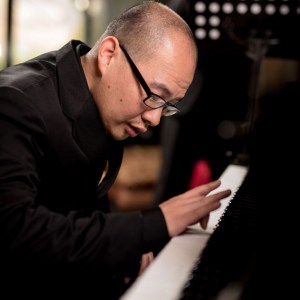 As a teenager, Michael Low studied piano under the guidance of Richard Frostick before enrolling in London’s prestigious Centre for Young Musicians, where he studied composition with the English composer Julian Grant, and piano with the internationally acclaimed pedagogue Graham Fitch. During his studies at Surrey University in England, Michael made his debut playing Tchaikovsky’s First Piano Concerto in the 1999 Guildford International Music Festival, before graduating with Honours under the tutelage of Clive Williamson. In 2000, Michael obtained his Masters in Music (also from Surrey University), specialising in music criticism, studio production and solo performance under Nils Franke.
 I have been teaching and coaching one-to-one in my own studio at the bottom of the garden with its lovely Steinway for around thirteen years and had already run some one-day workshops there. And from 2000-2008, I ran my own chamber music course at the Purcell School. But it was these requests from pianists that got me thinking: could I run a piano weekend from my own house and studio? I realised that I did have the space for a small group both in my kitchen and studio, and that perhaps there might be a gap in the piano course market for a weekend of teaching in a small, supportive group within a home environment.



 The Cross-Eyed Pianist