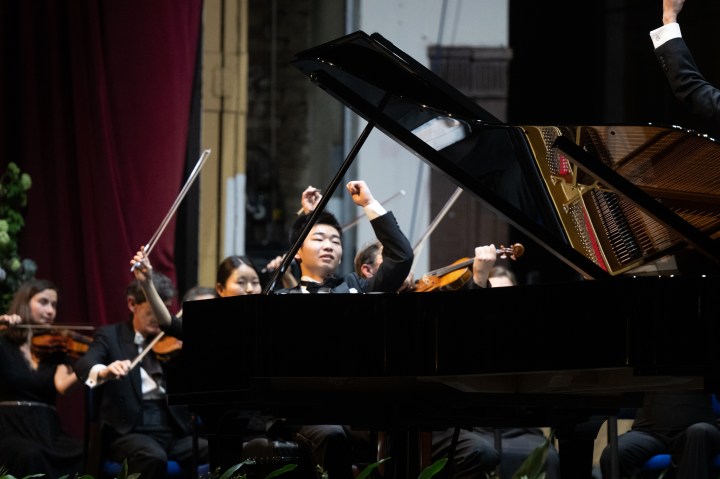
As the Royal Choral Society prepares to sing Handel’s Messiah on Good Friday, one of London’s great Easter traditions, I spoke to conductor Richard Cooke about his influences and inspirations, and how one keeps a work like Messiah fresh and exciting after conducting it for over 25 years.
Who or what inspired you to take up conducting and pursue a career in music?
I was a chorister at St Paul’s Cathedral from the age of 8 to 13. Some pieces we sang as anthems really inspired me, especially Recordare from Mozart’s Requiem, (which we sang in English to a truly terrible translation – *see below). This became my favourite piece of music from the age of 8, and it still is one of them. Also movements from Brahms’ Requiem, which I used to ‘conduct’ whilst listening to my mother’s record player. Seemed like fun.
Who or what are the most significant influences on your musical life?
Those five years at St. Paul’s were massively formative, though the choir was really not good! I could sight-sing music from the age of 11. I then had 4 years in Cambridge singing in King’s under David Willcocks, and after that I was teaching at Tiffin School for seven years. My colleague David Nield who was Director of Music (I was Director of Choral Music) made a huge and transformative impact on my life.
What, for you, is the most challenging part of being a conductor? And the most fulfilling?
My musical life has been choral conducting. The great challenge is to be an orchestral conductor when choirs sing concerts with orchestras. I try to conduct choirs ‘orchestrally’ so that they think that way when it all comes together. The most fulfilling thing is to come away from conducting a great work and feel good. Rare! There is usually something I would wish to have done better – it can be only a moment, but it’s there.
As a conductor, how do you communicate your ideas about a work to the orchestra?
Talk as little as possible. Show them what you want and be faithful to what one considers were the composer’s intentions.
Tell us more about the experience of conducting Handel’s Messiah…..
How do you keep such a well-known, well-loved work fresh for both performers and audience, especially in a large venue like the Royal Albert Hall?
This is the same for any professional. I saw an actor being interviewed about how he felt performing Hamlet 25 times and that was the same. You have to make each performance as unique as it is for the audience. This is easy. I have been fortunate to conduct this concert every year for about 27 years and I tell myself and the choir that it has to reach the audience as if it were brand new each time. The Royal Philharmonic Orchestra is wonderful in this respect too. I feel it has become bigger for me with the passing years.
What for you are the particular pleasures and challenges of conducting Messiah?
One has different soloists to engage with which is (nearly) always a pleasure, and the work slowly rises to its climactic end – particularly so in the Royal Albert Hall. That final 30 minutes is an inspirational and uplifting experience every time.
The main challenge is the choral writing in Part 1 where the choir is exposed to fast semiquaver ‘runs’ without orchestral support. From the beginning of Part 2 to the very end of Part 3, the strings play these demanding passages with the choir, and the support they provide is always reassuring. Mozart ‘solved’ this problem in his re-harmonised version of Messiah by giving all the fast-running sections in Part 1 to the soloists, with the choir joining only at the very end of each chorus. The only real challenge after that is never to coast along on ‘automatic pilot’.
Is there one work which you would love to conduct?
There are several I would like to return to, all of which are hugely expensive, including Berlioz’s Grande Messe des Morts and Damnation of Faust. A work which I wished I had been able to do is Honegger’s Jeanne d’Arc au Bûcher (Joan of Arc at the Stake), but promoters just smile when they see how much it would cost!
Do you have a favourite concert venue to perform in?
I love conducting in the Royal Albert Hall and Canterbury Cathedral, though each has its challenges with the acoustic. I have other favourites – Birmingham, Bridgewater Hall, Liverpool, Gothenburg. A very beautiful venue for concerts is Lund Domkyrkan (Cathedral) in Sweden. I conduct a concert there each summer.
What do you do off stage that provides inspiration on stage?
The direct reply to that has to be preparing the music and how one is going to interpret it, assuming you are not looking for an answer like ‘take a cold shower’ or ‘walk up a Scottish Munro’.
What do you feel needs to be done to grow classical music audiences?
A massive and prolonged revolution in schools. I work with children and it is the most inspirational thing to see how they engage when challenged. Schools are very under-nourished in music, and children are underestimated. Music provision has been declining for decades and there is a misconception that classical music is elitist. Becoming an elite performer does not make it ‘elitist’. There are elite sportspeople. I don’t think Joe Root or Marcus Rashford are elitist but they are elite.
As a musician, what is your definition of success?
Um…..I’m enjoying still being able to do what I do and have done for my whole life. My hobby is my career and whether I am successful or not is for others to judge.
What advice would you give to young or aspiring conductors/musicians?
I don’t presume to advise other than to say that you have always to prepare and work as much as is needed to master in detail whatever you aspire to.
What’s the one thing we’re not talking about in the music industry which you feel we should be?
The inadequacy of classical music provision in state schools and the value and enhancement it brings to children’s lives and well-being.
Where would you like to be in 10 years’ time?
Where I am now. Maybe optimistic!
What is your idea of perfect happiness?
Not sure but I’m perfectly happy
What is your most treasured possession?
Apart from family and friends I don’t really have one, but it feels special when I dig out a great score like Beethoven Missa Solemnis to prepare for another performance.
What is your present state of mind?
Sober
*Final stanza of Recordare from Mozart’s Requiem, early Novello edition:
“In thy favor’d sheep’s position
Keep me from the goat’s condition,
On thy right complete fruition”.
(I’m quite sure that if I had sung these words as an adult, the last word by many around me would have been change to ‘coition’.)
Richard Cooke conducts the Royal Choral Society in Handel’s Messiah on Good Friday, 7th April, at the Royal Albert Hall. The choir, which is celebrating its 150th anniversary, has performed Messiah every Good Friday since 1876. Only the 1940 Blitz and the 2020 Covid pandemic have prevented the performance of one of the UK’s favourite choral works.
Richard Cooke was appointed Conductor of the Royal Choral Society in 1995, becoming Music Director in 1998, and has appeared with us in many concerts in the Royal Festival and Royal Albert Halls. Most notable of these have been their annual Good Friday performances of Handel’s Messiah, and spectacular Christmas Carol concerts. He has directed concerts with the RCS in the cathedrals of Peterborough, Winchester, Salisbury and Southwark. He has also recorded Orff’s Carmina Burana with the RCS together with the Royal Philharmonic Orchestra.
Due to work commitments, I am finding it harder to produce regular, meaningful articles for this site.
However, I don’t want the site to lie fallow, and for this reason I am inviting guest posts. I’m afraid there is no payment for guest articles, but your writing will be shared with a social network of c13,000 followers and an average monthly blog readership of c25,000.
Guest articles can be:
Reviews of concerts, opera, recordings, music-related books (fiction and non-fiction) and other music-related events/activities (e.g. courses, workshops etc.) or products.
Opinion/”think” pieces on music-related subjects, including the music industry, music education etc.
At The Piano interview – specifically for piano teachers (sample here)
Piano Notes interview for amateur pianists (samples here)
An essay in six variations Written by GPT-3 and Howard Smith
The six essays below were written by an Artificial Intelligence called GPT-3. In the final essay, Satie speaks in his own voice and composes a poem reflecting on the influences of his work. The AI-generated essays were guided by Howard Smith, a human. Howard only had to give the briefest of instructions to the remarkable AI. Such ‘generative’ systems are making waves across the world. GPT-3 is but a taste of what’s to come. Humankind will shortly have many new AI companions.
Howard Smith is the human author of Note For Note, Bewitched, Bothered and Bewildered.Howard is also the author of an experimental book on the topic of Climate Change. The 180 page book was written by GPT-3 in response to questions posed by Howard. The two collaborators ‘wrote’ the book in just 12 hours. The work was self-published 6 days later and is now available via Amazon worldwide. In Conversation with GPT-3: An AI On Climate Change is a taste of what’s ahead for anyone working in any creative field.
One of 30 images generated by DALL*E 2 in response to a prompt by the author: A painting in the style of Dada art of the composer Erik Satie and a ticking clock
And now, dear friends, the essays:
Version 1
Human in italics. All else written by an AI.
Write an essay about the music of Erik Satie. Concentrate on explaining the musical influences and genres that led to Satie’s unique style. Also cover the way Satie’s music influenced composers that followed him.
Erik Satie was a French composer and pianist known for his unique and unconventional musical style. He was born in 1866 and began composing music at a young age. Throughout his career, Satie experimented with a wide range of musical genres and influences, which ultimately led to the development of his distinctive style.
One of the major influences on Satie’s music was the impressionism movement in art. Impressionist painters, such as Monet and Degas, were known for their use of light and color to create a sense of atmosphere and mood. Satie similarly sought to evoke a sense of atmosphere in his music through the use of harmonic and melodic color. He often employed unconventional harmonies and dissonant chord progressions to create a sense of tension and dissonance.
Another important influence on Satie’s music was cabaret and café-concert culture. These venues were popular in Paris during the late 19th and early 20th centuries and featured a wide range of musical styles, including folk songs, popular songs, and vaudeville. Satie was heavily influenced by the playful, irreverent, and often satirical spirit of these performances, and he incorporated elements of cabaret and café-concert music into his own compositions.
Satie’s music also drew inspiration from other genres, including folk music, medieval and Renaissance music, and popular music. He was particularly interested in the use of simple, repetitive rhythms and melodies, which he often incorporated into his music to create a sense of hypnotic and meditative states.
Satie’s unique and unconventional musical style had a significant influence on composers that followed him. Many of his techniques and ideas were adopted and adapted by other composers, particularly those working in the field of minimalism. Satie was one of the first composers to use repetitive rhythms and simple harmonies, techniques that would become central to the minimalist style. He was also an important influence on the development of ambient and experimental music.
In conclusion, Erik Satie’s music was shaped by a wide range of musical influences and genres, including impressionism, cabaret and café-concert culture, folk music, medieval and Renaissance music, and popular music. His unique and unconventional style had a significant influence on composers that followed him, particularly in the field of minimalism and experimental music. His music still continues to be celebrated and performed today.
Version 2
Improve the essay please by including some quotes by Erik Satie.
Erik Satie was a French composer and pianist known for his unique and unconventional musical style. He was born in 1866 and began composing music at a young age. Throughout his career, Satie experimented with a wide range of musical genres and influences, which ultimately led to the development of his distinctive style.
One of the major influences on Satie’s music was the impressionism movement in art. Impressionist painters, such as Monet and Degas, were known for their use of light and color to create a sense of atmosphere and mood. Satie similarly sought to evoke a sense of atmosphere in his music through the use of harmonic and melodic color. He often employed unconventional harmonies and dissonant chord progressions to create a sense of tension and dissonance. In his own words, Satie stated “I have found it necessary to get rid of all the parts that everyone likes and keep all those which no one likes”
Another important influence on Satie’s music was cabaret and café-concert culture. These venues were popular in Paris during the late 19th and early 20th centuries and featured a wide range of musical styles, including folk songs, popular songs, and vaudeville. Satie was heavily influenced by the playful, irreverent, and often satirical spirit of these performances, and he incorporated elements of cabaret and café-concert music into his own compositions. He once said, “I am a country whose boundaries are the imagination.”
Satie’s music also drew inspiration from other genres, including folk music, medieval and Renaissance music, and popular music. He was particularly interested in the use of simple, repetitive rhythms and melodies, which he often incorporated into his music to create a sense of hypnotic and meditative states. His music was described as being “inventive and original” by himself.
Satie’s unique and unconventional musical style had a significant influence on composers that followed him. Many of his techniques and ideas were adopted and adapted by other composers, particularly those working in the field of minimalism. Satie was one of the first composers to use repetitive rhythms and simple harmonies, techniques that would become central to the minimalist style. He was also an important influence on the development of ambient and experimental music.
In conclusion, Erik Satie’s music was shaped by a wide range of musical influences and genres, including impressionism, cabaret and café-concert culture, folk music, medieval and Renaissance music, and popular music. His unique and unconventional style had a significant influence on composers that followed him, particularly in the field of minimalism and experimental music. His music still continues to be celebrated and performed today. Satie’s own words offers a glimpse into his artistic vision, his revolutionary approach and his enduring legacy.
Version 3
Can you extend the essay by listing some of Satie’s best loved music. Place the list of works at the end of the essay.
Erik Satie was a French composer and pianist known for his unique and unconventional musical style. He was born in 1866 and began composing music at a young age. Throughout his career, Satie experimented with a wide range of musical genres and influences, which ultimately led to the development of his distinctive style.
One of the major influences on Satie’s music was the impressionism movement in art. Impressionist painters, such as Monet and Degas, were known for their use of light and color to create a sense of atmosphere and mood. Satie similarly sought to evoke a sense of atmosphere in his music through the use of harmonic and melodic color. He often employed unconventional harmonies and dissonant chord progressions to create a sense of tension and dissonance. In his own words, Satie stated “I have found it necessary to get rid of all the parts that everyone likes and keep all those which no one likes”
Another important influence on Satie’s music was cabaret and café-concert culture. These venues were popular in Paris during the late 19th and early 20th centuries and featured a wide range of musical styles, including folk songs, popular songs, and vaudeville. Satie was heavily influenced by the playful, irreverent, and often satirical spirit of these performances, and he incorporated elements of cabaret and café-concert music into his own compositions. He once said, “I am a country whose boundaries are the imagination.”
Satie’s music also drew inspiration from other genres, including folk music, medieval and Renaissance music, and popular music. He was particularly interested in the use of simple, repetitive rhythms and melodies, which he often incorporated into his music to create a sense of hypnotic and meditative states. His music was described as being “inventive and original” by himself.
Satie’s unique and unconventional musical style had a significant influence on composers that followed him. Many of his techniques and ideas were adopted and adapted by other composers, particularly those working in the field of minimalism. Satie was one of the first composers to use repetitive rhythms and simple harmonies, techniques that would become central to the minimalist style. He was also an important influence on the development of ambient and experimental music.
In conclusion, Erik Satie’s music was shaped by a wide range of musical influences and genres, including impressionism, cabaret and café-concert culture, folk music, medieval and Renaissance music, and popular music. His unique and unconventional style had a significant influence on composers that followed him, particularly in the field of minimalism and experimental music. His music still continues to be celebrated and performed today. Satie’s own words offers a glimpse into his artistic vision, his revolutionary approach and his enduring legacy.
Some of Satie’s best known works include:
“Gymnopédies” (1888)
“Sports et divertissements” (1914)
“Vexations” (1893)
“Socrate” (1918)
“Parade” (1917)
“Three pieces in the form of a Pear” (1903)
“Avant-dernières pensées” (1911-1915)
“Furniture Music” (Musique d’ameublement) (1917)
“Sonatine bureaucratique” (1908)
“Véritables préludes flasques (pour un chien)” (1913)
Version 4
Rewrite the essay please, in a writing style that Satie might have used.
My dear friends, let me regale you with tales of my musical endeavors. I, Erik Satie, have always been drawn to the unconventional, the unorthodox. I sought to challenge the status quo and to push the boundaries of what is considered to be “music.”
The movement of Impressionism, with its emphasis on light and color, has had a profound influence on my compositions. I strive to evoke a sense of atmosphere and mood through the use of harmonic and melodic color. I often employ unconventional harmonies and dissonant chord progressions to create a sense of tension and dissonance. As I have said before, “I have found it necessary to get rid of all the parts that everyone likes and keep all those which no one likes.”
The cabaret and café-concert culture of my beloved Paris have also had a great impact on my music. The playful, irreverent, and often satirical spirit of these performances has been a constant source of inspiration for me. I have incorporated elements of cabaret and café-concert music into my own compositions, always seeking to push the boundaries of what is considered acceptable. As I have said, “I am a country whose boundaries are the imagination.”
I have also been heavily influenced by the simplicity and repetition found in folk music, medieval and Renaissance music, and popular music. These have all played a role in my quest to create music that evokes hypnotic and meditative states. My compositions have been described as “inventive and original,” and I take great pride in that.
My unique and unconventional style has had a significant influence on composers that have followed me. My use of repetitive rhythms and simple harmonies, for instance, have become central to the minimalist style. And I have also been an important influence on the development of ambient and experimental music.
In conclusion, my dear friends, my music is the product of a wide range of influences and genres. I have always sought to challenge the status quo, to push the boundaries of what is considered to be “music.” And I will continue to do so, for as I have said, “The essential thing is to invent.” And with that, I bid you adieu, and hope that you will enjoy my compositions.
Some of my most notable works include:
“Gymnopédies” (1888)
“Sports et divertissements” (1914)
“Vexations” (1893)
“Socrate” (1918)
“Parade” (1917)
“Three pieces in the form of a Pear” (1903)
“Avant-dernières pensées” (1911-1915)
“Furniture Music” (Musique d’ameublement) (1917)
“Sonatine bureaucratique” (1908)
“Véritables préludes flasques (pour un chien)” (1913)
Version 5
Rewrite the essay once again to make it sound like Dada art.
Ladies and gentlemen, behold the absurdity of my musical creations. I, Erik Satie, have always been attracted to the nonsensical, the illogical. I sought to mock the status quo and to shatter the boundaries of what is considered to be “music.”
The movement of Impressionism, with its emphasis on light and color, has been a source of inspiration for my compositions. I strive to evoke a sense of chaos and confusion through the use of harmonic and melodic nonsense. I often employ unconventional harmonies and dissonant chord progressions to create a sense of confusion and disorder. As I have said before, “I have found it necessary to get rid of all the parts that make sense and keep all those which don’t.”
The cabaret and café-concert culture of my beloved Paris have also been a great influence on my music. The nonsensical, irreverent, and often satirical spirit of these performances has been a constant source of inspiration for me. I have incorporated elements of cabaret and café-concert music into my own compositions, always seeking to mock the boundaries of what is considered acceptable. As I have said, “I am a country whose boundaries are the absurdity.”
I have also been heavily influenced by the simplicity and repetition found in folk music, medieval and Renaissance music, and popular music. These have all played a role in my quest to create music that evokes hypnotic and chaotic states. My compositions have been described as “nonsensical and illogical,” and I take great pride in that.
My unique and unconventional style has had a significant influence on composers that have followed me. My use of repetitive rhythms and simple harmonies, for instance, have become central to the Dada style. And I have also been an important influence on the development of chaotic and experimental music.
In conclusion, my dear friends, my music is the product of a wide range of influences and genres. I have always sought to mock the status quo, to shatter the boundaries of what is considered to be “music.” And I will continue to do so, for as I have said, “The essential thing is to invent absurdity.” And with that, I bid you adieu, and hope that you will enjoy my nonsensical compositions.
Some of my most notable works include:
“Gymnopédies” (1888)
“Sports et divertissements” (1914)
“Vexations” (1893)
“Socrate” (1918)
“Parade” (1917)
“Three pieces in the form of a Pear” (1903)
“Avant-dernières pensées” (1911-1915)
“Furniture Music” (Musique d’ameublement) (1917)
“Sonatine bureaucratique” (1908)
“Véritables préludes flasques (pour un chien)” (1913)
Version 6 (the ‘final’ version, or is it?)
Include and invent an absurdist poem by Satie.
Ladies and gentlemen, behold the absurdity of my musical creations. I, Erik Satie, have always been attracted to the nonsensical, the illogical. I sought to mock the status quo and to shatter the boundaries of what is considered to be “music.”
The movement of Impressionism, with its emphasis on light and color, has been a source of inspiration for my compositions. I strive to evoke a sense of chaos and confusion through the use of harmonic and melodic nonsense. I often employ unconventional harmonies and dissonant chord progressions to create a sense of confusion and disorder. As I have said before, “I have found it necessary to get rid of all the parts that make sense and keep all those which don’t.”
The cabaret and café-concert culture of my beloved Paris have also been a great influence on my music. The nonsensical, irreverent, and often satirical spirit of these performances has been a constant source of inspiration for me. I have incorporated elements of cabaret and café-concert music into my own compositions, always seeking to mock the boundaries of what is considered acceptable. As I have said, “I am a country whose boundaries are the absurdity.”
I have also been heavily influenced by the simplicity and repetition found in folk music, medieval and Renaissance music, and popular music. These have all played a role in my quest to create music that evokes hypnotic and chaotic states. My compositions have been described as “nonsensical and illogical,” and I take great pride in that.
My unique and unconventional style has had a significant influence on composers that have followed me. My use of repetitive rhythms and simple harmonies, for instance, have become central to the Dada style. And I have also been an important influence on the development of chaotic and experimental music.
In conclusion, my dear friends, my music is the product of a wide range of influences and genres. I have always sought to mock the status quo, to shatter the boundaries of what is considered to be “music.” And I will continue to do so, for as I have said, “The essential thing is to invent absurdity.” And with that, I bid you adieu, and hope that you will enjoy my nonsensical compositions.
Here is an example of my absurdist poetry:
“The notes danced on the page
With no care for time or age
They sang of chaos and confusion
In a melody of self-illusion
The harmony was out of tune
But that only added to the moon
The rhythm was a mess
But it was the best
For in this madness, we find art
In this chaos, a brand new start
So let us revel in the absurd
For it is in this, true beauty is heard”
Some of my most notable works include:
“Gymnopédies” (1888)
“Sports et divertissements” (1914)
“Vexations” (1893)
“Socrate” (1918)
“Parade” (1917)
“Three pieces in the form of a Pear” (1903)
“Avant-dernières pensées” (1911-1915)
“Furniture Music” (Musique d’ameublement) (1917)
“Sonatine bureaucratique” (1908)
“Véritables préludes flasques (pour un chien)” (1913)
End of interaction with GPT-3
This site is free to access and ad-free, and takes many hours to research, write, and maintain. If you find joy and value in what I do, please consider making a donation to support the continuance of this site
ChatGPT (Chat Generative Pre-trained Transformer) is a chatbot which uses Artificial Intelligence and Natural Language Programming to interact with the user in a remarkably conversational way. One of its most interesting features is its ability to remember the thread of your dialogue, using previous questions and answers to inform its next responses. It sources its answers from huge volumes of information on the internet.
It has, understandably, induced quite a storm amongst creatives (see this article by composer Thomas Hewitt Jones about the threat of AI to music), who fear not just their replacement by AI but also the potential for plagiarism, copyright and royalty issues, lack of regulation and much more, which Thomas explains in his article.
Others see it as a potentially chilling example of the “power of the robots” and a sign that AI is gradually replacing human beings and human ingenuity. (Remember the AI computer on the spaceship in the film 2001: A Space Odyssey which turned against the astronauts?).
Alicia Vikander in the film Ex Machina
In fact ChatGPT, by its own admission, is probably not going to do that – because it doesn’t exactly know everything. It’s a form of Artificial Intelligence that is trained (by human developers) to recognise patterns in vast areas of text harvested from the internet which is then trained, with human assistance, to deliver more useful or better dialogue. The answers you get may sound plausible and even authoritative, but they might well be entirely wrong – as OpenAI, the creator of ChatGPT, warns.
Because I am curious minded, and because I was interested in the slightly hysterical response, from some quarters, to ChatGPT, I decided to try it for myself.
It’s very simple to use, but it does, like most computer programmes, function on the GIGO (Garbage In, Garbage Out) principle – so if you ask it vague, non-specific questions and requests, you are like to get vague, non-specific replies.
In an early encounter with ChatGPT, I asked it to write programme notes for a concert. To make it simpler, and so that I could assess the responses, I asked it to write a separate programme note for each piece in the programme. What quickly emerged was a very generic, bland text, with certain phrases and statements repeated in each instance (such as “this is one of the finest works in the piano repertoire, admired for its virtuosity”).
Another time, I asked it to write me a “short essay highlighting the key points of Schubert’s last three piano sonatas” and this is what it produced:
Schubert’s last three piano sonatas, composed between 1822 and 1828, are considered some of his most profound and challenging works for the instrument. They showcase his unique musical voice and mastery of form, harmony and texture. Some key features of these works are:
Complex forms: Schubert employs unconventional structures in these sonatas, blending traditional classical forms with his own innovations, such as incorporating variations, multiple themes and unexpected modulations.
Emotional expressiveness: Schubert’s last sonatas are known for their intense,melancholic and introspective character, reflecting his state of mind during the final years of his life. He achieves this through lyrical melodies, harmonic ambiguity, and the use of contrasting moods and tempos.
Diversity of textures: Schubert experiments with a wide range of textures, from delicate and ethereal to powerful and dramatic, to create different emotional effects. He uses innovative techniques like cross-handed playing and rapid arpeggios to create rich and complex textures.
Expansion of the piano’s capabilities: Schubert pushes the limits of the instrument, exploring new technical and sonic possibilities, and creating a large-scale, symphonic sound. He also incorporates elements of chamber music, such as dialogue between different voices, into his solo piano works.
In conclusion, Schubert’s last three piano sonatas are considered landmarks of the genre and demonstrate his unique musical vision and creativity. They are complex and emotionally charged works that challenge the performer and reward the listener with a rich and deeply moving musical experience.
It’s not a bad attempt. In fact, I think it would probably secure a decent pass in a GCSE exam. But a little deeper, and really this response reveals very little actual “depth”. If I was marking this essay, I would mark the candidate down for lack of actual examples from the music to underpin certain statements, and the whole text does come across as rather bland and superficial, with meaninglessly vague or clichéd descriptions of, for example, texture, and a distinct lack of question, argument, comparison or contextualisation – the sort of elements one would expect from an A-level or undergraduate essay.
However, what I do think this offers is a starting point from which to develop a far more detailed and involved essay – and for me this is probably how I would use ChatGPT.
I have also used it to generate marketing plans and social media posts for my publicity work. Like the programme notes exercise, the responses have been rather generic, with recurring phrases appearing regardless of the topic, but once again, I have found this a useful spark for my own creativity. I see ChatGPT as a tool, a kind of “office assistant”, if you will, but certainly not as a replacement or substitute for me
Finally, for a bit of fun, and because it was Schubert’s birthday the day I was playing with ChatGPT, I asked it to do the following:
“Rewrite this essay in the style of a poem by Heinrich Heine” – and it obliged with this fine piece of doggerel
Schubert’s final sonatas, so grand and divine, Piano masterpieces of his final nine. Complex forms, a blend of old and new, Unconventional structures, for a pianist’s view.
Intense, melancholic, introspective, these works, Reflecting his soul, so beautifully lurks. Lyrical melodies, harmonious dreams, Contrasting moods, and emotional streams.
Texture diverse, delicate to strong, Creating emotional effects, in each and every song. Innovative techniques, cross-handed play, Arpeggios rapid, in musical array.
Piano’s capabilities, Schubert did push, Exploring new sounds, so grand and lush. Chamber music’s elements, in his solo sound, Dialogue of voices, all beautifully wound.
Schubert’s final sonatas, a masterpiece of the art, Complex and emotional, a beautiful start. Challenging performer, rewarding the ear, A rich experience, so deeply sincere.
In a later article, a friend of mine shares his own encounters with ChatGPT, with some intriguing results….
This site is free to access and ad-free, and takes many hours to research, write, and maintain. If you find joy and value in what I do, please consider making a donation to support the continuance of this site
The Cross-Eyed Pianist is free to access and ad-free, and takes many hours every month to research, write, and maintain.
If you find joy and value in what I do, please consider making a donation to support the continuance of the site