(©2014 Amit Yahav)

Who or what inspired you to take up the piano, and make it your career?

There was a piano in the house ever since before I was born. It was my mother’s; she had played the piano as a young girl, and still plays the piano as a hobby occasionally today. It was a brown upright piano, which her grandfather had purchased for her. I have loved music for as long as I have memories, and have always enjoyed playing the piano. When I was slightly older and more advanced, my teacher at the time, Oscar Cano, explained to my parents that I needed a better instrument in order to make further progress. It was around the times that my parents bought a grand piano that they were able to afford, and I started going to watch concerts at the Concertgebouw (I grew up in Amsterdam) that I remember thinking, I want to be on that stage.

Who or what were the most important influences on your playing?

The greatest influences on my playing have been three of my teachers: in no particular order, the late Yonty Solomon, Oscar Cano, Mikhail Kazakevich and Niel Immelman. Most of what I know about playing the piano I learnt from these four great pianists.

What have been the greatest challenges of your career so far?

The music profession is one that requires a lot of persistence, and a great deal of determination. From performing and recording to teaching, almost everything in music is a challenge. For me it has always been a question of finding a new approach to learning a passage, or to explaining something to a student, etc.

The fact that classical music is being somewhat pushed aside in favour of other forms of music means that we keep being challenged to keep this century-old tradition alive, and to keep it relevant.

Which performances/compositions/recordings are you most proud of?

In June 2012, I played my Artist Diploma recital at the Royal College of Music. The programme included two Beethoven sonatas (“Moonlight” and “Appassionata”), as well as the Liszt Dante Sonata and Chopin’s G Minor Ballade. This mammoth programme, without a break, was a performance of which I was very proud.

Do you have a favourite concert venue to perform in?

Every performance venue is different. I very much enjoyed playing in the Kleine Zaal of Amsterdam’s Concertgebouw, the the Felicja Blumental Hall in Tel Aviv, and in the Purcell Room in London. I am generally more preoccupied with the instrument than with the hall. I love playing in locations that are more intimate, because I feel that I can then really communicate with everyone in the audience.

Favourite pieces to perform? Listen to?

This is difficult. There are so many! I really enjoy playing Rachmaninoff’s Rhapsody on a Theme of Paganini, the Liszt Sonata, Beethoven’s “Appassionata” and his Fourth Concerto, so many things by Chopin, Saint-Saëns’s G Minor Concerto… Like I said, there are so many!

Who are your favourite musicians?

I love listening to Radu Lupu and Grigory Sokolov playing live. Of those pianists who are no longer alive, I really love many of Arrau’s recordings, as well as those of

Gilels’s and Richter’s. One of the pianists whose recordings I really admire is Julius Katchen. For some unknown reason, despite being quite a well-known name during his life, he seems to have been somewhat forgotten of late.

What is your most memorable concert experience?

I remember watching the Israel Philharmonic Orchestra under Zubin Mehta at the BBC Proms. It was a dreadful experience, in a way, because people with political affiliations made great efforts to try and stop the concert and interrupt it in the middle. The orchestra, however, played all the way to the end. For me, it was a sort of affirmation of the power of music, and how it is above political divisions.

What do you consider to be the most important ideas and concepts to impart to aspiring musicians?

I think that good practice habits are crucial. Learning how to practise efficiently can dramatically reduce the amount of time one needs to spend practising a given passage. This has two important implications. Firstly, it allows one to learn a greater amount of repertoire, and to learn works quickly. I had to learn Beethoven’s Fourth Concerto in 4 weeks once. Secondly, the risk of repetitive strain injuries is reduced if one doesn’t need to spend 8 hours a day practising.

What are you working on at the moment?

Bach – C Minor Partita

Chopin – Polonaises op. 26, Concerto in F Minor op.21

Liszt – Transcendental Etude in F Minor (no. 10)

What do you enjoy doing most?

I love it when I get the time and the chance to learn something new. Preparing a new work for performance or recording is, for me, the ultimate journey of discovery.

Interview date October 2013

Amit Yahav’s debut CD of works by Chopin, including the Ballades, is available now. Further details here

Recipient of numerous international scholarships and awards, Amit Yahav is a graduate of the Royal College of Music with distinction. Following his distinction on the Master of Music course, he was invited to participate in the RCM’s exclusive Artist Diploma programme under the tutelage of Prof. Niel Immelman and Prof. Vanessa Latarche, from which he also graduated with distinction. Previously, he had studied in London with the legendary Prof. Yonty Solomon and Prof. Mikhail Kazakevich, and in Amsterdam with Oscar Cano and Marjès Benoist.

Amit Yahav’s full biography

www.amityahav.com

All 32 Piano Sonatas in a day? Read on……

Celebrated pianist Julian Jacobson, acclaimed for the vitality, colour and insight he brings to his performances, celebrates the 10th anniversary of his first all-Beethoven charity piano marathon by staging this amazing event once more. The event will run from 9.15am-10pm on 15th October 2013 at St Martin-in-the-Fields, Trafalgar Square, London, with the aim of raising money for WaterAid and St Martin-in-the-Fields’ The Connection at St Martin’s which gives crisis grants to people in need across the UK.  Donate here.

Julian Jacobson (photo credit: Roger Harris)

Julian will perform all 32 Beethoven Piano Sonatas from memory in chronological order with the exception of Op. 106 ‘Hammerklavier’, prefaced by the Sonata in E minor, Op 90, which together will form a special lunchtime concert from 1-2pm within the marathon event itself. Likewise there will be a special ‘Total Beethoven’ concert at 7pm that evening which will conclude the day’s marathon. During this outstanding feat of endurance – undertaken by only two other pianists – he plans to take just 2 longer breaks of 30 minutes each on the day and a few shorter breaks of just 5 minutes each. The event will be live-streamed with a button for people to donate during the webcast.

This will be a very special event indeed. Aside from the sheer Herculean task of learning, absorbing and reproducing all those notes, and sustaining a performance for over twelve hours, to hear Beethoven’s complete piano sonatas in (almost) chronological order offers a far-reaching overview of Beethoven’s musical style, the development of the piano sonata as a genre in the late eighteenth- and early nineteenth-century, and a glimpse into the inner workings of Beethoven’s compositional life and personality.

I asked Julian about the special challenges of preparing for such a musical marathon

CEP: How do you prepare, mentally and physically, for such a performance? What are the particular challenges of presenting all 32 Sonatas in one day?

JJ: Just attempt not to drown. An insane project. Go through all the sonatas in decreasing circles (revision over two months, then again over one month, two weeks, one week, three days…..). Try and keep fit, or get a bit fitter.

Admission to the event during the day is free, with a donation. Book tickets for the evening concert ‘Total Beethoven’ (7pm) via the Box Office: 020 7766 1100 or online from the St Martin-in-the-Fields website.

Read Julian Jacobson’s blog about the project

www.julianjacobson.com

This week I had the pleasure and privilege of attending a piano seminar with acclaimed Italian pianist and pedagogue Carlo Grante. Held over two days (I attended the first day only), the seminar focussed on a number of topics, drawn from Carlo’s book Fundamentals of Piano Methodology and his new book, currently in preparation, including:

  • “Chunking up and down”: the Lisztian legacy of problem-solving in piano writing
  • Identifying structures in seemingly complex music
  • Voicing and tone production
  • Mind-mapping and memorisation

Presented in the form of a lecture with musical examples, student participation and demonstrations at the piano by Carlo himself, the seminar offered stimulating and interesting food for thought for piano students, teachers and professional musicians.

In the first lecture of the day on “chunking up and down”, Carlo demonstrated how apparently very complex music can be reduced into small units or motifs, enabling one to simplify the music for learning. This practice also has benefits for memory work, as well as musical analysis.

Using Liszt’s ‘Mazeppa’ (the fourth Transcendental Etude) as an example, a work that on first sight appears highly complex and virtuosic, Carlo highlighted recurrent patterns, both thematic and harmonic, and showed how Liszt manipulates and expands this material, while never really deviating from the opening statements.

This approach encourages one to:

      • Simplify the structure of a seemingly highly complex piece of music
      • Looking at harmonic progression to help fingering
      • Learning the shape of the harmonic “chunks” to learn appropriate/most comfortable/efficient hand shapes
      • Looking for predictable/familiar devices, such as chromatic scales, arpeggios or triads
      • Putting all these “chunks” together to create a whole

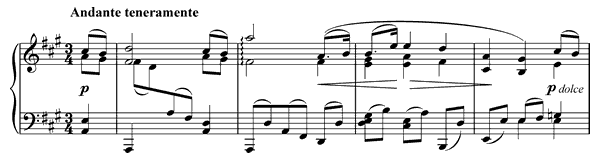
The second morning session used Brahm’s Intermezzo in A, Op 118 as the example for a discussion of how music can be divided into smaller elements, “zooming in” on these constituent parts to achieve more focussed practising.

For example, the right hand part divides into two distinct “voices”, upper and lower: practising each part or “voice” separately enables deeper learning. Much of this seems quite obvious, but it is surprising how many piano who play and study piano music do not use these kinds of learning tools.

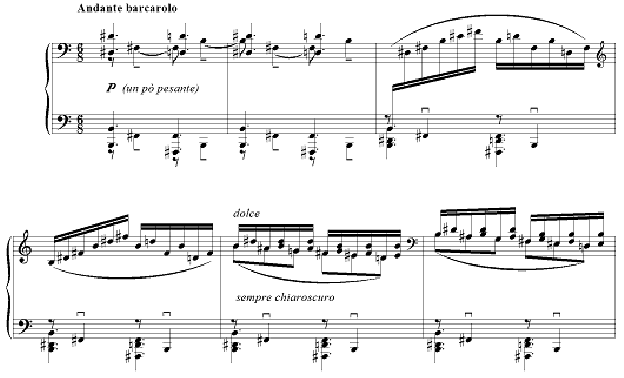
After lunch, during which I enjoyed talking about concerts and piano repertoire with some of the other participants, Carlo presented a session on memory work, demonstrating once again how reducing the music into small sections and patterns can facilitate memorisation. The musical example was Busoni’s elegaic barcarolle All’Italia.

Busoni

The session finished with some discussion on expressive grammar, the study of which is necessary for a truly coherent reading of a piece: by this, Carlo means not only the obvious dynamic, tempo and articulation markings, but other aspects such as the “stretching” intervals (in the manner of a singer), masculine and feminine endings and cadences, different types of accents and so forth.

Throughout the seminar, Carlo stressed that these aspects of piano study and method should not be seen in isolation and that the ultimate goal is to encourage deep, thoughtful practise resulting in an profound understanding of the music and the ability to play with expression. He also stressed the need to be a “curious learner”. All in all, it was an extremely valuable and thought-provoking seminar and I left full of new ideas for my own piano study and my teaching.

Carlo’s book Fundamentals of Piano Methodology is available in English (publisher Rugginenti)