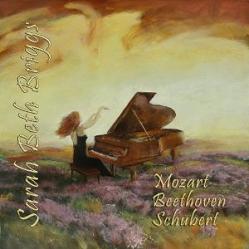
Schubert_Beethoven_sonatas_SMLMP35Mozart – Fantasy in C minor, K475
Beethoven – Sonata in C minor, op 13 ‘Pathétique’
Schubert Sonata in B flat major, D960

Semaphore: SMLMP35, 1 CD
Sarah Beth Briggs, piano


Sarah Beth Briggs’s latest release is dedicated to her teacher, the renowned pianist and musicologist Dennis Matthews, who died 25 years ago this December. Sarah pays tribute to his memory with a selection of much-loved works by Mozart, Beethoven and Schubert, pieces which were at the core of Matthews’ performing repertoire, and to which he introduced Sarah when she was still very young. The liner notes contain a touching tribute to Dennis Matthews by Sarah, recalling a concert when she heard him perform Schubert’s last sonata.

Mozart composed the C minor Fantasy in May 1785, shortly after the C minor Piano Sonata K457. Often a set piece for young piano students (I learnt the Fantasy, together with the C minor Sonata, when I was about 12 or 13, with little conception of how profound these works really are), the work is imbued with a gravity, drama and pathos more akin to Beethoven, and programming it before the great C minor ‘Pathètique’ Sonata allows the listener to make connections, both musical and emotional, between these two works. Sarah brings a sense of mystery to the opening motif,  with a spacious and suspenseful reading. This atmosphere of darkness and disquiet pervades the work, though there are sunnier episodes too.

Throughout Sarah plays with great clarity, sensitive to Mozart’s precise and dramatic articulation, dynamic ‘chiaroscuro’, and contrasting changes of mood, character, key and tempi. The major key interludes are warm and lyrical, while the Allegro sections are furious and agitated, the tremolando figure in the treble a brief but impassioned outburst. This is dramatic and highly satisfying reading shines a new light on this well-known work, and had me reaching for my (rather dog-eared) score from my teens, with a view to revisiting this Fantasy.

From the drama of Mozart’s C minor to Beethoven’s in the ‘Pathètique’ Sonata, Op 13. Like the Fantasy, the Sonata opens with a darkly dramatic and richly orchestral ascending broken chord figure. But this is more than an introduction, returning several times during the course of the movement. The succeeding Allegro is tight and energetic, played with a tempo which suggests the music bordering on unbridled frenzy, but never allowed to fully break free. This, coupled with the same careful articulation as in the Mozart, serves to further highlight the tension and dynamic contrasts of this movement. In the liner notes, Sarah gives her reasons for omitting the exposition repeat.

The slow movement is surely one of Beethoven’s best loved and most beautiful, a warm ‘cello-like cantabile over a gently moving bass line, suggesting a song without words. Unfussy pedalling, and sensitivity to the melody in the treble, and string articulation in the bass line, make this movement most satisfying, a delightful breathing space between the drama of the first and final movements.

The final movement has an elusive quality, and, despite its minor key, is wistful rather than dark. Sarah’s choice of tempo allows the passage work and cadenzas to shine. Like the Mozart, the movement ends defiantly.

Composed only a few months before his death in 1828, Schubert’s B-flat Sonata D960 was the result of a period of fervent compositional activity, and is considered to be his finest piano sonata. Compared to the Beethoven, it is expansive (indeed, the “heavenly length” of its opening movement is as long as an entire Beethoven Piano Sonata), and Sarah’s account offers a persuasive narrative, from the songful opening measures of the first subject, through the entire exposition (thankfully with repeat intact, to allow one to fully comprehend the drama of the trill before the reprise, and the extraordinary bridge into the development), to the gentle, prayer-like closing cadence. This is enhanced by the choice of tempo, a moderato that moves forward with a pleasing suppleness and fluency, and scrupulous attention to articulation.

Richly resonant bass notes underpin the meditative Andante sostenuto slow movement, while a sunny wamth pervades the central A major section, recalling the opening sentence of the first movement. The third movement sparkles, fresh and delicate, its playful Scherzo theme emerging gradually, as if from the mist of the previous movement. The essential sunniness is hardly obscured by the darker Trio; rather the shift of mood seems witty here, rather than gloomy.

The finale brings together many of the elements heard in the previous works on this disc: contrasting moods, tempi, dynamics, textures and colours, but always reinforced by Schubert’s melodic grace and poetry. Sarah is responsive to the shifting landscape of this movement, and the overall atmosphere is witty and positive, ending with a triumphant Presto.

Sarah Beth Briggs (image credit: © Clive Barda/ArenaPAL)

This is an extremely satisfying, characterful and thoughtful reading of three great works for the piano, underpinned by intelligent programme notes, and attractive design (the cover image is a painting of Sarah by Paul Martinez-Frias). The recording was made on a Steinway at Potton Hall, Suffolk, a venue famed for its clear acoustic. Combined with Sarah’s ever-responsive articulation, musical sensitivity, quality of sound and clarity of delivery, this is a splendid programme, and excellent value too.

Meet the Artist……Sarah Beth Briggs

“Everything we experience is a gift, a present we should cherish and pass on to those we love”

The inspiring and moving story of the oldest living Holocaust survivor and concert pianist Alice Herz-Sommer.

Now 109 and living in a tiny flat in London, Alice still plays the piano for several hours every day, practicing her beloved Bach and Beethoven. Once a renowned and celebrated concert pianist who performed to enthusiastic audiences around central Europe, Alice was deported to the Theresienstadt concentration camp, where, like thousands of others, she endured unspeakable hardships. Yet it was music that enabled her to look beyond the horrors of day-to-day life in the camp. She played more than 100 concerts inside the camp, and still talks with great passion about the experience.

Allice’s extraordinary story has now been made into a full-length documentary by Oscar®-winning filmmaker Malcolm Clarke

Full details about Alice and the film about her life here


(©2014 Amit Yahav)

Who or what inspired you to take up the piano, and make it your career?

There was a piano in the house ever since before I was born. It was my mother’s; she had played the piano as a young girl, and still plays the piano as a hobby occasionally today. It was a brown upright piano, which her grandfather had purchased for her. I have loved music for as long as I have memories, and have always enjoyed playing the piano. When I was slightly older and more advanced, my teacher at the time, Oscar Cano, explained to my parents that I needed a better instrument in order to make further progress. It was around the times that my parents bought a grand piano that they were able to afford, and I started going to watch concerts at the Concertgebouw (I grew up in Amsterdam) that I remember thinking, I want to be on that stage.

Who or what were the most important influences on your playing?

The greatest influences on my playing have been three of my teachers: in no particular order, the late Yonty Solomon, Oscar Cano, Mikhail Kazakevich and Niel Immelman. Most of what I know about playing the piano I learnt from these four great pianists.

What have been the greatest challenges of your career so far?

The music profession is one that requires a lot of persistence, and a great deal of determination. From performing and recording to teaching, almost everything in music is a challenge. For me it has always been a question of finding a new approach to learning a passage, or to explaining something to a student, etc.

The fact that classical music is being somewhat pushed aside in favour of other forms of music means that we keep being challenged to keep this century-old tradition alive, and to keep it relevant.

Which performances/compositions/recordings are you most proud of?

In June 2012, I played my Artist Diploma recital at the Royal College of Music. The programme included two Beethoven sonatas (“Moonlight” and “Appassionata”), as well as the Liszt Dante Sonata and Chopin’s G Minor Ballade. This mammoth programme, without a break, was a performance of which I was very proud.

Do you have a favourite concert venue to perform in?

Every performance venue is different. I very much enjoyed playing in the Kleine Zaal of Amsterdam’s Concertgebouw, the the Felicja Blumental Hall in Tel Aviv, and in the Purcell Room in London. I am generally more preoccupied with the instrument than with the hall. I love playing in locations that are more intimate, because I feel that I can then really communicate with everyone in the audience.

Favourite pieces to perform? Listen to?

This is difficult. There are so many! I really enjoy playing Rachmaninoff’s Rhapsody on a Theme of Paganini, the Liszt Sonata, Beethoven’s “Appassionata” and his Fourth Concerto, so many things by Chopin, Saint-Saëns’s G Minor Concerto… Like I said, there are so many!

Who are your favourite musicians?

I love listening to Radu Lupu and Grigory Sokolov playing live. Of those pianists who are no longer alive, I really love many of Arrau’s recordings, as well as those of

Gilels’s and Richter’s. One of the pianists whose recordings I really admire is Julius Katchen. For some unknown reason, despite being quite a well-known name during his life, he seems to have been somewhat forgotten of late.

What is your most memorable concert experience?

I remember watching the Israel Philharmonic Orchestra under Zubin Mehta at the BBC Proms. It was a dreadful experience, in a way, because people with political affiliations made great efforts to try and stop the concert and interrupt it in the middle. The orchestra, however, played all the way to the end. For me, it was a sort of affirmation of the power of music, and how it is above political divisions.

What do you consider to be the most important ideas and concepts to impart to aspiring musicians?

I think that good practice habits are crucial. Learning how to practise efficiently can dramatically reduce the amount of time one needs to spend practising a given passage. This has two important implications. Firstly, it allows one to learn a greater amount of repertoire, and to learn works quickly. I had to learn Beethoven’s Fourth Concerto in 4 weeks once. Secondly, the risk of repetitive strain injuries is reduced if one doesn’t need to spend 8 hours a day practising.

What are you working on at the moment?

Bach – C Minor Partita

Chopin – Polonaises op. 26, Concerto in F Minor op.21

Liszt – Transcendental Etude in F Minor (no. 10)

What do you enjoy doing most?

I love it when I get the time and the chance to learn something new. Preparing a new work for performance or recording is, for me, the ultimate journey of discovery.

Interview date October 2013

Amit Yahav’s debut CD of works by Chopin, including the Ballades, is available now. Further details here

Recipient of numerous international scholarships and awards, Amit Yahav is a graduate of the Royal College of Music with distinction. Following his distinction on the Master of Music course, he was invited to participate in the RCM’s exclusive Artist Diploma programme under the tutelage of Prof. Niel Immelman and Prof. Vanessa Latarche, from which he also graduated with distinction. Previously, he had studied in London with the legendary Prof. Yonty Solomon and Prof. Mikhail Kazakevich, and in Amsterdam with Oscar Cano and Marjès Benoist.

Amit Yahav’s full biography

www.amityahav.com

All 32 Piano Sonatas in a day? Read on……

Celebrated pianist Julian Jacobson, acclaimed for the vitality, colour and insight he brings to his performances, celebrates the 10th anniversary of his first all-Beethoven charity piano marathon by staging this amazing event once more. The event will run from 9.15am-10pm on 15th October 2013 at St Martin-in-the-Fields, Trafalgar Square, London, with the aim of raising money for WaterAid and St Martin-in-the-Fields’ The Connection at St Martin’s which gives crisis grants to people in need across the UK.  Donate here.

Julian Jacobson (photo credit: Roger Harris)

Julian will perform all 32 Beethoven Piano Sonatas from memory in chronological order with the exception of Op. 106 ‘Hammerklavier’, prefaced by the Sonata in E minor, Op 90, which together will form a special lunchtime concert from 1-2pm within the marathon event itself. Likewise there will be a special ‘Total Beethoven’ concert at 7pm that evening which will conclude the day’s marathon. During this outstanding feat of endurance – undertaken by only two other pianists – he plans to take just 2 longer breaks of 30 minutes each on the day and a few shorter breaks of just 5 minutes each. The event will be live-streamed with a button for people to donate during the webcast.

This will be a very special event indeed. Aside from the sheer Herculean task of learning, absorbing and reproducing all those notes, and sustaining a performance for over twelve hours, to hear Beethoven’s complete piano sonatas in (almost) chronological order offers a far-reaching overview of Beethoven’s musical style, the development of the piano sonata as a genre in the late eighteenth- and early nineteenth-century, and a glimpse into the inner workings of Beethoven’s compositional life and personality.

I asked Julian about the special challenges of preparing for such a musical marathon

CEP: How do you prepare, mentally and physically, for such a performance? What are the particular challenges of presenting all 32 Sonatas in one day?

JJ: Just attempt not to drown. An insane project. Go through all the sonatas in decreasing circles (revision over two months, then again over one month, two weeks, one week, three days…..). Try and keep fit, or get a bit fitter.

Admission to the event during the day is free, with a donation. Book tickets for the evening concert ‘Total Beethoven’ (7pm) via the Box Office: 020 7766 1100 or online from the St Martin-in-the-Fields website.

Read Julian Jacobson’s blog about the project

www.julianjacobson.com


