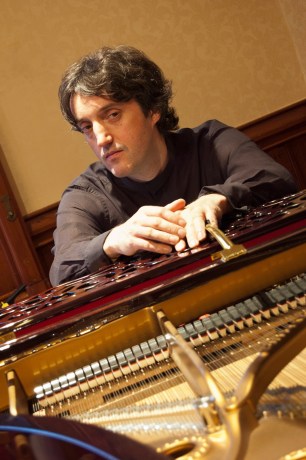
Ziyu Chen

A new series of concerts launches on 5th February 2014 at the Radcliffe Centre at the University of Buckingham with a concert by violist Ziyu Shen and pianist Anthony Hewitt.

Hot on the heels of their recital at London’s Wigmore Hall, these two world-class musicians bring a glorious, innovative programme of music by Bloch, Brahms, Prokofiev, Ravel and Guan. Sixteen year old Ziyua Shen won the 11th Lionel Tertis International Festival and Competition in 2013, the youngest prize-winner of this prestigious competition.

Anthony Hewitt


Pianist Anthony Hewitt is founder of the Ulverston International Music Festival, now in its 11th year, and an internationally acclaimed virtuoso, whose communicative performances have won his high praise.

An intriguing addition to the programme is the inclusion of a specially commissioned poem by Artist in Residence, Graham Roos, to mark the 10th anniversary of the Chinese Cocklepickers’ disaster at Morecombe Bay. The event has resonances for both performers: Chinese born Ziyu and Cumbrian Hewitt, whose home town Ulverston overlooks the fated bay.
Further details and tickets

Future concerts in the series, which take place on the first Wednesday of each month, include:

5th March – Preludes and Promenades. The world premiere of a new words and music collaboration between Anthony Hewitt and actress Susan Porett, featuring selected Preludes by Scriabin and Mussorgsky’s Pictures at an Exhibition, with original artwork by Klara Smith.

2nd April – LePage/McLean Duo. Violinst David LePage and pianist Viv McLean in a programme of music by Bach, Brahms, Debussy, Ravel and Monti.

Further information www.sevenstarconcerts.com

Who or what inspired you to take up composing, and pursue a career in music? 

It was the organ at Romsey Abbey. I was in the choir from the ages of about 8-10 and just had to get my hands on it! I could read music well and used to page turn for the organist. I begged him to let me play it, but he refused to let me until I’d got Grade 5 piano. By the time I did, I’d entirely lost interest in the organ and was already starting to get really interested in composing. But I bet there aren’t too many other 10-year-olds who know Bach’s complete organ works (from recordings)!

Who or what were the most significant influences on your musical life and career as a composer? 

Composers: Bach, Beethoven, Debussy, Stravinsky, Berio. Teachers: my main one (at the RNCM) Anthony Gilbert – I owe him so much in ways he never understands, however hard I try to explain to him; also Berio; and Paul Lansky and J. K. Randall at Princeton University. And then there are individual musicians I’ve admired and learned from at different times in my life and in different ways – Barenboim, Ashkenazy, Bernstein, Richard Barrett, Pat Metheney, Miles Davis… Right now I’m working with the folk singer Chris Wood, and finding him very inspirational. And playing in and writing for my band, notes inegales, and launching our Club recently with Peter Wiegold has been terrifically important to me. I’ve also found the landscapes, folk music and history of the United States musically stimulating ever since my teens.

What have been the greatest challenges of your career so far? 

I think ‘career’ is a daft concept, especially for a composer! I feel I’ve been lucky that people have wanted to play and listen to what I write (and sometimes pay for it too), and thankfully continue to do so. I suppose the greatest challenge is to keep what you do fresh and honest; and accepting that if you’re in it for the long haul, this means getting up every day and ploughing on, even when you don’t feel like it.

What are the special challenges/pleasures of working on a commissioned piece? 

Quite often a commissioned piece will be for a combination, or in a genre, or for an occasion for which you have little or no enthusiasm and it can be a challenge to drum some up! But that’s a good challenge. A composer should be flexible that way and it’s part of the job to adapt and tailor ideas to the task before you. If you can’t, don’t accept the commission. On the other hand, a commission can sometimes be collaborative and involve working with others to develop ideas and new ways of creating. When that works successfully it’s a deeply pleasurable experience, not least because it means you’ll have learned something new.

What are the special challenges/pleasures of working with particular musicians, singers, ensembles and orchestras? 

It’s always a pleasure to write for or play with long-standing musical friends, simply because you know them well, can play to their strengths and can make music borne of a deep knowledge and understanding of their musicianship. I’ve been fortunate enough to have several such relationships, but I’d single out the Schubert Ensemble: I’ve written 4 or 5 pieces for them over the last 15 years and they’ve played a couple of these in excess of a hundred times! Each time I hear them play my music, it’s more ingrained and natural but also always fresh and illuminating. Playing with notes inegales on a regular basis is the same. We do a lot of free improvising, and it’s got to a stage now where we can predict what each other is going to do, individually and collectively – but not exactly: there’s always an unpredictable dimension, an element of risk that keeps our relationship exciting and fulfilling.

Which works are you most proud of?  

My two operas – Craig’s Progress and A Better Place because they involved the most, and the most varied kinds of work, including some wonderful collaborations! Also my orchestral piece, O Rio, and a handful of others that still ‘work’ for me after many years (in some cases). But, as always, everything is far from perfect and I own up to being yet another artist who’s never satisfied…

Do you have a favourite concert venue? 

Not really. Our lovely basement bar at Club Inegales is a fine place to be for me right now!

What is your most memorable concert experience? 

Lots, of course. But I’ll always remember sitting in on rehearsals, then a performance of The Rite of Spring by my old college symphony orchestra (RNCM) when I was a student there. It was totally galvanising and revelatory – I learnt more then about how an orchestra works than at any time since. Also, my first ‘Ring’ cycle. There are no words.

What do you consider to be the most important ideas and concepts to impart to aspiring musicians? 

Diligence; preparation for boredom, frustration and being misunderstood; faith; generosity of spirit; healthy mistrust in authority; no cutting corners; and above all artistic honesty.

What are you working on at the moment? 

I’m working with Chris Wood on a big piece that we’ll be performing at Club Inegales with the band. There’s also an oboe concerto waiting in the wings, plus a handful of smaller things. I’m one of those composers who can only work on one thing at a time, though…

Where would you like to be in 10 years’ time? 

More or less where I am now, doing the same stuff, only better. And with an even better understanding of cooking.


Martin Butler was born in 1960 and studied at the University of Manchester, the Royal Northern College of Music, and Princeton University, USA. From September 1998 to July 1999 Butler was Composer-in-Residence at the Institute for Advanced Study at Princeton in the United States.  He is currently Professor of Music at the University of Sussex. 

Butler’s works are widely performed and broadcast both in the UK and abroad.  He has received commissions from, amongst others, the BBC (O Rio was first performed at the 1991 Proms), the London Sinfonietta (Concertino and Jazz Machines, of which the latter was played at the 1995 Venice Biennale), the Schubert Ensemble (American Rounds and Sequena Notturna) and the Brighton, Cheltenham, Canterbury, Norfolk & Norwich, and Presteigne festivals.  


In June 1994 Mecklenburgh Opera premiered the operatic adventure story Craig’s Progress, which was adapted for radio broadcast by BBC Radio 3.  His chamber opera A Better Place was premiered by ENO at the Coliseum in London in July 2001, and Two Rivers for choir and orchestra was premiered by the Oxford Bach Choir and The Britten Sinfonia in December 2001. Sentinels for string quartet and viola was premiered by the Brodsky Quartet and John Metcalfe at the 2006 Brighton Festival, and William Howard gave the premiere of Funérailles, a substantial work for piano, at the 2006 Norfolk and Norwich Festival. 


From 2006-8 Butler was the Brighton Philharmonic Orchestra’s first ever ‘Composer in Focus’. The orchestra performed several large scale works during this period and his tenure culminated in two major performances of a new commission for the orchestra, From the Fairground of Dreams in January and March 2008 at Brighton Dome Concert Hall, conducted by Barry Wordsworth. Recent works have included a Saxophone Concerto, commissioned by the Presteigne Festival, and Rondes d’Automne, a nonet premiered at the 2011 Cheltenham Festival and shortlisted for a Royal Philharmonic Society award in 2012. 

 As a pianist, Martin has been active as soloist and with a number of ensembles, and is a founder member of the improvising new music collective, notes inegales. He is Associate Director of Club Inegales. 


Ronald Center: Instrumental and Chamber Music 

Volume One:

Music for Solo Piano

Catalogue Number: TOCC0179
EAN: 5060113441799
Release Date: 2 September 2013

Christopher Guild, piano

Sometimes described as “the Scottish Bartok”, composer Ronald Center (1913-73) was born in Aberdeen, the youngest member of a musical family. Despite his active working life as a soloist, accompanist, organist and teacher, his music was somewhat overlooked during his lifetime and after his death, and the centenary of his birth was rather lost amid the furore of last year’s composer anniversaries of Britten, Wagner and Verdi.

Fellow Scotsman and pianist Christopher Guild is a crusader for the neglected Center, and makes a persuasive case for Center’s piano music in his new disc on the Toccata Classics label. There are intimations of the percussive spikiness of Prokofiev, the folk idioms and harmonies of Bartok, the simplicity of Poulenc, the wit and humour of Shostakovich, and the sensuality and stately parallel harmonies of Claude Debussy (in a work entitled ‘Hommage’ which is dedicated to Debussy). Hints of Scottish airs make intriguing appearances in the music, reminding us of the composer’s heritage. There are moments of haunting beauty and wistful lyricism, such as in the ‘Larghetto’, the middle movement of the ‘Sonatine’, the ‘Impromptu’, or the first of the Six Bagatelles. Meanwhile, the Piano Sonata opens with a sprightly Bartokian Allegro molto,

Alert to the musical and emotional cross-currents in the music, Guild offers a sensitive reading of these interesting and varied works that is insightful, colourful, brimming with rhythmic vitality, and meticulously presented on this high-quality recording. An excellent introduction to Ronald Center’s oeuvre.

Toccata Classics

Meet the Artist……Christopher Guild

I recently contributed an interview to firstsiteguide.com, a web development collective which helps people to create their own websites and blogs, and offers helpful related resources. I was approached to comment on the whys and hows of getting online, specifically as a music blogger and more generally as an active member of the online community.

As I explain in my interview, I believe it is crucial to have an online presence, as a musician, teacher and writer. A website acts as one’s “shop window” and is the place where one can include useful information for promoters, agents, colleagues, students and potential audience, from a concert diary to biography, downloadable photographs and press coverage, to video and sound clips. As a teacher, it’s likely to be the first point of contact for a prospective student or parent of a student, and therefore should include clear information about your teaching philosophy, lesson fees, other services, testimonials and terms and conditions.

It is de rigeur to have a web presence these days, and yet I am continually astonished at the number of professional musicians and teachers I meet who either do not have any web presence, or have a very rudimentary or badly-designed website. On the back of a website, one can attract further attention to one’s activities by having a presence on social networks such as Facebook, Twitter, Google+ and LinkedIn, which gives one other streams from which to promote oneself. The single most important reason why this blog has become well known is through my active online presence.

“I don’t like talking about myself”, “it seems really egotistical” people say to me when I express dismay at their lack of an online presence. Others worry about security, “trolling” and privacy. All these aspects can be managed, by you the user, if you use these platforms sensibly and control how much information you want to reveal.

As an ingenue concert promoter (I launched the South London Concert Series with a colleague last winter), I have seen how useful and powerful these networks can be. We use Twitter, Facebook and a website as our main forms of promotion and contact with our potential audience, and we operate a paperless ticketing system through WeGotTickets, which saves a degree of admin for us. We have not had to pay for any advertising, and the first two concerts of the series sold out weeks far ahead of the actual date.

As a writer and blogger, the internet is a huge and wonderful resource, and every day I come across articles and more which form the basis for articles or discussions amongst like-minded people around the world. Almost all of my Meet the Artist interviews are the result of an approach made via Twitter or Facebook, and the internet remains a potent means of promotion for me, and many of the musicians I have met in the course of my writing.

Setting up a website is so straightforward these days, with platforms like WordPress, Tumblr and Wix which offer attractive templates and clear guidance, that there really is no excuse not to have a web presence. And these platforms are so easy to use and manage that one really doesn’t need to spend a lot of money or time on web design. (Take a look at my recently redesigned personal website for an example of a “homemade” site, hosted by WordPress.)

For more about how I got online and how I manage my online presence, read my interview