Image
Bobby Chen (photo credit: Sussie Ahlburg)

Who or what inspired you to take up the piano and make it your career? 

When I was 7 years old, my parents moved into a new neighbourhood in a satellite town in Kota Kinabalu, Sabah, Malaysia, and I heard some piano sounds coming from just across the street. I went over, met the lady, had a few informal lessons with her, and felt fascinated by the piano. I never had proper lessons with her, but the fascination remained.

Who or what were the most important influences on your musical life and career? 

Firstly, my parents, who had introduced me to the gift of the music and piano. Second, my first teacher in Kota Kinabalu, who played me a recording by Glenn Gould, and travelled overseas with me for extra tuition. Third, to Geoffrey Smith, who was the Regional Consultant in charge of South-East Asia for the ABRSM in 1991, he suggested that I audition for the Yehudi Menuhin School, and guided me through that process. Lastly, my teachers in the UK, who were Ruth Nye, Hamish Milne and Nikolai Demidenko.

What have been the greatest challenges of your career so far? 

I can find it easy to lose focus, and to not push myself 100%. This can make me fall away slightly in my pursuit when trying to understand certain works and ways of playing.

Which performances/recordings are you most proud of? 

I remembered very fondly: a) touring Britain with Lord Menuhin and the Beethoven Triple Concerto in 1996; b) making my Italian debut recital at the Fazioli Hall in Sacile, Italy in 2011; c) performing at my 4th solo recital at the Wigmore 2011; d) recording an all Prokofiev solo disc for SOMM Recordings in 2009; e) as one of the pianists in the first ever complete Beethoven sonata cycle for South-East Asia in 2008. Also, I am also very proud to have organize my first winter piano course, taking place at the Yehudi Menuhin School. So these were some of my favourite moments!

Which particular works do you think you play best? 

Recently, I have been working a lot on Prokofiev’s piano music. Also on Debussy and Schubert.

How do you make your repertoire choices from season to season? 

If I play Prokofiev in season 2012-13, it is because in 2010, I started to find his music increasingly fascinating. I find it lovely to explore works in this way.

Tell us a little more about your duo partnership with Douglas Finch. What are the particular pleasures and pitfalls of playing duo repertoire? 

I got to know Douglas many years ago, when I started to play his works. In 2010, I invited him to come to my winter piano course at the Yehudi Menuhin School. After performing a complete Liszt programme with Leslie Howard at the Wigmore Hall in 2011, Douglas and I struck up a piano duo partnership.

With 4-hands, the entire keyboard register can be used, the instrument transformed into this amazing orchestra, with exciting possibilities! One major pitfall is that any minute lapses of concentration from one player can be glaringly exposed!

Do you have a favourite concert venue to perform in and why? 

I love playing at the Wigmore Hall, the intimacy there is unique. Also Fazioli Hall, so state-of-the-art, and a gorgeous piano there.

Favourite pieces to perform? Listen to? 

This season, performing Prokofiev’s and Debussy’s piano music. I love listening to Fischer-Dieskau singing Bach. I love watching ballet at the Royal Opera House.

Who are your favourite musicians? 

Dietrich Fischer-Dieskau and Ferruccio Busoni.

What is your most memorable concert experience? 

Bernard Haitink and the Berlin Philharmonic live at the Proms in 2011. Incredibly awe-inspiring.

What do you consider to be the most important ideas and concepts to impart to aspiring musicians?

To stay true to your art, and to find all sorts of ways in order to fulfil your musical/artistic ambitions.

What are you working on at the moment? 

I am currently learning the Sonatine by Ravel, Impromptus Op.142 by Schubert, and revising the 4 Chopin Ballades.

Where would you like to be in 10 years’ time? 

Performing music in public.

What is your idea of perfect happiness? 

Spending time with family and good friends.

What is your most treasured possession? 

My teapot.

What do you enjoy doing most? 

I love watching films in cinema, going to concerts and chatting with interesting people.

What is your present state of mind? 

Fairly good, I think! Although a bit Prokofiev-ian.

Bobby Chen performs duo piano works with Douglas Finch as part of the Bristol International Piano Duo Festival, 7 March 2014, at the University of Bristol. Full details here

Described by International Piano Magazine as: “…an armour-clad player of complete technique,  a thinking musician, a natural Romantic. Young bloods come no better”, Malaysian pianist Bobby Chen studied at the Yehudi Menuhin School and the Royal Academy of Music with Hamish Milne and Ruth Nye. He burst on the scene in 1996 with a sensational season of concerts, which included a British tour with Lord Menuhin in a performance of Beethoven’s Triple Concerto and a recital at the Royal Festival Hall as part of the South Bank Prokofiev Festival.

Chen has performed under conductors Lan Shui, Mathias Bamert, Maximiliano Valdés, Sir Neville Marriner, Pierre-André Valade, Giancarlo Guerrero and with several orchestras including the Academy of St Martin-in-the-Fields, Malaysian Philharmonic Orchestra, Warsaw Sinfonia, Singapore Symphony Orchestra and the London Sinfonietta.

In recent seasons, venues Chen has played in included Beijing’s Forbidden City Concert Hall, Dublin’s National Concert Hall, Singapore’s Victoria Concert Hall, Italy’s Fazioli Hall, Holland’s Hermitage Amsterdam, Poland’s Antonin Palace, Hong Kong’s City Hall, Malaysia’s Petronas Twin Towers, UK’s Purcell Room, Bridgewater Hall, Royal Concert Hall, Cadogan Hall, and Wigmore Hall. He has performed under the special auspices of Australia’s Southern Highlands International Piano Competition, at Brazil’s Musica Nova Contemporary Music Festival, Sweden’s Lidköping Music Festival, Ireland’s Music for Wexford and Wicklow Arts Festival, UK’s Worcester Three Choirs Festival, Guildford International Music Festival and Marlborough College Summer School. He has recorded six commercial discs, and broadcast live for UK’s Classic Fm, Hong Kong’s Radio Television Hong Kong and USA’s Pianoforte Chicago.

Chen was awarded ‘The BrandLaureate – Country Branding Award’ from The Asia Pacific Brands Foundation, appointed a tutor at UK’s Chethams International Piano Summer School, elected an Associate of London’s Royal Academy of Music (ARAM), and runs the Overseas Malaysian Winter Piano Academy (OMWPA) at the Yehudi Menuhin School.



As regular readers will know, I write concert and exhibition reviews for several arts and culture websites, as well as for this blog. I thought it would be helpful to have all my reviews in one place, and to include content written by my reviewing colleague Nick Marlowe. So a new blog has been launched – MusArtLondon – as a permanent home for all our reviews. We cover all major art exhibitions in London as they open, and music and opera, together with longer articles on places of interest in London, in particular those with literary, artistic or musical connections.

Do take a longer look at http://musicartlondon.wordpress.com/

All my reviews and articles for Bachtrack to date can be found here

Read Nick’s reviews for OneStopArts here

In an recent interview for the Herald Scotland, the Scottish pianist Steven Osborne describes how he uses techniques drawn from sports psychology to enable him to counteract the exigencies of the concert pianist’s life, the anxiety of performance and the sometimes unpleasant side-effects of adrenaline.

Jessica Ennis

I often liken the pianist’s life to that of a sportsperson’s: the many hours of specialist training, the constant need to hone and improve one’s techniques and skill base, to keep fit and build stamina to cope with the Herculean learning and upkeep of all those notes, punishing concert schedules, traveling, and indeed the music itself which can present its own particular physical and mental challenges (for example, playing Rachmaninov’s Third Piano Concerto has been likened to shoveling around three tons of coal – and that does not include the mental and emotional exertion required to learn and perform this monumental work). Added to this there is the need to feed the artistic temperament, never having permission to be less than perfect, for one is only as good as one’s last performance – just as the champion sportsman or woman will be remembered for the last record broken or gold medal won.

It can be a smothering profession, at whatever level one is engaged in it. In addition to the many hours of practising at the piano, there is painstaking work to be done away from the keyboard, reading, analysing and annotating scores, marking up fingering schemes which once learnt remain embedded in the memory and the fingers forever. There is always new repertoire to be learnt, old repertoire to be revised, overhauled, finessed, or just simply kept going, a vast repertoire “in the fingers” which can be made ready for some kind of performance within a matter of days, depending on one’s schedule. Top athletes and musicians know that excellence comes from hours and hours of this kind of highly focused training. One is not born with this extraordinary talent: it must be developed and refined – and that takes hard graft and commitment.

And then there is performing itself which requires special preparation, in particular learning how to deal with the rush of adrenaline which comes with the anxiety of performance. As Steven Osborne says “Concert tours aren’t quite real life……………All that weird adrenaline. The rhythm of anticipation then coming down afterwards – it’s not normal to do that day after day.”

Sports people experience this too: it is the adrenaline pumping through the body which, in addition to all the careful training and preparation, propels Mo Farah down the track or Chris Froome up that Hors Categorie Alp in the Tour de France. And it drives that particular aspect of ego which makes sports people and musicians go out and perform (and sport can be seen as a performance – why else are we captivated by live TV broadcasts of rugby matches, skeleton bobsleigh, snowboarding, gymnastics, et al?).

2013 Tour de France winner Chris Froome in the leader’s yellow jersey

The pressure to perform and perform perfectly has caused many an athlete, and concert pianist, to abandon the sport/profession and turn his or her attention to related aspects such as teaching and developing young talent. For in that moment when you are alone on the stage, you know that if you make a mistake there will be no-one there to help you. Learning how to deal with the anxiety and loneliness of performance and that special rush of adrenaline is a crucial aspect of being a performer, and an athlete, and many strategies for dealing with performance anxiety are drawn from sports psychology and NLP. Even the most junior students and performers need to understand why we feel nervous and to be given strategies to overcome anxiety and to learn how to work with adrenaline to enable one to respond to it positively and to lift one’s performance. And also to accept that mistakes are inevitable and normal, because we are all human.

There are day-to-day aspects of the musician’s life which also chime with that of the athlete: just as one experiences an endorphin rush, the feeling of well-being and euphoria as the body is flooded with “happy hormones” during physical exercise, so musicians enjoy the same feelings through the physical activity of practising and engaging with the instrument. When this is combined with adrenaline in a performance situation, one can come off stage on an extreme “high” and it can take several hours to come down.

Musicians also need to understand how to listen to the body and manage injuries in the same way as sportspeople do. Injuries can be devastating if not managed correctly, leading to cancelled concerts (and therefore loss of income), and, in extreme cases, can bring careers to a premature end. Repetitive strain conditions such as tendonitis and tenosynovitis must be taken seriously, and affected fingers, hands, wrists, backs and other limbs rested and given time to recuperate. It is important to adopt the correct posture when playing (for the pianist, an adjustable piano stool is essential) and to take regular breaks. Many musicians whom I know actively engage in sports such as tennis, running, swimming, cycling and weight-training, and many of us use exercises drawn from yoga, Pilates, Alexander Technique and Feldenkrais to keep our bodies in good condition. Exercise and sport can also provide useful “down time” for the musician, allowing time away from the instrument.

In my teaching I often use analogies drawn from sport to help explain a particular point or aspect of technique to my students, the most frequent being learning how to do an over-arm serve in tennis to illustrate why we practise repetitively: just as the tennis player needs to learn the movements in sequence to serve the ball, so the pianist must learn a set of movements to play a certain passage, scale or exercise. Repetition of these movements fixes them in the “muscle memory” – or what psychologists call the “procedural memory”. (I remember practising my over-arm serve endlessly as a teenager – but I never became a decent tennis player! Maybe there is a lesson here…..)

The image of the pianist as an effete artiste locked in his or her ivory tower is no longer accurate. Instead imagine a focused athlete, honing body and mind.

Resources and further reading:

BAPAM (British Association for Performing Arts Medicine) – health advice for musicians

Music and Health – many articles, links and other resources written and collated by Richard Beauchamp.

Herald Scotland interview with Steven Osborne

An earlier post on Playing in the Zone

The Piano and Neuro-Linguistic Programming

On Saturday the London Piano Meetup Group ventured south to Wimbledon for a recital at the showroom of Hanna Pianos. Nine pianists performed an interesting and varied programme of works by Shostakovich, Brahms, Granados, Chopin, Debussy, Scriabin, Stanchinsky and Szymanowski; we also enjoyed a performance of a clarinet piece by Paul Reade.

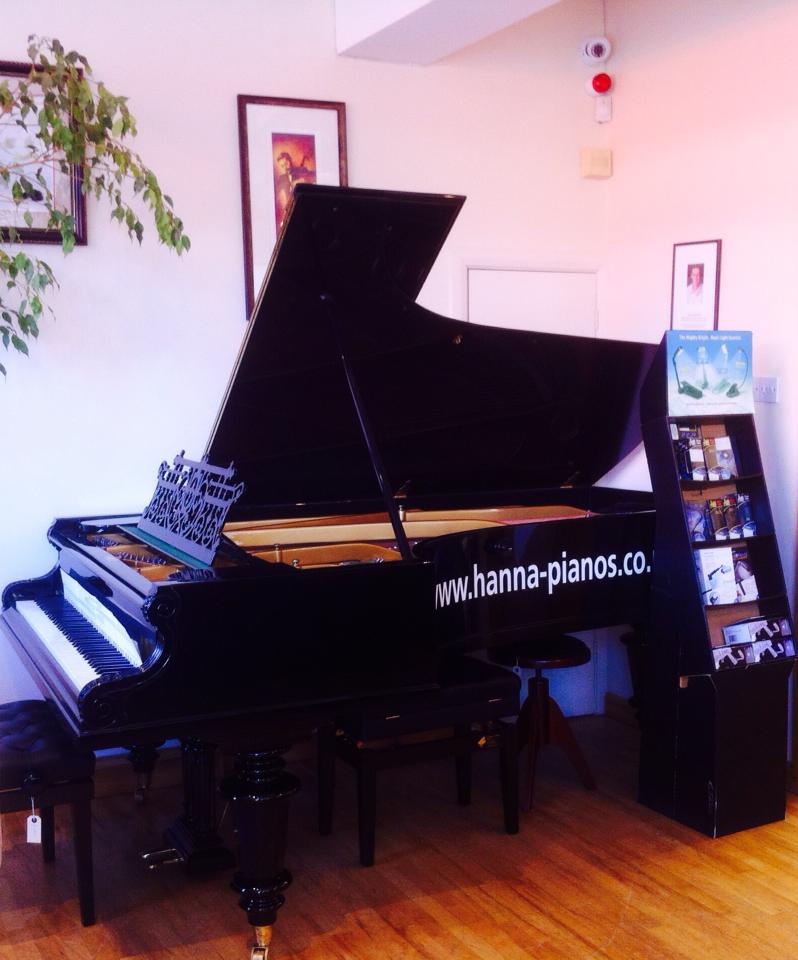
1452077_600409663360040_497822147_nHanna Pianos has had its showroom on Kingston Road SW19 since 1990. It’s a family-run business and the owner, Fadi Hanna, learnt his trade from a young age, observing and working with his father who established the business in 1960; meanwhile Fadi’s brother, Chucri, looks after the technical and tuning side of the business. When we visited the showroom was graced by a beautifully restored 1900 Bechstein, a Steinway Model O with a lovely burr walnut case and a 1927 Bluthner autographed by Kelenyi (?). We were lucky enough to play the Bechstein for our recital.

DSC_3952
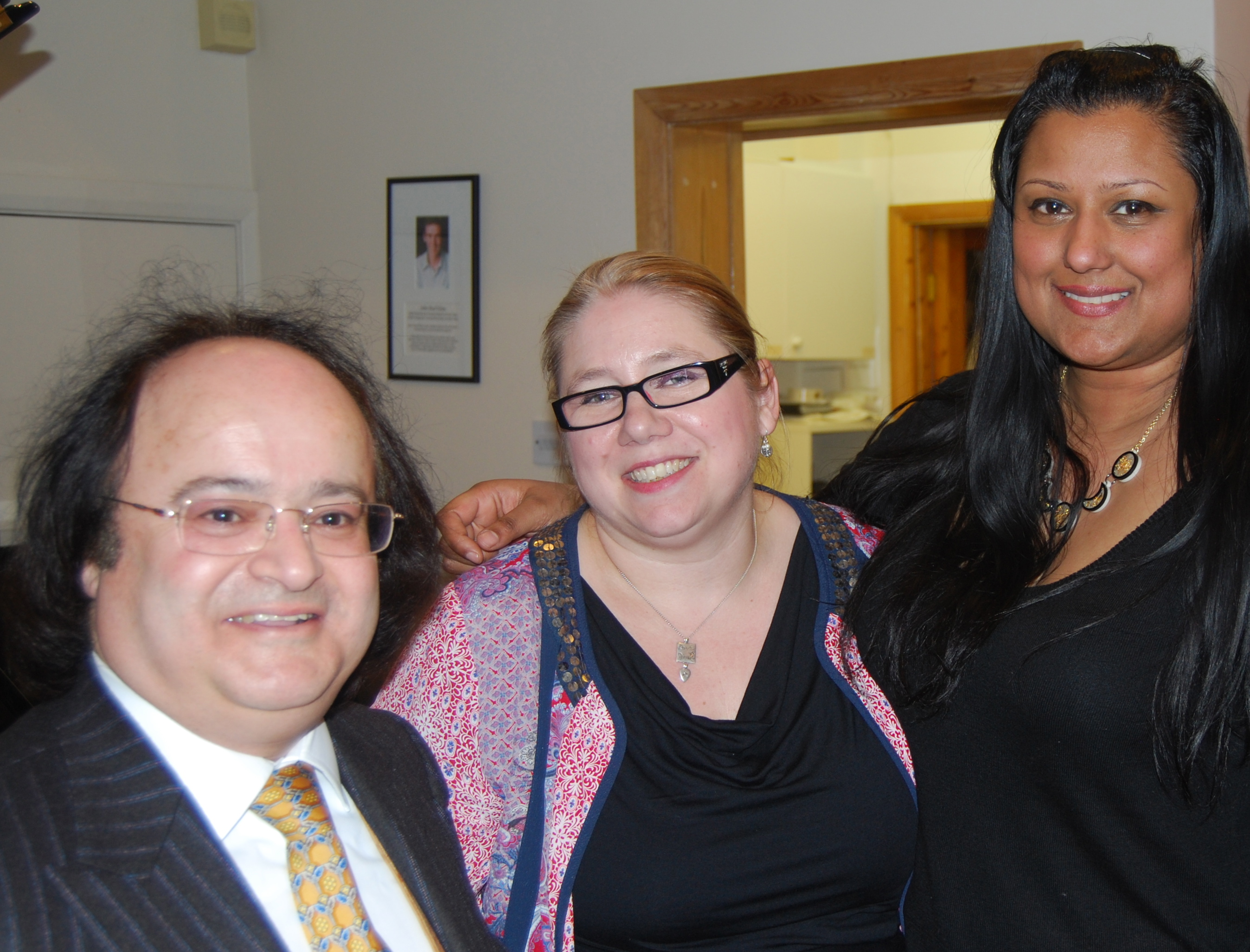
Mr Fadi Hanna with LPMG co-hosts Frances & Lorraine


The audience, seated around the piano on stools and chairs, listened attentively and applause was given generously for every performance. The atmosphere was intimate and friendly, and one had the impression of everyone listening very carefully to such high-quality piano music. At the end of the event, Mr Hanna produced the most delicious baklava and other gifts for us. We were absolutely bowled over by his hospitality and generosity, and there was much positive feedback after the event, praise for both venue and instrument. We are hosting a masterclass with Graham Fitch at Hanna Pianos towards the end of this month, and we very much hope to host further recitals in the showroom.

1920 Steinway Model O with burr walnut case

A Hanna & Sons Pianos Ltd

London Piano Meetup Group