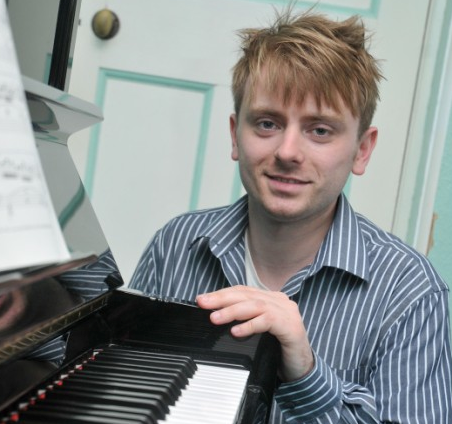
Who or what inspired you to take up the piano and pursue a career in music?

I started playing on a whim. My mother walked in from work one evening and asked out of the blue if I wanted to learn the piano. Neither of my parents are musicians but they have the broadest musical tastes of anyone I know and had a wicked sound system which was playing music constantly. I gave an offhanded “yeah why not” and it all snowballed pretty quickly from there.

After a year or so I started participating in local competitions in Philadelphia where I was brought up and when it looked like I was taking music seriously we moved to England so I could attend the Yehudi Menuhin School.

When I was eleven one of my teachers told me I’d never be a pianist because I started too late. That was it – I had to prove her wrong and here I am! Maybe she was flexing her reverse psychology knowhow.

Who or what are the most important influences on your playing?

I spent some time in the Gambia to study Wolof drumming and in Bali playing and listening to lots of Gamelan. Both of those trips had a huge impact on my playing. Mostly they changed the way I listen. Especially coming from a background which is so focused on learning visually – from a score. They were incredibly liberating experiences for me.

Some other important influences are watching dance and doing it, the photographs of Ansel Adams and practicing meditation.

What have been the greatest challenges of your career so far?

Staying balanced, healthy, positive and productive in a life which can fluctuate between breathless busy-ness and the threat of total stagnation.

After finishing my formal education and years of having the luxury of playing for my teachers on a regular basis it took some time to start trusting my own musical instincts and to believe my own feedback.

Which repertoire/composers do you think you play best?

All the music I haven’t played yet.

How do you make repertoire choices from season to season?

Often a venue will request a specific piece or composer and I’ll build a programme around that. I also keep an eye out for anniversaries and featured composers in up coming festivals.

I’m all for choosing pieces that really suit my playing. It can be tempting to perform works I think I ‘should’ play or adhere to what I think will placate a certain kind of audience but if it doesn’t suit me and I don’t totally love it then there’s a risk of a performance falling flat (and it has!)

I always have something on the go that pushes me to my limits and balance that with pieces that come more naturally.

Which performances/recordings are you most proud of? 

I don’t get much enjoyment out of recording as a soloist but absolutely love recording with ensembles. I used to be a member of the band Jetsam and we wrote and recorded an album called Disruption which was commissioned by the Barbican in collaboration with the street dance company Boy Blue Entertainment. We wrote most of Disruption as we recorded which allowed for our imaginations to run wild. There’s a big Japanese Taiko and Noh theatre influence in the piece which meant a lot of recording us stamping in a padded hallway. I spent a couple days at the piano recording every sound I could think of on the strings, metal frame and wood. Playing with harmonics, using chains, plastic, glass and rubber. It was a proper prepared piano geek-out and the album sounds amazing.

Do you have a favourite concert venue to perform in?

I recently played at Café OTO which was so much fun. It’s small, dark and intimate – I think I nearly head butted someone in the front row when I bowed. The audience was one of the most attentive, supportive an electric I’ve ever played for which restored my faith in the contemporary classical music audience. I also love performing in the Barbican. I’ve performed in every one of their performance spaces as a soloist and in ensembles and bands I’m involved with and it has such a stimulating and creative atmosphere. On any given day there is something weird and wonderful happening in one of its nooks and crannies.

Favourite pieces to perform? Listen to?

I’m very fickle. I tend to think that whatever I’m playing in the moment is the Best Thing Ever!

I love performing George Crumb’s ‘Makrokosmos’. I have a secret predilection for a bit of theatre and because of the extended techniques, singing and moaning involved in its performance it’s a full body theatrical experience. I used to get so frustrated by the static nature of the piano and was hugely jealous of my cellist friends. The process of learning ‘Makrokosmos’ taught me how to overcome that immovability, become more malleable and dance with the instrument.

To listen to…shall we just say for the Spring/Summer season? Otherwise we’ll be here forever.

Appalachian Spring which, thanks to my dad, is my first memory of music. Lately I’ve been listening to John Legend and The Roots album Wake Up which transports me back to growing up in Philadelphia. Steve Reich’s Music for 18 Musicians, Partita for 8 Voices by Caroline Shaw, Chaka Kahn. I’m always inspired by hearing what my friends make and have been listening non-stop to Sam Mumford’s album Scatter and Old Man Diode The King Krill

Who are your favourite musicians?

There are so many I admire for different reasons and on different days. To name a few: Glen Gould, Bjork, my husband and saxophonist Jon Shenoy, John Adams, Beyoncé, John Cage, Seth McFarlane, Joanna Newsom, Pat Metheney, Punch Brothers, Joan Baez, Charles Ives.

What is your most memorable concert experience?

A few years ago I performed ‘Phrygian Gates’ for John Adams. Before the concert there was a Question and Answer session in which he said he didn’t like the piece very much anymore. After I performed he came up on stage with tears in his eyes, gave me a hug and said to the audience “I’ve changed my mind, I like it again.”

What do you consider to be the most important ideas and concepts to impart to aspiring musicians?

Keep your ‘don’t know’ mind. Play with musicians who challenge you. Get involved with projects that scare the hell out of you. Make mistakes – they could turn into something wonderful. Learn how to meditate. Meditate. Practice as much as you can while you can but remember that it’s only a small part of the process.

You have been working with the composer Mica Levi on some new works for piano. Tell us more about this collaboration and the pieces….

Working with Mica has been my ideal collaborative process. We’ve had the time and space to learn each other’s processes. Trying out loads of ideas, figuring out what works and what doesn’t, trying something else. It’s been such a valuable experience to learn her compositional language in every stage of the works progress. From conception to performance. The pieces she’s writing are a collection of short piano studies. I performed three at Café OTO at the beginning of the year and will be performing three new ones at the Forge in June.

Each of the six pieces presents a single theme, for example an interval, the resonance produced in a particular register of the piano or a specific attack on the keys. They are really ‘studies in piano’ in the purest sense. Beautiful, raw and a little bit dirty. At times quite exposing for the pianist, which exhilarates me. Mica is extremely specific about what she wants to hear and it’s been exciting for me for me to work with her in finding the best way to translate that on to the piano – playing around with notation which can perfectly capture both the sound in her ears and how I can best physicalise it.

What are the particular challenges and pleasures of working with a living composer?

The moment I start playing someone their piece the doubting voice in my head immediately shouts “Ah, you’ve completely misunderstood everything they’ve written – you’re going to embarrass them and yourself”. That voice is a total liar but the fear creeps in nonetheless.

The beauty is that the composer is there to answer every question and wonderment that’s come up for me during the learning process. To help me get down to the bare bones of their work and discover the weird and wonderful processes a composer goes through to translate an idea into sound. The defining moment for me is when a composer trusts me enough to cut the umbilical chord and hand me the ownership of their work.

What is your most treasured possession?

My Yamaha grand piano which has travelled with me from Philadelphia to London with many stops on the way. But if there were a fire I’d grab my red Versace wedding dress.

What is your present state of mind?

Open, alert, mischievous, spacious and a little self-conscious.

Eliza McCarthy premieres new works by Mica Lewis, together with music by Henry Cowell and John Adams at The Forge, Camden, north London on Wednesday 3 June. Further information and tickets here

www.elizamccarthy.com

Belgian instrument maker Chris Maene and renowned conductor and pianist Daniel Barenboim are turning the piano world upside down with a groundbreaking new concert grand

Daniel Barenboim is not only a guest conductor of the New Year’s Concert in Vienna, the Ambassador of Music Fund, driving force of the West-Eastern Divan Orchestra (where young talents from Palestine, Israel and other Arabic countries play together in peace), but also a celebrated pianist. Together with Belgian piano maker Chris Maene, he has conceived and developed a brand new instrument that may change the piano-world as we know it today.

Today, modern pianos have become highly standardized. There haven’t been many fundamental changes to the design of the modern piano in the last 100 years. Furthermore, it has been more than 80 years since a concert grand piano was built in Belgium. At a time when there are fewer piano factories in Europe, as pianos are now mostly built in Asia, Chris Maene is investing in the development, research and construction for this concert grand for the 21st century.

Photo: Chris Maene

Barenboim discussed his idea with Steinway & Sons who introduced him to Chris Maene, who had also wanted to create a brand new instrument inspired by the past. The two maestri were able to combine their respective musical and technical expertise to begin work on their shared vision. Just 15 months ago, Barenboim’s personal technician Michel Brandjes tested several 19th-century historic grand pianos from Chris Maene’s collection and some of the remarkable replicas made by him. His findings and reflections on the sound and technical aspects of the instruments were discussed with Barenboim who then commissioned Maene to work a detailed concept for the new instrument which was then developed, constructed, tested and revealed today.

Daniel Barenboim says:

“The transparency and tonal characteristics of the traditional straight-strung instruments is so different from the homogenous tone produced by the modern piano across its entire range. The clearly distinguishable voices and colour across its registers of Liszt’s piano inspired me to explore the possibility of combining these qualities with the power, looks, evenness of touch, stability of tuning and other technical advantages of the modern Steinway. I am so delighted to have worked with Chris Maene, who had the same dream and I must pay tribute to his incredible technical expertise and his deep respect for both tradition and innovation. I must also thank Steinway & Sons, for bringing us together and for delivering key components for our new instrument, thus enabling a perfect match of the traditional qualities and modern advantages.”

Chris Maene says:

“All my life I have been building replicas of legendary historic instruments. But for many years I have also been dreaming of building a new type of concert grand. It has always surprised me how the fantastic and unique sound diversity of the grand pianos of the 19th century disappeared. By the end of the 19th century many piano builders tried to copy the success of Steinway & Sons. In this process, they all ignored the straight-strung grand pianos with their unique sound characteristics. As a result, the 20th century offered us very similar instruments in regards of construction and sound. Therefore it has never been my goal to build another copy of a Steinway, but rather to make a different instrument in which I could incorporate all my expertise about building historic instruments. It has been a true honour to be able to work with Maestro Daniel Barenboim. I hold the Maestro in very high regard and was delighted to discover our mutual interest in straight-strung pianos. His input, confidence and order made it possible to build this new instrument: a concert grand for the 21st century. For me it is truly a dream come true.”

Chris Maene and Daniel Barenboim unveiled the new instrument at the Royal Festival Hall, London today, ahead of Daniel Barenboim’s Schubert Piano Sonatas recital series there.

www.chrismaene.be

(source: press release)

RD

What is your first memory of the piano? 

Well, that depends if you mean playing or listening. Even at the age of 5 I was singing in school performances but I was always fascinated by the piano and how you could get such a large sound from one instrument.  However I don’t think it was until secondary school that I really thought about it – as I began to be in a position to pay for lessons of my own. I remember meeting a boy at secondary school who was already around Grade 7 and being so in awe. I think having that achievement in view really helped me to drive towards my goal of becoming a pianist.

Who or what inspired you to start teaching?

Before studying music at Lancaster University in 2005 I did teach some beginner students for around two years. I always felt at school that what I didn’t want was a boring nine-to-five job with no creative outlet. Once I left school I had a 2 year gap which is when I began to explore teaching. As I was working on my Grade 8 piano at the time, along with singing, I felt that teaching piano would help me to develop all those skills. After entering my first student achieved a merit in his first exam, I definitely felt I had enjoyed the experience and considered other teaching work at that point. However I think it was probably my father who helped me to realise I should refocus on my main passion for music. Having left that office job I said I would never take, back in June 2011, in part to help look after my father who had been battling Parkinson’s for several years, I finally made the decision to focus full time on teaching and began working freelance by the end of that year. Sadly my father passed away the following January, having not seen me fully realise my ambition, but I think he was at least happy to see me doing what I loved and focussing on it full time.

Who or what are the most important influences on your teaching? 

Definitely the most important musical influence is my long time tutor and mentor Daphne Sumbler who trained me as a singer and really helped me to reach my potential when I started secondary school, where she worked as Head of Music. Without her, I know I wouldn’t have pursued music with the same level of determination. She really helped me to see I could achieve something, even though at 12, I was very late starting. Certainly her ethos that students should enjoy music first and foremost has stayed with me and is at the core of my teaching practice.

Most memorable/significant teaching experiences?

So hard to pick one specific moment, one memory that stays with me is my first adult student, who I taught in the 2 years before going to university. I remember being fascinated that this gentleman, who was 67 at the time, who had great aspirations of composing and playing, but had not had much musical training to date. He had so much passion and enthusiasm for learning. It was great to see that at any age, at any point in your life, music can be such a powerful and positive influence.

What are the most exciting/challenging aspects of teaching beginners and advanced students and adults?

Teaching beginners is often the most interesting as it is a real opportunity to see what excites them musically. I always offer a free consultation so that we can explore ideas right from the very start and we always take 2 or 3 lessons to explore different repertoire before focussing on something longer term. Many parents say to me you must have lots of patience for beginners. I think this is probably true but often I find it very rewarding as it means I have to constantly be refining my teaching, in order to help a student overcome those initial hurdles.

Advanced students offer their own unique challenges. Again often uncertain of what to play, and still very critical of their own playing, they do at least have a sense of those basic elements so you can focus more on musicality and performance. I also make my advanced students work much harder to find answers themselves, rather than expect the answer directly from me.

Both adults and children have different learning styles and objectives. Whilst a child might often be uninhibited, willing to try and explore, and have the years in which to develop towards a specific goal, adult students often come with a much clearer sense of themselves and what they want to achieve, even if they are unsure just how to achieve it. I find adult students the most nervous and self critical, especially those who played when they were young. A common comment always being made to me is “I wish I had continued when I was a child”. It’s definitely wisdom I try to impart to my younger students so that they don’t regret not continuing learning music, in whatever capacity.

What are the most exciting/challenging aspects of teaching adult amateur pianists?

Adult amateurs are often very accomplished so they too often have a specific goal in mind. Often it is simply reassurance of a piece or their interpretation that is needed, or help and guidance with a particularly tricky section. They also tend to be much more knowledgeable about wider musical ideas, often attending concerts or having read about composers and performers. I think the greatest role I have to play is helping them to continue to play and to simply enjoy it, for whatever purpose.

What do you expect from your students? 

Regardless of age or ability, I do ask that students are honest about their goals and aspirations and that they commit to practice, however much that might be, so that they continue to learn and develop as musicians. My aim has always been to get students to really understand and question their own reasons for playing, as this is often the key to inspiring and motivating them to practice.

What are your views on exams, festivals and competitions? 

I think examinations and qualifications serve a certain purpose. However, in the larger scheme of things they aren’t something to overly worry about. Younger students will often work to examinations as they are used to this structured form of assessment, whereas adults often find this can be the reason they don’t want to learn! As much as possible though I do encourage playing for others, so this is often through my own student concerts, or local opportunities, festivals or competitions. All this experience will undoubtedly improve their playing so I think just go for it…what’s the worst that could happen!

What do you consider to be the most important concepts to impart to beginning students, and to advanced students? 

A sense of self, their own wants and desires, and to realise that there is no limit to what can be achieved but the limit we put on ourselves.

What are your thoughts on the link between performance and teaching? 

For me, I know my playing has drastically improved since teaching. I think it gives you such a great opportunity to reflect and to find better ways of doing things.  I think it also helps to relax you at the keyboard. I found when I started teaching I was worried about if I made a slip in a piece that the parents might know and think I was a bad pianist. Now I just don’t worry and as a result I am much more confident, both in teaching and performing, and of course there are now fewer slips!

How do you approach the issue of performance anxiety/tension? 

As someone who has really struggled with recital nerves, it is something I am very much aware of. Again I try to reflect on my own achievements and balance that with the negative “what if” moments that are often so consuming. The more experience you have, the easier it is to manage. However, I think I will always feel a little nervous but that it’s also a sign that you care enough about the performance to do as good a job as you can.

As far as teaching goes again I try to provide opportunities for my students to perform and to build on these positive experiences. We do explore elements of posture, hand position, arm weight and tension in the hand whenever it appears to become as issue that impacts on the sound. It’s about trying to be relaxed at the keyboard. As Bach famously said “It’s easy to play any musical instrument: all you have to do is touch the right key at the right time and the instrument will play itself.”

Who are your favourite pianists/pianist-teachers and why?

Having access to music and to performances by top music professionals is now easier than even and I always find that the internet is a constant source of opportunity to listen, learn and evaluate. Growing up it was friends, students and teachers who I looked to as my inspiration, trying to achieve what they had. However I think some of my favourites are people like Valentina Lisitsa, Horowitz, Zimerman, Rubinstein along with several fantastic teachers I have had the opportunity to study with, including Daphne Sumbler, Peter Noke, John Clegg and more recently Penelope Roskell. I will always be grateful to my tutors who have helped to inspire me to simply play, learn and enjoy making music.

Richard began his musical studies late, and it was not until the age of 12, after taking the part of the young boy in Mendelssohn’s Oratorio Elijah at the Royal Northern College of Music, where he sang the part of the young treble, that he began to explore this potential. Having trained as a singer with Daphne Sumbler, Richard’s musical talents were given opportunity to flourish. Studying both singing and piano at that time, he worked tirelessly to complete his advanced training in both, ahead of university applications. Within 6 years Richard had achieved this goal and had completed his Grade 8 in singing and piano in 2003 & 2004 respectively.  

After initially considering a career in musical theatre, following several successes with Daphne Sumbler in both local choirs and as a soloist, most notably taking part in a launch event at the RNCM for a musical centred around the Busby Babes and the tragic Munich airplane crash, Richard reconsidered his future prospects and decided to spend those years away from academic study to consider his future. By the Summer of 2004 Richard had secured a place as a first study singer at Huddersfield University but turned it down to study at Lancaster University as a pianist, fulfilling his life-long dream to study piano as his first study . Having studied initially with John Clegg, who was a student of Herbert Fryer’s, and then subsequently with Peter Noke, Richard completed his studies and in 2009 graduated with BA Combined honours in Music and German.  

After graduating in 2009 Richard stepped away from music altogether to focus on his German studies. However, he returned to focus on music full time as a freelance musician in November 2011. The move back home, made in part by the deteriorating health of his father who had been battling with Parkinson’s Disease, helped Richard to re-evaluate his long term ambition of making music and he returned to reignite his passion and enthusiasm for piano.  

Richard now works full time as a freelance musician and piano tutor in Manchester. Boasting a busy teaching portfolio and fantastic exam results for his students, along with his most recent success at receiving confirmation of one of his students to being accepted to attend Chetham’s School of Music, he’s now focussed on building a successful music career. Having undergone further study with Penelope Roskell, with an increase in both his freelance and local performance work, Richard is set to continue to prove that with enough self determination and drive, anything is possible. 

For more information about Richard, along with teaching advice and upcoming performance dates, please visit his website at www.richarddinsmore.co.uk

Stage fright remains a largely taboo and highly sensitive subject amongst musicians, yet the anxiety of performance is a common feeling experienced by many, including some of the world’s top-flight artists. Learning how to manage performance anxiety is a crucial part of the performing artist’s craft, and musicians of all levels and ages can learn from the professionals who have developed effective strategies to manage the stress associated with performing.

The Beyond Stage Fright online summit is a series of video interviews given by top international soloists and principal orchestral players, along with leading writers and teachers who all share their unique take on managing performance stress. Host Charlotte Tomlinson, pianist and author of Music from the Inside Out, uncovers the whole topic, giving you a rare chance to look into the inner world of the professional musician. The interviews are fascinating, insightful and inspiring!

To get access to the summit, you need to sign up to the website: www.beyondstagefright

The summit goes live on Friday May 29th and once you register, you will receive access to two video interviews a day for 11 days in your inbox.

Musicians, writers and teachers taking part: • Hilary Hahn (violinist) • John Lill (pianist) • Martin Roscoe (pianist) • Tracy Silverman (US electric violinist) • Claire Jones (harpist) • Amy Dickson (classical saxophonist) • Zuill Bailey (US cellist) • Paul Harris (educator/composer) • Janice Chapman (singing teacher) • David Krakauer (US clarinettist) • Swingle Singers • Maya Beiser (US cellist) • Martin Owen (principal horn BBCSO) • Louisa Tuck (principal cello RNS) • James Rhodes (pianist) • Louise Lansdown (Head of Strings, Birmingham Conservatoire) • Michael Whight (clarinettist) • Roderick Williams (opera/concert singer) • Elise Batnes (leader Oslo Philharmonic) • Eric Maisel (US writer on Performance Anxiety) • Diane Widdison (Musician’s Union)