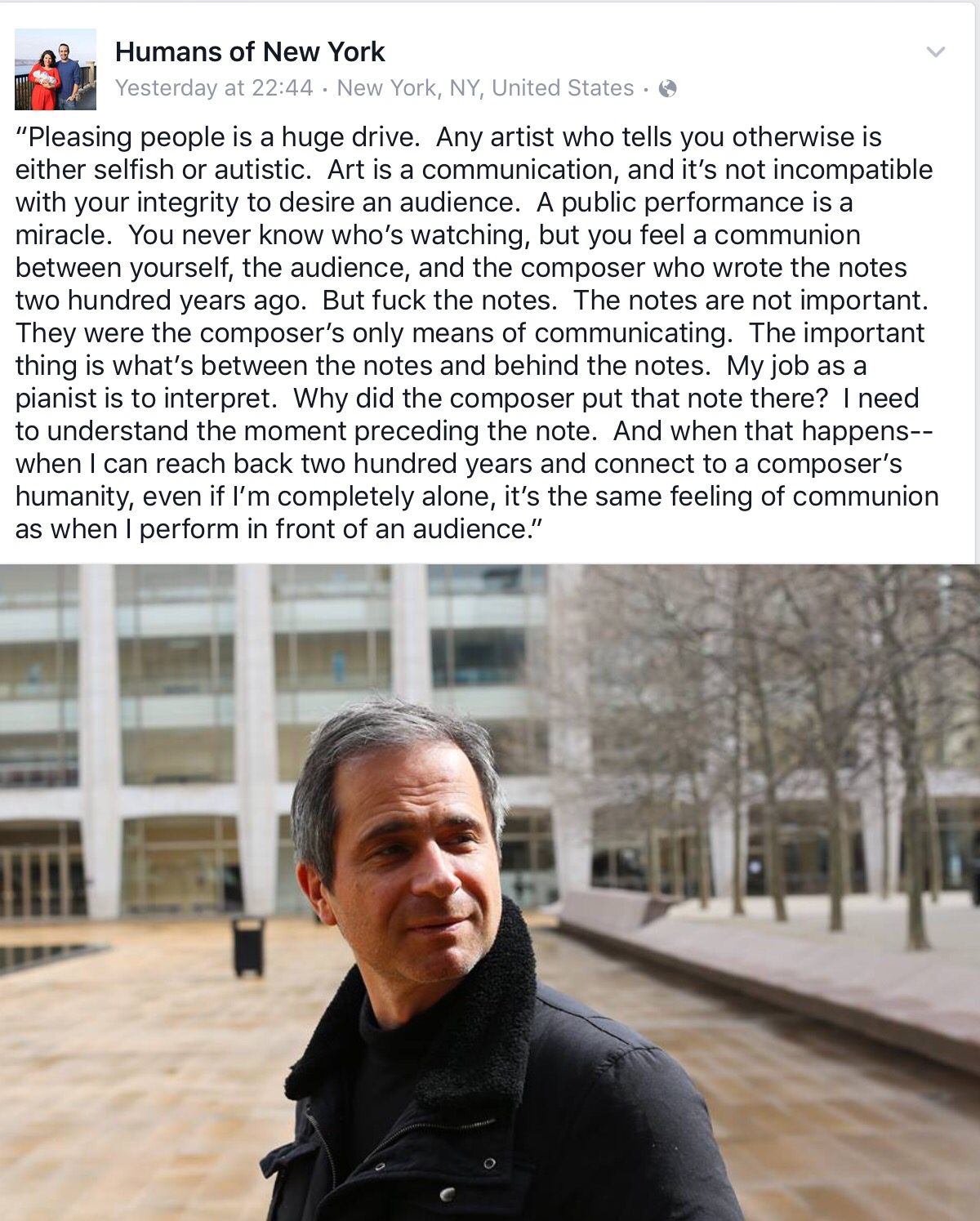
Polish-Hungarian pianist Piotr Anderszewski was photographed and interviewed by Humans of New York, a blog (and bestselling book) featuring portraits and interviews collected on the streets of New York City. Founded in November 2010 by photographer Brandon Stanton, the blog has a huge following via social media.
Piotr Anderszewski, a pianist I much admire in particular for his sensitive and thoughtful approach to the keyboard music of J S Bach, is a famously perfectionist and selective about the music he plays. By his own admission, he “cannot play just anything” and chooses to perform only those composers he feels a strong urge to play. By the standards of most pianists active today his repertoire is regarded as “narrow”, but it is this limited focus which results in playing which is both fastidious (without fussiness) and spontaneous, and such spontaneity is clearly the result of a long association with the music coupled with a patient, thoughtful study of it. I was fortunate to meet Mr Anderszewski after his Wigmore Hall concert in February 2016: he was quietly-spoken and modest in accepting glowing praise for his playing. During the green room conversation, he mentioned taking a sabbatical in order to study some new repertoire and that he might soon be “getting to know” Schubert better, something I look forward to with great interest when he returns to the concert platform.
Speaking to Humans of New York, Anderszewski offers insights into the life of the concert pianist, performing and his approach to interpretation and communication with his audiences.
Keys….. The word “keys” has a dual meaning for pianists as it refers to both the keys of the piano, which we touch to set in motion a mechanism which produces the sound, and the musical keys (C major, D minor etc).
The modern piano has 88 keys – 52 white keys and 36 black keys for a total of 88 keys. Many older pianos only have 85 keys and some piano manufacturers extend the range further in one or both directions (the Bosendorfer ‘225’ and ‘290 Imperial’ models, for example, have 92 and 95 keys respectively). Today keys are usually made of spruce or basswood (spruce is typically used in high-quality pianos). Black keys were traditionally made of ebony, and the white keys were covered with strips of ivory, but during the 1950s makers such as Steinway decided to cease using ivory on financial and moral grounds. Now that elephants and other ivory-yielding species are designated as endangered and protected by treaty, piano makers use plastics almost exclusively (“legal ivory” can still be obtained in very limited quantities). Also, ivory tends to chip more easily than plastic. The Yamaha piano company invented a plastic called Ivorite, that they claim mimics the look and feel of ivory. This has been taken up by other piano manufacturers.
The key is the point of contact between the pianist’s fingers and the mechanism within the piano and a huge amount of information can be transmitted from key via the pad of the finger to the rest of the pianist’s body. This information is then rapidly processed to make decisions regarding arm weight, articulation, tone control…. all of which have a bearing on the type and quality of sound produced.
More about the mechanism (“action”) of the piano here
For many musicians, each musical key has distinct characteristics or “personality”(and I am sure I am not alone in having “favourite” keys). For some of us, A major is warm, D major is bright and cheerful (Mozart apparently described it as “the happiest key”), while C minor is dark and stormy and E minor is deeply serious and melancholy. Christian Shubart, a German poet, composer and organist, assigned specific characteristics to each key. (Read his descriptions here.) And for some of us, each key comes with its own distinctive colour as well as a personality – this form of synaesthesia is shared by certain musicians and composers, including Franz Liszt, Gyorgy Ligeti, Olivier Messiaen, Leonard Bernstein, Itzhak Perlman and Stevie Wonder, and also the author of this blog.
‘Steps’ is a large-scale cycle of music for solo piano by British composer Peter Seabourne (born 1960). Begun in 2001, it now runs to five volumes and is a project which the composer, by his own admission, anticipates running through his life, as a kind of “companion”. It is significant in Seabourne’s oeuvre not only for its scale, but because piano music was the medium which drew Seabourne back into composer after a 12-year silence. Volumes 2, 3, 4 and 5 are available on the Sheva label, and also on Spotify. The composer has also made scores available via his website.
The first volume of the cycle is entitled simply ‘Steps’, but subsequent volumes have subtitles which point to the compositional impulse for each collection – Studies of Invention (Vol 2), for example, are inspired by Leonardo da Vinci’s inventiveness and creative genius, and include works with titles such as ‘Flying Machines’, ‘Perspectives of Disappearance’ and ‘Lenses for Looking at the Moon’ (a haunting, luminous piece which utilises the piano’s resonance and is redolent of Arvo PArt’s piano music). Volume 3, Arabesques, is inspired by the Alhambra in Granada, Southern Spain, while the most recent volume, Sixteen Scenes Before a Crucifixion, takes the Passiontide paintings of Caravaggio as its starting point, though the music is not overtly religious. The composer describes the pieces as nearer to Preludes and “a pianist’s Winterreise”. The first volume is not intended as a cycle, but rather a collection of pieces in the manner of Grieg’s Lyric Pieces, for example, and the pieces display a wide range of technical challenges, so that some are playable by younger or less advanced pianists.
In terms of style, all the works in the volumes are extremely varied and idiosyncratic, with much rhythmic and melodic interest, often very lyrical though not necessarily “tuneful”. Seabourne employs a colourful and piquant harmonic palette which recalls Debussy, Janacek and Messiaen, while the rhythmic vitality of the music is akin to Prokofiev; indeed the brevity and aphoristic nature of the pieces aligns them with Prokofiev’s ‘Visions Fugitives’ and ‘Sarcasms’. The works are challenging, and probably best tackled by the advanced pianist who enjoys such technical challenges as varied time signatures, polyrhythms, myriad articulation, filigree textures and one with the requisite artistic sensitivity and imagination to bring musical colour and invention to the music. It is always gratifying to find new music for the piano, and Steps is undoubtedly an important addition to the repertoire and definitely worth seeking out.
Different pianists appear on the recordings of Steps (Giovanni Santini, Michael Bell, Fabio Menchetti and Alessandro Viale) and all display sensitivity to the material and the varied moods and characteristics of this music, together with clarity of tone and pristine articulation. Pianist Minjeong Shin from Korea will record ‘Steps’ Volume 1 this summer.
Peter Seabourne will feature in a future Meet the Artist interview
It’s easy to assume the singer is the star in classical song – just like with rock bands. I’ve stopped counting how many album covers feature an accompanist-shaped gap.
As a player-of-sorts – not to mention a lieder nut living too close to London’s Wigmore Hall for his wallet to ever completely relax – I’m turning the spotlight towards the piano stool.
Accompanists are indispensible specialists. There’s a huge repertoire to learn, or suddenly be required to learn. Schubert alone wrote some 600 lieder, with other masters of song – from A (er, Brahms) to Z (um, Wolf) – comfortably filling more modest, but still handsome, box-sets with their output.
Ian Bostridge & Julius Drake (photo: Sim Canetty-Clarke)
Of course, there’s a fair amount of other piano music. But song comes with a special set of daunting quirks. Solo, pianists forge their style unfettered. Accompanists must make their mark while supporting and complementing the other artist on stage. And (without getting into divo/a clichés) the link between the emotion channelled by a singer and the sound they produce is uniquely, biologically close, bringing that frisson of nuance and unpredictability the pianist must always be prepared for.
Some of the best-known and loved song – for example, Schubert’s great song cycles – also comes in different editions to suit various voice types. As certain keys will be more comfortable across the pieces than others, I’ve often admired the pianist’s mental strength when working up the songs in their more thorny positions – and then making sure they even bring the right music. Is there a recurring nightmare, like falling naked into your maths exam (or something), where, about to perform ‘Winterreise’ with a baritone, you launch into your version for high voice..?
Star soloists sometimes step onto the accompanist’s pedals. It can work – Mitsuko Uchida has been a superb foil for Dorothea Röschmann in Schumann and Berg – audible empathy, unwavering attentiveness – and a jolt of unwelcome shock at the rarity of seeing women in both roles. At other times… I once heard a great pianist bring so much of their robust energy to ‘Winterreise’, they partly ‘took over’, and you got the sense the two performers would reach the end of the GODDAMN. JOURNEY. IF. IT. KILLED. THEM.
Let’s not forget that accompanists have their own differences in approach. Of the two I hear most often, Malcolm Martineau’s liquid expressiveness – and ability to play to the audience as if also ‘in character’ – makes me slightly favour him in French song, while Julius Drake’s thrilling, vivid style especially electrifies German lieder (I note that MM features on series of Poulenc and Debussy CDs while JD is working through Liszt). Other personal favourites include the sensitive, intriguing playing of Anna Tilbrook, and the brilliantly versatile Joseph Middleton.
They are all professional chameleons, who can keep their own style while shaping the sound around any singer. When you next go to a recital, give at least one ear to the piano, and reap the rewards.
Adrian Ainsworth writes for a living, but mostly about things like finance, tax and benefits. For light relief, then, he covers his obsessions – overwhelmingly music, but with sprinklings of photography and art – on the ‘Specs’ blog, which you can find at http://www.adrianspecs.blogspot.co.uk
The Cross-Eyed Pianist is free to access and ad-free, and takes many hours every month to research, write, and maintain.
If you find joy and value in what I do, please consider making a donation to support the continuance of the site


 Keys….. The word “keys” has a dual meaning for pianists as it refers to both the keys of the piano, which we touch to set in motion a mechanism which produces the sound, and the musical keys (C major, D minor etc).





 The Cross-Eyed Pianist