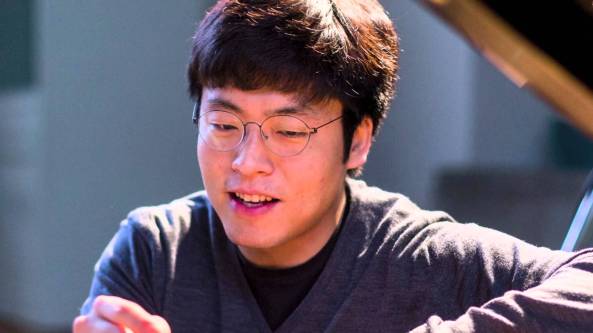
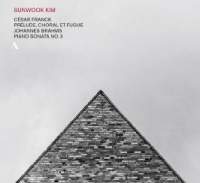
Korean pianist Sunwook Kim (born 1988) came to international prominence in 2006 when he won the Leeds International Piano Competition at the age of 18. Since then he has spent much time giving concerts and exploring repertoire, developing his own style, sound and ideas about the music he plays. By his own admission, he has now arrived at a point in his career and development as an artist where he feels ready to demonstrate “a more romantic, dramatic and yet refined pianism”. In doing so, his new CD, on the Accentus label, brings together two of his favourite works – Cesar Franck’s Prelude, Choral et Fugue and Johannes Brahms’ Piano Sonata No. 3 in F minor. It is an unusual pairing, which reflects Sunwook’s interesting in programming, and in it he aims to show the link between the two composers, despite their stylistic differences: here are two composers, both pianists, who paid a special hommage to the music of the past. Both revered the spirit of Classicism and Bachian polyphony, as well as a love of proportion and well-ordered architectural structures within music. Thus, on this disc two great musical edifices are placed side by side, and the result is magisterial.
The Prelude, Choral et Fugue is the work of a composer at the height of his powers. Composed 1884, the work displays cyclic and thematic relationships, particularly in the recall of the Prelude and Choral in the Fugue, and the tripartite structure, probably inspired by Bach’s BWV 564, lends considerable weight and emotional power to the work. Franck was also an organist, and Sunwook Kim is sensitive to the full-bodied textures which recall the sonorities of the organ, while never comprising on clarity of tone and articulation. The work unfolds with a darkly dramatic grandeur, growing progressively more intense as the music approaches its denouement in the final passages of the Fugue. Such is Sunwook’s skilled sense of pacing that the opening Prelude in particular has the spontaneity and improvisatory qualities one expects to find in similar works by Bach. By the time we reach the central Choral, with its rich broken chords which recur throughout the piece and link the three sections, the music’s message and monumental architecture is driven home authoritatively, all handled with consummate skill and dramatic tension by Sunwook.
In contrast Piano Sonata No. 3 is a young man’s work, composed in 1853 when Brahms was just twenty. It was inspired by Beethoven and Schubert, and like the Prelude, Choral and Fugue, the five individual movements are linked with each other through subtle unifying themes. Sunwook displays sensitivity to the architecture of the music, building and emphasising structure through intelligently-paced climaxes, but just as in the Franck, there’s spontaneity too, particularly in the grander gestures. In contrast, the second movement is played with an unassuming and tender lyricism. The third movement begins with virtuoso panache, all dancing dotted rhythms, before the music moves into a hymn-like middle section. Again, the contrasting moods and textures are adeptly handled. The fourth movement opens like an intermezzo, intimate and expressive, but the serenity is quickly disturbed by an ominous low motif in the bass. The finale has everything in it – a jaunty main theme, sweeping lyrical melody, stately marches, a fugue, and moments of real pianistic bravura and high-octane energy. Sunwook’s crisp articulation and awareness of Brahms’ shifting moods, structures and soundscapes makes this a rewarding and absorbing performance. The recording has a bright yet warm clarity, the acoustic of the Jesus-Christus-Kirche, Berlin ideal for this music. The CD comes with comprehensive notes, including an introduction to the pieces by the pianist himself.
Sunwook Kim, piano
César Franck
Prélude, Choral et Fugue Johannes Brahms
Piano Sonata No. 3 in F minor, op. 5
Who or what inspired you to take up the piano, and pursue a career in music
I was born into a musical family. My father Ernst (a tenor) was the preeminent Evangelist (in the Bach Passions) of his time and also a wonderful Liedersinger.
Under these circumstances it is difficult to describe when the passion for music arose. It was simply always there and, maybe as the smell of leather permeates the childhood of the son of a shoemaker, the smell of music permeated mine.
My mother talked about me always being drawn to the piano – at three years of age I would walk over and start playing, my arms reaching up to the keyboard.
The conscious decision to pursue the career was thus more like an acceptance of the inevitable.
Who or what have been the most important influences on your musical career and life?
Again I must start with the earliest and biggest influence – my father.
From the earliest age I was immersed into going to operas, oratorios and lieder recitals. Wonderful musicians like Karl Richter, Erich Werba, Dietrich Fischer-Dieskau came to our house to make music and as soon as I was able to I had to accompany for pupils who came to the house for lessons. What better training could a child wish for.
In early adulthood my dreamy childhood fantasies were quickly adjusted to the reality of music-making through my studies at the Mozarteum in Salzburg with Hans Leygraf and then through my Juilliard studies with Herbert Stessin and the iconic William Masselos.
At age 17 the towering presence of Alfred Brendel came into my life and studies and dialogue continued for many years for which I am thankful to this day.
What have been the greatest challenges to your career so far?
The pianist’s life is one of constant growth.
As an interpreter you have to find just the right mix of ego and humility and this requires tremendous investment not just in the art of music, but also in the growth as a human being. Therefore challenges are omnipresent in your daily life as you walk through this growth.
Which performances/recordings are you most proud of?
I am still very pleased with my early recordings of Mozart, Schumann and Gubaidulina for Sony. Later I challenged myself with the Perspectives Recordings of which the Beethoven op 106 was a milestone of sorts. The human growth I talked about in the last question is audible however in the last recording of Schumann Fantasy and op 109- so may be I could say this one is the one that has reached an intermediate goal. My public perfomances have always been mirrored by the CDs so therefore I am also at a new level of expression in this medium.
Which particular works do you think you play best?
I do believe that my talent lies mostly in the interpretation of the central european repertoire. I also very much however enjoy commissioning new music from all over the world.
How do you make your repertoire choices from season to season?
I am a strong believer in the importance of programming. The piano recital offers to the pianist an opportunity to combine pieces and lead the audience from work to work much as a curator would in a museum. In the past six seasons I have made the Beethoven Piano Sonatas the central part of this exhibition and I combine them with works that intuitively or intellectually share or juxtapose ideas, keys or moods.
Do you have a favorite concert venue to perform in?
I love the famous halls in this world- each one has something particular and stunning to offer. All share the component of facilitating densely concentrated moments in time, thus making the creation of great art possible.
I also sense however that there will be evermore a branching away from these platforms of high culture and that music in less formal settings will become more and more popular. In the best circumstances this can aid the art form tremendously as it will create an atmosphere of accessibility without watering down the content.
Favourite pieces to perform?Listen to?
I always enjoy the pieces that I am working on at the moment. In listening I like to be surprised by repertoire I don’t know.
Who are your favorite musicians?
Edwin Fischer, Wilhelm Kempf, Bruno Walter
Edwin Fischer once said that the perfect interpretation is to enliven a work without violating it. These three performers all shared this ability.
What is your most memorable concert experience
May be in an odd turnaround from my previous answer this still remains Leonard Bernstein with New York Philharmonic performing Mahler 2nd symphony. A wildly involved performance that was stirring to attend- oddly I am much less fond of the recording of this very concert.
What do you consider the most important ideas and concepts to impart to aspiring musicians?
Where does work begin and inspiration end?
We find ourselves in a very strange profession. Ultimately we are the flag bearers of a great achievement of human civilization. Ideally we go on stage in front of thousands of other human beings and transport them to never before experienced emotional heights. Years of study in matters both musical and philosophical have brought us to the point where we find ourselves capable of presenting phrases with such intensity and knowledge that they reach the listeners ear without distraction. Great art is made.
At the same time we live in an age of crippling competition and ability. Worldwide travel and immediate availability are a matter of course in a world where the other one will go and play if you don’t. Quick fix artistry is rampant in a selfie culture that looks to propagate the own achievement through any means possible. The music world is a confusing place.
At some point the student today has to make a decision to involve herself in the slow process of musical growth. At the same time modern aspects of musical performance cannot be ignored but must be incorporated in order for artistic intensity to be realized.
The young student must address this dichotomy early on in order to be able to successfully navigate the art form.
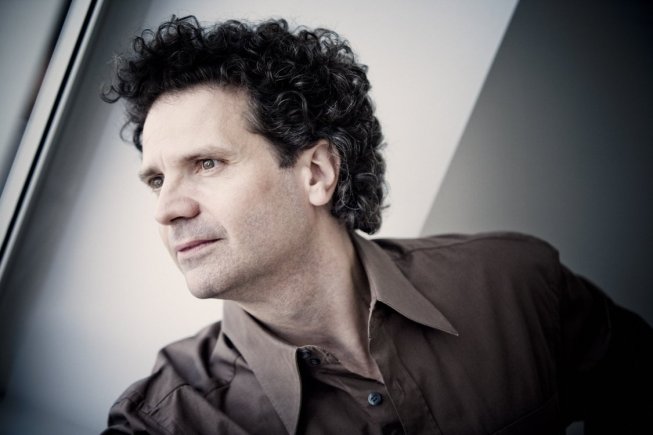
Coming from a rich tradition, the pianist Andreas Haefliger is: “consummately lyrical. Exhibitionism and pretence are antithetical to his musical personality”; he has “a vision of musical architecture second to none and a tender, profoundly cultivated sensibility, from which music flows unimpeded” ( International record review, September 2014). He has won many plaudits for his Beethoven Perspectivesrecitals on disc (Avie) and at major halls and festivals. He is also much sought-after as a chamber musician – past highlights include Mostly Mozart New York with the Takacs Quartet, and Salzburg Festival with Mathias Goerne. In 2014 he gave the premiere at the BBC Proms of a new concerto written for him by Chinese-American composer Zhou Long.
Haefliger was born into a distinguished Swiss musical family and grew up in Germany, going on to study at the Juilliard School in New York. He was quickly recognised as a pianist of the first rank, and engagements with major US orchestras followed swiftly – the New York Philharmonic, Cleveland Orchestra, Los Angeles Philharmonic, Boston Symphony, Pittsburgh, Chicago and the San Francisco Symphony Orchestras among them. In his native Europe too, Haefliger was invited to the great orchestras and festivals – such as the Royal Concertgebouw, Rotterdam Philharmonic, Munich Philharmonic, Budapest Festival Orchestra, Deutsche Symphonie-Orchester Berlin, Orchestre de Paris, London Symphony Orchestra and Vienna Symphony. He also established himself as a superb recitalist, making his New York debut in 1988, and has since performed regularly at major venues in Europe such as the Lucerne, Salzburg and Edinburgh Festivals and the Vienna Konzerthaus, as well as at major halls across North America and Asia.
Haefliger is a regular visitor to London’s Wigmore Hall, where he appears in December 2015 for the next instalment of his Perspectives series, in which he performs the complete piano works of Beethoven alongside works by other composers from Mozart to Ligeti. This series has formed the focus of Haefliger’s solo recital appearances and CD recordings in recent years. His latest chamber music project gathers friends Benjamin Schmid and Karen Gomyo (violins), Lise Berthaud (viola) and Christian Poltera (cello) for intensive rehearsal periods and concerts every year at the Louisiana Museum in Copenhagen, which the group will then take further afield. In spring 2016 he performs with his wife, the distinguished flautist Marina Piccinini, on an extensive tour of the USA.
The acclaimed Norwegian pianist Leif Ove Andsnes organised a mini-series of three concerts featuring music by his countrymen to coincide with an exhibition of the work of Norwegian artist Nikolai Astrup (1880 – 1928), the first ever outside of Norway. It is a mark of how important this artist is in the cultural landscape of Norway that Andsnes came to the leafy suburbs of south-east London to present these concerts, which amply proved, in the words of Dulwich Picture Gallery’s director Ian Dejardin, “there is more to Norwegian music than Grieg”. In addition to exploring the music, visitors were invited to view the exhibition of Nikolai Astrup’s colourful and expressive paintings, prints and woodcuts.
Nikolai Astrup Midsummer Eve Bonfire, SBF/DNB/The Astrup Collection/KODE Art Museums of Bergen (photo: Stuart Leech)
Music was important to Astrup. He grew up in Jølster in the region of Sogn og Fjordane, a landscape of scattered farms around a scenic lake, surrounded by high mountains. With no towns or large hubs nearby, access to classical music was minimal and the music that was most accessible to Astrup as he was growing up was Norwegian folk music, in particular the type played on the Hardanger fiddle. Dancers and fiddle-players appear frequently in Astrup’s ‘Midsummer Bonfires’ paintings, and references to music and musicians feature in many of his other paintings, along with the landscape of the area of Norway he knew well. Thus the programmes for the three concerts at Dulwich Picture Gallery revolved around the theme of Norwegian folk music and its influence on composers who succeeded Grieg. The music was selected to reflect the themes and beauty of Astrup’s paintings.
andthe world premiere of a new work by Paul Mealor
29 April – 2 May 2016
The Wales International Piano Festival will be held from 29 April – 2 May 2016 at Galeri, the iconic arts centre in Caernarfon. This year’s festival has a new Director, pianist Iwan Llewelyn-Jones and is the third festival to be presented by Canolfan Gerdd William Mathias (CGWM/The William Mathias Music Centre). The festival comprises concerts, competitions, masterclasses, workshops, lectures and interviews with guest artists.
Peter Donohoe, acclaimed international pianist, opens the festival on Friday 29 April at 7.45pm in a recital of works by Ravel, Debussy, Scriabin and Rachmaninov. A former winner and recent jury member of the Tchaikovsky International Piano Competition, Peter Donohoe will chair the Jury for the Senior Solo Piano Competition.
The first of three piano competitions begins on the morning of Saturday 30 April with the preliminary stage of the Junior Solo Piano Competition; the final round takes place on the afternoon of Sunday 1 May. The Senior Solo and Piano Accompanist Competitions begin on the morning of Sunday 1 May (preliminary rounds) with the public finals on the afternoon of Monday 2 May. Participants come from all over the UK and abroad.
At lunchtime on Saturday 30 April, there will be a concert entitled ‘Satie on the Sidewalk’, celebrating the music of Erik Satie.
The evening concert on the 30 April at 7.45pm showcases the versatility of Welsh music and musicians, featuring six world premieres of specially commissioned short works for solo piano, inspired by images and words on the theme of ‘Peace and Remembrance’. Three works are by young, upcoming composers and three by renowned composers of international standing: Paul Mealor, well known for his anthem for the marriage of The Duke and Duchess of Cambridge; Richard Baker, noted for his orchestral and chamber music, and Owain Llwyd who is at the cutting edge of film and media composition. The young composers are Luke Lewis, Mared Emlyn and Maja Palser.
The Festival Education Project reaches its climax in this Saturday evening concert with the premiere performance of a new work for chamber ensemble by four young A-level students. This three-movement composition with accompanying fanfares will be performed by instrumentalists from CGWM.
On Sunday 1 May at 7.45 it’s ‘Fiesta’ mode when the piano take centre stage to raise the roof with other instrumentalists, singers and narrators in a concert of music from across the globe including Lambert’s Rio Grande, Poulenc’s delightful setting of Babar the Elephant and Milhaud’s Scaramouche. The programme features five pianists, including Festival Director Iwan Llewelyn-Jones, and the CGWM Chamber Choir.
On the final morning, Monday 2 May, two fun events will be held in Galeri’s atrium: ‘Coffee and Croissants with Chopin and Debussy’ at 10.00am and at midday, the ‘Pianothon’, where pianists of all ages and abilities have an opportunity to tinkle the ivories.
Festival commissions (first performances on Saturday 30th April) have been supported by the PRS for Music Foundation and the Ralph Vaughan Williams Trust.
Funding for the main prizes in the competitions:
Senior Solo Competition donated by Roberts of Port Dinorwic
Accompanists Competition donated by the Sickle Foundation
Junior Solo Competition donated by the Piano Tutors of Canolfan Gerdd William Mathias (funds raised from a public concert).
The Cross-Eyed Pianist is free to access and ad-free, and takes many hours every month to research, write, and maintain.
If you find joy and value in what I do, please consider making a donation to support the continuance of the site






 The Cross-Eyed Pianist