du2bpre2bwigmore2bhall Another concert programme, another artist biography comprising a dry list of eminent teachers and mentors, concert halls performed in, orchestras and conductors worked with, recordings made and “forthcoming engagements include”. All standard information: exchange the names and the impersonal text could be used for any international virtuoso.

Wouldn’t it be refreshing, once in a while, to read an artist’s biography which was less a list of achievements and name-dropping, and more about the personality behind the dry words and the professional photograph? To discover more about that person’s musical influences, their likes and dislikes, what music excites them and why, and what makes them tick as a musician? Details that may not be found on the artist’s website and which might bring the musicians closer to their audiences. In reality, most artist biographies tell us very little about the musician or musicians we are about to hear in concert and seem only to serve the requirements of their agents and managers.

Some artists and the writers of their biographies have attempted to go beyond the dull list of activities, resulting in some interesting vocabulary and very purple or simply incomprehensible prose, especially when taken out of context:

“a re-balancing of the artistic equation”

“she breathes the oxygen of imagination and finds balance in musing”

The second quote is from a young female pianist’s biography, penned for her by a French journalist. The complete biography is an interesting read: breathless, adoring, gushing, almost embarrassing in its attempt to sound poetic, and very far removed from the standard artist biography. On one level, it is quite wonderful.

But the more cynical or ungenerous reader or fellow musician might read such hyperbole and suspect that the artist in question is trying to cover up for mediocrity (in fact not an issue for the above-mentioned artist). And then there are those people who describe playing at prestigious venues such as Carnegie Hall or the Leipzig Gewandhaus without mentioning that both venues have smaller recital rooms, or that you have “participated” in a masterclass with this or that renowned international artist when in fact you were sitting in the back row at the Royal College of Music. Unfortunately, in the uber-competitive sphere of classical music, mentioning that you played a coffee concert in the Weill Recital Room to a handful of pensioners is not going to have promoters rushing to your door and therefore such economy of truth is essential in our image-driven world: most of us are guilty of these little white lies in our biographies.

The popularity of the Meet the Artist interview series, which has been running on this blog for 4 years now, confirms that concert goers and readers have a great curiosity about what goes on behind the public persona of a musician or composer. There is, I find, a continual interest in the working lives of creative people – by which I mean what motivates and inspires them to do what they do – and I’m sure that most concert goers would enjoy reading something more like a Meet the Artist interview than a tedious list of international concert venues and renowned conductors.

Of course, it is important to have a comprehensive biography or CV on one’s own or one’s agent’s website for the benefit of prospective promoters and concert managers, but surely it is possible to deliver this information in a style and manner which is both engaging and informative? And at a time when “audience engagement” is at the forefront of the minds of concert organisers, venue managers and musicians themselves, it seems sensible to offer a biography that audiences might actually want to read (and don’t forget that in major venues one can expect to pay upwards of £4 for a programme which often seems more about advertising than the music we are about to hear).

9 classical musician bios that aren’t terrible

Artist Biography Generator

anna-tcybuleva

Who or what inspired you to take up the piano and pursue a career in music? 

I spent my childhood in a small scientific town in the south of Russia. I grew up in a creative family. My father is a radio physicist, my mother was a musician. She opened this fantastic world of music and art for me. She graduated from the College of Music as a pianist and also studied in Imperial Academy of Arts in St. Petersburg as an art historian. We had a lot of books about music and art at home. While I was a child my mother often played for me, or showed gramophone records of great musicians. When I was 6, my mother became my first piano teacher. Aside from that, I studied violin, but after two years I made the decision to play only the piano.

I remember one important moment in my life. I was 10 and I prepared for my first serious competition for young pianist in Moscow. At that time I already lived without parents, studied with another teacher in a town of Volgodonsk (approx. 700 km from my home). My mother also came to Moscow to support me. But everything was so difficult… I missed home, my parents missed me. My new teacher was very strict with me, forced me to practise more and more. When my mom saw how difficult the life of her 10-years-old daughter already was, she told me: “Let’s give up music and go back home?” To which I answered: “No, mommy, it is too late to go back”.

From that moment I never doubted that I was on the right way, and my mom always supported me.

Who or what were the most important influences on your musical life and career? 

For me there is no difference between musical and real life. Everything that happens to me affects my outlook. In other words, I learn from everything. My parents taught me to be always honest and analyze what is happening. I learn from my dear teachers, who are also teaching me to be honest and to listen to the sounds. They are the same important people for me as parents. By the way, my mountain skiing and swimming instructors taught me to be strong and always keep working, no matter what.

When I take the music scores, read them and play, I learn from composers. Some of them have greatly influenced me and my views. When I listen to great musicians, I get inspiration from their way of expression, but never try to copy them.

Life influences me every day and gives the most important lessons. And the music helps me to understand and express them.

What have been the greatest challenges of your career so far? 

There are a lot of creative challenges in the life of a musician: for example, to play something, what you wanted to play before, but weren’t ready for; how to analyze and understand, how to unite the form of the piece in your mind. Sometimes this kind of problem interrupt my sleep. But for me, the more harder the challenge is, the more interesting it is. I will never stop searching for new musical challenges.

Which performance/recordings are you most proud of?

It is very difficult for me to be satisfied with my playing. Every time after my performance I know how to make the piece better.

It is too early for me to be proud of something, which I played. The big and interesting endless searching is ahead. I hope I will be able to reach something genuine in the future. But I will start thinking about it no earlier than in 60 years.

Which particular works do you think you perform best? 

The works which I love with all my heart I play well. If I open the score and don’t like the piece, it means that I didn’t looked at the score attentively. Then I try to find more interesting details (there are always a lot). I discover something new for me in the piece and attempt to better understand the intent of the composer. Step by step, I fall in love with the work and then I play the piece, which I love!

How do you make your repertoire choices from season to season? 

The choice of repertoire is a very serious thing. Sometimes I spend weeks choosing the programme for a concert. I often seek advice from my teachers who have more experience than me. We discuss each programme and decide together.

Do you have a favourite concert venue to perform in and why? 

When I go to the stage, I get into a special private space, where I can imagine around me whatever  I want (big or small hall, empty or full audience and etc). There is no favourite concert venue for me. My feelings don’t depend on the external situation. I try not think about it while I’m on the stage.

Favourite pieces to perform? Listen to? 

I happy to play any kind of solo, chamber and orchestral music.

And I love to listen any musical genre in general.

What do you consider to be the most important ideas and concepts to impart to aspiring musicians?

The main thing in music for me is to listen and hear.

Where would you like to be in 10 years’ time? 

At home with my family, in front of a keyboard with scores and a pencil.

What is your idea of perfect happiness? 

Fortunately, I don’t know yet. When the time comes and if I have a chance, I ask one man, who definitely knows about that.

What is your most treasured possession? 

Health and happiness of my family.

Anna Tsybuleva was born in 1990 and started piano studies at the age of six. Anna is currently a post-graduate student at the Moscow Conservatory, while also studying at the Basel Music Academy with professor Claudio Martinez Mehner.

In 2012, Anna took part in the International Gilels Piano competition in Odessa (Ukraine), where she has won the 1st prize. The same year Anna was one of the winners of the prestigious Hamamatsu Piano competition (Hamamatsu, Japan).

Anna has performed at a number of international music festivals in Russia, the United States, Europe and Japan.

In June 2015, Anna Tsybuleva won 1st Prize at the prestigious Leeds International Piano Competition in the United-Kingdom, leading to many important invitations to perform in the UK and internationally.


qsmolzomdsqg96-gyfbfopjs_w7_lgtb2l2kftvgoy57udwjhdrjmda-asj4rjglizp2gouoe-8w599-h795-no

Who or what inspired you to take up the violin and pursue a career in music? 

To be honest there was no great epiphany or moment of inspiration, it just always felt like I was meant to be making music – exactly how and in what form is still wonderfully open … tomorrow is a new day and will bring with it new inspiration.

Who or what were the most important influences on your musical life and career? 

Everything and everyone we encounter seeps into our being and becomes a part of our fabric, not least musical. When we give a name to the ‘most important’ influences there is always the danger that we forget the ‘very minor influences’, whose accumulation pave the indispensable road. Having said this, there are two remarkably special people who have shaped my playing and my life, and to whom I am eternally grateful: my mentor and teacher Nina Balabina and – on a more ethereal plane – Mahatma Gandhi.

What have been the greatest challenges of your career so far? 

Not to pursue one.

Which performance/recordings are you most proud of?  

Life has taught me not to look back but rather, in the spirit of forgetfulness, learn to live in the present, so I hope you do not mind if I pass on this question.

Which particular works do you think you perform best? 

More than anything I feel at home performing contemporary music or music from the last century, often in unusual and improvisatory combinations with older music.

How do you make your repertoire choices from season to season? 

I love having a large variety of works during a season both in style and genre. I try and create a balance between works I have played many times and into which I can delve deeper; new repertoire pieces; newly commissioned works; and finally works that will challenge different aspects of my playing and musical personality and which will hopefully open me up to new musical spaces.

Do you have a favourite concert venue to perform in and why?

For me it is more than anything the energy of the audience that makes a concert special. Therefore I love performing in any space that encourages a bubbling sharing of energies. Then, there are of course the ‘great’ halls that have their unique aura, filled with the sounds of past legends – it is a great privilege to be able to stand and add ones own little sounds to such spaces.

Favourite pieces to perform? Listen to? 

My tastes are rather eclectic and vary from day to day, from season to season. Some days I love the melancholic strains of Byrd and Josquin, on other days the romantic drama of Strauss, while Bach is always close at hand to cleanse the soul. I may also get immersed in the epic melodrama of Muse or the contemplative strains of Indian music.

Who are your favourite musicians?

Oh dear, this could be a very long list! Two personalities that immediately come to mind our David Oistrakh and Ravi Shankar.

What is your most memorable concert experience? 

Playing to monks in the Himalayas.

What do you consider to be the most important ideas and concepts to impart to aspiring musicians? 

Always LOVE every minute of what you are doing and learn to totally immerse yourself in the process, not worrying too much about where it will lead and what the resulting outcome will be.

What is your idea of perfect happiness? 

I experience perfect happiness when I get so lost in what I am doing, which happens most often when I am performing, that all time – past and future – seems to converge on the singularity of the present moment, bringing with it a surreal combination of overwhelming peace and the feeling of ecstasy.

Hugo Ticciati performs with Dame Evelyn Glennie at Kings Place on 27th April, and directs the Festival O/MODERNT in Stockholm from 10th to 16th June, centred on Handel and the Art of Borrowing. 

Festival O/MODERNT

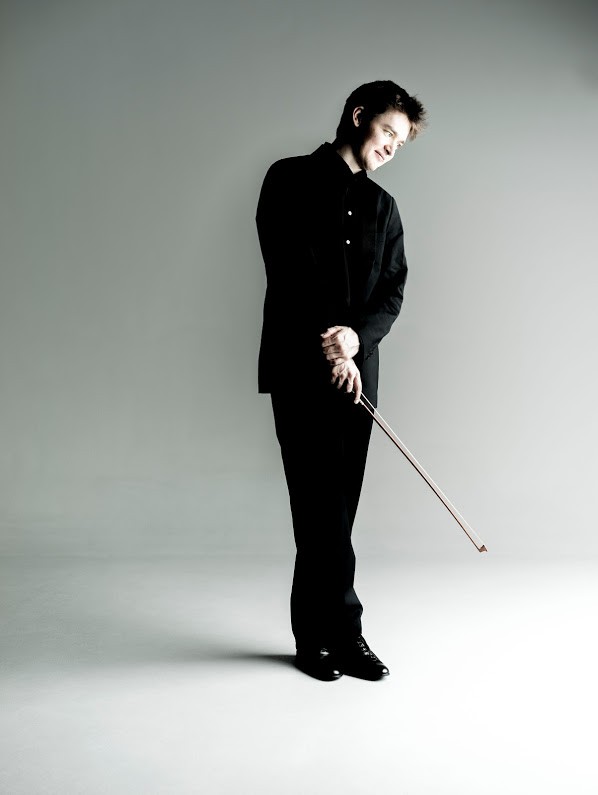
Hugo Ticciati is a violinist with a uniquely intellectual approach to his work, incorporating aspects of literature, philosophy, spirituality and meditation. He embraces the world of contemporary music, collaborating with composers such as Sven-David Sandström, Albert Schnelzer, Anders Hillborg, Djuro Zivkovic, Leonardo Coral, Andrea Tarrodi, Tobias Broström, Thomas Jennefelt, Sergey N. Evtushenko, Esaias Järnegard, Wijnand van Klaveren. In the coming seasons he will be performing world premières of concertos dedicated to him in Europe, Asia, and North and South America. Hugo also loves devising concerts and events that combine music with dance, literature and more obscure arts such as kinetic painting and rock balancing.

Last season’s highlights included concertos by Bach, Mozart, Prokofiev, Schnittke, Hartmann, Shchedrin, Piazzolla, Auerbach, Glass, Lutosławski, Takemitsu and world premieres of concertos by Tobias Broström, Sergey N. Evtushenko and Albert Schnelzer in venues including Carnegie Hall, Mariinsky Theatre Concert Hall, Chicago Symphony Hall and King’s Place. He also curated a series of concerts at the Wigmore Hall and the Muziekgebouw aan ‘t IJ, Amsterdam.

Read more about Hugo Ticciati

(Photo credit: Marco Borggreve)

Last weekend I ran a masterclass for members of the Hitchin Piano Club who are taught by a teaching friend of mine. It was the first time I’d taught adults in this format and I found the experience hugely enjoyable and stimulating – and I think the participants did too. In addition to one-to-one coaching while the others observed, we covered warm up exercises away from the piano, managing performance anxiety and finished the day with a listening game in which participants were asked to try to identify nationality, period and style of a selection of pieces chosen from Spotify. The day ended with me giving my friend a brief lesson, which was interesting for both of us and an important test of mutual respect and trust.

The commonest issue with adult amateur pianists tends to be performance anxiety – by which I don’t mean the fear of playing in an actual concert, but simply playing in front of other people. This anxiety has its roots in a number of places, including negative musical experiences in childhood and the simple, and entirely understandable, fear of making mistakes and feeling a fool in front of one’s peers. Whenever I discuss performance anxiety with any student, I stress that such feelings of anxiety are normal, natural and common – even amongst top-class professional musicians. Until fairly recently, performance anxiety – like injury – was not discussed amongst professionals. It was considered taboo to mention it for fear of admitting to a weakness, but recent projects such as Charlotte Tomlinson’s Beyond Stage Fright and interviews with leading musicians who have revealed their own anxieties and how they deal with them, has led to greater openness. Personally, I find a state of acceptance about the symptoms of performance anxiety, coupled with solid preparation of one’s music, can lead to greater confidence in performance, whether this involves playing in someone’s living room on a Sunday afternoon, as at our Piano Day, or in a formal concert.

The participants in Sunday’s piano day had not been taught in a masterclass format before and I tried to ensure that even while I was giving individual coaching, everyone found something useful in what I was saying and doing with the other student. In fact, the masterclass format can be one of the most useful and inspiring ways of being taught – one can learn a great deal by listening and observing, and I encouraged the others to comment on one another’s playing, including differences in sound and touch. We covered a number of technical aspects, such as rotary motion and lateral arm movement to help certain players release tension in their hands and arms, and to help them achieve the kind of sound they envisaged.

My main aim when teaching is to help students to achieve the sound and emotional content they desire in their music and to enable them to play with colour, expression and confidence. To achieve this, I use visualisation techniques in my teaching, asking students to explain what they like about the music they are playing, to describe the character of the music and ascribe a narrative or mental picture to it to help them create a vivid portrayal in their playing. Technique, such as a cantabile legato or particular type of staccato, gives us the tools to create timbre, mood and emotional impact in music, and technique must always be seen as something with a clear musical purpose. Combine solid technique with imagination and the rather elusive “artistic vision”, and one can create wonderful music, and play with confidence and authority.

It was a thoroughly enjoyable and very stimulating day and a pleasure to work with a group of such engaged and receptive students.

Repertoire played:

Mozart – Fantasy in D minor, K.397

Philip Glass – Metamorphosis 3

Beethoven – Sonata in F minor, Opus 2, No. 2 & Sonata in D, Opus 10, No. 3


Further reading

Masterclasses without tears

More than hobbyists – the world of amateur pianism


