“The music is not in the notes, but in the silence between.”
This quote from Mozart seems particularly apt for Steven Osborne’s concert at Milton Court which featured music by Morton Feldman and George Crumb, two radical American composers with a special interest in exploring the piano’s expressive qualities as much through the spaces between the notes as in the notes themselves. Eschewing melody as the main vehicle for expression in their music, both Feldman and Crumb offer the listener a special soundworld infused with simplicity and stillness. Osborne’s interest in stillness in music combined with his ability to produce magical kaleidoscopic shadings, as evidenced by his very fine performances and recording of Messiaen’s Vingt Regards surl’enfantJèsus, make him the perfect performer for this programme.
(Photo Benjamin Ealovega)
Silence in music, any music, is very important. Pauses and silences provide “punctuation marks” and create ebb and flow, just as in speech. Silences also create drama and set up expectations in the minds of the listener, while stillness and quietness in music allow the listener to be drawn in to create a special, sometimes very intense connection with the performer. In the pre-concert talk, Osborne talked of how, as a child, he liked to experiment at the piano to see how quietly he could play, fascinated by the tactile experience of producing very soft sounds. He described how the simplicity and stillness of Feldman’s music in particular – music which is sometimes merely a handful of notes or a few carefully chosen chords with no clear narrative nor organic development – allows the listener to engage with the music “in the moment”, with a mindfulness akin to meditation without the need to conceptualise nor admire it as an “art-object”.
Who or what inspired you to take up composing, and pursue a career in music?
My musical life began as a chorister at the Anglican Cathedral in Liverpool in 1977 when I was nine, but singing had already been a part of my life (winning local music festivals for solo singing), which is the reason I went to audition at the Cathedral. After joining I was given piano lessons and other basic theoretical training. From about the age of ten, I was composing a number of things which further supported my initial forays into composition; primarily the unwavering support of my mother and grandmother who purchased a piano and reams of manuscript paper. Various BBC programmes on music at the time engaged me; my parents mentioned a James Blades programme on percussion that I was enthralled by before I want to the Cathedral and I subsequently took up percussion alongside piano. I also fondly remember the Stravinsky centenary programmes on BBC 2 in 1982. The support of the organist at Liverpool Cathedral, Ian Tracey, a lovely piano teacher, Dorothy Hill, who was also an opera fanatic who would invite me to accompany her to Opera North seasons in Liverpool for a number of years. Singing high quality choral music of the Italian renaissance, English Tudor and even 20th century periods, all of these cemented my need to live in music.
Who or what were the most significant influences on your musical life and career as a composer?
It dawned on me about 10 years ago that one reason much of my work is saturated by activity against sustained resonances comes from my childhood memories of the acoustical properties of the Cathedral building. The sort of aural glow that is present in that building (and sometimes, musical confusion!) seeped into my head at an impressionable age and has remained ever since. The reverberation of a large acoustic space also suggests ambiguity, doubt and distance to me. Also, the nature of ritual and text, the rich, reflective nature of space and echo, all left their mark on me.
Music of the Franco-Russian period – orchestral music mostly – was important when I was a very young composer and remains a pleasure for me to this day. I was lucky from the age of 13 to have my orchestral work performed by the Merseyside Youth orchestra and Royal Liverpool Philharmonic. From 2007-2009 I was the RPS Composer in the House with the RLPO which felt like a full turn of the wheel and a wonderful homecoming. About the age of 12 I had composition lessons from composer Steven Pratt (I remember that mine would often follow Steve Martland’s lessons) and he challenged my rather safe musical horizons with works by Berg, Messiaen, Boulez, Hugh Wood (his teacher) and other repertoire I would not have come across myself at this time. Three composers followed who have had a profound influence on how I believe a composer should be, Edwin Roxburgh, Oliver Knussen and Henri Dutilleux – fastidious in work, with acute musical ears and generous in spirit and nature.
What have been the greatest challenges of your career so far?
Maintaining space – both physical and mental – to work, to stay on top of commissions, to teach and be an active and present father to my young son. The musical challenges have been to remain true to the real inner voice and how to express it as clearly as possible, which also has a direct impact on technical issues of notation and performer psychology.
What are the special challenges/pleasures of working on a commissioned piece?
The challenges may come from the terms of the commission, the constraints of the instrumental forces, the duration, the context which the new piece will find itself in (I’m not a fan of ‘themed’ or anniversary commissions but take them anyhow) and so on. The solving of these problems is also the pleasure of working on a commissioned piece. Solving a self-imposed technical issue (formal, harmonic etc.) and conveying something of the deeper intended affect or mood – without simply priming people in a programme note! – is also a challenge/pleasure coupling.
What are the special challenges/pleasures of working with particular musicians, singers, ensembles and orchestras?
As scores are only the best possible ‘model’ to aspire to in realising a work, one hopes that it can be executed as conceived in the rehearsal time allowed. One also hopes that a collective situation can be arrived at where I feel the piece is well represented and speaks as intended (expresses its nature) and that there has been a transformative journey, for all involved – audience, performers, myself. Working with technically brilliant and artistically informed musicians is one of the great pleasures of this musical life, as is the celebratory drink after a premiere!
Which works are you most proud of?
The ones which seem the most authentic to my ‘inner voice’ (perhaps even musical conscience) and also the ones where I’ve taken technical and emotional steps beyond my own initial expectations. This, in the happiest of circumstances, can lead to a synthesis of things I was only dimly aware of but which then become a foundation to build on in the following work.
Who are your favourite musicians/composers?
There are a great deal of established musicians and composers from the past and present who I find exciting, and even close to, that cover different musical genres (art music, medieval music, Moorish music, folk music). But I suppose it is the people that I have established a long-term working relationship with (and usually personal friendship) that are the most interesting and that I favour.
What is your most memorable concert experience?
To be honest I find performances nerve-wracking (perhaps a reason I gave up giving them myself) so I try to put them behind me or at least view them in hindsight. However, my Prom concerts – be they as a performer (I was in the National Youth Orchestra of GB as a percussionist) or composer – are very special memories. Going onto the stage with an audience at the RAH is a hard experience to beat. But then, when I was 17, accepting the applause of a Liverpool Philharmonic Hall audience after the premiere of my early symphony, and more than two decades later accepting the applause on the same stage for a large work for orchestra, choir and tenor and being greeted with a warm and extended applause once more, these will also remain in memory.
What do you consider to be the most important ideas and concepts to impart to aspiring musicians?
Strive for technical mastery; be honest to your inner creative impulse; be curious and listen, read and experience art in all its forms; challenge yourself regularly if not daily (ask hard questions); make connections and get your name and work out there, however distasteful or difficult you may feel it is. If you wanted an easy profession you took the wrong turn.
Where would you like to be in 10 years’ time?
Still here.
Pianist Clare Hammond has released a disc of solo piano music by Kenneth Hesketh. Featuring Kenneth’s masterpiece, Horae (pro clara), a series of twelve miniatures written for Clare in 2011/12, this disc features a further three works which illustrate his kaleidoscopic approach to colour and the incisiveness of his imagination: Notte Oscura, Three Japanese Miniatures and Through Magic Casements. The disc is available now on the BIS label.
Described by Tempo magazine as “a composer who both has something to say and the means to say it”, Kenneth Hesketh’s work has met with widespread critical acclaim. He is a composer fluent in multiple genres and has worked with leading ensembles and orchestras in Europe, the USA, and the Far East.
He has received commissions from organisations including the Seattle Symphony Orchestra, the BBC Philharmonic, the Royal Liverpool Philharmonic Orchestra, the Göttinger Symphonie Orchester and Birmingham Contemporary Music Group amongst others. Hesketh’s work has featured at the Prague Premieres (Czech Philharmonic orchestra), Tanglewood, Munich Biennial, Beijing Modern Music, ISCM (Korea) and Gaudeamus Festivals. Appointed Royal Philharmonic Society/ PRS Foundation Composer in the House with the RLPO, his works were performed and broadcast as part of European City of Culture events. His music has been recorded on the London Sinfonietta label and has been the subject of a number of portrait discs on the NMC, BIS, Psappha and Prima Facie labels.
Hesketh’s early interest in other artforms, be they classical architecture, medieval iconography, poetry or Bauhaus constructivism, have more recently included a fascination with entropy, mutation and existentialism. His work has been described as “pure music, in possessing – because the notes seem to be creating their own harmonic and rhythmic forces and processes – a great freshness.” (Paul Griffiths).
Hesketh has worked with an array of important conductors including Sir Simon Rattle, Vasilly Sinaisky, Vasily Petrenko, Susanna Malkki, Ludovic Morlot, Pascal Rophé and Oliver Knussen who was an early champion of his work. Christoph-Mathias Mueller and Clark Rundell have also championed Hesketh’s music in Britain and Europe with orchestras including the Orchestra della Svizzera Italiana, SWR Sinfonie Orchester Baden-Baden and Ensemble 10/10.
His works for chamber and solo forces have been performed by Nicholas Daniel, Hansjorg Schellenberger, Sarah Leonard, Rodney Clarke, Sarah Nichols, Christopher Redgate, Tamsin Waley-Cohen and Clare Hammond. Commissions in this genre include the Endymion Ensemble (in honour of Hans Werner Henze’s 75th birthday), the Festival Présences (Paris), the Munich Biennale, Kissinger Sommer Internationales Musikfestival, ensemble Psappha, the Continuum ensemble, the Michael Vyner Trust for the London Sinfonietta, Ensemble contemporain de Montréal and the ASKO ensemble.
Hesketh’s music for the stage covers subjects as disparate as the Brothers Grimm and DNA. Commissioned by The Opera Group and Phoenix Dance Theatre, his work has toured nationally (including performances at the Royal Opera House in London). He has also composed music for three art films, all sharing an interest in the bizarre and eerie on celluloid.
Kenneth Hesketh is professor of composition and orchestration at the Royal College of Music, honorary professor at Liverpool University and active as a guest lecturer and visiting professor.
“Hesketh’s music is beautiful, complex and restless … His response to musical form is particularly remarkable … The colorful orchestration and palpable verve in the individual gestures and large-scale construction make me want to return to them again and again.” American Record Guide
Nostalgia has a two-fold meaning: firstly, it is a longing for the past, and secondly, within such longing, an attempt to recreate and glorify the values of a bygone age. The 19th century’s obsession with nostalgia can be traced back to the Romanticism itself, where the name of the movement is a reference to the old French word romance, which referred to the often extravagant and fanciful literature of the Middle Ages. Don Quixote (published 1605 and 1615) by Miguel de Cervantes Saavedra (not to be confuse with the fictitious Cervantes de Leon of the Playstation and Xbox fame) was perhaps the most notable of such literature it was also referenced in some of the 19th century’s most famous novels: Alexander Dumas’s The Three Musketeers (1844), Mark Twain’s Huckleberry Finn (1844) and Edmond Rostand’s Cyrano de Bergerac (1897). All three novels have been adapted into films during the 20th century with varying degree of success.
Though it is not often implicit in the musical text, an example of nostalgia can be found in the Romanze of Chopin’s E minor Piano Concerto (1830), the composer himself described this movement as: ‘Calm and melancholy, giving the impression of someone looking gently towards a spot that calls to mind a thousand happy memories. It is a kind of reverie in the moonlight on a beautiful spring evening.’ A more obvious example of nostalgia can be found in Liszt’s Ninth Transcendental Etude entitled ‘Ricordanza’. The title itself has a two-fold meaning. It can mean ‘recollection’, possibly even a literal reference to the fact that this etude looks back and adheres to its 1827 prototype as no other etude in the ‘Transcendentals’ does (Liszt himself wrote three versions of the Transcendentals Etudes, the 1827 juvenile prototype, the 1839 Paganini inspired Grandes Études, before the final version in 1857 which stripped the exorbitant technical demands of its intermediate predecessor). In Italian, the term ricordanza can also refer to a memento, an object that was stored over a period of time to recall a specific moment of the past. The eminent pianist composer Ferruccio Busoni famously compared the musical content of this Liszt etude to ‘a bundle of faded love letters from a somewhat old-fashioned world of sentiment’.
It is also possible that Beethoven’s An die ferne Geliebte (To the Distant Beloved, 1816) is a musical reference to the composer’s own Unsterbliche Geliebte (Immortal Beloved) letters. Written in 1812 and never sent, the anonymity of the intended recipient triggered what was perhaps the most comprehensive sleuthing exercise in the history of Western Art Music. In fact, the controversy about these letters is such that they have been the subject and title of a Hollywood film (Immortal Beloved 1994), which was dismissed by scholars for its lack of historical evidence and speculative ending (casting Gary Oldman as Beethoven didn’t exactly help…), as well as making a brief appearance in the award winning HBO Series Sex and the City. In these letters, Beethoven expressed his longing for the beloved, and how he looks forward to the day of their next meeting. A similar situation appears in An die ferne Geliebte, where for reasons unknown to the listener, the poet and his beloved are also separated. Here Beethoven recalls the opening song as a symbol of memory within the last song, which not only gives the song cycle a sense of completeness and closure, but also signifies that the distance which initially appear between the poet and his beloved has now been bridged by the songs he sang to her, showing that music has the ability to transcend time and space. And just as in the Immortal Beloved letters, hope springs eternal in the poet’s heart with regards to his next meeting with the beloved.
In Romantic music, nostalgia can represent either a bitter sense of lost happiness or a wistful yearning of the past, both of which are often linked with the idea of cyclic reprise. This can be found in the coda of Schumann’s Dichterliebe and Frauenliebe und leben (both composed in 1840). Further significant examples can be found in Schumann’s Fantasie (1836) and Fantasiestücke (1837). In the former work, Nostalgia took the form of Beethoven as the Fantasie was an attempt to raise fund towards the construction of a Beethoven monument in Bonn – this is most evident the majestic march-like second movement in the key of E-flat major – a key reserved for some of Beethoven’s most heroic compositions such as the Eroica Symphony, and the Emperor Concerto. The element of longing and passion in Schumann’s Fantasie was prefaced firstly by Schlegel’s quote:
Durch alle Töne tönet
Through all the notes
Im bunten Erdentraum
In earth’s motley dream
Ein leiser Ton gezogen
One soft note
Für den, der heimlich lauschet
Can be heard by one who listens stealthily
Second and more importantly, nostalgia adheres to a musical quotation from Beethoven’s song cycle An die ferne Geliebte as a mean to express the unattainability of his own love for the then seventeen-year-old Clara Wieck. This haunts the first movement in its fragment before appearing fully in the coda. Schumann’s sketchbook showed that there were actual attempts to quote the Beethoven quotation in the valedictory last movement before he changed his mind.
Similar to the Fantasie, Schumann also uses a falling five-note motif to enshrine the image of Clara in the Fantasiestücke. This motif appears prominently in Des Abends, a piece which evokes the haunting stillness of the Fantasie’s final movement, before returning in the opening and the coda of Ende vom Lied, a piece which Schumann confessed that had him dreaming of ‘wedding bells’ (evident in the middle section) before realising that there was still much distance between himself and Clara. Worth mentioning is that the third piece of the set – Warum? – with its persisting motif, was perhaps Schumann’s own way of asking fate why the lovers remained apart.
Although she is just a peripheral figure in Goethe’s Wilhelm Meister Lehrjahre (Wilhelm Meister Apprenticeship 1795), the enigmatic Mignon has been immortalised in the lied by composers such as Reichardt, Schubert, Schumann, Spohr and Wolf. In Goethe’s novel, the eponymous hero first encounter the androgynous Mignon after meeting a group of assorted actors who not only seek his wisdom but also funding for their aspiring theatre troupe. Having learnt that Mignon was abducted from her country of birth in Italy (one of the spiritual homeland of the Romantic imagination), Wilhelm proceeds to rescue her by buying her from the acrobats who had taken her. In Wolf’s setting of Mignon’s Kennst du das Land (Do You Know the Land 1875), Mignon nostalgically recalls the land where ‘the lemon blooms and the orange grows, and remembers the house with ‘marble statues and pillar roof’. Here nostalgia is two-fold, as Mignon longs for her distant homeland, and for a vaguely remembered past.
In Schubert’s Winterreise (1827), the poet’s recollection of the past serves only to remind him of his present suffering and lost happiness. The images of rural life and (in particular) of nature became symbols of his lost love: the gate of his beloved where he passes to bid her farewell (Gute Nacht), the weather-vane that reminds him of her fickleness (Die Wetterfahne), the frozen stream which became a metaphor of his own heart – frozen, but overflowing with passion beneath the icy exterior (Auf dem Flusse), the ‘town of inconsistency’ where two eyes captivated the poet (Rückblick), and the linden tree that recalls past happiness and promises rest (Der Lindenbaum). It is possible to interpret Müller’s text in such a way that the ‘rest’ here signifies death as this is the only release from the poet’s longing and pain. Schubert’s Lindenbaum looks forward to the final song of Mahler’s Lieder eines fahrenden Gesellen (Song of a Wayfarer 1885), where the poet recalls the ‘two blue eyes of his beloved’ also by symbolically embracing death under a linden tree.
The title Rückblick also appears as the title in the fourth movement (Intermezzo) of Brahms F minor Sonata Opus 5. Literally translated, Rückblick means retrospect, or remembrance, and this is evident in the way the music recalls the second movement (Adagio espressivo) in its thematic materials and programmatic intentions. Prefaced by Sternau’s poem Junge Liebe (Young Love), the Adagio espressivo depicts the image of two lovers embracing beneath a moonlit sky:
Der Abend dämmert, das Mondlicht scheint
The evening falls, the moonlight shines
Da sind zwei Herzen in Liebe vereint
Two hearts are united in love
Und halten sich selig umfangen
And keep themselves in bliss enclosed
The emotional directness of this movement such that one of the 20th century’s greatest pianist, Claudio Arrau, described it as ‘the greatest love music after Tristan, and the most erotic.’ However, whilst Brahms was obvious in regards to the programmatic intentions of the Adagio espressivo, the composer was far more cryptic about the subject matter behind the fourth movement. Although is it not identify in the score, the Intermezzo is based upon Sternau’s poem Bitte (Request), which depicts a love that has grown cold similar to a withered tree or a barren forest.
Furthermore, it is possible to see Brahms’s late piano and chamber works as music which verges on the dream-like realm of nostalgia. Unlike the early works, (in particular the F minor Piano Sonata and the D minor Piano Concerto) which place titanic demands on the soloist in terms of technique, emotion and physical stature, the late works (in particular Opus 117, 118, 119 and the Clarinet Quintet) are much more intimate in their conception and exude an autumnal atmosphere. In these works, we no longer hear the intense, passionate young composer haunted by Schumann’s attempted suicide as well as his love for Clara (as attested by the opening bars of the Concerto and its slow movement, written as Clara’s ‘portrait’). The drive, the titanic tussle, and the composer’s allegorical triumph over adversary fate (in the finale of both the F minor Sonata and the D minor Concerto, Brahms utilised the frequently adopted 19th-century compositional device of transition from the minor key to the tonic major identical to that in Beethoven’s Fifth and Ninth Symphonies), all of which were hallmarks in the Brahms’s early, large-scale works, were replaced by a sense of contentment, acceptance and serenity in the composer’s late musical essays.
In a similar way, Schumann’s Kinderszenen (1838) is the composer’s own nostalgia of childhood. Although it is difficult to speculate the autobiographical content (or the lack of) within these pieces, Schumann himself admitted to Clara that they were inspired by her comment in regards to the composer who seemed ‘like a child’ at times. Most poignant is the first piece of the set entitled Von fremden Ländern und Menschen (Of Foreign Land and People), which (to me at least) is a musical portrait of a toddler’s foremost interaction with the outside world. Perhaps the most famous piece of set is Träumerei (Dreaming), immortalised by Vladimir Horowitz as a favourite encore and used in the 1947 Hollywood film Song of Love, starring Paul Henreid as Robert Schumann and Katherine Hepburn as Clara Wieck.
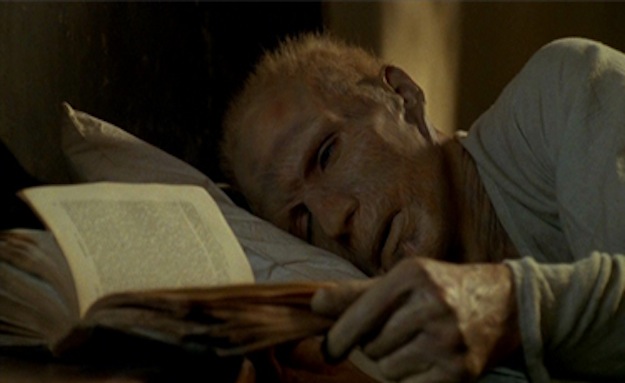
Romanticism’s idea of nostalgia has been one that was well adapted by Hollywood. In Anthony Minghella’s adaptation of Michael Ondaatje’s The English Patient (1996), Almásy’s heavily annotated copy of Herodotus’s The Histories serves only to recall his torrid love affair with Katherine Clifton (expertly captured under Minghella’s direction), which was to have devastating ripple effects on those around them. At the same time, Irving Berlin’s ‘Cheek to Cheek’ is a mere reflection of the Almásy’s state of mind (and heart) for it is only in heaven (hence death) that he is able to ‘find the happiness that he seeks’. In David Fincher’s adaptation of F. Scott Fitzgerald’s The Curious Case of Benjamin Button (2008), Daisy Fuller’s deathbed merely serves as the only consistent variable throughout the course of the film as Daisy recalls her life, along that of her lover, Benjamin Button, whilst her daughter Caroline reads from the protagonist’s diary. The film was also haunted by the use of Scott Joplin’s Bethena Waltz (1905) which serves as a reference to period when the film was set. And finally, it was the grown up Peter (Pan) Banning (played by Robin Williams), who enlist the help of Tinkerbell (Julia Roberts) as he rummages through his childhood memory in search of the one big ‘happy thought’ that will enable him to fly in Steven Spielberg’s Hook (1991).
Ralph Fiennes in ‘The English Patient’
Recommended listening (All of which can be found on YouTube)
Ludwig van Beethoven: An die ferne Geliebte Opus 98
Johannes Brahms: Piano Sonata No 3 in F minor Opus 5
Johannes Brahms: Piano Concerto No. 1 in D minor Opus 15
Johannes Brahms: Sehnsucht Opus 14 No.8
Johannes Brahms: Clarinet Quintet in B minor Opus 115
Johannes Brahms: Piano Pieces Opus 117, Opus 118 and Opus 119
Frederick Chopin: Larghetto from Piano Concerto in E minor Opus 11
Franz Liszt: Transcendental Etude No. 9 in A Flat Major ‘Ricordanza’
Gustav Mahler: Lieder eines fahrenden Gesellen: Die zwei blauen Augen von meinem Schatz
Franz Schubert: Die Winterreise D911
Robert Schumann: Fantasiestücke Opus 12
Robert Schumann: Kinderszenen Opus 15
Robert Schumann: Fantasie in C Major Opus 17
Robert Schumann: Frauenliebe und leben Opus 42
Robert Schumann: Dichterliebe Opus 48
Robert Schumann: Lieder und Gesänge aus ‘Wilhelm Meister’: Mignon (Kennst du das Land)
Hugo Wolf: Goethe Lieder: Mignon (Kennst du das Land)
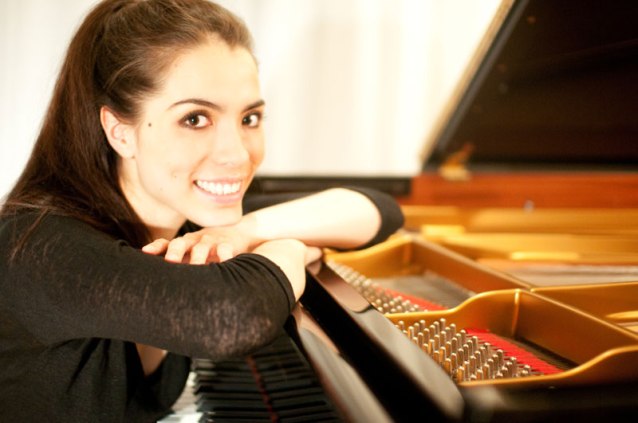
Who or what inspired you to take up the piano and make it your career?
There are no musicians in my family but we always had a piano at home (my mother played as a hobby pianist) and my older sister was also having lessons, so I started playing as soon as I could climb onto a piano stool. I didn’t decide to become a professional pianist until quite late – I was 16 when I was in professional environment for the first time at Chetham’s School of Music and knew this was what I wanted to do for the rest of my life.
Who or what were the most important influences on your musical life and career?
My most important influence in my musical life was definitely my time at the Royal College of Music. I really feel that I met many of the most important people in my life today there and that I found myself as musician, pianist and person in the seven years I studied at the RCM for.
What have been the greatest challenges of your career so far?
I think the greatest ongoing challenge for a musician is to be able to accept that each piece of music you choose to play is a life-long work. You will never be entirely content with what you have achieved at the time or when you come off stage. You always strive for something better – but in a way, it’s also the beauty of music making.
Which performances/recordings are you most proud of?
My debut album for the label KNS Classical is very exciting. I recorded a disc with two major works by Schumann (Sonata No.3 and ‘Davidsbündlertänze’) which are both very special to me.
Which particular works do you think you play best?
I can identify myself most with the German Romantic repertoire. I always felt that the music by Brahms and Schumann were very innate in me. But I also enjoy playing many works by Liszt and much of the Russian repertoire. I have been able to explore much of this with my professor and long-term mentor Dmitri Alexeev.
How do you make your repertoire choices from season to season?
I tend to have long-term projects for the next few years and I usually combine these with my current interests. I always think that coherence or an inner connection of works in a recital programme is very important.
Do you have a favourite concert venue to perform in and why?
I don’t necessarily have one favourite concert hall but one of my favourites is definitely the Laeiszhalle in Hamburg. It’s a beautiful hall with a wonderful acoustic and it brings back great memories as Hamburg is the city where I spent most of my childhood.
Favourite pieces to perform? Listen to?
Currently works by Schumann and Rachmaninov’s Second Piano Concerto. I always love working on every programme I choose for each season. For listening it’s perhaps slightly different – I tend not to listen to that much piano music. I mainly listen to orchestral and chamber music and operas. I do occasionally enjoy listening to Jazz as well.
Who are your favourite musicians?
Many great artists from the past have given me much inspiration over the years, it’s impossible to list all of them but there are a few that I would single out: Furtwängler, Edwin Fischer, Sofronitsky, Kempff to name a few.
What is your most memorable concert experience?
The most memorable concert I have experienced was a piano recital by Radu Lupu in Brighton where his rendition of Schubert’s Sonata in A D959 was beyond description..…
What do you consider to be the most important ideas and concepts to impart to aspiring musicians?
First and foremost, to choose music as a career for the right reasons – one must love music to the extend that you could not live without it. Being creative, imaginative and respectful towards the music you are playing.
Where would you like to be in 10 years’ time?
Having the freedom to combine concertizing, teaching and family life.
What is your idea of perfect happiness?
To lead a harmonious life where I can enjoy music and family life to the full.
Caterina Grewe’s debut solo album of piano music by Robert Schumann is available now on the KNS Classical label. More information
German-Japanese Pianist Caterina Grewe, born in Tokyo in April 1988, has performed to great critical acclaim throughout the UK and continental Europe as a Steinway Artist.
The Cross-Eyed Pianist is free to access and ad-free, and takes many hours every month to research, write, and maintain.
If you find joy and value in what I do, please consider making a donation to support the continuance of the site







 The Cross-Eyed Pianist