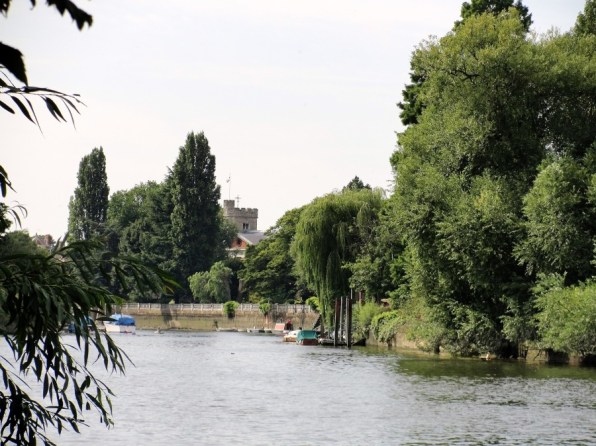
A mile or so along the river from where I live in Teddington, SW London, the attractive 18th-century church of St Mary’s in Twickenham sits on a grassy plinth overlooking the Thames. And for the weekend of 10-12 June 2016, it became the home of a new chamber music festival, directed by Emily Pailthorpe of the London Conchord Ensemble.

Regional and local classical music festivals are such a good idea. They take music out of formal metropolitan concert venues and into communities, forging important and lasting connections between musicians, local people and venues, and many attract world class performers, as well as encouraging young musicians. Conchord Festival boasted an impressive roster of performers, including actor Simon Callow and baritone Roderick Williams. I was delighted to attend the Saturday afternoon concert, music for piano duo performed by Alasdair Beatson and Julian Milford.

St-Marys-Church-Tower-in-Twickenham-by-e1456080701261

The theme of the concert was dance and the connecting thread was Sergei Diaghilev, ballet impresario and founder of the Ballets Russes, who collaborated most famously with Igor Stravinsky in the staging of The Rite of Spring, the piano 4-hands version of which concluded the concert. The afternoon opened with Debussy’s Prelude à l’Aprés Midi d’un Faun, a symphonic poem which formed the basis of the ballet Afternoon of a Faun, choreogaphed by Nijinsky and staged by the Ballets Russes in Paris in 1912. The piano duo version was transcribed by Ravel and loses nothing of its sinuous lines and erotic textures in the piano reduction. Beatson and Milford’s performance was languorous, nuanced and sensuous, perfect for a humid summer’s afternoon. This was followed by four of Dvorak’s Slavonic Dances, a reminder of the popularity of music for piano duo during the nineteenth-century and a foot-tapping musical palette-cleanser before the main event, The Rite of Spring, which followed the interval.

When The Rite of Spring opened in Paris in May 1913 the avant-garde nature of the music and the staging caused a near-riot in the audience. The piece still has the power to shock over 100 years later, with its narrative of savage rituals and human sacrifice. Stravinsky first performed his own four-handed version of The Rite of Spring with Debussy, the arrangement created to accompany rehearsals for the first performance of the ballet. This music was born on the piano, written in a tiny room, so Stravinsky tells us, on an upright piano, and it contains an exhilarating and precarious excitement. Forget the orchestral version: here is a work of raw energy, convulsive rhythms and pagan exoticism, aptly described by Debussy as “a beautiful nightmare”. It remains a vertiginously challenging work for piano duet, straining the medium to its limits. Beatson and Milford rose to the challenge with aplomb, managing pianistic gymnastics with ease and creating a riot of colour, texture, rhythmic drive and narrative. The famous stamped-out chords were percussive and metallic, redolent of heavy machinery, pistons and steam engines. (Let us not forget this piece received its first performances as Europe was preparing for the most mechanised and destructive war in its history.) This was truly an enthralling journey.

Next year’s Conchord Festival takes place from 9-11 June 2017.

I never thought I’d write an article on “note bashing”. In general it’s not something I advocate – mindless repetitive practise, thoughtlessly hammering away at the same phrase or group of notes. However, during my work on one of Schubert’s late piano sonatas I discovered that note bashing really does have a purpose in practising.

Every piece we learn will have its tricky or hard-to-master sections – that finger-twisting little passage, that scalic run which never feels comfortable under the hand, those hand-filling chords which are just a little bit too hard to reach accurately. For me it was arpeggios, a weakness in my technique which was making it more difficult for me to play the (many) arpeggios in the Schubert sonata precisely and fluently. My teacher worked with me on both good fingering schemes and some useful wrist rotation technique but what I knew I needed to do was to be able to play the passages automatically without the need to think about what was going on in the fingers and hands.

Musicians endlessly talk about training the “muscle memory”. Of course our muscles don’t really have memory, and the correct term for this is in fact “procedural memory”. This is part of our long-term memory that is responsible for knowing how to do things (also known as “motor skills”). Procedural memory retains information on how to perform certain procedures, such as walking, talking and riding a bike – and playing the piano. Procedural memory is created through “procedural learning” – repeating a complex activity over and over again until all of the relevant neural systems work together to automatically produce the activity. This is why as musicians we should be engaging in a hefty amount of repetitive practise, for it is these repetitions which fix the music in head and hands. Forget “practise makes perfect” – the real reasons why we do repetitive practise is because practise makes PERMANENT.

I was away from my own piano at the time when the arpeggios in the Schubert needed the most work, but as luck would have it, I had access to a digital piano which belonged to my husband’s niece. No matter that the keys were covered in a rather unpleasant sticky residue due to repeated use by small children: for three days I worked solely on arpeggios, focusing only on learning the correct sequence of notes and fingering. I did not consider the tone or quality of sound, or any of the more esoteric/artistic aspects of playing these sections; I simply concentrated on repeating the passages over and over and over again…… Back home to my piano and the exercise continued for a further week, by which time my husband, who also works from home, was beginning to develop a deep aversion to those particular sections of the Schubert sonata. “When are you going to practise something else?” he asked me. “When I’ve learnt this bit” I replied.

The “note-bashing” exercise served its purpose: at the end of 10 days the sections were well-learnt and my attitude to them virtually intuitive. I no longer approached them with a feeling of unease, concerned that I was going to fumble the arpeggios, and I have subsequently used this approach to memorise and/or make secure other sections of the Sonata – and indeed other pieces of music. With such security comes confidence and the ability to play without physical tension or anxiety.

Of course my practising wasn’t really note-bashing because all the time I was playing I was taking notice of what I was doing to ensure that notes and fingering were correct, that I was employing the right amount of rotation to move smoothly up and down the arpeggios, that the tempo and pulse were accurate and so forth.

There are stories of pianists doing repetitive exercises or 100 repetitions of the same passage while reading a newspaper or reading aloud from a book. In these cases, one is training the procedural memory while testing one’s ability to divide one’s attention between several different tasks. I do this exercise with students, getting them to repeat a section and once the repetitions begin to feel comfortable and well-known, I might ask them what they are having for dinner or what they are doing at the weekend. Given the amount of multi-tasking that is required in piano playing, this can be a very useful exercise.

If you are simply note-bashing for the sake of it, it is perhaps time to stand back a little from your playing, consider the sound you are making and return to your practising with thought and care.


(photo by James Eppy)


The world of classical music is riven with conventions from the way we dress to the manner in which music is presented in public and when it is acceptable to applaud. Many of these customs developed in the second half of the nineteenth century when concertising became far more formalised. These conventions can seem restrictive and limiting, to both players and audience, but they exist and therefore we are largely obliged to work within them. The profession has its mavericks and colourful characters who kick against The System, but in general most of us abide by the “rules” to a greater or lesser extent – and there are good reasons for this. Our behaviour, from the way we market ourselves and interact with others in the profession to what we wear at concerts and how we deport ourselves on stage, in addition to how we play, is constantly under scrutiny by peers, audience members, promoters, agents, teachers, mentors and critics.

We are all being judged, whether we like it or not, when we work with others and when we perform. That is not to say that everyone should knuckle down and follow the directives of the conductor, nor engage in discussion with conductor and colleagues – and good colleagues and conductors will be open-minded and keen to discuss points which arise in rehearsal. But an ensemble or orchestra is a “team” and respecting the team dynamic and working with it rather than against it will lead to a happier working environment, good performances, and future work. In reality, while some may want to strike out and do something original and creative, such behaviour does not pay the bills, and freelance musicians have to be pragmatic as well as disciplined.

One may argue that soloists have greater freedom to buck the system and to play with spontaneity and originality, and while this is true up to a point, we are still bound by conventions. There are, for example, established ways of playing Bach, Beethoven, Schubert, Chopin et al, conventions which develop and change over time, reflecting historical precedents, new scholarship, differing attitudes to interpretation and teaching, and the influence of recordings. If anything, the way the big warhorses of the solo repertoire are presented in concert today is more standardised than ever as soloists, particularly younger ones, believe that they must play these works in a certain way to satisfy audiences, critics and promoters, not to mention the influence of high-quality recordings. With so much music being performed and so many concerts of largely the same repertoire, it can be hard to find an individual voice, and if you are playing the same programme across three continents for six months, it can begin to feel like a chore rather than a joy.

So how do we bring spontaneity, originality and individuality to our performances? Paradoxically, it is the very discipline of practising which brings freedom in performance. When we perform, we want our performance to be engaging and memorable (ideally, for the right reasons) for our listeners. The work we do in private, in the practise room, is crucial in enabling us to pull off a performance which is accurate, faithful to the score, imaginative, colourful, expressive and personal. No one, not even the greatest pianist in the world, gets by on talent alone. That talent has to be nurtured, honed and finessed, and the only way to do this is through regular and consistent work on one’s craft. Discipline turns ability into achievement.

Knowing we are well-prepared means we can step back from the music in performance, not over-think it, play “in the moment”, and produce a performance which is special, memorable and unique. In effect, one needs two personalities in order to be a convincing  performer: a perfectionist in the practise room and a “bohemian” (Stephen Hough) on stage. This sprezzatura, the result of many hours of careful, deep practising, allows the bohemian in us to be set free on stage. Audiences can sense this confidence too – just as they can tell when the performer is under-prepared, or is trying out something new which has not been road-tested in advance.

As regular readers of this blog will know, I attend many concerts and hear a wide variety of performers and repertoire, from well-established international artists such as Stephen Hough, Murray Perahia and Steven Osborne to lesser-known and young musicians. I can usually tell if a performer is not wholly convinced about his or her approach to particular repertoire, has not spent enough time with it or has been told to play in a certain way by a teacher or promoter. The playing lacks conviction and depth and sounds contrived or artificial. Occasionally someone comes along and does something new or unexpected with a Beethoven Sonata or Chopin’s Etudes, and if it is done with conviction, one has the sense of a performer who is well-prepared and who has spent many hours living with and thinking about the music. Such “wow!” moments are quite rare, but when they happen they are truly magical. Equally, a musician who has spent many years living with and performing the same repertoire can bring new and wonderful things to the music every time he or she performs it. A long association with certain repertoire also enables one to step back from it and set it – and one’s imagination – free.


The title of this post is a quote from Aristotle

Further reading

You Can’t Win a Performance….

Cavaliers and Roundheads


jackwhite1

Who or what inspired you to take up composing, and pursue a career in music?

My parents and especially my granddad have always been very supportive and encouraging. My granddad always wanted to be able to play the piano and compose, but he wasn’t offered any opportunities to learn when he was younger. I think that’s what drove him to encourage me: he saw that I enjoyed it, and made sure I took all the opportunities I could.

Who or what were the most significant influences on your musical life and career as a composer?

It may sound obvious, but my parents. I couldn’t have been offered the opportunities I have been today without their help and support.

What have been the greatest challenges/frustrations of your career so far?

I think it’s important to learn how to fail ‘productively’. As a freelance composer you are never going to get every single opportunity you put yourself forward for. It’s important to try and remain positive. Take criticism on board where you think it’s fair, but remember that your music should ultimately be defined by you. There have been times when I have felt it was right to reject criticism. Knowing when to do this can be tricky to navigate when you’re starting out.

With every performance you get better at communicating the music in your mind’s ear to an audience. This process is a very personal one. It operates on many levels between transcription and translation. No-one can tell you whether it has been successful other than yourself. Do not be too self-critical when you make a mistake, because that’s how you learn.

What are the special challenges/pleasures of working on a commissioned piece?

It’s great when you can shape a piece around a specific group. I always try to feed off the energy and enthusiasm of an ensemble when I write.

What have been your favourite aspects of working with London Music Masters as part of your award over the last year?

I think the performance of my piece “Flutter” in Festival Hall was very exciting.  I loved seeing the faces of the children after they had performed the piece, they looked like they had enjoyed performing it, and that was very satisfying for me.

Can you tell me a little bit more about how the piece came about?

I had the idea of using pieces of foil on the strings, to make the piece a bit more fun for the very young performers.  This came from the idea of music’s transformative power which has the possibility to effect change in people’s lives. The piece was written for beginner string players and a choir, so this idea became part of the chorus: “Music is a butterfly, filling the air with something you can’t buy, because
it makes my heart-beat flutter”.

What feedback did you receive from the piece?

Well it was lovely to hear that the piece had been well received by the LMM teachers who said that it was aimed at just the right level without being too simplistic.  I also had a few parents come up to me to thank me after the concert. One mother said that her child had been singing it all the time, so I apologised as you may expect!   When I was writing it I structured the whole piece around the simplest part (just using open strings) and built it up from there. I think this approach worked well rather than taking the hardest part and working back.

You’ve also been writing for a YCAT artist as part of the award, can you tell us who it is yet?

Yes, it’s the trombonist Peter Moore.  I was very excited to have the opportunity to write for such a talented performer.

What have you written for him?

The piece is called ‘Three After-Dinner Pieces’.  It’s in three movement and each is based on a different type of cheese.

Cheese? Tell us more about this….

I am a big fan of cheese in all it’s different variety.  I work part time in a cheese shop in Cardiff called “Madame Fromage” and I thought it would be a unique way of structuring a piece. My ideas have come both from the physical form and taste of the cheese, and its country of origin. For example, in the first movement (Stilton) the mouldy striation reminded me of unsynchronised fanfares, which have become part of the texture of the work. Similarly the viscosity of Epoisses has allowed an exploration of glissandi effects in the trombone part.

Which cheeses did you select for your piece?

Stilton, Caerphilly and Epoisses, the last of these being my favourite.

Are you pleased with the piece?

Yes, I haven’t written for the trombone as a solo instrument before, and Peter is such an excellent performer with an amazing expressive range that I wanted to write something to show this off.  I will be looking forward to the premiere very much.

When is the premiere and where will it be performed after that?

27th September in Colston Hall, Bristol, with the first London performance on October 3rd, in Wigmore Hall. I am also lucky to be able to conduct some workshops around this performance in association with LMM. We will be visiting schools to talk about the writing of the piece.

What are you working on at the moment?

I have been commissioned to arrange a recording of Satie’s “Parade” for National Dance Wales, in a performance about the Russian revolution.  BBC NOW are recording the piece in early September so I will have my work cut out for me to get everything ready in time for the performances on 25th Oct in Wales Millennium Centre, Cardiff and the 29th in Pontio, Bangor.


Of which works are you most proud?

I love the recording of my BBCSO orchestral piece ‘Digital Dust’. Also, the multi-part choral piece ‘Islands (Ynysoedd)’ I wrote for what became a celebration of Sir John Tavener’s life in Southwark Cathedral, following his death. More recently I wrote a piece for Côr Aduniad called ‘We Have No Right To The Stars’. This is a translation of a poem by Hedd Wyn, and I think it’s one of my favourite choral settings to date.

How would you characterise your compositional language?

I like to describe my style as emotional and accessible. When I was first getting inspired by music I used to get the ‘tingle factor’ (when the hairs on the back of your neck used to stand up) when I listened to music I loved. I have tried to find a compositional language which allows others to feel a strong emotional attachment to my work.

How do you work?

I like to write straight into the computer if I am working on a piece. I usually work at a piano to sketch ideas, and when I am happy with them, notate them straight away.

Who are your favourite musicians/composers?

Kaija Saariaho, Jonathan Harvey, Michael Tippett, John Tavener, Benjamin Britten, Tori Amos, Björk.

What is your most memorable concert experience?

I can’t remember the exact details but I watched Vaughan Williams’ ‘Fantasia on a Theme by Thomas Tallis’ when I was very young. I can remember the music having a profound impact upon me.

What do you consider to be the most important ideas and concepts to impart to aspiring musicians?

Learning how to listen is probably the most important part of becoming a musician. It takes time to develop and is fundamental to your success in all areas of the business.

Where would you like to be in 10 years’ time?

In a studio which would make Hans Zimmer jealous!

What is your idea of perfect happiness?

Being truly grateful for everything you have.

What is your most treasured possession?

My piano.

What do you enjoy doing most?

Laughing.

What is your present state of mind?

Upbeat.


Jack White studied music at Somerville College, Oxford.  His postgraduate studies have been undertaken solely at Cardiff University where he has recently finished his PhD in composition.  His research interests are in electroacoustic composition and the combination of this media with traditional ensembles in ‘live’ performance.  He is also interested in the scoring methods used by electroacoustic composers and the relationship between such methods and a work’s identity.

Jack White is the recent recipient of a London Music Masters award

Jack White’s website