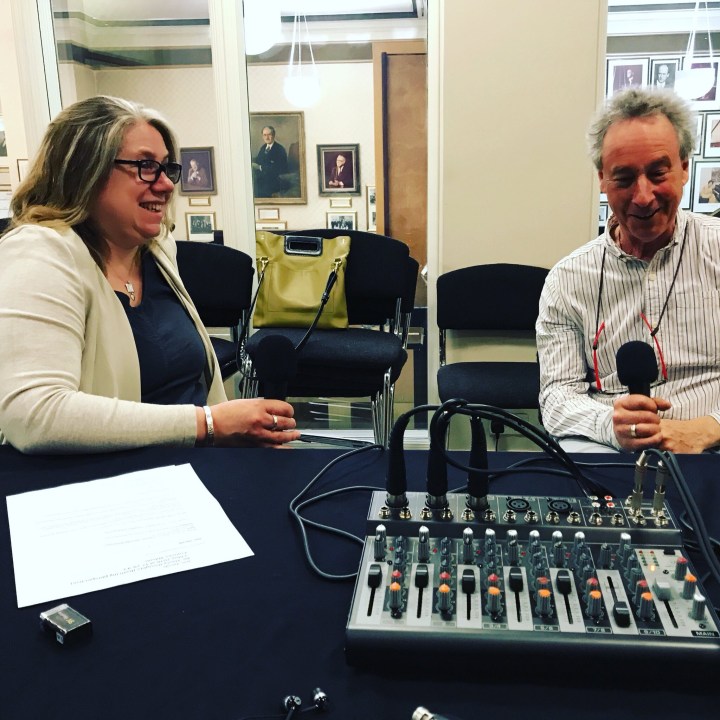
dsc-98012-lst263101

The 3 British Tenors are…..

Barry Clark, David Heathcote and Matthew Scott Clark

Who or what inspired you to take up a career in music?

Barry: From an early age I sang and acted at school, later joining various local amateur theatre groups. My parents were vociferous in their disapproval of this and actively discouraged any thoughts of my turning professional. I languished as a cartographic draughtsman at the Ordnance Survey for four years before rebelling & applying, successfully, for the chorus of the D’Oyly Carte Opera Company. Through local productions I had acquired a love of the Gilbert & Sullivan operas, their tunefulness and oddly skewed humour being entirely to my taste.

David: from as early as I can remember I was fascinated by opera singers and conductors. In fact, my mum would catch me pretending to conduct orchestras whenever they came on the TV! My biggest influence as a singer has been José Carreras, particularly his beautiful sound, his vocal honesty and connection to the words and music. I also remember the story of his battle with leukaemia, even though I didn’t know who he was at the time; I just somehow knew it was an important story.

Then in 1990 the world changed when The 3 Tenors emerged. I just loved the format and the sheer joy of three tenors on one stage, singing the arias they loved. Listening to Luciano Pavarotti in these concerts is a concentrated masterclass of vocal technique. What a huge talent he was!

Matthew: Music has always been a big part of my life; listening and making it. It’s always been in the family with my parents being opera singers too, but early on I was keen on pursuing a career in acting and even film making. The tipping point came when I played Salieri in a student production of Amadeus; that affectively ignited my love for the music of Mozart, and eventually led me to play Papageno in an amateur production of The Magic Flute. It was thereafter that I knew I wanted to be an actor-singer.

Who or what have been the most important influences on your career?

Barry: Being self-educated in music & drama, I would say that a particular singing teacher, the singer/actor Andrew Downie, unlocked the voice and got me started on the road to a proper, and stable, vocal technique. Watching the Carte’s “patter man”, John Reed was a great influence; his stagecraft and attention to detail, plus the maintaining of stamina over eight performances a week, have all aided me over the years.

David: my teachers have been amazing and have all brought our something different in me. In recent years Colin Baldy and Justin Lavender have helped me realise what I always knew was there, particularly in the higher registers. But it’s all the wonderful family and friends who have kept me going on my journey. Also my late friend and West Yorkshire singing teacher Steven Mellor, who gave the most important advice ever: “Just open your gob and sing”. Classic!

Matthew: Other than my parents and friends in the industry, I think it’s the music itself and the composers who wrote it. When I hear a piece of music that really affects me it’s a great feeling; and I love being able to express that when I perform, so others can feel it too.

What have been the greatest challenges of your career so far?

Barry: Remaining in work!

David: being business-like is so important. Equal to the dedication of establishing a vocal technique (an ever-present occupation!) and learning the right repertoire is the business and marketing skills to succeed. I have been lucky enough to have worked as a singer and as a producer and also in other business areas. I try my best to apply these skills and knowledge to my own career but I know it is so much harder when you are the product you’re selling.

Matthew: They are too numerous to list here! (Laughs) But the ongoing challenge is just doing it: keeping yourself at that level of performance all the time. That’s really hard.

Why did you decide to form The 3 British Tenors?

Barry: Re-form really. The original act ran roughly from 1995 to 2005 and performed all over the UK & abroad. As the tenors began to seek other work, the act disbanded. I decided that the time was ripe for a revival and with the new team of myself, David Heathcote and Matthew Scott Clark we tried out at the Chapel of the Royal Foundation of St Katharine, London, towards the end of 2017.The response was heartening enough for us to decide to continue and we are looking forward immensely to building the act during 2018.

David: Barry Clark was one of the original The 3 British Tenors and enjoyed great success in the UK and internationally. With my background in the music business, Barry approached me to sound me out about bringing the it back, which I was delighted to do. We tried out the format at an intimate concert in the Chapel of The Royal Foundation of St Katharine in London and were convinced by the audience reaction in our sell-out performances. Now we know it works we look forward to having lots more fun performing together in 2018!

Matthew: I just remember seeing Dad in the original Three British Tenors back in the ’90s, and it was this great operatic cabaret act with sparkly curtains and synthesisers and wonderful old stories from the world of opera; and as a kid I just loved it. So when Dad said he and David were thinking of reprising the act with the three of us in mind I said “Hell yeah!”

Which performance/recordings are you most proud of?

David: our launch concerts in autumn 2017 were special occasions for us. Can we report back in a year’s time?

Matthew: Other than our recent performances at St Katherine’s Foundation, I have to say performing the role of Bardolpho in Verdi’s Falstaff for Royal Welsh College a couple of years ago. It was this wonderfully creative production set in the 1980s, with some great up and coming people in the principle roles. It was conducted by Carlo Rizzi, so it was like being conducted by Verdi himself! And the characterisations were just so nutty, which are the best kind of roles for me.

Which particular works do you think you perform best?

Barry: My particular love has always been operetta, not just Gilbert & Sullivan, but the Viennese répertoire: Lehar, Strauss, Kalman etc.

David: the beauty for us is that we can choose repertoire that suits us individually and then come together in the famous songs and arias that the audience expects from having three tenors together on one stage. I am most at home in the coloratura madness of Rossini and Donizetti and I love singing the famous tenor songs with Barry and Matt. The audience love it when we come together to sing the classics such as O Sole Mio, La Donna è Mobile and Nessun Dorma, for example.

Matthew: Anything that tells a story, and has some really stand out emotive hooks or amusing jokes thrown in there. I love the character roles, because they are just so much fun to play; but with the lyrical roles you can really make a mark, change people’s hearts. I can never decide what I enjoy more! (Laughs)

How do you make your repertoire choices from season to season?

David: for our general performances we choose arias that suit us well and make sure there are always some pieces with the ‘wow factor’ when we come together as a trio. Our Christmas programme was pretty special as we choose classical and operatic repertoire that was connected to the season: Rossini’s Si, Ritrovarla io Giuro from Cinderella, Britten’s The Holly and the Ivy and Warlock’s The First Mercy were crowned with O Holy Night in our Christmas concert.

Matthew: For me, it’s really a choice of what speaks to me the most. There are some roles or pieces which are essential for any singer’s repertoire; but if there’s a particular tune or scenario in a piece that affects me in particular, then that’s the deciding feature in my mind.

Do you have a favourite concert venue to perform in and why?

Matthew: I love the Buxton Opera House. I was there a few years ago in a production of Handel’s Acis and Galatea for Mid Wales Opera, when I was a member of the chorus. It’s just such a gorgeous venue, all the royal greens and golds; and when you see the names of William Shakespeare and Sir Arthur Sullivan painted opposite to each other in front of the stage, you know you’re in exactly the right place!

What is your most memorable concert experience?

Barry: Participating in the 25th anniversary celebrations of “The Phantom of The Opera” at the Royal Albert Hall in 2011.

David: I was lucky enough to perform the role of Gandhi in what was possibly the professional British premiere of Philip Glass’ opera Satyagraha at The Midlands Arts Centre (sorry ENO but it wasn’t you!). That was an emotional experience and the start of my professional career in 1999.

Matthew: Singing in college chorus for a Royal Welsh performance of Benjamin Britten’s War Requiem, conducted once more by Carlo Rizzi, with baritone soloist Simon Keenlyside and tenor soloist, my teacher, Adrian Thompson. It was such an incredible piece to be a part of, not just for the personnel, but for that truly heartrending score!

I remember one movement towards the end where it feels as though the whole world has ended beneath you, and you’ve left the ground without anything to grab onto except the words on the page! It was nuts.

As a musician, what is your definition of success?

David: getting paid to make people happy.

Matthew: Audience reaction. If you can convince them for one song, that’s the biggest success in my book.

What do you consider to be the most important ideas and concepts to impart to aspiring musicians?

David: don’t be afraid to treat you and your art as a business. You need a great product and absolutely to love performing but you can’t sustain it if you’re not bold enough to be business-like.

Matthew: Honesty. Always look for the truth in what you do. Otherwise what’s the point?

Where would you like to be in ten years time?

Barry: In comfortable retirement!

David: Going around the world singing my favourite repertoire would be heaven!

What is your idea of perfect happiness?

Matthew: Knowing your vocation, and sticking to it. That and Netflix.

What is your present state of mind?

Barry: Buoyant!

David: Excited!


The 3 British Tenors have entertained audiences in concerts and private and corporate events for over 20 years in the UK, in Europe and the United States of America.

As you’d expect, the tenors include the great arias such as the world famous Nessun Dorma (which was sung by Pavarotti on the eve of the 1990s World Cup), the brilliant, La Donna e Mobile and wonderful arias by Puccini, Verdi as well as the great Neapolitan songs such as O Sole Mio.

Throughout their performances, The 3 British Tenors sing as a trio to create magical moments from opera, music theatre and songs.

Being British, the tenors like to lighten things up with humour and audiences love the stories they tell throughout the programme.

www.the3britishtenors.co.uk


CDA68213Piano Sonata in B flat major D960

Four Impromptus D935 Op 142

Marc-André Hamelin, piano

(Hyperion CDA68213)


Canadian pianist Marc-Andre Hamelin, more used to scaling the most vertiginous peaks of the piano literature or revealing the more esoteric nuggets and rarities of repertoire, has released a recording of Schubert’s final piano sonata and the second set of Impromptus.

The evergreen Sonata in B flat, D960, is perennially popular with pianists and audiences alike, and regularly graces concert programmes and recordings. Not only is it a beautiful and absorbing piece of music, it also holds a curious fascination for pianists and listeners. Completed just a few months before the composer’s death in November 1828, this sonata (and to a lesser extent its companions D958 and D959) is regarded by many as a valediction or a premature message from beyond the grave – the composer’s final farewell at the end of a life cut tragically short by syphilis. As a consequence, this sonata has acquired a certain “otherworldiness” which can influence the way pianists approach it. It is, in my opinion, unhelpful to apply too sentimental an interpretation to this striking work, or to approach Schubert’s life and work in Vienna in the first part of the nineteenth century with 21st-century sensibilities:  it is worth noting that the average life expectancy for a man in Vienna in the 1820s was 38 years, and at the time when Schubert lived in that great city it was dangerous, dirty, disease-ridden, and rife with crime. All lives were lived on the edge of sorrow, not just Franz Schubert’s. And so while there is pathos, sombre melancholy and a sense of acceptance (but never resignation) in this Sonata, there is also serenity, exuberance and a tangible joie de vivre, particularly in the third and fourth movements. Indeed, by the close of the work, one has the sense of a composer who lived a full life and still had plenty more to say.

When so many performances and recordings of this great sonata exist, including some notable “benchmark” recordings which stand the test of time (and we each have our personal favourites), why would a pianist of Marc-André Hamelin’s standing and facility, with an already impressive discography, turn to Schubert? Well, in a way, late Schubert – like late Beethoven – sits up there alongside Shakespeare, and like Shakespeare’s writing, there’s always more to find in this music, and each performance (as a player or listener) is a different experience. The D960 has the richness of a journey willingly undertaken and plots a course through the whole gamut of the composer’s personality, his emotions and ideals. He’s introspective, yet his message has a universal truth – and tenderness too.

For a pianist who seems able to handle anything the repertoire can throw at him, from the craggy edifice of Charles Ives’ ‘Concord’ Sonata, Stockhausen’s enigmatic Klavierstück IX, to Villa-Lobos’ savage Rudepoema, or the mannered witty classicism of Haydn, late Schubert seems an unusual choice. Yet I know from a conversation with Marc-André that this is a hugely significant undertaking for him personally, and I feel this recording perhaps says more about the pianist than the work itself.

This is not virtuosic music, in the traditional sense of the word. It has no grand gestures nor intricately glittering passages; it is introspective and often deeply intimate. But there are certainly connections between Schubert’s last sonata and Ives’ Concord – both are large-scale works, expansive and wide-ranging, and require the pianist to create a clear narrative for the entire work, rather than “sleepwalking” through it. Schubert combines beauty and a structure so vast that it seems it may never end, and the work requires special reserves of concentration and artistic vision to be convincing. Pairing this large sonata with the four Impromptus D935 gives the listener a chance to appreciate Schubert’s intense artistic maturity and skill in handling structure in smaller works too.

Fortunately, Hamelin eschews the valedictory or overly sentimental approach for the D960 and opts for a leisurely Andante moderato in the opening movement, highlighting the graceful hymn-like melody of first subject, and despite a couple of rhythmic anomalies, the music moves forward with a serene sense of purpose, occasionally tinged with hesitancy. Agogic accents (a slight hesitation before arriving at a note) are used to emphasise the long notes which begin the phrases in the first subject. This can feel a little self-conscious at times, although I appreciate why Hamelin does it – it lends a dramatic poignancy to the melody. The infamous bass trill, first heard in bar 8, is a distant rumble, nothing more ominous, though later iterations feel more unsettling, quickly dispelled by the poetic melody, which is tastefully balanced against the accompaniment. The bridge to the development section (the exposition repeat is, thankfully, intact!) – those two extraordinary chords at bar 117 – is suitably ethereal, though the pause before embarking on the development is just on the uncomfortable side of dramatic for me. Overall, Hamelin’s take on this movement is not “Schubert as Beethoven on a quiet day”, but rather Schubert the genial spinner of songs: Hamelin gives this movement the intimacy of a lieder while also appreciating its regal expansiveness. Schubert’s good nature is never far away in the transitions between major and minor passages, to which Hamelin responds with a nuanced warming up or cooling of the sound, and the overall mood is positive – imperturbability and joyfulness are only occasionally disturbed by darkness.

The temperature drops somewhat in the slow movement (famously given a desolate, almost funereal air by Sviatoslav Richter’s choice of tempo), though the atmosphere is restrained and meditative rather than cold and melancholy. The bass line, whose rhythmic ostinato figure maintains the underlying sense of forward motion in the outer sections, is well delineated and never obscured by too much pedal. And it is that rising bass figure, over which the melody is simply yet elegantly shaped, which also saves the music from becoming too sombre. The middle section, in warm A major, is rather passive. I would have liked a greater sense of exaltation: it feels a little held back and occasionally ponderous. The coda however is sensitively managed, ending on a rising arpeggio in radiant C-sharp major.

If the opening movement unfolds like a great river plotting its final course, the third movement is as bright and playful as a mountain stream. Hamelin captures its bubbling, quixotic character, responding neatly to the harmonic sidesteps and shifting registers. A change of mood is signalled in the minor key Trio, whose fzp bass accents and syncopations in the right hand suggest an exotic and rather menacing dance or ländler, but the former ebullience is quickly restored in the return to the Scherzo, preparing the way for the finale.

It is in the finale that Hamelin has the greatest opportunities for virtuosity, yet there is restraint and sensitivity here, just as in the opening movement: supple responses to the shifting moods and harmonies, the second subject melody lyrically shaped, the dotted rhythms dance gracefully, and some colourful voicings give this movement playfulness and vigour. The occasional places where the tempo presses forward somewhat unexpectedly lend a slightly breathless sense of urgency, while the coda is bright, robust and positive.

Coming after the expansive D960 (other programmes may place these works the other way round), the Impromptus D935 also have the sense of a sonata in four contrasting movements. The fourth of the set has a toe-tapping vigour and wit, a darkly lit Hungarian dance (remember these pieces were written the year before the final sonatas in the aftermath of Winterreise), the third is graceful and mercurial, occasionally tongue-in-cheek, and the second tender and intimate.

The F minor Impromptu, the first of the set, has an orchestral grandeur offset by the tender duetting passages. Purists will balk at the addition of a “new” coda, written by Hamelin himself, who regards the score “a frozen moment in time“. His justification for adding a coda in this instance is that the work “basically finishes without a coda“, and while he believes that one should not stray too far from what the score says, it is sometimes “permissible to go a little bit away from it“. Certainly, it’s an interesting addition, perhaps more akin to Schumann than Schubert in its romantic textures, and it picks up the duetting fragments from the main body of the work. For me it just feels too unexpected.

But perhaps the most unexpected aspect is Hamelin’s decision to record late Schubert, given his predilection for more virtuosic/unusual repertoire. It’s a bold move, because the Sonata D960 holds such an important place in the repertoire and the hearts and minds of pianists, listeners and commentators. Do we need another recording of the D960? Does it matter that many others have also recorded it and others are waiting to record it in the future? I don’t think so, because the music is there to be played and this recording will enter the great catalogue of Schubert recordings to give pleasure to listeners. It may not be to everyone’s taste –  no recording ever could be – but there’s an eloquence and sensitivity in Hamelin’s approach to this music which is satisfying and committed.


Recording details: May 2017
Concert Hall, Wyastone Estate, Monmouth, United Kingdom
Produced by Andrew Keener
Engineered by Simon Eadon
Release date: 27 April 2018
Total duration: 81 minutes 48 seconds

Informative and readable liner notes by Richard Wigmore


Who or what inspired you to take up the piano and pursue a career in music?

My first love was accordion which was brought to my attention in a very spontaneous way by my father when I was around 4 years old. The accordion is used in Macedonia mostly for folk music, although there are many talented people who can play classical music on it as well. I grew up playing folk music on it and I believe that being part of that tradition helped me a lot from the rhythmic point of view, as well as developing a natural musicality especially in terms of lyricism. At the time when I was entering the primary music school there was no accordion to study as a subject, so it seemed more natural to take up on piano.

Who or what have been the most important influences on your musical life and career?

I certainly had a great influence and great schooling from my Russian teachers, the Romanovs, who taught me the greatest things from the good old Russian tradition and understanding of the music in general. Than I listened to many of the pianistic legends who have inspired me in many different ways. During my concert career I have met many people from different fields around the world who have inspired me to share the musical views and the depths with music lovers. One learns each day and has many different experiences which are part of personal life and interpretation as well.

What have been the greatest challenges of your career so far?

The music is a challenge by itself. In a good way of course – because it enriches the soul and makes life much more beautiful, especially in these crazy times. It is a challenge to keep such a high level of understanding and sophisticated taste on the music circuit and in the music scene nowadays, especially due to the very commercialized world. I am a person who likes purity and embraces life and tries to share that in the most natural way with the colleagues and audiences.

Which performance/recordings are you most proud of?

Oh that is a very difficult question! Each concert or recording is a special in its own way. One concert differs from the other but the truth is that a professional and truly dedicated artist always gives his/her best to each performance. If I really have to give one example, then my very first CD for EMI with the Scriabin and Prokofiev Sonatas as well as Pletnev’s Nutcracker arrangement and Stravinsky’s Petrushka is a special one for me for many reasons. Certainly, I am looking forward to the recording that was done at the beginning of this year of my new folk project “Makedonissimo”, with transcriptions of Macedonian folk music, which will hopefully be released in the near future.

Which particular works do you think you play best?

It would be unfair to my understanding of the music and my total dedication that I have towards all the different styles to answer this question. I think it is good to leave it to the listeners to judge that.

How do you make your repertoire choices from season to season?

I try to have a variety first of all due to the fact that I want to have a more interesting life rather than staying mostly with the same repertoire. Then, I always try to accommodate to the promoters’ wishes and at the end we come to the mutual agreement. I do try to broaden the repertoire carefully each season.

You’re performing the Tchaikovsky Piano Concerto No. 1 with Kirill Karabits and the Bournemouth Symphony Orchestra in May. Tell us more about this?

I’m glad I was invited to play this piece with the BSO on tour to Dublin as well. I remember that I played this piece with the orchestra several years ago with Kees Bakels and as always with this group, I have really wonderful memories. I am also very happy to rejoin Kirill in this old warhorse which always brings an immense joy in performance, but we must not forget that it brings a great sense of responsibility due to the fact that it is one of the most popular pieces in the piano repertoire. That is why I always have a very serious approach to the “well known played notes” and I am looking forward to this collaboration again. 

Do you have a favourite concert venue to perform in and why?

There are certainly great halls around that I have played in, especially in the UK. One really feels nice at the Wigmore Hall, the Light House, Liverpool Philharmonic Hall, Birmingham Symphony Hall, Edinburgh and Perth and Dundee halls for example. But I also like playing in churches which give some majestic feeling. In any case I feel privileged.

Who are your favourite musicians?

The ones who show really natural musicianship and are very natural and simple people. No need to be cautious nor careful. Everything goes smoothly.

What is your most memorable concert experience?

There are really several ones. The first are certainly strong ones. It is not easy. If I have to give one or few, I will mention my debut with the Macedonian Philharmonic as well as my Wigmore Hall debut. I certainly remember my recital at the Light House in Poole which brings back wonderful memories.

As a musician, what is your definition of success?

Being truly dedicated to what you do, pure and unpressured, and share that in the most natural way without any “external” needs. That should help you to be at one with the music, and that can be felt by the audiences. Keeping the feet strongly on the ground and not “flying in the clouds” artificially. That way you can certainly sleep calm during the nights. And fulfilled.

What do you consider to be the most important ideas and concepts to impart to aspiring musicians?

To be true to themselves after following the most natural guidance of the composers – written in the scores. Keep the logic and nature in the music. Do not try to pretend just for the sake of being different in an unnatural way. It gives the opposite effect.

Where would you like to be in 10 years’ time?

Hopefully in a “safe” place both privately and professionally. Most importantly, to be healthy and with a peace in the soul and mind.

What is your idea of perfect happiness?

To see my family happy.

What is your most treasured possession?

My children.


Simon Trpčeski performs Tchaikovsky’s Piano Concerto No. 1, conducted by Kirill Karabits, with the Bournemouth Symphony Orchestra on 9 and 10 May in Poole (Lighthouse) and Dublin (National Concert Hall).


Macedonian pianist Simon Trpčeski performs with the world’s foremost orchestras including London Symphony Orchestra, Royal Concertgebouw, Russian National Orchestra, NDR Elbphilharmonie Orchester, WDR Sinfonieorchester Cologne, Helsinki Philharmonic, Oslo Philharmonic, Orchestre National de France, Real Filharmonía de Galicia, New York and Los Angeles Philharmonics, New Japan Philharmonic, China Philharmonic and Melbourne Symphony Orchestra. He regularly gives solo recitals in such cultural capitals as New York, London, Paris, Munich, Prague and Tokyo, and performs chamber music at festivals such as Verbier, Aspen Music Festival, Bergen International Festival, the Baltic Sea Festival and the BBC Proms.

Conductors he regularly collaborates with include Marin Alsop, Lionel Bringuier, Thomas Dausgaard, Gustavo Dudamel, Jakob Hrůša, Vladimir Jurowski, Susanna Mälkki, Andris Nelsons, Gianandrea Noseda, Sakari Oramo, Antonio Pappano, Vasily Petrenko, Jukka-Pekka Saraste, Lahav Shani, Dima Slobodeniouk, Robin Ticciati and Krzysztof Urbański.

During the 2017/18 season Trpčeski will reunite with the San Francisco Symphony, St. Louis Symphony, City of Birmingham Symphony Orchestra, Philharmonia Orchestra, New Zealand Symphony Orchestra and the Tonhalle-Orchester Zürich on tour, as well as joining Stavanger Symphony Orchestra, Orchestra del Teatro di San Carlo, BBC Scottish Symphony Orchestra, Tasmanian Symphony Orchestra, Ulster Orchestra and Slovenian Philharmonic, amongst others. Autumn 2017 marks the beginning of a string of diverse performances at London’s Wigmore Hall as an Artist in Residence, featuring his regular duo partnership with the cellist Daniel Müller-Schott, as well as including the UK debut of the self-made folk-based project, “Makedonissimo”, celebrating the music, culture and people of his native Macedonia.

Trpčeski has recorded prolifically to widespread acclaim. His first recording (EMI, 2002) received both the “Editor’s Choice” and “Debut Album” awards at the Gramophone Awards. In 2010 and 2011, his interpretations of Rachmaninov’s four piano concertos with Vasily Petrenko and the Royal Liverpool Philharmonic Orchestra were recognized with Classic FM, Gramophone “Editor’s Choice,” and Diapason d’Or accolades. Trpčeski’s March 2012 recital at the Wigmore Hall, released on “Wigmore Hall Live”, was immediately hailed by The Telegraph as “Classical CD of the Week.” His most recent recording for Onyx Classics features Prokofiev’s Piano Concertos No. 1 and 3, and again won him the Diapason d’Or in September 2017.

With the special support of KulturOp — Macedonia’s leading cultural and arts organization — and the Ministry of Culture of the Republic of Macedonia, Trpčeski works regularly with young musicians in Macedonia in order to cultivate the talent of the country’s next generation of artists.

Born in the Republic of Macedonia in 1979, Simon Trpčeski is a graduate of the School of Music in Skopje, where he studied with Boris Romanov. He was previously a BBC New Generation Artist, and was honoured with the Royal Philharmonic Society Young Artist Award in 2003.

www.trpceski.com

Composer Paul Burnell has compiled a playlist of “everything that meant something to me with a keyboard connection“. The result is an intriguing and eclectic compilation with “a lot of stuff from the 60s and 70s, including tv themes and a sprinkling of classical, contemporary


Meet the Artist – Paul Burnell