Interesting things come from online connections – and this is one of the nicest projects I’ve been involved in recently, thanks to a Twitter/Facebook connection with composer Doug Thomas.

The Seasons is Doug’s hommage to Tchaikovsky’s suite of 12 piano miniatures which bears the same name, a year-long collaborative project with 12 pianists from around the world. Doug composed 12 short pieces, 1 for each pianist participating in the project. Each pianist recorded his/her piece and these recordings were released month by month via Doug’s SoundCloud and social media. Now all 12 pieces have been collated into an album, available via SoundCloud and Spotify (in a fully mixed/engineered version).

The music is generally minimalist in style, and each piece is different – like Tchaikovsky’s Season’s, Doug captures the character of each month, from the solemn frozen majesty of January to the reawakening of nature after winter (March – which Doug composed for me), the sunny playfulness of July and the melancholy nostalgia of December at the close of the year.

Other pianists participating in the project include Christina McMaster, Clio Monterey and Simeon Walker – all of whom have, coincidentally, appeared in my Meet the Artist series. This for me is a mark of the wonderful connectivity that social media affords us, and that those of us in the piano world have many overlapping networks and circles within circles.

It is very special to have a work composed especially for one and I felt a huge responsibility towards the composer and his music to interpret the work in a way which I hoped would fit with his original vision for the work, which conveys the excitement of nature bursting into life again after the winter chill.

Listen to the album on Spotify

In addition to the album, the sheet music for the complete project is also available here.

The pleasures and rituals of home listening

There is nothing quite like the excitement and atmosphere of hearing music performed live in a concert hall, but immense pleasure can be gained from listening at home, in the privacy of one’s living room or other personal space.

Once upon a time, the only media for home listening were the radio or the record player. As a child growing up in the 1960s and 70s, long before the advent of CDs, my parents (and by default myself) listened to classical music on the radio and on vinyl LPs. My parents enjoyed music and took me to concerts from a young age, but the majority of listening was done at home and putting an LP on the record player was a deliberate act to encourage engaged and concentrated listening. In some ways, home listening mirrored the etiquette of the concert hall. We would listen quietly and respectfully, and often whole works – symphonies by Beethoven and Schubert, Divertimenti by Mozart, lieder and piano music. When my father upgraded his old mono record player to a rather sleek Bang & Olufsen stereo system, I took the record player up to my bedroom and it became “mine”. Here, listening alone, I could explore the fantastically varied emotional realm of music, from the drama of the opening of Schubert’s Unfinished Symphony which briefly gives way to a lyrical melody, to Tchaikovsky’s soaringly romantic first Piano Concerto. Left alone, I could sing along, if I chose to, or, more often than not, conduct an imaginary orchestra. In this way, I explored and enjoyed a wide range of music, which put me in good stead when I came to study music formally.

In addition to the music itself, there was the parallel pleasure of preparing a vinyl LP for the player. LPs had to be treated with care, slid reverentially from their cardboard cover and the paper envelope which protected the precious grooved surface (where the music resided). Before placing the disc on the player, one had to clean it with a special cloth to remove fine particles which could clog the stylus and create intrusive crackles or muffle sound as the disc was playing. Then the disc was carefully placed on the turntable and, in the case of my old mono record player, the stylus had to be manually lifted into position over the outermost groove of the LP. I am sure this special process contributed to one’s listening regime. It certainly wasn’t the same when I upgraded to a radio cassette player…..

This slideshow requires JavaScript.

Today we’re spoilt for choice when it comes to the medium by which we enjoy our home listening. The recorded back catalogue available to the home listener is bigger and more varied than ever before, and is continually being updated; we have better quality sound that at any previous time which gives us a much better listening experience; and the cost of discovering classical music is much less – and even free – now.

We can enjoy home listening 24/7, should we desire it. I’ve got a stack of CDs to choose from, but more often than not I now listen via a music streaming service through a high-quality Bluetooth speaker system. The same Bluetooth system also connects with other music services such as YouTube (where many high-quality recordings and performances can now be found), Medici TV or the Berliner Philharmoniker’s Digital Concert Hall (live concert streaming).

These platforms have undoubtedly changed the way we listen at home, making our listening experience incredibly diverse. Streaming services like Spotify and IDAGIO allow users to create personalised playlists or listen to specially-curated playlists. Thus, we may not necessarily be listening to music by the same composer, but rather a mix, giving us the opportunity to explore and listen more widely. In addition, algorithm-generated playlists, based on one’s regular listening habits rather than by genre, offer spontaneity and unexpected surprises.

But despite all this up-to-the-minute technology, I often find my bed-side radio provides the most intimate and intense home listening, and it is often through this concentrated listening experience that I discover new repertoire. Perhaps it is the organization of playlists on, say, BBC Radio Three’s Breakfast programme where early Renaissance choral music is side by side with an Etude by Philip Glass – the old shining a light on the new, and vice versa. A live concert broadcast can create a special kind of intimacy: right up close to the device, you feel the announcer is talking exclusively to you, and with the technology available today, a broadcast concert often offers a higher quality audio experience at home.

It’s where I experience the most intimate connection…..listening to a concert through the smallest of speakers – the stereo kitchen radio.

– Jon Jacob/Thoroughly Good

There are, of course, more prosaic reasons for enjoying home listening. It’s entirely own your own terms: you’re not obliged to remain seated for the entire experience, you can take food and drink into your own private concert hall, and if you’re not enjoying it, you can simply switch it off!

All music trains the ear to hear it properly, but classical music trains the ear to hear with a peculiar acuity. It wants to be explored, not just heard … it trains both the body’s ear and the mind’s to hearken, to attend closely, to listen deeply, as one wants to listen to something not to be missed.

– Lawrence Kramer, Why Classical Music Still Matters (University of California Press, 2009)


Guest post by Alexandra Westcott

People think the Alexander Technique is about posture. Or about how to stand up and sit down. But actually it is about our use, or most often misuse of the self. In all walks of life this misuse is going to have a negative impact, both physically and mentally, but as a pianist it is at the piano where I most often have shown back to me what needs to change, both at the piano, and then emanating outwards into the rest of my life.

We often complain “I have a bad back” or “my shoulders are tight”, rather than accepting our role in their demise: “I have misused my back”, “I have tightened my shoulders”, or “I can’t play fast passages”. But “the workings of the mind are not separate from our the behaviour of the mind’s owner” (Pedro Alcantara – from his book ‘Indirect Procedures’ – aimed at all musicians, not just pianists, and highly recommended).

Pain-762485

The first step in our desiring to be different is to know that we have to do different. And do differently all the time; not to expect to find one ‘fix’ but to find a way of being that is organic and responds to each moment as it presents itself. This takes a lot of attention, as over years and years we become a mass of reactions to stimuli, reactions that might have been helpful at one point, but which on becoming habits, are now less so! Take playing a fast passage. If we try to do it before we have an understanding that we can let it happen,  ‘trying’ creates tension and then…we are lost. No amount of tension will make for fluidity.

Digging deep into our habitual nuances is challenging because they are very subtle and ones to which we are so used that they feel ‘comfortable’. Why would we try and change something that feels so?  One of the challenges of utilising the Alexander Technique is that we have to be constantly and acutely aware of what is going on and prepare to feel UNcomfortable and unfamiliar. We need to try different things, and/or do the same things but differently, often with a completely different mental as well as physical approach.

Another misconception of the Alexander Technique is that one has to be relaxed. On the contrary. We’d end up in a heap if we relaxed our muscles all over. What we need is the right tension, in the right place, for the right length of time that is necessary. The ‘wrong’ tension is usually compensating for the right tension elsewhere. Again, we feel we need to ‘try’, but trying mostly creates the tension of which we desire to let go. More accurately we need a very careful ‘undoing’ of our habitual response. It took me ages to figure that one out. Doing so little felt slightly ‘naughty’ in a time and with a personality that feels ‘trying hard’ is ‘good’. But learning over time to do less, my fingers are now able to create flowing passages, and not being in a fixed ‘position’ I can mould the music more than if I were constantly in rigid tension. Before I discovered these ideas, I used to play my scales, major and both minors, from C/C#/D/Eb etc etc until I felt tired, thinking the goal was to do more, or for longer, until I got tired. Now I know that being tired means I’m misusing myself. Depressing a note means letting go of energy into the key, so a constant letting go should not create an increase of tension…  At this point it should be said that one cannot ignore posture, but just that using oneself correctly is not just ABOUT posture. Sitting with, again, right tension and an ‘upward’ direction rather than a curve or slump is necessary, but just the beginning of a whole way of using the self.

I have written about being curious when practising, something that musicians often fail to recognise during their time at the piano. They are too keen to ‘fix’, rather than spend time working out quite which needs ‘fixing’. Exercises that aim to solve problems are played in a way that embeds those problems and which can be ultimately harmful.  Played with inattentiveness, overeagerness, a fear of forgetting, a fear of missing out, a fear of being wrong, preconceived ideas, hurrying, all prevent any real new outcome. Buddhists  talk of ‘beginners mind’. We too have to lose everything we THINK we know and start finding out what is true, i.e. necessary.  Daily practice is often used as a search for control but over repeating one thing means overworking one mechanism and underworking others. Intelligent practice and the whole use of self is a much more economic and valuable use of time.

One of the dangers we have is to get something ‘right’ (for instance a flowing run) and then try to recreate what we did to get it. To retain an organic and responsive technique at the piano, to use Alexander’s words, we need to ‘reproduce not the sensations but rather their co-ordinative processes. The experience you want is of getting it, not having it. If you have something give it up.’

This of course seems illogical and tiresome, but it is also engaging and exciting and keeps the music and our experiences at the instrument alive.

It is extremely hard to describe specifics in writing so all this short article can do is whet an appetite for what is possible. A good teacher hopefully will direct you to ask the right questions for yourself, and show you the possibilities of how to approach the text with a different perspective.  From then it is an ongoing but fascinating journey.


Alexandra Westcott, BA

Piano teacher/Accompanist
Follow me on twitter: @MissAMWestcott

Guest post by Karine Hetherington

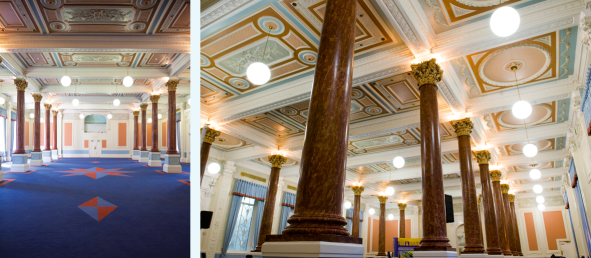
In early December, the beginning of the Christmas season, I attended a unique performance of Handel’s Messiah in the newly-refurbished Pillar Hall, Olympia. The modest red-brick building of Italianate design hugs the vast exhibition halls of Olympia. With a 250 seating capacity, it is an ideal venue for what was to be an intimate rendering of Handel’s masterpiece.

Pillar_Hall_Olympia_1

Ten professional singers step out onto a small raised platform: three basses, two tenors, two altos and three sopranos. They are framed by two marble pillars with the chamber musical ensemble in front, composed mostly of strings, a trumpet and harpsichord player. All the artists look a picture in evening attire.

Down the road, at the Albert Hall, the same work is being performed with full choir, solo artists, conductor and full orchestra. Sheer numbers are of course de rigueur in large concert venues such as the Albert Hall. How else can you vocally fill a vast auditorium of amphitheatre- type proportions?

Back in Olympia meanwhile, the harpsichord player, the heartbeat of the music ensemble, strikes up. The distinct baroque sound transports us back to the 13th April 1742, date when Handel’s Messiah was first performed in the New Music Hall, Dublin. It was an extraordinary night. Dublin ladies had been told to arrive without hoops for their dresses and gentlemen without swords, to create more room. One hundred extra Dubliners were squeezed in to witness Handel’s magnificent Messiah. The small orchestra was borrowed from Dublin castle and a handful of singers plucked from the city’s theatres and cathedrals.

47161060_1893708670722933_3159876614410469376_nMiles Lallemant, harpsichord player and musical director of the Kensington and Olympia Festival of Music and the Arts, summed up this particular production at the Pillar Hall during my interview with him pre-performance: “This musical and singing ensemble would have been this size in Handel’s day, which makes our performance of the Messiah all the more authentic and exciting to play”.

Tenor Robin Bailey steps forward proudly and intones a robust ‘Comfort ye, comfort ye my people’, the opening solo. Canadian baritone, Andrew Mahon, follows shortly with his rich and smooth interpretation of ‘Thus saith the Lord’. He mounts and descends the lower registers effortlessly. His blond neighbour, James Geidt, sporting a full Victorian beard has a wonderful bass too but the style is different, his voice is all about vigour.  The three sopranos are sweetness incarnate. In such a music space, each soloist comes into sharp relief, their outward appearance, their personality and of course their voice, with its unique timbre and inflexion.

When alto soloist, Laura Lamph comes to sing ‘He was despised,’ her mournful voice reminds us of a young Kathleen Ferrier. Each poignant word is a soft dagger to the heart.

This is where an intimate space really works. A powerful and moving libretto such as this needs to be heard, especially as it is sung in English. A large choir, no matter how professional, cannot deliver that so easily in an echoing auditorium or in a cathedral, where music and words so often disappear up into lofty vaults and crannies.

And so is it a case of less is more in the music world? Not always. Music originated in churches. Not all churches have good acoustics. London, indeed the UK, has a wealth of musical venues to choose from, but the concert each time can only be as good as its artists.

The Amen in Handel’s Messiah ends in a gradual swelling wave of divine loveliness. All ten soloists unite to create a sound of extraordinary beauty and power.

If you close your eyes you can imagine a choir three times the size.


Karine Hetherington is a teacher and writer of novels, who also blogs on art and music. Her two published novels, The Poet and the Hypotenuse, and Fort Girard, are set in France in the 1930s and 1940s. Karine promotes singers and musicians performing in the fast-growing Kensington and Olympia Music and Arts Festival. She is also an arts reviewer for ArtMuseLondon.com. When she is not writing about music, she likes to sing in her local choir or tackle piano sonatas, some of which are far too difficult for her.