Guest post by Jessica Yeartie

To our benefit, there are usually several paths one can choose to arrive at the same end result. Doing so in the traditional way or manner, and the unconventional way. Whichever decision you make is incumbent on the most comfortable way for you in accomplishing something.

To me, I am always seeking the easiest and most convenient way to do something, however I would not perceive myself as lazy. I am just conservative and selective with how I spend my energy. The only thing I exercise to the brink of exhaustion on a daily basis is my brain and thought processes. I can usually just take a nap to recuperate when necessary.

When I had decided I wanted to learn the piano, I knew seeking out a professional teacher to personally instruct me was out of the question, financially and time-wise. My mentors and research consisted of pianists who posted helpful videos on YouTube for beginners and affordable piano books and exercises I could purchase from Amazon.

Due to my circumstances, these choices suited my situation best and I made the best with what I had at my disposal. If aspiring pianists have the funds to hire a personal instructor, I would highly encourage you to do so.

Many tactics I did not learn until much later would have been made aware to me had I had someone to overlook my practice sessions and provide instant feedback I could apply on my own time. Though I think I have gotten on fine enough considering the circumstances.

Like everything in this universe, there are pros and cons when we make these choices. When we choose one thing over the other, we are knowingly sacrificing what could have been had we chosen differently. Sometimes the fear of ¨what could have been¨ can cripple us so much that we just do not make a choice at all.

Some have the opportunity to experience both but I cannot say if that is the default when it comes to decision-making. Although, I can say that hard work can certainly aid with filling in the gaps where personal instruction could have been well-utilized.

Pros

Learning anything outside our immediate area of expertise is a struggle, to say the least. Fortunately the individuals who would consider themselves to be of a more independent nature could definitely benefit from the self-taught avenue.

Adhering to Your Own Schedule

Going solo means you do not have to refer to someone else for when a task should be completed. Finding ways to manoeuvre around each other´s, sometimes very busy, schedules can be time-consuming and hard to negotiate.

Also, life is still going on around us. Many of us have outside responsibilities that come first before giving precious time to what most would consider a hobby. Things like family, relationships, work, household duties, etc. are more than enough to keep the average citizen occupied for the majority of their week.

Of course we definitely need sleep as well, especially me. We are not machines that only need to be recharged when we are feeling fatigued at the end of a long, busy day. Being self-taught can eliminate some of these issues.
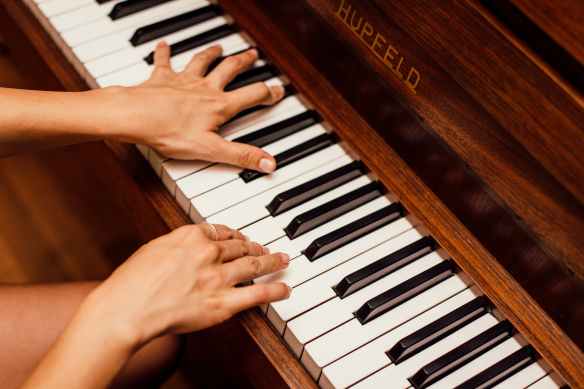
Photo by Juan Pablo Serrano Arenas on Pexels.com

No Time Constraints

Typically, teachers expect you to have practiced a certain amount during the week and present that to them when you see them next. Sometimes, the pressure of performing and getting in the required time for a full practice session can be tiresome and anxiety-inducing.

While I immensely enjoyed taking a piano close as a Junior in high school, I hated the weekly tests the teacher would grade us on for the song he selected. I always performed so much worse during the exam than when I was practicing and it frustrated me to no end.

Also, my school did not have enough pianos for each student to have their own so our allotted time slot was much shorter time to accommodate our larger than average classrooms. Now that I practice in the comfort of my own home, I can take as much time as I need to make sure I fully understand a concept.

Working at Your Own Pace

Slow-learners and fast-learners are the bane of the other´s existence. We all have that one subject or skill we excel in and get mildly irritated when others are not. At least that was the case for me in the past. I was even more irritated when I did not understand something and everyone else did, leaving me behind while I struggled.

Some concepts take longer to comprehend than others so rushing them can exacerbate their feelings of inadequacy, leading them to eventually quitting.

On the contrary, moving too slowly can lead to boredom. It is hard for a professional and newbie to come to terms with their individual skill levels and find a way to move forward that satisfies both of their needs.

Working alone means you can work as fast or slow as you need. You can speed up when something comes easier to you or take additional time for more difficult roadblocks without feeling like you are infringing on someone else´s time while still moving forward.

Cons

On the other side, there are some hiccups one should take into consideration before taking the plunge. While there is a considerable amount of freedom that comes with being self-taught, there are also some factors one should think about. Determine whether or not these possible setbacks are something you are willing to take on during your progression.

Lack of Support

One thing that makes starting a new hobby so exciting is meeting new people who have the same passion as you. This can be said about starting a new sport, joining a club at school, or attending weekly community gatherings for a specific project.

What all of these activities have in common is a group of individuals that are physically present. You have others you can converse with as the two of you are working while establishing a relationship.

In the beginning stages, learning an instrument can be kind of isolating if you are teaching yourself. Having a teacher present can remind you that they are there to help and support you when you eventually hit a wall. We can sometimes lose motivation when we have no one holding us accountable.
Lack of Foundation

If you are anything like me, you tend to want to skip the ¨boring¨ stuff and tackle the more exciting lessons. The problem with this is you hit a plateau much quicker due to a lack of knowledge in basic strategies you should have focused on to begin with.

We all have songs in our heads we really want to learn so we convince ourselves, prematurely, that we can learn it at our current level only to receive a slap in the face when you realize you cannot even play both hands at the same time without being out of time.

It takes a responsible person to stave off instant gratification and spend time on the more mundane, but important, aspects that are the very foundation of what they can accomplish in the future.

Little to No Feedback

Unless you asked someone to watch over you who is well-versed in piano and the proper form, you do not have much immediate feedback so you would have to refer to second-hand resources for clarity.

Playing in front of someone can be extremely nerve-wrecking but it is worth it to learn in the early stages which behaviours need to be corrected so they do not turn into bad habits that are nearly impossible to break further down the line.

Don´t shoot yourself in the foot by relying on your intuition in unfamiliar territory. There are lots of resources and videos out there that will inform you on better ways to play arpeggios or the perfect posture to maintain when practicing.

In Conclusion

We are all different. Some thrive in solitude while others, in the company of others. I do not regret that I chose to be self-taught however I definitely believe I could have benefited greatly from having a stable authority present to help me when I struggled.

Ideally, I think the best situation would be to experience both. Have a teacher as a novice player then gradually become more independent as you improve. That is just my opinion, though.

Whatever decision you choose is ultimately up to you unless you have parents who insist on paying for your lessons. I hope whatever path you choose leads you to victory.

Keep playing!


Jessica Yeartie is a US-based writer and blogger.
Find out more

Are there pieces that are simply too challenging for non-professionals to even attempt?

Guest post by Caroline Wright

There are those who believe that, yes, there are indeed pieces that amateurs should leave well alone. Hugely technically challenging pieces – of which there are many in the piano repertoire –  should be respected by those who cannot hope to do them justice. We should all be aware of our limits, and leave the tough stuff to those who can handle it!


I think most musicians probably disagree with this position. Personally I don’t think any repertoire should be off-limits, to anyone. We all need to be aware of our level and personal limitations, but that’s true of professionals and amateurs alike. Many individuals have physical limitations that mean they will never be able to play certain pieces, but that has no effect on their ability to play other repertoire – for example, having small hands is a curse for pianists who wish to play Brahms, Rachmaninoff and Ravel, but may actually bean asset in Bach, Scarlatti and Mozart. Finding and expressing the beauty of a piece of music can be both a challenge and a joy for anyone, irrespective of it’s technical demands.

I cannot think of a better way of respecting the music of great composers than by dedicating many hours to playing and memorising it. Listening to recordings and live concerts given by great performers is wonderful too, of course, but undoubtedly a more passive way to experience music than playing it and internalising it yourself. Learning the music, to such a level that you can see the score in the mind’s eye and listen along without the need for external sound, is surely a greater mark of respect than playing it note-perfect in every performance?

In reality, the boundary between amateurs and professional musicians is blurred. Many amateurs are highly skilled, qualified musicians, and many professionals rarely perform in public. At the end of the day, any musician (particularly soloists!) must decide what repertoire they are happy to play in concert in front of strangers, versus that which they prefer to play for their own enjoyment, in the safety of their own home. And here, I believe, is where the most stark difference occurs between amateurs – literally ‘lovers’ of music – and professional performers who must make a living from music. Those of us who have the (dubious!) ‘luxury’ of earning a living outside of performing can afford never to play to a fee-paying public, if we so desire. We may play to friends and family, students and colleagues, or simply to ourselves, without having to conquer performance anxiety and the very real possibility of making fools of ourselves on stage. This choice should certainly not act as a barrier to playing particular repertoire. Professional performers, on the other hand, must make a living from performing and accept that anything less than a polished performance is unlikely to help their career progression or recording sales.

As an amateur pianist, there is no doubt that there are many pieces that I will never be able to play well enough even for my own satisfaction (and wouldn’t dare inflict on anyone else!), and others that I believe I play well enough both for myself and others to enjoy. There’s a balance that I find hard to strike between painstakingly learning more challenging repertoire and playing technically easier repertoire to a higher musical level. The guidance of a teacher to steer any unwary students towards repertoire that they will find challenging yet satisfying is crucial. But no music should be off-limits and, regardless of one’s ability, it is a privilege to be able to study some of the greatest works that have ever been created by the human mind.


Caroline Wright is a musician (MMus, LTCL) and scientist (MSci, PhD). Her compositions have a diverse range of influences, from classical and contemporary to blues and jazz, film and folk, dance and electronica.

The Proms – London’s annual eight week festival of (mostly) classical music – is over for another year, despatched with the traditional Last Night pomp and circumstance and noisy flag-waving enthusiasm.

This year I attended more Proms than at any other time during my adulthood, and out of the 10 I attended, I reviewed 6 concerts. I also deliberately chose Proms outside my usual “comfort zone” of piano music and this gave me the opportunity to experience some truly wondrous orchestral music including Messiaen’s joyful and ecstatic Turangalila Symphonie, two Sibelius symphonies, an all-Brahms Prom (with the splendid Marin Alsop) and a superb Schubert C major Symphony with Bernard Haitink. As a pianist who (mostly) plays music conceived with orchestral textures in mind (Mozart, Beethoven, Schubert), to see and hear live orchestral music was extremely instructive. Aside from that, the infectious atmosphere and good-humour of the Proms, and going with a companion or companions to each concert, undoubtedly contributed to my enjoyment.

Every spring, when the Proms season is announced there is a chorus of disapproval about the programming – and this year was no different. In fact, if anything the anxious and dissenting voices were louder than usual because with the BBC Charter up for review, the BBC’s activities under extreme scrutiny by the Conservative government, and a general antipathy towards classical music, also on the part of this government, it seems that the Proms have to try harder than ever to justify their existence. As usual there were howls of complaint about the Proms being “too populist” or “gimmicky” (with concerts such as the Radio One Pete Tong “Ibiza” Prom or the Sherlock Prom), or not populist enough. Or too inclusive. Too much, or too little new music. Too little coverage on BBC television – and so on. The adage that “you can’t please all of the people all of time” is particularly apt for the Proms, but each season the Proms has a pretty good go at doing this – and usually gets it just about right, in my opinion. The Proms enjoy a pre-eminent position as a national treasure, and for every detractor there are hundreds of others vociferously standing up for them (myself included). That the Proms attract such noisy debate every year is surely a good thing, and a sign of their enduring importance in our national cultural landscape.

When the Proms were originally conceived, by Robert Newman (not Henry Wood as many people assume), the intention was to bring classical music to a wider audience by presenting “easy” pieces and gradually introducing more challenging repertoire. They were called “Promenade” concerts because a large part of the seating area at Queens Hall, their first home, had no seats and so patrons had to stand during performances. Patrons were also allowed to eat, drink and smoke in the auditorium, though were requested not to strike matches during the quiet passages. The first Promenade concert programmes were lengthy affairs, often lasting three hours and certainly challenged the audience with Beethoven and Wagner nights, and new works which were called “novelties”.

The spirit of the original Proms continues today, with modern and contemporary music and new commissions being presented alongside more familiar repertoire, and “themed” concerts: this year, for example, solo Bach in separate concerts featuring works for violin, cello and keyboard (Andras Schiff’s magical performance of the ‘Goldberg Variations’). There were “novelties” too, such as all five Prokofiev piano concertos in a single concert: for some this was too much Prokofiev in one night, or nothing more than an “ego trip” for conductor Valery Gergiev; but for others (myself included) it was an extraordinarily immersive experience, with fine pianism on display from Daniil Trifonov, his teacher Sergey Babayan, and Arcadi Volodos. As for the “gimmicks”, these were largely successful and very popular (and let’s just pause here to recall the fuss and eye-pulling that erupted the first year the John Wilson Orchestra performed at the Proms – and how they are now an integral part of the festival, ever popular and always attracting a full house).

Nowhere else can one enjoy such an international range of artists: leading orchestras, and celebrated conductors and artists from all around the world converge on the Proms between July and September, and this year there have been fine performances by established artists such as YoYo Ma, Andras Schiff, Bryn Terfel, Mitsuko Uchida and Daniel Barenboim, as well as the younger generation of performers, including Martin James Bartlett, Nicola Benedetti and Benjamin Grosvenor. In addition, in recent years there have been spin offs such as the excellent Chamber Proms at Cadogan Hall, and Proms in the Park, as well as pre-concert talks and lectures, and Proms Extra programmes on television.

The Proms also remain affordable – you can Promenade for a fiver – and the more relaxed atmosphere means that classical music “newbies” are more likely to sample the Proms rather than a concert in the more rarefied atmosphere of the Wigmore Hall. When I attended the all-Brahms Proms with the Orchestra of the Age of Enlightenment and Marin Alsop, I shared a box with a family who had never been to the Proms before – and they loved it: the special Proms atmosphere, the music, the whole experience.

We’re very lucky to have the Proms and we should celebrate rather than criticise them. Of course not every concert is going to appeal to everyone, but for every person who enjoyed the Sherlock Prom or the Ibiza Prom, I can guarantee that there are countless others who have enjoyed total immersion in Sibelius or Bach, Brahms or Bruckner. And if the more “populist” Proms encourage people to explore classical music, then the Proms are definitely doing it right. Of course there’s more the Proms could do – more coverage of women composers, for example – but one hopes that the organisers and concert planners learn from past seasons, while looking at what other artists and orchestras are doing in order to move the great behemoth of the Proms forward each year. And as of this year, the Proms has a new director, David Pickard (formerly of Glyndebourne). Described as down-to-earth, enthusiastic and deeply musical, it will be interesting to see what developments and innovations he brings to the concerts.

I for one am already looking forward to next year’s season with interest and excitement

Concert

noun

1. a public musical performance in which a number of singers or instrumentalists, or both, participate.

2. a public performance, usually by an individual singer, instrumentalist, or the like; recital:

As regular readers of this blog, and friends and colleagues will know, I go to a lot of concerts, at least one a week, and sometimes two or three. I also occasionally give my own concerts or perform in recitals organised by others.

Earlier this year, I took part in a concert for a medical charity. It was held at the intimate and convivial 1901 Arts Club close to London’s Waterloo station. I’ve performed there are couple of times, and it is also where the South London Concert Series events usually take place. On this occasion, the audience was almost entirely comprised of medics. Plied with champagne before the concert, when people came down to the music salon for the concert, one had the sense of them relaxing into their seats, happy to enjoy whatever we presented to them. The programme was varied with performances by a soprano, a violinist, piano solo and piano 4-hands, and included works by Debussy, Gershwin, Saint-Saens, Rachmaninov, Grainger and Ravel. During the interval and after the concert, members of the audience expressed their delight at the music making and congratulated us on our performances. Throughout the evening, there was a very palpable sense of a shared experience and that the audience had really enjoyed the evening’s entertainment.

Which set me thinking……. Are concerts purely for “entertainment” or do they serve another more serious or different purpose or purposes?

Of course, “entertainment” needn’t be something amusing or funny (though the word is more commonly associated with humour). Entertainment is a form of diversion, an agreeable occupation for the mind, or something affording pleasure. People (including me) gain enormous pleasure from live concerts, and for many concerts offer a wonderful escape from the humdrum, the every day and the mundane. Take this a step further, and for some a concert offers something more transcendent, a near-religious experience (even for the non-religious). A concert can take the listener on a journey outside themselves, it can uplift and even heal.

Since time immemorial, people have got together to make and share music. That sense of community, of belonging, of a shared experience remains very important today. There’s a feeling of collaboration between performer, music and audience which is infectious and absorbing: witness people at the Proms – you can see the sense of engagement and absorption in their faces as they listen to the music (and of course without an audience, a “concert” would cease to be).

Live music can be really really exciting: a live concert is a “one-off”, and that excitement, spontaneity and sense of risk is what makes concerts so compelling – and something one can never truly get from a recording. I love the sense of the music being created “in the moment” (of course, I understand that the performer has in fact spent many careful hours preparing the music). The composer Helmut Lachenmann says of concerts: “Some people go bungee-jumping or climb a mountain to have an existential experience – an adventure. People should have this same experience in the concert hall.” How performers create this sense of “adventure” is discussed later in this article.

Nor do I do believe there is such a thing as a truly “bad concert”, for we each take from the performance something personal and unique, and while I may not have enjoyed a certain performance, others have and who I am to tell them they are wrong? The meaning of music is different for each individual listener, and whether it merely “entertains” or offers something deeper, it is the way music “speaks” and communicates that makes it so magical. This sense of magic is heightened when one hears live music.

For musicians, concerts are in integral part of their raison d’etre and an opportunity for them to share their musical vision with the audience. (One pianist friend of mine describes giving concerts as “a compulsion and a rather beautiful narcotic”.) Music was written to be shared and the audience share their appreciation of what is coming from the performer, thus making a concert a collaborative experience. Performing should have less to do with ego and more the musician’s desire to share the music with others.

Bringing spontaneity to one’s performance can be tricky, especially if one is playing the same programme over a series of concerts. As the British pianist Stephen Hough put it in a programme about practising for the BBC, one needs to be a “perfectionist” in the practise room to allow one to be “bohemian” on stage. By which he means if one is very well-prepared, one has the confidence to “let go” when one performs. Often the best and most memorable performances are from performers who understand the balance between being perfectionist and bohemian. At other times, it is the sense of intense concentration and profound understanding and affinity with the music which can create a moving and memorable performance. I have occasionally been moved to tears on such occasions, crying quite spontaneously at the end of the piece (notably in Messiaen’s Quartet for the End of Time and a complete performance of the Vingt Regards. On both occasions, the pianist was Steven Osborne.)

On a more prosaic/commercial level, concerts can be used to promote a new CD or related material, or launch of a recording label or similar. And for composers, concerts provide a means of getting their music out there, heard, appreciated and reviewed.

Finally, the late great Claudio Arrau on the subject of concerts:

“I don’t know what will happen, but I trust it will be wonderful”
