
Syzygy Saxophone Quartet formed in 2009 after playing together at the World Saxophone Congress in Bangkok. The quartet aims to promote and perform established contemporary classical works for saxophone, alongside new music written especially for the ensemble.
At the beginning of 2013 Syzygy Saxophone Quartet were the only ensemble in Europe to be awarded the performance and recording rights to the new 45 minute work by the American composer David Maslanka. Entitled ‘Songs for the Coming Day’, the work considers ethical and moral issues facing the world today such as the environment and war. Despite such problems, the piece is imbued with hope, reflecting the composer’s belief that “that under the chaotic surface of our world there is a rising creative energy through which is growing a new idea of living in harmony with ourselves and the Earth” (David Maslanka) and that there is still optimism regarding the future of the planet.
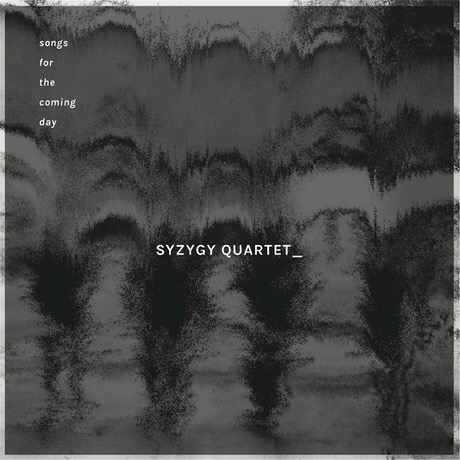
Lasting around 45 minutes, the work comprises nine movements, relatively brief “songs without words”, with titles such as Breathing, Awakening, Letting Go of the Past, and The Soul is Here for its Own Joy. The movements have hymlike qualities both in the SATB harmonies and ensemble playing, but also because some are actually based on hymns or songs, adapted and reset for saxophone. Eight of the nine movements have varying degrees of slow tempi and a generally quiet or restrained dynamic palette.
The opening movement, ‘At This Time’, utilises a three-note motif redolent of ‘Nimrod’ from Elgar’s Enigma Variations, and just as in the Elgar, this rising figure sounds a note of hope. All the movements, except for the penultimate one, are reflective and meditative, and Syzygy’s precise and concentrated ensemble playing and exceptionally well-blended, warm tones enhance the sense of contemplataion and stasis. The music itself is melodic and accessible. At times it has a choral quality reminiscent of Renaissance sacred music in it harmonies and simple lines underpinned by ostinato figures or pedal points.
In contrast to the other movements, the eighth, ‘The Soul is Here for its Own Joy’, bursts forth with exuberance and rhythmic excitement, while the closing movement, the poignant and introspective ‘Song for the Coming Day’ returns to the pensive mood of the earlier movements.
The saxophone is often the poor-relation instrument in classical repertoire, rarely utilised in the orchestra and not generally taken up by “famous” composers. In ‘Songs for the Coming Day’, the combination of elegance, restraint and melody and Syzygy’s technical assuredness and musical understanding, we are given the opportunity to appreciate the saxophone as a classical instrument.
Highly recommended
‘Songs for the Coming Day’ is available now
Syzgy Quartet will feature in a forthcoming Meet the Artist interview


 The Scottish composer Ronald Stevenson died in March 2015. He was one of the most important composers of our time, a composer-pianist in the grand tradition of Beethoven, Chopin and Rachmaninov, probably best remembered for his monumental Passcaglia on DSCH. Pianist Christopher Guild’s first volume of Stevenson’s piano music was released on the Toccata Classics label in early March 2015, though I suspect Guild did not realise at the time that his recording would become a kind of memorial for Stevenson. The CD celebrates Stevenson’s shorter works for piano with a special focus on one of his major preoccupations: his love of Scottish and Celtic culture. The album contains three suites of pieces based on Scottish folk songs or songs for children, together with the more substantial A Scottish Triptych, three pieces each written some time apart, and A Rosary of Variations on Sean O’Riada’s Irish Folk Mass (1980).
 The piano is the ideal instrument for miniatures, and Christopher Guild brings warmth, intimacy and wistfulness to the pieces based on Scottish folk tunes with his assured lightness of touch, sensitive voicing, clean articulation, rhythmic vitality and a keen sense of the fleeting moods and characters of each piece, and Stevenson’s penchant for complex harmonies and unexpectedly vivid dissonances. Meanwhile, A Scottish Triptych explores more plangent piano sonorities in its opening movement, and even utilises the piano’s interior (strummed and plucked strings) to produce unexpected colours and resonances in the final movement.



 The Cross-Eyed Pianist