Repertoire in Focus is a new, occasional series on repertoire – and not just repertoire for the piano. The articles will take a single piece or suite of pieces and offer an overview of the music, some analysis, and commentary on practising/performance, together with reasons why this music is special or meaningful for the player and why they have selected it. For teachers, it may also be an opportunity to highlight some of the challenges and pleasures of teaching specific pieces.
If you would like to contribute to this series, please get in touch via the Contact page.
This site is free to access and ad-free, and takes many hours to research, write, and maintain. If you find joy and value in what I do, please consider making a donation to support the continuance of this site
Death has been on our minds, collectively and individually, more than usual during this time of COVID.
A number of famous people have died during the pandemic, though not necessarily as a direct result of it but merely due to old age – writer Clive James, composer Ennio Morricone, statesman Colin Powell, and jazz musician Chick Corea, to name but a very few. The classical music community has lost some of its leading lights, including conductor Bernard Haitink, violinist Igor Oistrakh, mezzo-soprano Christa Ludwig, French horn player Barry Tuckwell, cellist Lynn Harrell, composers Frederic Rzewski and Krzysztof Penderecki, and pianists Peter Serkin, Leon Fleisher and Nelson Freire.
But while we naturally, and properly, mourn the felling of these great oaks, fortunately their legacy does not die with them.
Recordings are the most obvious permanent legacies of these, and other musicians’ life and work, and today the archive is vast, thanks to platforms like Spotify and YouTube which offer not only recent recordings but also those from earlier eras. Thanks to remastering and digitisation, it is possible to access vintage recordings and films. This material offers remarkable insights into changing attitudes and trends in interpretation, instrumentation, performance practice, programming and musical taste, and as such is a valuable and often inspirational resource for musicians, students, teachers and commentators. For the home listener, recordings of past performers are cherished and valued as a connection to the artist and the pleasure their music-making brings.
For audiences and listeners, our personal legacy also comes through the memories of performances, many of which may remain deeply significant to us. Such memories may be enriched through recordings, but nothing can truly replace the experience of a live concert. (I feel very privileged to have heard Bernard Haitink and Nelson Freire in concerts in London in recent years.)
But perhaps the greatest legacy, especially of pianists such Leon Fleisher, is through their teaching. Here, their knowledge is passed on to subsequent generations through their pupils and those pupils’ pupils. Great pianist-teachers like Fleisher also connect us to earlier generations of pianists – Fleisher, for example, studied with Artur Schnabel and Maria Curcio – and this provides a unique window on past practices in teaching and performance. This passing on of ‘secrets’ handed down from earlier teachers enriches one’s experience of previous performers and performances while informing one’s own musical study and development.
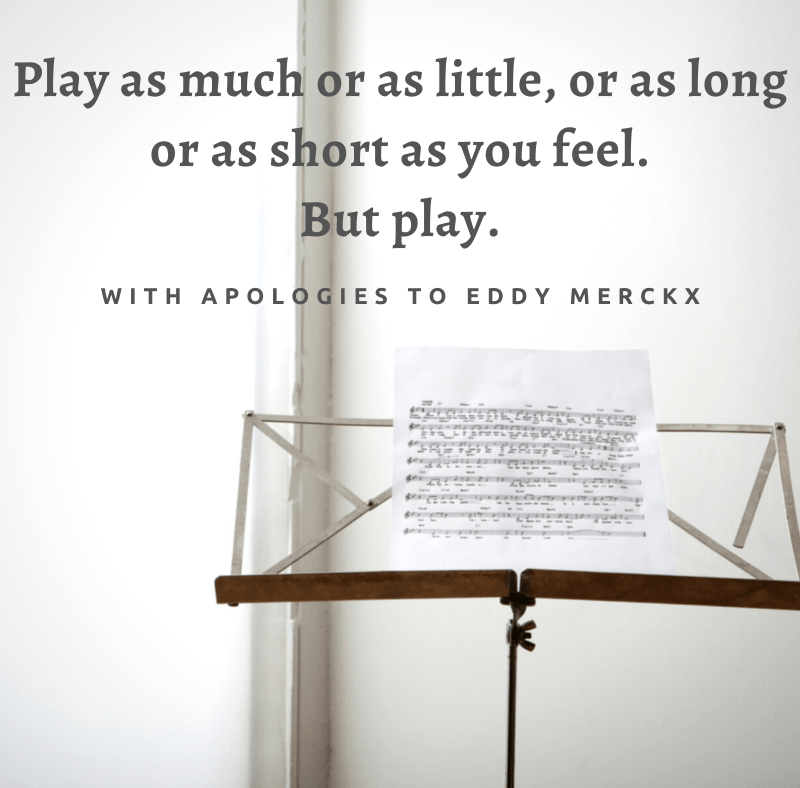
I’ve “borrowed” this quote from the great Belgian cyclist Eddy Merckx. Nicknamed “the Cannibal”, Merckx, the most successful male rider in the history of competitive cycling. I reckon Eddy knows what he’s talking about when he says:
Ride as much or as little, or as long or as short as you feel. But ride.
But what does he really mean, and how does this apply to musicians?
“Ride lots” – an abbreviation of Merckx’s above quote – was his simple opinion on how to become a better cyclist. “Play lots” might be a mantra by which musicians can improve their skills.
For the serious cyclist, or committed musician, training or practicing is – or should be – a habit, something we do every day, as regular as brushing one’s teeth. No one, not even professional musicians, or sportspeople, at the top of the game, is born with an innate talent which negates the need to practice and to hone one’s skills.
Those of us who are committed to our musical development, whether amateur or professional, know that regular, intelligent practice equals noticeable progress. There are tens of thousands of articles, blogs, books and social media posts about how to practice better, more efficiently, more productively, in addition to advice one may receive from teachers, mentors, peers, friends….yet this “noise” of information can become overwhelming, to the point where one may feel stalled, unable to practice.
This is where Eddy Merckx comes in.
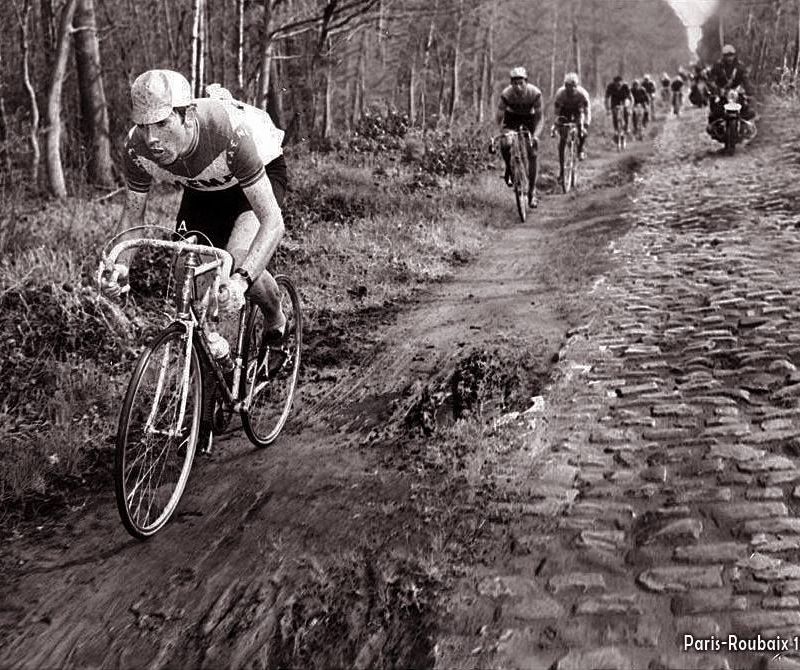
Merckx was an incredible cyclist. He achieved 525 victories over his eighteen-year career, including 11 Grand Tours (5 Tours de France, 5 Tours of Italy and 1 Vuelta d’Espana), all 5 Monuments (classic races which include the brutal Paris-Roubaix), and three World Championships. He attributed his successes less to rigorous training programmes or advice from coaches and more to simply riding “lots”. He believed that any time spent on the bike was hugely valuable, that there were no short cuts to winning, and that if one really desired success, one should simply “ride lots”. In many ways, his attitude mirrors that of Anna Kiesenhofer, the Austrian cyclist who won the women’s road race at the Tokyo Olympics. Both were/are driven by a fierce, all-consuming passion.
Eddy Merckx competing in the gruelling Paris-Roubaix race
Just as Merckx recognised the value of time spent on the bike, so we should recognise that any time spent at the piano is useful.
So stop procrastinating and go play! Stop analysing why you’re not progressing with that Bach Prelude & Fugue – and go play! Stop telling others that you “really should be practicing” – and go and play!
Play for two hours, or five, or for just 10 minutes – but play! Practice the pieces your teacher assigned to you, or play the music you love; but play! Reject the tyranny of “should” – just play! Don’t even think about it – just play!
“You train to ride”
This is a mantra from my husband, a keen amateur cyclist (and great admirer of Eddy Merckx). It seems obvious that training, or practicing the piano, leads to improved skill and greater executive function, yet too much time can be spent theorising and analysing methods of training or practising, without actually doing it. Is it not better to simply “play lots”?
I appreciate that this flies in the face of what most of us are taught – that intelligent, focused, “quality not quantity” practicing leads to noticeable improvement – but I also believe that the intent has to be driven by an overwhelming desire to simply spend time the with instrument. If you prefer to loll on the sofa watching Netflix, while saying “I really should be practicing”, you’re not displaying real intent or commitment. Instead, be driven by that all-consuming passion to play – and play lots
The pandemic has been a huge challenge for piano teachers, not least in the inherent isolation of learning the piano being exacerbated by the lack of opportunities for group work, duets in lessons, and of course live performance. However, necessity being the mother of invention, many of us have latched onto live digital performances and performance recordings as a way of creating performing opportunities and encouraging performance. This has become a permanent part of most teachers’ offerings.
Digital exams – love them or loathe them – are here to stay, and have incontrovertible benefits such as being accessible to all pupils, including nervous adults, those living in remote areas without easy access to an exam centre, and those who simply don’t ever want to endure a live examination experience but nonetheless value the feedback. Digital festivals and events have also provided pupils with a greater breadth of musical experiences from the awesome Compose Yourself! created by Alison Matthews and Lindsey Berwin, to June Armstrong’s Play for the Composer.
So what are the benefits to pupils and teachers of a carefully thought out programme of performance opportunities throughout the year?
Motivation to practise FOR something – and for something perhaps more meaningful than an exam. These experiences allow pupils greater choice in what they play, but still provide a goal to work towards. The fact that this goal is not a summative assessment – a pass/merit/distinction that despite being a mere snapshot can come to be worn as a proverbial badge of honour or dunce hat – makes it all the more valuable. Constructive criticism without a numerical mark or grading is perhaps more likely to be received without invoking defensive feelings and therefore internalised and acted upon.
A feeling of community. Within most teaching studios most pupils never or rarely meet each other. Everyone taking part in the same event – be it digital or live – can build a sense of community and common enterprise. During the lockdowns I hosted monthly Zoom concerts. Whilst the quality was not always ideal, there was a clear motivational and social benefit. Themed sessions such as “bring your pet”, “wear your PJs” etc, built a sense of fun and allowed pupils to see each other, albeit on screen.
A sense of shared responsibility. This year will be my second year doing an Advent “virtual busk”. Everyone records a Christmas song which we post every day of Advent to raise money for the local homeless hostel. (Last year we raised over £1500.) All pupils know they are expected to perform well for this; there is a sense of responsibility for everyone playing their part in this event. Yes, it is a small amount of pressure, but everyone is given plenty of time, and I feel a small amount of responsibility for ensuring they are all up to scratch is a positive thing and engenders a sense of responsibility.
So if all these benefits can be drawn from digital events, which are probably more easily accessible to teachers and pupils, then why bother with live events? One important benefit of live performance springs to mind:
Taking risks. With live performance, more so in front of an audience than in front of an examiner, the sense of personal risk is an important part of the experience. My personal experience is that pupils have become increasingly risk-averse over the last few years. The reasons are probably outside the scope of this article, but perhaps reside in our education system and its focus on testing, results and “success”. I find many pupils are inclined to avoid trying rather than to risk making a mistake, especially in public. This affects their ability to communicate through their music and invest it with their own personal involvement. I’m sure we can all agree that this is not a healthy or happy mindset. Live performance in festivals seems to be a varied experience with some finding the atmosphere friendly, while others find it very competitive – perhaps not the ideal place for nervous, or dare I say it “average” performers?
It is this last point that has been bothered me sufficiently to galvanise me into action. Certainly, where I live on the south coast of England there is not a wealth of local, accessible music festivals and performance events for pupils to participate in. There is also a real lack of suitable venues with decent instruments that are affordable and available at appropriate times. All my pupil “concerts” thus far have been very tiny occasions hosted in my home for a small handful of pupils at a time. Larger, less local occasions tend not to appeal to any but the most serious students.
Hence the creation of Play Piano South – one of a handful of local piano groups that has sprung up in recent months, each with its own character, aims and events that are suited to its local profile. My vision for Play Piano South is local informal live events that pupils can participate in regularly such that performing becomes a natural and non-threatening part of their piano education. Removing any form of competition, grading and adjudication makes everything easier to administrate. It also removes the threat of judgement, allowing young pianists the freedom to focus purely on the performance experience itself, without any formal “outcome”. Mistakes due to nerves, or any other reason, can be left behind without consequence and processed appropriately and proportionately with a view to improving the experience, without the pressure to improve a grading or mark.
The Play Piano South Facebook group acts as a meeting place for teachers in the region to share their events – either for other teacher’s pupils to attend, or just to showcase their events for others to learn from. Collaborative events allow teachers to share the burden of organising and hosting an event and can make a decent venue with a good instrument more feasible as more pupils can attend and share the cost of hire. Such a model also allows a regular performance schedule to grow that is very local and easy for pupils to attend. I believe this regularity and sense of community will make performing become a natural and integral part of learning the piano for all pupils – not just the most gifted or well-resourced.
In my own studio, my pupils will continue to benefit from the many new and wonderful digital performance initiatives that have developed during the pandemic. These will be complemented by a regular programme of informal concerts which will be open to the pupils of any other teachers who wish to participate.
The Cross-Eyed Pianist is free to access and ad-free, and takes many hours every month to research, write, and maintain.
If you find joy and value in what I do, please consider making a donation to support the continuance of the site






 The Cross-Eyed Pianist