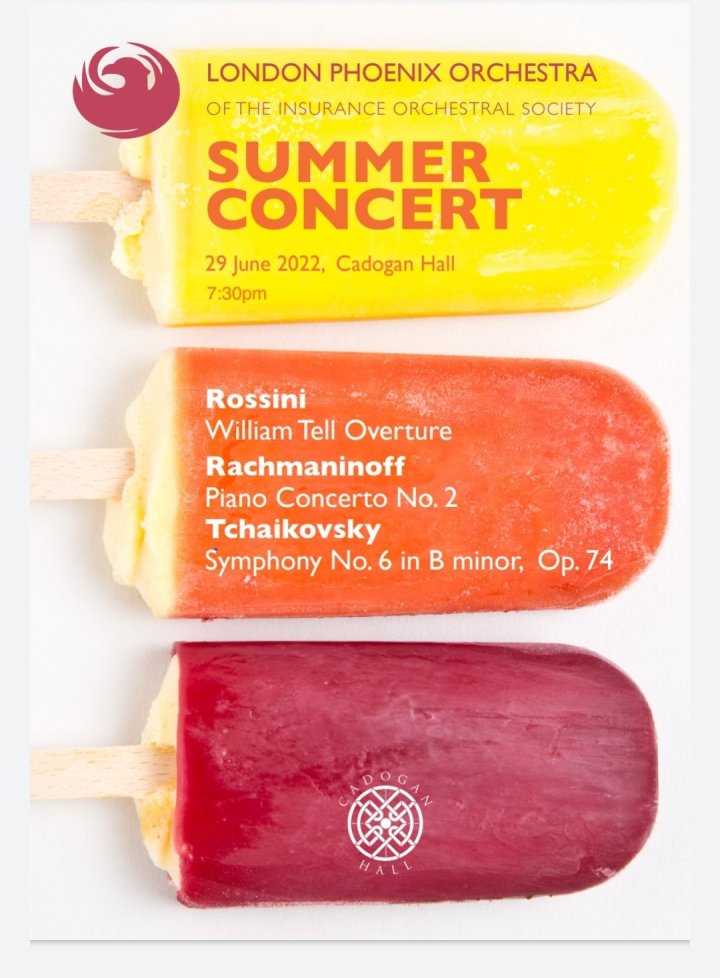
Scrolling through Twitter, as I do far too often each day, this concert poster caught my eye:
It’s striking, isn’t it? Not just the bright colours and simple design, but the choice of image which instantly says “summer” – appropriately, for a summer concert.
It’s also not a typical classical music image. There are no people in penguin suits, or conductors with wild hair, or women in evening gowns – indeed, none of those tired, cliched images all too often still associated with classical music. It’s immediately eye-catching, it contains the information you need, and the choice of the ice lollies instead of a more “classic” (as it were!) image might just attract people who might not normally choose to go to a classical music concert.
Working in the publicity and promotional realm of classical music, I am struck more often than not by how poor a lot of concert promotional material is – including by the big/important venues and promoters. It is a fact almost universally acknowledged these days that we live in a visual age; for advertising and marketing material – whether physical posters or flyers – or digital assets for online promotion, the choice and quality of images is pretty crucial. Yet time and time again I see poor quality, or simply bad, images, and, worse, in appropriate and/or illegible typefaces.
Today one doesn’t necessarily need to hire a graphic designer to create decent promotional materials. Easy-to-use design programmes like Canva offer templates and a wealth of images and other elements to help you create quality flyers, posters and social media posts, which are set to the correct dimensions for specific platforms, e.g. Twitter or Instagram (this ensures no chopped off heads or misaligned text etc).
In addition to high-quality images, choice of typeface is also important. Florid scripts may look pretty or artistic, but think about how they translate to a flyer or poster. Are they easy to read? Largely, no. Another pleasing aspect of the ice lolly poster above is the clean typeface (something like Helvetica or Arial, I think). Note how a different weight (bold) of the same typeface is used to highlight the composers’ names. The final aspect which receives a big thumbs up from me for this poster is its simplicity: it contains the crucial information (though it could perhaps do with a website link and note of ticket prices).
That oft-quoted three-word phrase from architect and designer Mies van der Rohe (“less is more”) is as applicable to furniture design as it is to concert promotional materials. Too often I see posters and other materials which contain far too many words. Give your potential audience enough What Where and When information and trust them to do the rest by visiting the relevant website or calling the box office. There’s no need to tell them everything about that forthcoming concert…..
D major is unquestionably one of the “bright” keys – perhaps the brightest, and, allegedly, for Mozart the “happiest” key (he wrote three piano concertos in D major and four piano sonatas, including the sonata for two pianos KV 448). It’s heroic and triumphant, the key of joyous fanfares, majesty and optimism.
Mozart – Sonata for Two Pianos KV 448
This finely-crafted sonata epitomises the pure classical structure and is an uplifting and virtuosic work to play and to hear. The joyous first movement opens like an operatic overture, replete with timpani and trumpets while the middle Andante has a single aria-like melody shared between the two instruments. The finale is an ebullient rondo which feels like a piano concerto without orchestra.
Chopin – Prelude in D, Op 38 & Mazurka in D Major, Op 33, No. 2
Chopin composed most of his Opus 28 preludes prior to the winter of 1838-39, when he joined his lover, George Sand, on the island of Majorca. The Prelude in D Major, the fifth of the set of 24, packs a lot into a miniature which lasts a mere half a minute. It’s scored in continuous semiquavers which glitter with all the positivity which the key of D major suggests.
The Mazurka in D major opens with a happy main theme, embellished with ornaments. The off-beat rhythms, characteristic of the Polish folk dance on which Chopin based his Mazurkas, is clear in the accompaniment.
Beethoven – Piano Sonata No. 15 in D major ‘Pastoral’
The nickname ‘Pastoral’ was given to this piano sonata by a London publisher, suggesting perhaps nature and the countryside or the calm simplicity of this sonata in contrast to the one which precedes it (the ‘Moonlight’ with its unsettling opening movement and restless finale). The first movement of the Sonata in D major opens with a low D pedal point in the bass, which suggests a bagpipe drone and is associated with country scenes. This pedal point is heard again in the Andante which opens with a foreboding minor-key theme before a cheerful, skipping dance in the middle to lighten the mood. A brief, playful Scherzo follows, while the finale is firmly rooted in D major, whose lilting opening recalls the pedal point of the first movement. According to Beethoven’s pupil Czerny, this was one of the composer’s favourite sonatas and one which he never tired of playing.
Rachmaninoff – Prelude in D, Op 23 No. 4
This Prelude rather contradicts the main characteristics of the key of D major. It begins with a calm, flowing melody and accompaniment, a song without words, almost Schumann-esque in character, but grows increasingly more dramatic in its middle section, with several minor-key modulations and ecstatic episodes.
When did I begin my love affair with the music of living composers? The moment I found Yvar Mikhashoff’s ‘Incitation to Desire’ CD of tango music for the piano. The smoky cover, the provocative title track – I was caught before I listened to a single piece. Ah, and what a collection! Tangos from multiple eras and in multiple styles. Tangos that spoke of something illicit, a smoky world of furtive late-night romance, smoky dance halls, and sensuality. These tangos represented a freedom I craved – freedom from the performance practice expectations of standard repertoire, and freedom from the years of insecurities and assumptions I brought to the music I’d been playing my whole life. Tangos broke the rules. I’d never danced a tango in my life, but I knew I needed to make music with the freedom I heard in these pieces.
I’d never worked on music by a living composer before I found this CD, but my love of this music was such that I set about tracking down the scores of my favourite pieces. Many of the tangos were unpublished, which meant I wrote to the composer to purchase a copy. Scott Pender’s tango, ‘Ms Jackson Dances for the World’ was one of these. After I received it, Scott and I kept corresponding. We became friends and have remained so for over a decade. And I loved his music – so much so that I eventually played, performed, and taught most of what he’s written for the piano. Ironically, although Chester Biscardi’s ‘Incitation to Desire’ was easier to find (it was published), I never felt I got inside it well enough to perform it publicly. It sat in my music collection, its provocative title and gorgeous writing teasing me with the promise of something I couldn’t quite grasp.
It took me over a decade to put ‘Incitation to Desire’ on a concert programme. I think this was because I needed to live more before I truly understood it. I needed to go tango dancing and feel the freedom and sensuality of the Argentine tango in my bones. I needed to perform and record Piazzolla tangos with my duo partner Molly Wheeler. And, on a deeper level, I needed to break a whole lot of rules. I needed to experience the judgment that comes from choosing to leave a marriage that had been on life-support for years. I needed to experience being swept off my feet by an unexpected grown-up romance that changed my entire life. In other words, I needed to know freedom before I could play it on the piano.
Because ‘Incitation to Desire’ is about sensuality and freedom. Much like the Argentine dance, it relies on the pianist’s ability to instinctively feel their way through the score. This piece begs to be played almost as an improvisation – just the same way that the Argentine tango is danced. It’s the pianist and the piano and the interplay of notes – sensuous, slinky, unapologetic. Chester Biscardi asks for a flexible interpretation of dynamics and tempi. I take this to mean that that this piece is best played from the senses, not the brain; instinct, not reason. In other words, you can’t play this music until you let yourself be seduced by it.
It was my No Dead Guys post about (and YouTube recording of) ‘Incitation to Desire’ that prompted Chester Biscardi to email and tell me how much he enjoyed my performance of it. That correspondence led to me learning ‘In Time’s Unfolding’ and ‘Companion Piece (for Morton Feldman)’, two pieces that, ironically, I still feel I had more of an innate understanding of than the tango that introduced me to Chester’s music. Best of all, Chet and I kept corresponding, and that correspondence blossomed into another friendship that I cherish.
I’ve never coached a student on ‘Incitation to Desire’; I’m not sure it can be done without introducing topics to a lesson that can get an instructor arrested. Furthermore, because it’s so improvisatory, the key to playing this piece well lies within each pianist’s personal experience. If they’ve lived it, they can play it. If not, no amount of musicianship or technique will bring this piece to life. I can, however, offer some general guidelines on how to navigate the score:
1) Don’t be in a hurry. This is slowly unfolding, sensuous music that can’t be forced by the pianist. All forward momentum must come from the sense that the power of the moment itself is what propels the music forward.
2) Don’t dig in too deeply on the scale passages. These are flourishes, the twirl of a tango skirt, a spin. They’re caresses, not demands.
3) Don’t start your accelerando too quickly at m. 29; you’ve got a very long way to do before you hit the end of it. This – like everything else in the piece – should feel inevitable and effortless.
4) Pay very close attention to the pedalling; it makes or breaks the piece.
5) If you’ve never danced the Argentine tango, watch some videos of it. This will explain the start/stop, slow/fast, gesture-driven nature of the score.
6) When you play it, drop all expectations of the piece, surrender to the music, and let it take you where it wants to go.
Sometimes the best way to find ourselves is to break a bunch of rules. Incitation to Desire gave me the permission I needed to follow my instincts rather than others’ expectations. It seduced me into a lifelong passion for the music of living composers. And even today, it reminds me to let moments and situation unfold naturally; it reminds me that the richest life (and my best playing) lies in releasing rigidity and entering the messy, beautiful, passionate dance of earthy, real life with my hands and heart wide open.
Rhonda (Ringering) Rizzo is a writer and a former performing and recording pianist. Her novel, The Waco Variations, was released in the summer of 2018, and her numerous articles have appeared in national and international music magazines, including Pianist Magazine, American Music Teacher, Clavier, Piano & Keyboard, and Flute Talk. A specialist in music that borrows from both classical and jazz traditions, Rizzo released four CDs, Made in America, Oregon Impressions: the Piano Music of Dave Deason, 2 to Tango: Music for Piano Duet, and A Spin on It.
She holds a BA from Walla Walla University and a MM from Boston University and is a passionate advocate of new music and living composers.
This site is free to access and ad-free, and takes many hours to research, write, and maintain. If you find joy and value in what I do, please consider making a donation to support the continuance of this site
Frances Wilson in conversation with Maxim Vengerov
I’ve admired world-renowned violinist Maxim Vengerov ever since I first heard him at the Proms in 1999, when he played a fabulous, varied programme which included Brahms’ Violin Sonata No 3, Rachmaninov’s Vocalise, Ravel’s Tzigane, and a selection of glittering concert showpieces, including a spellbinding performance of Waxman’s Carmen Fantasie. It was just him and pianist Vag Papian, on a special stage set up in the arena (promenading) area of the Royal Albert Hall, playing to a packed house.
In September this year he returns to the Albert Hall, for a special concert celebrating 40 years on stage – or rather 42 years on stage as this concert, originally scheduled for June 2020, was postponed because of the pandemic. In addition to a celebration of his remarkable performing career, it is, for him, also a celebration of his connection with British audiences. “I’ve been here from right at the start of my career. This is like my second home.” As well as giving many concerts in the UK, since 2016 Maxim Vengerov has been a visiting professor at London’s Royal College of Music.
London was also where he studied with Mstislav ‘Slava’ Rostropovich, an adored mentor and friend, whose name comes up frequently during our conversation.
“I have great memories with Slava, of visiting his home in Maida Vale. Without him I would be a different musician today. He opened my vision for music and he inspired me also to continue and to share music. Not just to be a performer, but to share it. That’s why I became a teacher at the age of 26. I always wanted to make space for teaching, in spite of my busy schedule.”
The two years of the pandemic and lockdowns, and the shutdown of live music, have had a profound impact on the lives of musicians, and for Vengerov, like many others, it was a time to reflect on the demands of the profession. With an empty concert diary, confined to his home with his family and parents-in-law, the first month of lockdown was an “amazing time with family. I’ve never stayed so long with my family…. But after a month, my elder daughter Lisa says, ‘Daddy, aren’t you going away?’. It was the biggest shock of my life! I realised that for my family, I was the father who was always travelling and sometimes coming back. Today it is different; despite my heavy schedule….in my family’s mind and my own, I am the father who is at home and sometimes on tour.”
During lockdown, Vengerov was keen to do something for other people. “It was horrific that we weren’t able to make music, and people weren’t able to listen.” So, as Artist in Residence at ClassicFM, he gathered together a trio and organised a livestreamed concert, an hour of live music, broadcast to some quarter of a million listeners worldwide. This inspired him to continue, to communicate to the world and to share his experience, this time via the medium of interactive online lessons. With the help of a brilliant tech team, he built a platform, created a website and held in excess of 150 free live online lessons with optimal sound and high-quality visuals. These remain in the archive of his website, available to all, while new material is regularly added.
Of this particular lockdown project he says “It was so traumatic to see so many people leaving the profession, but so understandable, because nobody cancelled paying mortgages or bills! But we needed to continue what we feel passionately about and we needed to give some hope. And I did that in my own little modest way.”
Now live music is back and audiences are thrilled to have concerts again “Every venue was full – Elbphilharmonie, Salzburg festival, Carnegie Hall, all amazing experiences! People were crying.”
With such a long performing career, how does he maintain the interest, the excitement and the inspiration? “I am never bored!” Vengerov replies immediately, and then goes on to illustrate this point further:
“How many things are involved in the process of making a concert? It requires great preparation, great delivery on stage, great spirit, great instrument [he plays a 1727 ‘Kreutzer’ Stradivari], great hall, acoustically – a wonderful acoustic together with my instrument is always a different experience because my instrument reacts differently to every concert hall and I always play differently in every hall. Then of course partners that I work with, chamber music…. And audiences…they don’t necessarily have to be educated, but they have to be open, and they have to be there for the right reasons, to discover music. And if you’re not in love with the composition you’re performing you should better not do it! There is not a moment when you can be bored….it’s pure enjoyment and pure challenge.”
Away from the concert stage, he draws inspiration from his family and friends, good food and socialising, playing tennis, and walks with his Shiba Inu dog, Toto. And of course the music.
Returning to his forthcoming London concert, we talk about the Shostakovich Violin Concerto, the centrepiece of this concert, and a work which he has played many, many times. The challenge here is keeping the music, and the performance, fresh, and once again the conversation turns back to Slava, and his advice to always play the work as if performing it for the very first time – or “perhaps the last time”. Deep knowledge of the music is important too, and this is where training to become a conductor has helped Vengerov gain crucial insights into the score which inform his performances and lend greater enjoyment and fulfilment. “Once you know the full score, it adds a new dimension to your performance. It’s no longer a violin piece with orchestral accompaniment… you can refer to one or another line in the orchestra and that’s where you draw your inspiration….The impact that the orchestra has on the soloist is vast. And if you’re not part of it, then it’s a different piece.”
The other major work in this concert is Beethoven’s Triple Concerto, for which Vengerov will be joined by cellist Mischa Maisky and pianist Simon Trpčeski. Too often regarded as a “party piece”, Vengerov asserts that the Triple Concerto is “a most profound work” that requires a very particular relationship between each member of the orchestra and the soloists. The orchestra in this instance is the Oxford Philharmonic, conducted by Marios Papadopoulos, with whom Vengerov has a long-standing association, having shared “so many wonderful things” during his residencies with them. “They are like family members.” Orchestra and soloists will also be joined by students from the RCM for a special arrangement of Sarasate’s Navarra, to celebrate the joy of music-making and music education.
How does it feel to play in such a large venue as the Royal Albert Hall, I ask him, and he replies that it’s important to make the venue “feel cosy”, regardless of its size. He tells me that he encourages students to “play to the last row” when performing at a hall like RAH, to encourage them to think less about volume of sound and more about projection and vibration.
It’s evident from our conversation that for Maxim Vengerov the ongoing pleasure comes from performing and sharing his music to impact people emotionally.
“At the age of 5 I didn’t understand why, but when I played in front of an audience, I understood. It gave it [the music] purpose. I’m the lucky one that can bring it alive – and this is the greatest joy.”
Maxim Vengerov celebrates 40 years on stage in a concert at the Royal Albert Hall, London, on 19th September, with Mischa Maisky, Simon Trpčeski, the Oxford Philharmonic Orchestra and Marios Papadopoulos, and students from the Royal College of Music.
This site is free to access and ad-free, and takes many hours to research, write, and maintain. If you find joy and value in what I do, please consider making a donation to support the continuance of this site
The Cross-Eyed Pianist is free to access and ad-free, and takes many hours every month to research, write, and maintain.
If you find joy and value in what I do, please consider making a donation to support the continuance of the site






 The Cross-Eyed Pianist