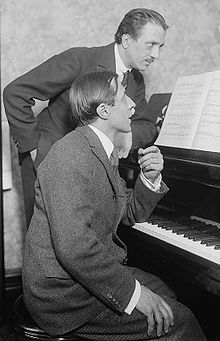
To the Wigmore Hall last night for an evening of late Schubert piano music, performed by Paul Lewis. A few years ago, Lewis stamped his mark emphatically upon the international piano world with his concert cycle and recordings of Beethoven’s complete piano sonatas, thus elevating him to the rank of one of the top flight pianists of his generation. Now, in another epic world tour, he is exploring the late music of Schubert.

Lewis was taught and mentored by Alfred Brendel – and it shows. Brendel famously does not teach – except for the chosen few (Imogen Cooper, Till Fellner). He performed (he retired in 2008), choosing to concentrate on the Viennese school, he writes and he gives lectures on music. His on-stage persona is austere, didactic, intellectual, highly disciplined.

Watching Paul Lewis play music composed in the last six years of Schubert’s short life, I felt the shadow of Brendel at his shoulder throughout the evening. The opening Waltzes, D145, written in response to the seemingly unending desire for dance music in Vienna, were largely serious, grand and solemn. Only occasionally was the music allowed to “let go”, offering brief glimpses of the private life of a composer who enjoyed evenings of music, song, women (and men, it is said) and wine with his friends, students and writers, radicals and intellectuals. As opening pieces, I would have liked more lightness, more spirit, more playfulness. And maybe a touch less darkness.

In the D899 Impromptus there was a greater sense of the music being thought out in advance, each signpost along the journey of these pieces clearly highlighted, lest we miss it. In the opening C minor Impromptu, there was less coldness in those early measures, less of a sense of the tyranny of the bare G which marks the opening, reminding us that this is a work which falls post-Winterreise. There was warmth in the major key measures and lyricism, but towards the end, from bar 160, the repeated Gs in the treble and bass were too mechanical, too obvious, robbing the music of its portentous chill.

The E flat Impromptu was rapid and polished, and, as a consequence, lost some of its agitation and hysteria. At times, during the Trio, the touch was too heavy and occasionally muddy. Though many measures in this section are marked fortissimo, at times there was not a proper sense or attack, or if there was, it was quickly reined in, cheating the music of its startling contrasts and harmonic and emotional shifts. This was even more evident in the final Impromptu of the set, the A flat. The opening semiquavers never really took flight, and some smeared or inaccurate notes suggested a tiredness on the part of the performer, possibly the result of having played this programme several times already.

The Hungarian Melody D817 was a pleasing opener for the second half, settling us in before the expansive G major sonata. It was enjoyable if overly dark, its folksy elements muted in favour of a grander delivery. (For a really wonderful performance of this piece, I would flag up Imogen Cooper’s from her ‘Schubert Live Vol 3’ album.)

The G Major sonata, D894, was the favourite of Russian pianist Sviatoslav Richter, and, in his hands, the spacious opening movement, marked Molto Moderato e Cantabile, comes in at 26 minutes, roughly the same length as an entire Beethoven piano sonata. It is graceful and meditative, Richter achieving an amazing stillness in the first motif. Paul Lewis opted for a brisker tempo, which suited the second subject elements better, but rather robbed the first subject of its grace and philosophy. In the middle movements, my attention began to wander: I craved more life, more bounce and vivacity. Throughout, the very cerebral reading of the score was evident (witness the powerful influence of Brendel!). The final movement was more questioning, charming and humourous, but overall I felt the sonata was played with too much gloss and a curious ‘intellectual complacency’ that diluted the music’s spontaneity and tempered the ever-shifting soundscape and emotional landscape of Schubert’s writing.

Paul Lewis repeats the programme at the Wigmore on Thursday night, and then in Oxford and Schwarzenberg, Austria, before returning to London next week for performances of Die Schëne Mullerin with tenor Mark Padmore.

As a postcript to this review, I must also mention Paul Lewis’s annoying habit of snuffling and “chuffing” as he plays. I have been aware of this “tic” before, and it seems to be getting worse. It was particularly noticeable during the quieter or more profound measures, and was obvious from the earliest bars of the first Waltz.

Sviatoslav Richter – Schubert: Piano Sonata No.18 in G, D.894 – 1. Molto moderato e cantabile

This question seems particularly pertinent as I help prepare another crop of students for their piano exams. The question was, in fact, put to me last week by a student of another teacher (Clarinet) who came to me for some extra aural training ahead of his Grade 5 exam next week. I found myself quoting from the ABRSM website when I said “Aural tests help to train your musical ear, and to help you make an important link between listening to music and playing music”.

I think most of us who took music exams as children would agree that, along with sight-reading, the aural tests were the most dreaded element of the graded music exam. I can still remember being “trained” by my music teacher at school, Mr Weaver, and, in my nervousness, finding it almost impossible to sing a simple major third or fifth. (I was also tested for perfect pitch when I was about 12, in front of the entire class, which was excruciating and cringe-makingly awful.) One of my students, Laurie, absolutely refuses to sing for me and so when we come to the part of the test, where he is required to sing an echo, we mime (or I sing it for him), on the strict understanding that he will sing at his exam!

Joking apart, as well as forming an integral part of the graded music exams, training the musical ear is a crucial process for the developing musician. Intelligent and informed listening lies at the heart of good music making, whether listening to others, or to oneself, and is fundamental to music training, especially for performance. The key aspects from the Prep or Initial stage are:

  • Identifying and clapping a pulse
  • Clapping a rhythm
  • Singing and echo or pitching notes in a sequence
  • Identifying simple features in an extract of music – e.g. detached or smooth playing, loud or soft

As one proceeds through the graded exams, additional skills are tested

  • Identifying a rhythmic or pitch change in an extract of music
  • Identifying features such as staccato, legato, dynamic, tempo or key changes
  • Singing and identifying intervals
  • Identifying cadences
  • Learning to appreciate music from different periods – e.g. Baroque, Classical, Romantic, Modern, Jazz

What bothered me while working with the other teacher’s student last week was that the child had no idea why he was required to take an aural test, hence my explanation about training the musical ear. Being able to identify a pulse is crucially important, for any musician, and those of us who have played in ensembles or orchestras can surely still remember the player/s who could not keep time. I regularly do pulse and rhythm exercises with my teacher, and anyone who has learnt ‘Bah-Ba-Doo-Bah’ (John Kember, ABRSM Grade 2 syllabus) with me this term has had to do a lot of clapping and counting to master the syncopation in this piece.

Singing is also incredibly useful as a musician, and I often sing (not especially well!) to demonstrate a line of melody or the shape of a phrase. So much music follows a “singing line”, and singing a phrase rather than playing it demonstrates “natural shaping” which comes from the innate rise and fall of the human voice. It’s a pity that so many students are reluctant to sing because I think if they were more prepared to try it, they would find phrasing music so much easier.

When I worked with the clarinet student last week, I was astonished at his lack of knowledge of music history and the distinct periods in classical music. He did not even realise that the piece he played for me was jazz! He came armed with a book on how to improve your aural, and, flicking through it, it fell open on a page about the main periods of classical music. Each one – Baroque, Classical, Romantic, Modern – had four bullet points identifying the key features. When I played an extract of a Gershwin Prelude (No 2 – the middle section) he reeled off the salient features of Baroque music – and my heart sank.

If one doesn’t develop an appreciation and understanding of different kinds of music – and not just ‘classical’ music, but jazz, rock, pop, world, ambient, electronic etc – how can one properly understand how to interpret and play a piece properly? One of the first things I do when looking at a new piece with a student is set the music in context. When we study Bach, we look at the kinds of keyboard instruments he was writing for (I have pictures loaded onto my iPad) and listen to Bach played on the harpsichord or organ. While working on a simplified version of Schubert’s ‘Trout’ with a student recently, I played both the sung version and the quintet to him. Result: the next week he was beginning to play the piece with clearer phrasing and a nice sense of the “song line”.

I was very fortunate when I was growing up: my parents were keen concert-goers and LP buyers, and of course there was live music in the house because my father played in both a wind ensemble and an orchestra. From a very early age, I went to concerts, and my tastes and knowledge developed quickly. Listening and playing were normal activities for me – and remain so today. But many children who are learning instruments now are doing just that – learning the instrument, without being taught an appreciation of music. Perhaps their parents are not interested in music, or the school is not encouraging an appreciation? I admit I’m on something of a mission to encourage my students to both play well and to love music: if just one or two of them remember what they did with me as students when they are browsing iTunes or similar when they’re older, and they download some Beethoven piano sonatas, or one of Schubert’s String Quartets, then I can consider my job well done.

So, there is a lot of point to aural – and it is important for us, as teachers, to explain WHY!

Having spent most of the afternoon compiling the wretched thing (time which would have been better spent practising, or sunbathing), I felt I should share my Classical music timeline here. There are sins of omission, I know, so please don’t contact me to point out who I’ve forgotten! It is intended simply as an overview, and, because I am a pianist, is somewhat weighted towards composers of the piano.