
Who or what inspired you to take up the piano, and make it your career?
I grew up listening to my sister practicing the piano, so the initial impetus to start lessons came from her; I was fascinated with the instrument and the sounds it made. I remember ‘helping her practice’ by playing certain of the notes for her. In particular I remember the final bass note of the first movement of Debussy’s ‘Children’s Corner’ – I would stand by the side of the keyboard and wait until she got to the end when it was time to play the bottom C. In hindsight I must have been quite a nuisance! It was only half-way through high school that I decided to aim for a professional career in music. While the piano was always my greatest passion, I did toy with the idea of being a film composer at one point. I think this was mainly thanks to John Williams.
Who or what were the most important influences on your playing/composing?
To date the biggest influences on my playing have been without doubt my two main teachers: Nina Svetlanova and Graham Fitch. I couldn’t even begin to say how much I have learned from them both.
What have been the greatest challenges of your career so far?
Staying motivated when things aren’t going well. When you’re young it’s difficult to not get despondent after failure – a bad performance or defeat in a competition. But it’s important to turn these occasions into learning experiences. You only learn that with age though.
Which performances are you most proud of?
I would have to say my Masters graduation recital this past May. I programmed the Beethoven ‘Pastoral’ Sonata Op. 28, a selection from the Schumann Fantasiestücke Op. 12 and the Liszt Sonata. It was my first performance of the Liszt Sonata – quite daunting! It went well though.
Do you have a favourite concert venue to perform in?
I enjoy playing in both larger and smaller spaces. I have many happy – and not so happy! – memories of playing at the Baxter Concert Hall in my home city of Cape Town. Every performing space is unique, so I try to make the most of wherever I am.
Favourite pieces to perform? Listen to?
To perform: Liszt Sonata, Funérailles, Beethoven Sonatas (especially the ‘Waldstein’), Mozart Concerto K466, Shostakovich E minor Trio
To listen: Wagner’s ‘Ring’, Beethoven’s Choral Fantasy & Fifth Symphony (a good performance of this is better than almost anything), Brahms Concerti, Mozart’s Don Giovanni, the ‘Goldberg’ Variations, there is so much…
Who are your favourite musicians?
I generally listen to, and try and learn from, musicians from the early/mid-twentieth century, most notably Rachmaninov, Rubinstein, Arrau, Richter, Gilels, Sofronitsky, Heifetz & Oistrakh. They all had such wonderful tones – it’s almost unbelievable. That said, there are definitely some modern-day musicians who I admire too, such as Marc-André Hamelin, Boris Berezovsky, Grigory Sokolov, András Schiff, Stephen Kovacevich & Cecilia Bartoli. There are some ‘non-classical’ artists that I also respect immensely, like Oscar Peterson and Keith Jarrett.
What is your most memorable concert experience?
There are several that come to mind. I saw the Leipzig Gewandhaus in an all-Beethoven programme conducted by Chailly. They did the Beethoven Seventh Symphony and Louis Lortie was the soloist in the Fifth Concerto. Both orchestra and soloist had to give an encore! There was also an all-Shostakovich concert given by the Cape Philharmonic Orchestra in the Shostakovich centenary year. I can’t remember who the conductor was – I know he was visiting from Russia – but they did an earth-shattering performance of the Seventh Symphony. Last year was also my first live Wagner experience – Die Walküre at the Met – and I think that will stick with me too.
What do you consider to be the most important ideas and concepts to impart to aspiring musicians?
I still see myself as an aspiring musician! But if I were to go back in time ten years and give myself advice, it would be the following: Establish a good work ethic. Develop good practice habits (practice the left hand alone always!). Learn to manage your time wisely. Don’t ever be afraid to be yourself – a first-rate you is always better than a second-rate someone else. Be proactive – don’t expect opportunities to fall into your lap (but be grateful if/when they do). Take chances. Develop your interests – don’t just lock yourself up in a practice room all day. After all, how can you have anything to say if you don’t actually live a little? Above all, make every note count and don’t take it for granted.
What are you working on at the moment?
Beethoven – Sonatas Opp. 28, 53 & 90 (I plan to do the whole cycle of thirty-two one day – and I really mean one day! – so I’m always working on at least one)
Alkan – several pieces including the Sonata ‘Les Quatres Ages’ Op. 33 (this is a long-term project)
Chopin – Polonaise Op. 53 (something I’ve loved since childhood and am finally learning)
Liszt – Sonata in b minor (I’ve given several performances to date, but this is a life-long endeavor – especially those octaves at the beginning)
Balakirev – Islamey (this is also a long-term project and something I will be blogging about, so be sure to check out my blog)
What do you enjoy doing most?
To be honest, I love practicing. I love taking a work apart, analyzing it, understanding the nuts and bolts. Many people hate practicing even though they enjoy being on stage, but I love the process. Learning to enjoy the journey is key to being successful I think. Music aside, I love cooking (have a look at my blog, fermatas & frittatas), watching a good movie and spending time with my wife, Jo-Mari.
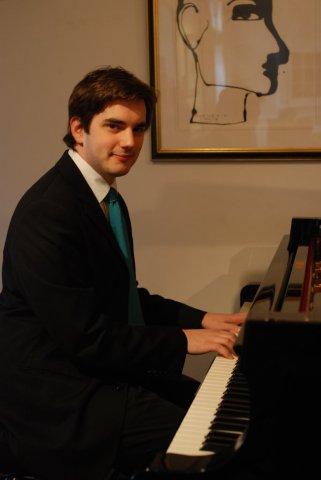
An emerging artist from South Africa, pianist Bradley Burgess has shown himself to be a versatile and accomplished musician. Recent awards have included the Pick ‘n Pay/Fine Music Radio Music Awards and a generous overseas bursary from the National Arts Council of South Africa and Oppenheimer Memorial Trust. His solo and chamber engagements have seen him playing in the states of New York, New Jersey, Idaho & Utah in the US, as well as the UK, Finland and in several major venues in his home country of South Africa. Bradley received his Bachelor of Music degree from the University of Cape Town cum laude and recently completed a Master of Music at the Manhattan School of Music in New York City. He is currently the Director of Music & Organist at St. Mark’s Church in Islip, NY, and is on the piano faculties of the Music Academy of Long Island and the Brooklyn Musical Arts Center. Bradley’s main interests are in music of the late-eighteenth and nineteenth century, especially Beethoven, Liszt and Alkan, and when he’s not at the keyboard you can often find him in the kitchen. You can read more about this at his blog, ‘fermatas & frittatas’ at bradleyburgess.net.





 The Cross-Eyed Pianist