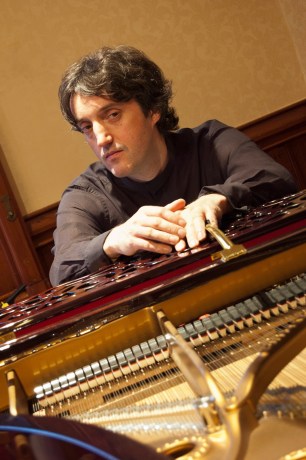
pianist Lucy Parham (© Sven Arnstein)

Who or what inspired you to take up the piano and make it your career? 

Originally, my Mum inspired me to play. She was a keen amateur pianist and there was always music in the house. One of my earliest memories is of her practising for her diplomas and strains of beautiful Chopin and Beethoven sending me off to sleep at night.

I always wanted to be a musician, or, more to the point, I could never have imagined not having music in my life. When I was 18 I was the Piano Winner of the BBC Young Musician of the Year and things just progressed gradually from there. I was at the Guildhall but I began to do a lot of professional engagements.

Who or what were the most important influences on your playing? 

Since I was a child I had a profound love for the music of Robert Schumann. Looking back, he seems an unlikely candidate for an eight year old but I felt something spoke to me. As if it was a voice I understood. And I still feel that – although who knows whether my instincts are right, of course! It’s not just the piano music – it is his entire output. I only have to hear the opening of the 4th Symphony and I’m off! Brahms has a pretty similar effect on me.

Pianistically, I have always been inspired by Richard Goode and Mitsuko Uchida. I heard Richard Goode at the Wigmore Hall in June playing the last three Beethoven sonatas. It was a revelatory concert and something I shall always remember.

 What have been the greatest challenges of your career so far? 

I think everything is a challenge. Performing in itself is the greatest challenge. But all the organising of concerts, learning repertoire, writing scripts, practising, travelling. It all takes it out of you, emotionally.

Which performances/compositions/recordings are you most proud of?  

My recent performance of Rêverie (with actor Henry Goodman) at the Wigmore Hall was a very happy occasion, as was touring the USA with the Schumann Concerto, conductor Barry Wordsworth and the BBC Concert Orchestra. And last year, playing the Clara Schumann Concerto at the RFH with Jane Glover was rather special evening for me. Generally though, I’m pretty self critical and rarely feel that happy with myself. It’s the same with CDs, I think. All my recordings were the best I could do on that day. I don’t like listening back to them – I think they are snapshots of how you were in a particular moment. You always want to re-record them a year later!

Do you have a favourite concert venue to perform in? 

London’s Wigmore Hall

Favourite pieces to perform? Listen to? 

Brahms’ First Piano Concerto is a particular favourite to perform. But I think these things chop and change depending on your mood and what is happening in your life. There are far too many favourites to name. And I have obsessions about Jerome Kern, all Tchaikovsky’s ballet music and about many jazz musicians like Stacey Kent, Jim Tomlinson and Miles Davis. The John Wilson Orchestra is extraordinary. I have been to all their Proms, which are my idea of heaven. John and I have worked together too (with the Philharmonia) and he is a really exceptional musician.

Who are your favourite musicians? 

Where to start..?!

Dinu Lipatti, Daniel Barenboim, Richard Goode, Andras Schiff, Bryn Terfel, Yo Yo Ma, Itzak Perlman, Mitsuko Uchida, Sarah Connolly, Paul Lewis, Natalie Clein, Sir Colin Davis. I could go on and on, but…..

What is your most memorable concert experience? 

There are too many to list – but playing the Ravel Concerto in Moscow with the Moscow State Symphony Orchestra, with a formidable female conductor called Veronica Dudarova, must rank among them! Being on stage with the most extraordinary actors in my words and music evenings makes my feel very lucky, too. Performing “Nocturne” at the Almeida with Juliet Stevenson and Henry Goodman on the very same stage I had seen them perform “Duet For One” was memorable for me. I learn a lot from them too and it has opened up a whole new world for me.

What do you consider to be the most important ideas and concepts to impart to aspiring musicians?

My own highly inspirational teacher was Joan Havill. She was (and is) quite extraordinary in so many ways and I owe so much of what I do now to her original belief in me and her dedication. I try to pass that on to my pupils but whether I succeed with that who knows?!

I feel that humility as a performer, and as a teacher, is crucial. We really are just the servant of the music. Trying to get to the heart of what the composer wanted and not about you as the performer should always come first.

What are you working on at the moment? 

I am learning the Schumann Humoreske Op.20. It has taken me a long time to tackle this piece – and I’m not sure why I never learnt it before. It is a masterpiece and hugely underrated. I am also learning Brahms’ Op.116 which is pure heaven for me.

What is your idea of perfect happiness? 

Perfect happiness is being at peace with yourself and being good and kind to those around you. It would also be owning my own private swimming pool – but sadly that isn’t ever going to happen!

Launched in December 2013, Lucy Parham’s King’s Place Sunday Coffee Concerts (Word/Play) continues throughout 2014. All details can be found here: 

2014 sees the launch of her new Sheaffer Sunday Matinee Series at St John’s Smith Square, featuring all four of her words and music concerts. Actors will be: Henry Goodman, Martin Jarvis, Joanna David, Alex Jennings, Juliet Stevenson, Harriet Walter and Simon Russell Beale. There will be a Q and A session after each performance. The first concert ‘Beloved Clara’ is on Sunday 19th January 2014. Further details can be found here: 

Lucy Parham first came to public attention as the Piano Winner of the 1984 BBC TV Young Musician of the Year. Having made her Royal Festival Hall concerto debut at 16, she has since appeared regularly at all the major concert venues in London and around the UK. Conductors with whom she collaborated include Barry Wordsworth, Sir Charles Groves, Bryden Thompson, Jane Glover, En Shao, Richard Hickox, Antoni Wit, Owain Arwel Hughes, Yoav Talmi, Veronika Dudarova, Martyn Brabbins, Sian Edwards, John Wilson and Jean-Claude Cassadesus. Festival appearances include, in the UK, Brighton, City of London, Perth, Leeds Castle, Rye, Bury St Edmunds, Three Choirs, Newbury, Victor Hugo, Guernsey, Canterbury, Cambridge, Winchester, Harrogate, BBC Proms, Welsh and Scottish Proms, Chelsea, Cardiff, North Norfolk and Oxford, and abroad, Bergen, Istanbul and Mexico City.

Full biography and more on Lucy’s website

www.lucyparham.com 

Lang Lang (photo © Philip Glaser)

Here’s an article from Bachtrack’s ‘Piano Month’ on pianists and their gestures. Whether you love or hate Lang Lang’s extreme facial expressions and flamboyant OTT gestures, or feel the perfomer’s gestures should only serve the music, this is an interesting and thoughtful read.

Every age has its own tastes, its own aesthetic lines drawn in the sand. Since the 19th century, with its seminal guardians of musical decorum (Clara Schumann chief among them), pianists and their critics have debated the role of stage persona. Most outspoken are those who believe that a quiet, undemonstrative approach to the instrument – à la Arthur Rubinstein – best reflects a serious commitment to earnest musicianship. The corollary is presumed true as well: that excessive body movement or facial expressions can cheapen an interpretation or betray a lack of real understanding. Pianist Lang Lang, often insensitively derided as “Bang Bang”, is held in this case to be Public Enemy Number One. Our current notion of good taste is less extreme, and concedes that a bit of visual display can be acceptable and even beneficial, so long as it is a natural byproduct of a performer’s interpretation. Read more


In a recital space somewhere in central London a group of people are seated in a rough semi-circle around a Fazioli 212 grand piano. Some lounge in their seats in a pretence of relaxation, others crane forward eagerly for a view of the keyboard, many clutch music scores. The young man seated at the piano composes himself for a moment, takes a deep breath, and then lifts his hands and launches into the iconic opening bars of Rachmaninov’s G minor Prelude. The music soars from the piano, filling the space. The small audience listens attentively, and at the end there is enthusiastic applause. Welcome to the world of amateur pianism.

This is an extract from a longer article I wrote for Bachtrack’s ‘Piano Month’. Read the full article here

1415062_237580389742917_302191053_o

photo(1)

Who or what inspired you to take up composing, and make it your career? 

I have never thought of it as a career. It is something more than that.  As far back as I can remember music has been the thing in my life, is and will be.

Who or what were the most important influences on your composing? 

Dr. Gordon McPherson, Ravel, Morton Feldman, John Adams, Steve Reich, Sibelius, Takemitsu, Olav Anton Thommessen, Harrison Birtwistle, Bartok, Shostakovich, Talk Talk, Prefab Sprout, Bach, Admiral Fallow, A-ha, John Martyn, Ligeti, Koechlin, Satie, Nicole Lizee, Nancarrow, Mahler, Mozart, Beethoven, Webern, Yannis Kyriakides, John Cage, John Lautner, William Boyd, Steven Hall, Zoe Strachan, Primo Levi, Van Gogh, Rothko, Rembrandt, Pollock, Renee LeGrande, David Hockney, Stanley Kubrick, John Keats, Robert Burns, Norman McCaig, Wilfred Owen, Marion Colyer, Shakespeare, Star Trek, Sergei Leone, nature, travel, science and space flight.

What have been the greatest challenges of your career so far? 

Every piece offers its own challenges. If I were to pick one it would be the first proper piece I wrote for orchestra – Ridge A. It is all about the coldest, driest and calmest place on earth which was discovered in 2009.

I spent nine months writing it alongside the rest of my folio in the final year of my BMus  and the technical leap it required from me was significant. I studied a lot of the orchestral repertoire and sat in on orchestral rehearsals at college. I realised afterwards that Takemitsu and Sibelius were important influences on the piece.

Standing in front of eighty people and answering questions about your work is quite intimidating, but it was a great experience in the end. The orchestra played it beautifully. The conductor, Christian Kluxen, was fantastic and I hope I can work with him again.

Which compositions are you most proud of?

I was very proud to be commissioned by the Royal Scottish National Orchestra on their collaboration – ‘Heart of Govan’ – with CRAN Theatre to celebrate the peoples and history of Govan and their historic Govan Parish Church.

Also my piece ‘Sober Observer Sees (HD)’ to be selected by Ensemble Modern for performance in 2012.

Do you have a favourite concert venue to perform in? 

My favourite venue in Glasgow is The City Halls, which sound fantastic.

Favourite pieces to listen to? 

Ravel’s ‘Piano Trio in A Minor’ and ‘La Valse’, The ‘Adagietto’ from Mahler 5, Ligeti’s String Quartets, Thomessens ‘From Above’ and ‘Beyond Neon’ .

Who are your favourite musicians? 

Lots! Many for different reasons. I love Glen Gould, especially his recordings of Bach’s Goldberg Variations. Nina Simone is a very powerful performer.

I have been lucky enough to have had some incredible performances of my work and I am very grateful to the hard work and dedication shown by those musicians.

What is your most memorable concert experience? 

The guitarist Pavel Steidl visited the RCS twice and each concert, all solo guitar, were amazing.

What do you consider to be the most important ideas and concepts to impart to aspiring musicians? 

Work hard, be true to yourself but admit to yourself when you know other people’s advice is valid. Always do what is best for the music, not yourself, and have fun. Only write music you love and write about what you want.

What are you working on at the moment?

I am currently making final edits on a 15 minute solo guitar work called ‘Treasures’. It is in three movements and is about the relationship between memory and objects, such as old photographs. It is dedicated to Anthony Winton.

I am about to start work on a new piece and there are a few projects in the pipeline.

Where would you like to be in 10 years’ time? 

Living on the coast of the Mediterranean and supporting myself by commissions!

Richard Greer was born and raised in Glasgow, Scotland where he has recently completed a Masters in Composition at the Royal Conservatoire of Scotland studying with Dr. Gordon McPherson.  His works have been performed by various individuals and ensembles, including Guitarist Sean Shibe, Soprano Claire Thompson, Trumpeter Andrew Connell-Smith, MusicLab, the Viridian Quartet, The Expedition, Red Note Ensemble, Said Ensemble, the RCS Symphony Orchestra, the Royal Scottish National Orchestra on their ‘Heart of Govan’ Project, and Ensemble Modern.

http://composergreer.co.uk/